
Many thanks to SWLing Post contributor Bob (K7ZB), who writes:
Hi Tom,
Bob, K7ZB here, and I was just looking at a post on your SWL site for NSS, the US Navy station which was activated back in 1918.
It brought to mind a very unique QSL card I made for a listening event back in the days that I served on board a Polaris missile submarine during the Cold War.
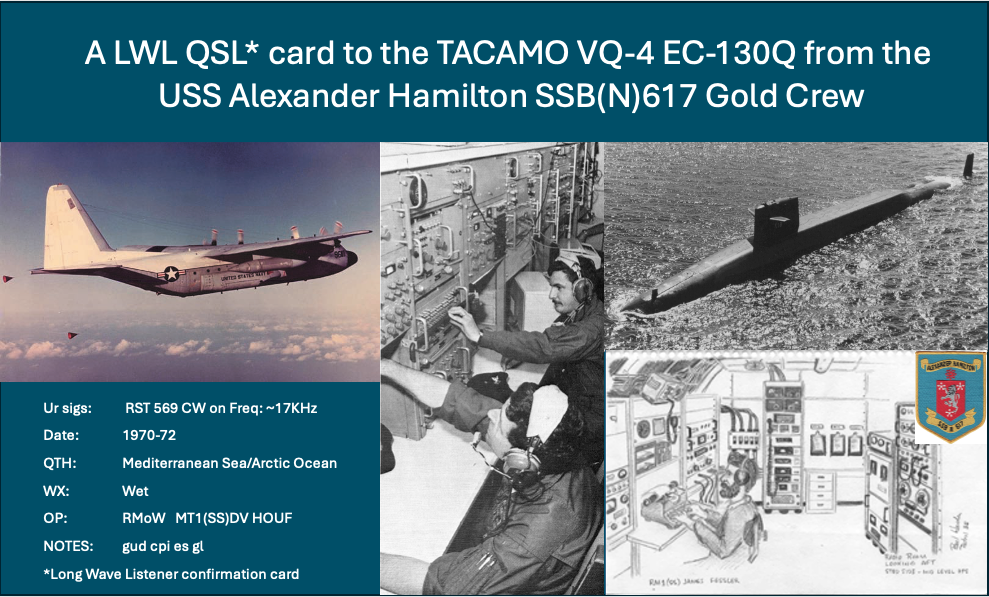
I created an “LWL” QSL card (I did this tongue-in-cheek) for Long Wave Listening confirmation of TACAMO transmissions sent from a special Hercules C-130 aircraft which was used in the event of nuclear war and the anticipated destruction of all land-based military communications capabilities. TACAMO aircraft are still in use in this system today and aviation enthusiasts track them occasionally.
The National Command Authority would issue commands to launch retaliatory nuclear strikes from our missile subs through the signals sent at VLF 17KHz from the aircraft and received by our boats while submerged.
The system is unclassified (like the Doomsday Machine in ‘Dr Strangelove” of the 1960’s film noir – if it is kept secret it is not a deterrent) so you can read about it here:
https://www.wikiwand.com/en/articles/TACAMO
I was a Missile Technician and Navy SCUBA Diver on a missile boat during the Cold War and had been a ham radio operator (WA8KEX) for 6 years prior to serving on board. When I reported to the submarine, the LPO (Leading Petty Officer) of the Radio gang was also a ham and when I spoke with him he got permission for me to qualify as a Radioman of the Watch so I could stand watches in the radio shack while out at sea on our 75 day patrols in the Mediterranean Sea and above the Arctic Circle. I did that when I was off watch back in the Missile Compartment which was my normal duty staton.
Of course we maintained radio silence during patrols but we could copy VLF when we put out our long trailing floating wire antenna when we were near but below the surface. We could then pick up the transmissions from the TACAMO EC-130Q’s flying in very tight circular patterns just above stall speed with a 5-mile long wire trailing behind them which circled down in a helical form just above the sea somewhere out in the Atlantic.
This allowed the VLF signal to travel great distances and we could then copy it while submerged.
The transmissions were digital with the exception that Morse code was also used back in my day. I served on board the USS Alexander Hamilton SSB(N)617 Gold Crew from 1969-72 for 6 patrols out of Rota, Spain.
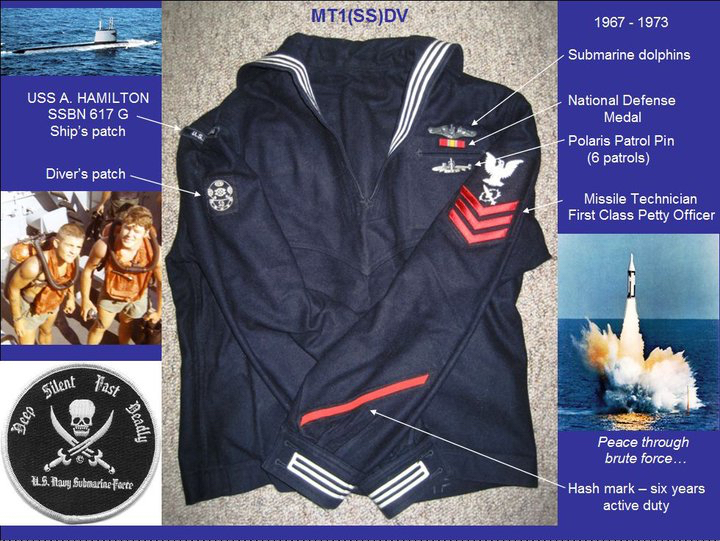
I was an MT1(SS)DV, and here is the uniform I wore. I am on the right in the photo of the two divers and with my swim buddy at the US Navy Diver School in Key West, FL (1970), who was a Recon Marine.
I or another RM (Radioman) would strap on headphones and sit at an IBM Selectric ‘mill’ and copy 5-letter code groups sent in International Morse code from a Navy RM up in the aircraft. That RM was working in tough conditions because the C-130’s had to fly at a steep angle approaching 45 degrees which put them at about 1G and they were sending on a straight key at 15wpm.
Once the messages were received I handed them off to the RM’s and then I left for the Missile Compartment because it meant we were going to have a Weapons System Readiness Test soon – a drill in preparation for the real thing.
Which never came, thank God, or we wouldn’t be seeing this email.
The special LWL QSL card I made shows a real C-130 with the antenna spooling out with its counterpoise – you can just see the drogues at the end of the wires – and the middle photo is of the aircraft internal transmitter gear where the signals were sent.
My submarine is shown in the card with our ship’s patch and a pencil sketch of what the radio shack on board an FBM Polaris submarine looked like – the RM with his headphones is sitting at the mill copying TACAMO messages.
I put a small QSL data block on the card detailing some of the conditions of a typical message received as if we had been SWL QSLing a ham station.
I posted this on my submarine’s FB group as well as the FB Submarine Radioman’s group for their enjoyment – if any of them were also hams or SWL’s they would get it immediately.
73,
Bob
K7ZB
Thank you, Bob, for allowing us a glimpse into this chapter of Cold War communications history through your unique LWL QSL. It’s a wonderful blend of personal story, service, and radio heritage.
That’s been a problem a number of us have been encountering Bill with it not allowing our call sign as it once did these past weeks.
Thanks, I thought perhaps I had done something wrong!
Wow, fascinating! I was going to ask how long the EC-130’s trailing wire antenna was, but you answered that. Love the QSL card and the weather conditions (Wet)!
Run Silent, Run Deep
(Note to Thomas: I tried to include my usual name, “William, KR8L” and got an error message saying that “number in author name not allowed.”)