
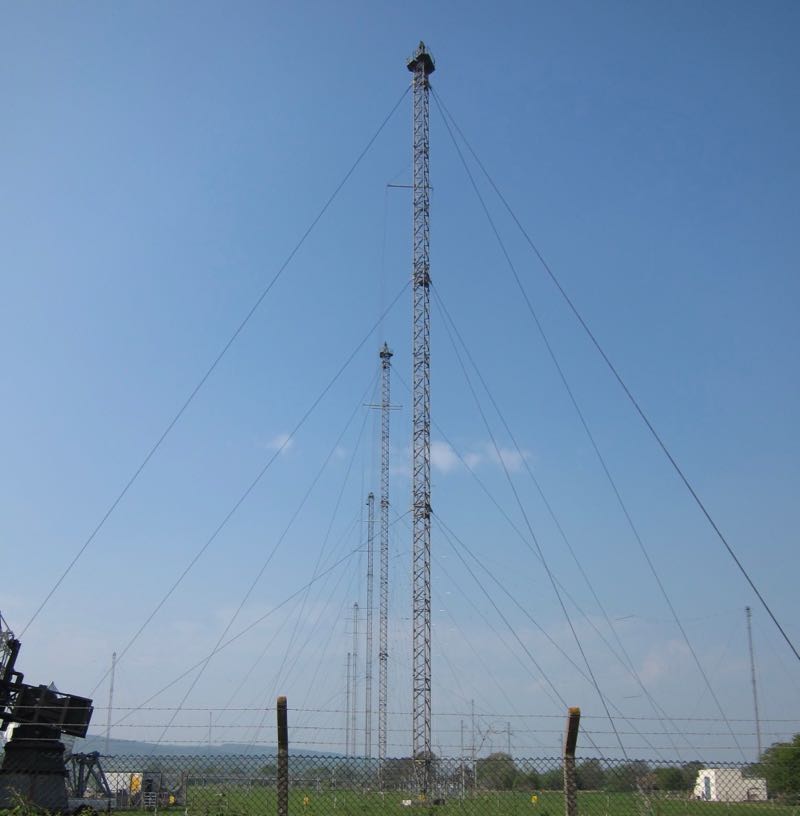
Woofferton Transmitting Station (Photo by Shirokazan via Wikimedia Commons.)
Many thanks to SWLing Post contributor David Iurescia for sharing this fascinating piece from The Spectator. In a world increasingly reliant on fragile digital communication networks, what happens when cyber warfare, physical attacks, or global conflict disrupt the systems we depend on? Clifford Beal explores how shortwave radio—once the backbone of wartime communications—could again play a vital role in ensuring information access when all else fails. “True, it’s retro-analogue, but shortwave gets through to people where more sophisticated digital communications fail,” Beal writes, making the case for renewed investment in resilient radio infrastructure.
Read the full article here: https://www.spectator.co.uk/article/bring-back-shortwave/
I am in Australia, and as much as I would love to see Shortwave broadcasting come back, I fear in Australia that we are too late for a revival. Our last international shortwave transmissions were in 2017, 8 years ago now. The masts, transmitters and even the land has been disposed of or sold off in many cases. It would cost millions to reinstate the infrastructure before even considering operating costs. On top of that, a lot of our frequencies were taken over by Chinese stations, so getting frequency allocations would also be difficult now.
I have so many older short wave receivers, and as much as it is nice to listen from around the world, I miss the days of Radio Australia also.
I wish it was different, but we have had both Labor and Liberal governments and none have considered bring back shortwave broadcasting.
Solution: Reach Beyond Australia. Rent air time with them. Send them ABC news and programming feed. They have some off time and can use exiting infrastructure. They come in like a torch most of the time in the eastern USA at 8: am local time on 15460 KHZ. I know they would be interested in rebroadcasting over shortwave and make money. I am surprised that it has not been done by now. Come on Australia, RNZI spent $2.4 million on a new 100 KW transmitter after 33 years and rocking on shortwave, you can too at a much lower cost.
Very bad decision by politics and leaders thinking to save a buck and no not what they do by killing shortwave broadcast. China now patrols the waters surrounding Australia. Verbally threatening a possible take over “saying you do not have the means to resist us”. While there economy has already filtered into the Pacific islands. I am telling Australia you need to wake up and be active. Get Australia back on shortwave. Its reliable long distance communication to let very one know what is going on. It cannot be controlled like digital media or the internet.
Old school SW communication is still the best method for coverage and let the world know.
With world events and possible war everywhere, shortwave is still a vital link for news and communication. If a EMF bomb exploded in the upper atmosphere overhead. No life would be harmed but it would be electronic chaos, Goodbye 5 G, Internet and local transmission lines. Bell LAN lines may still work. But for long distance communication nothing beats SW. I think countries need to rethink about having SW stations for backup communications. Example Australia, Radio Australia provided communication and news over a vast region of the country. for decades. I loved it when I picked it up on the US east coast in the mornings to listen to what happened in the land down under that day. Much better than today’s news. Now the Shepperton transmitter station is a building without transmitters and sold property by short minded politics. Recently China is spreading through out the Pacific islands changing E-commerce and way of life on these islands as well as surrounding Australia herself. China spoke to Australian officials and said you do not have the military might to resist an invasion. That is a cold hard threat. Not many people know what is going on in areas where the internet is non existent but SW breaks the boundaries. Australia is now looking at plans to resurrect Radio Australia in some form on SW.
If I were them I would buy back the Shepperton facility and property because no one has done anything to it in five years. Get some used 100 Kw SW transmitters. Go on the air and rebroadcast Australia Broadcast Corporation (ABC) News until Radio Australia can get on its feet. Yes, it would cost a million or 2 dollars with volunteer effort but they could pay the investment back through advertising and special program broadcast. Governments are good at throwing money at something but no clue of how to make money thorough normal
economic.
Another avenue would be to lease air time from Reach Beyond Australia.(formally HCJB network). In this case they have 100Kw transmitters and would need to add an antenna matrix to beam the signals to the Pacific region and USA .This could be done for under 1 million dollars, relaying ABC news. Currently they broadcast religious programming mostly to India and Asia regions.
Again there are options.
We need credible shortwave stations to keep us informed and to counter disinformation. Also it provides a good path for technology support to students and young technologists.
This is exactly why I hang onto my old Grundig Satelit 800.
Russia continues to invest in SW?
What is the author thinking? Moscow shut down SW over a decade ago. SMH. And DRM is a solution looking for a problem and causes more problems than it solves. Seriously — this reads like it was written by someone who has never turned on a SW radio in his lifetime.
That said, there ARE some reasons to continue or restart broadcasting on SW. Just not the ones he lists.
Correct and true. Using DRM defeats the main purpose of having a system that, as the author suggests, “gets through to people where more sophisticated digital communications fail” because DRM does not provide that.
First of all, the author should acknowledge that DRM is not some sort of a shiny new invention that is just waiting to be embraced by the people – the reality is that it’s been around since over 2 decades, has been subject to numerous forms of tests in many different countries and the majority of them has returned to AM or scrapped long-distance broadcasting altogether.
Secondly, there are features of a system capable of delivering messages in a troublesome times that can be named and assessed. It should be resilient to any jamming attempts – DRM is extremely easy to jam, it has practically zero immunity to in-channel or co-channel interference. Jamming a DRM signal is a child’s play. AM shortwave broadcast will always get through – the Soviets were not able to block Radio Free Europe even with megawatts pumped into the air. Furthermore, such system should be easily accessible to the population, and that would require wide availability of receivers. There are lots of them available for analogue AM, both new and used, while DRM receivers are purely unobtanium and it doesn’t seem like it’s going to change. Obviously, we are witnessing a steady flow of press releases and trade fair demos from the DRM consortium, but none of these actions have any tangible results. No major web store offers any DRM-capable receivers, so it’s not a valid solution.
The author also brings the example of the Ukraine invasion, but since the article is trying to portray broadcast as an important medium (which I think it is), why doesn’t he refer to the actual events happening there in the field of broadcast? It’s well known what happened there. The first thing Russian occupiers are doing on arrival (even before they start torturing, kidnapping and killing innocent civilians) is the switchover of all broadcast transmitters to Russian channels. The same is done with the Internet connections, they get routed through Russian networks so that all the traffic can be intercepted. The response of Ukraine in the first months of invasion was firing up all available mediumwave AM transmitters (both home and abroad) to provide a stable communication channel. And it has been proven to be a literally life-saving measure, since these stations were the only ones available in the occupied territories that provided info on humanitarian escape corridors. This has been verified by the accounts of people that managed to escape that hell.
So the solution to these problems is there, and it has been there since almost a century – the solution is traditional AM radio that has been already tested in all possible conditions and proven to work well. No need to change what’s not broken.
Yes, and while a few are on SW channels,
The vast majority are not.
Some blasts with FM don’t work as it is LoS
[ Have you met qwertzFMdx ?
The thing that amazes me is the proliferation of new radios covering the shortwave spectrum, which have been brought to market in recent years. They are obviously being purchased in great quantities, not only in China, but throughout the world. Further, these radios have a functionality and ease of operation far beyond what was available to us in the so-called “golden age” of shortwave.
Three years ago, it was rumored that the Tecsun H501 and PL-990 would be the last high-end portables marketed by that company. Yet six months ago, they introduced the S-2200x. At the other end of the price range, a perfectly usable XHDATA radio can be purchased for $10 to $15. Who is buying all these radios, and what are they listening to?
In the early days of personal computers this was what was called the “installed base,” that is, the number of computer owners who represented potential purchasers of new software. Certainly, we have an installed base of potential shortwave listeners who would be open to consumption of shortwave broadcasting. Internet technology aside, shouldn’t this be an incentive for a few new folks to invest in shortwave broadcasting, either to advance their own ideas or to promote a product?
Simple. The Software Designed Radio chips can tune these bands at virtually no cost unless you add filtering between the antenna and an RF amplifier. From then on the only difference is the programming of the oscillator divider to produce the same frequency as the wanted signal. This is why some of these radios have problems if there is a very strong signal around.
China how has DRM high frequency transmission for domestic use. Now they are making their car manufacturers to install DRM radios in new cars for the Chinese market.
>Simple. The Software Designed Radio chips can tune these bands
None of the radios mentioned by Bob use SDR, so I cannot understand how is that relevant to his comment.
>China how has DRM high frequency transmission for domestic use.
I think it was meant to say ‘now’. These DRM transmissions are only for testing purposes, which is evident if you look at the number of operational transmitters. They have like five or six sites that are transmitting in DRM as opposed to hundreds that operate in AM. It’s nowhere near a deployment that would accommodate the domestic use in country such big as China.
>they are making their car manufacturers to install DRM radios in new cars for the Chinese market
Which companies provide these receivers?
Today, long after the automobile has nearly taken over most land transportation, people still ride horses. Nevertheless, there are still places where cars can’t go but horses remain a practical way to get around. The same is true of the internet. Yes, it has pretty much eaten the market for most communications media. However, there are still a few places where Shortwave is a viable and reasonable way to gather information.
Not many Shortwave radio stations remain. There are a few contract stations mostly run by people who do it for the love of the media, (not unlike people who like to ride horses). It’s good to keep a few around, and to continue support for them, if for no other reason than having it available when it will be needed.
Absolutely spot-on article.