Tag Archives: Digital Radio Mondiale

A Special QSL Card: Remembering the BBC and Deutsche Welle DRM Partnership

Many thanks to SWling Post contributor, Paul Jamet, who hares the following article and notes:

I enjoyed this beautifully illustrated article: Snail Mail QSLs – A Few Stories from a Bygone Era

I’m also taking up the invitation to share a memorable QSL card of my own.

I’ve received hundreds of QSL cards by snail mail. After some hesitation, I’ve chosen a QSL card that I received quickly (in 6 days) but which reflects a time when two very important international radio stations were strong believers in Digital Radio Mondial (DRM):

Testimony of a Joint BBC / DW DRM Programme for Europe

by Paul Jamet

My most memorable QSL card bears witness to the collaboration between the BBC World Service (BBC-WS) and Deutsche Welle (DW). These two broadcasters launched a major radio project in the late 2000s: a joint shortwave transmission in DRM (Digital Radio Mondiale), aimed at providing a high-quality digital service for Europe.

The BBC and DW established a partnership to pool their transmission capabilities and deliver a single digital stream (in English) across Europe. Transmission sites located in Sines (Portugal), Woofferton (United Kingdom), and Moosbrunn (Austria) were used to ensure broadcasting from 06:00 local time until midnight.

This is why I invested around €300 in purchasing a DiWave 100 receiver to listen to this programme, broadcast using a technology that both broadcasters were intensively testing at the time. The AFS function—Alternative Frequency Switching or Signalling—allowed the receiver to automatically follow frequency changes throughout the day without any manual intervention. The programme originated alternately from Berlin or London, on one or more frequencies transmitted from the sites mentioned above.
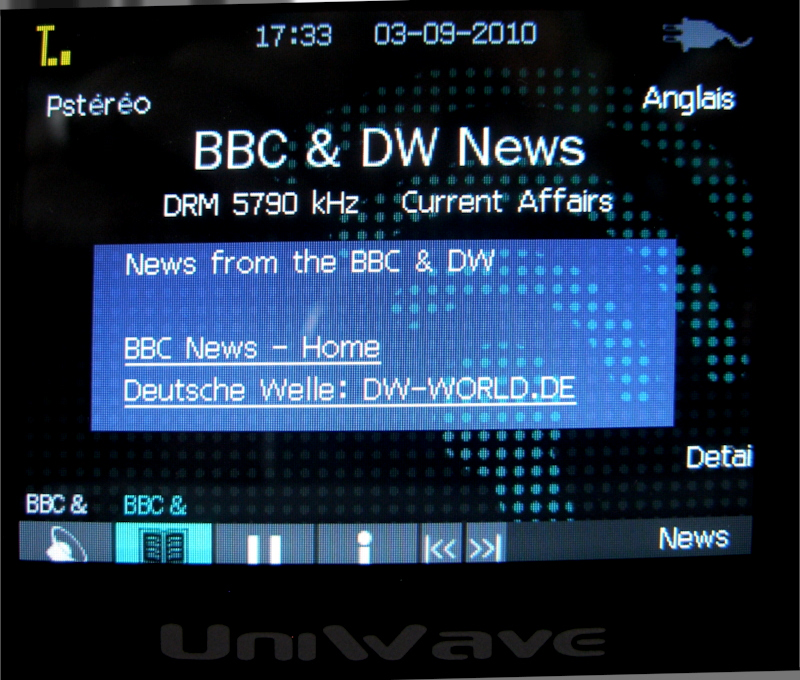
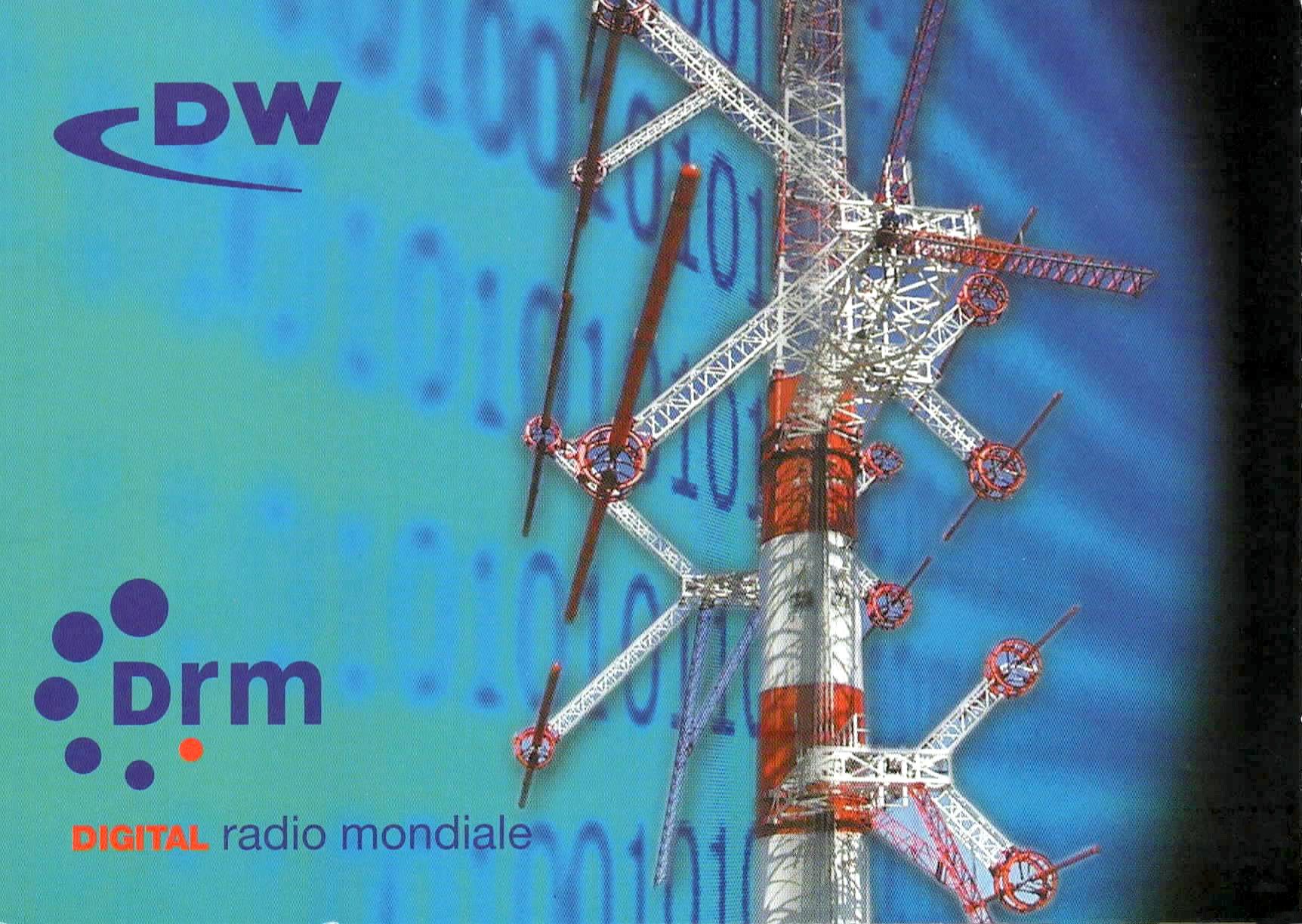
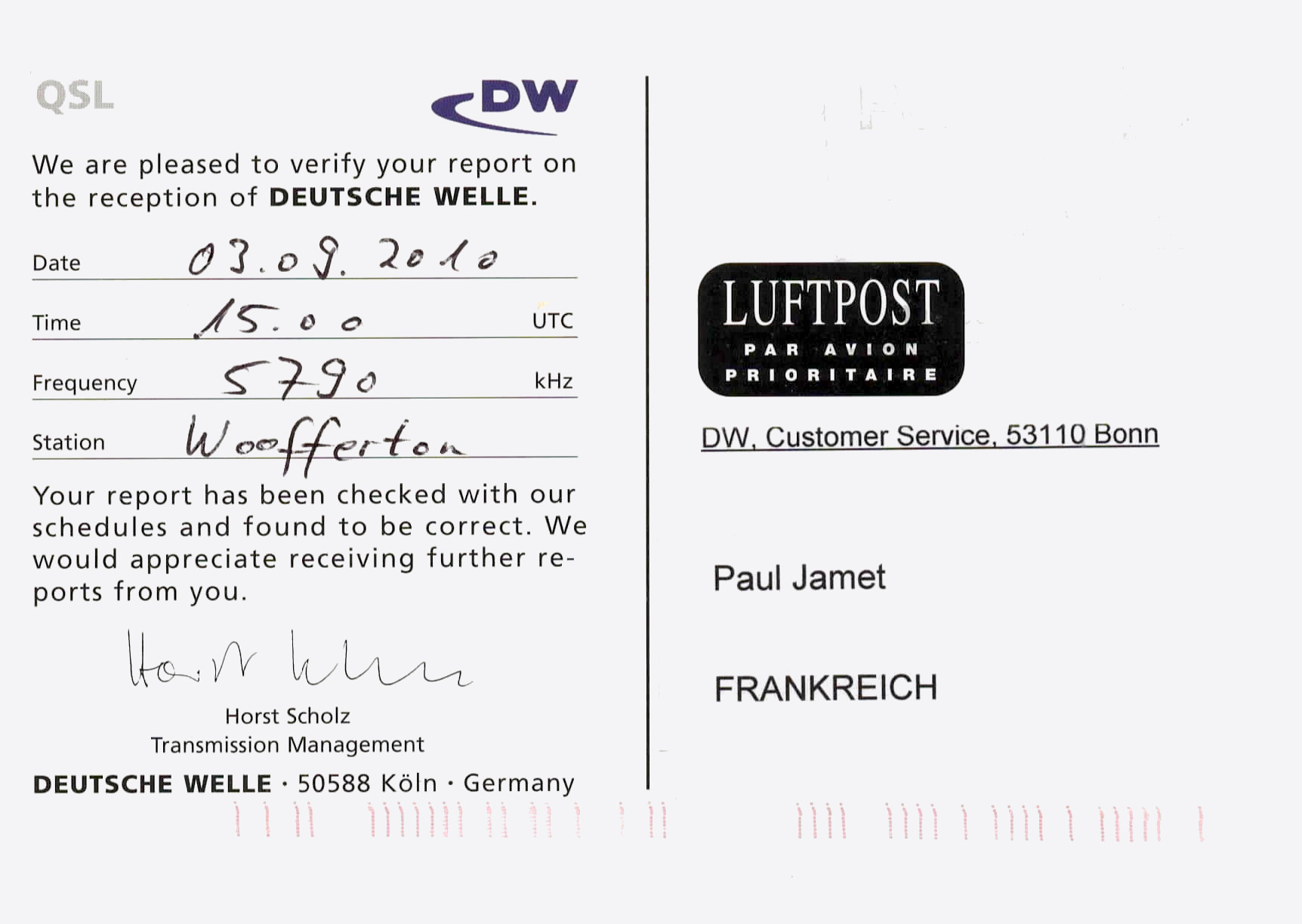
This QSL card, along with the screenshot from the DiWave 100 that enabled me to obtain it, stands as evidence of a broken dream [mainly due to the rise of streaming, but also the lack of DRM receivers].
The BBC and DW eventually abandoned the project. In terms of digital broadcasting, DAB+—a technology stemming from the European Eureka project—has become dominant across Europe. Today, the BBC World Service, and especially Radio Romania International, continue to broadcast daily to Europe. TDF (Télédiffusion de France) is conducting trials on various frequencies from its Issoudun transmission centre.

Today, I still believe in DRM. This technology uses HF bands and makes it possible to cover vast areas with a single transmitter, while offering significantly improved listening conditions and additional services such as text transmission (Journaline), images, and emergency warning messages (EWF technology).

References :

2025 DRM Developments

Many thanks to SWLing Post contributor, David Iurescia, for bringing our attention to this recent roundup of developments in Digital Radio Mondiale (DRM) as the year comes to a close.

The article from RedTech.pro was written by Ruxandra Obreja, chairman of the DRM Consortium, and summarizes a range of DRM-related updates and activities in 2025, covering new broadcasts, technology progress, and announcements from stakeholders in the DRM community.

You can read the full article here.

China Chooses DRM for Its AM Broadcast Future

Many thanks to SWLing Post contributor, David Iurescia, who shares this Radio World article, which reports that China has officially adopted the Digital Radio Mondiale (DRM) standard to modernize its AM radio bands.

The plan includes technical guidelines for analog/DRM simulcasting, requirements for provincial transmitters to deploy DRM systems, and a nationwide push for DRM-capable receivers in vehicles.

Click here to read the announcement on Radio World.

Click here to read the DRM Consortium’s announcement.

Radio World: Three Mysterious New Shortwave Stations Approved in the U.S.

From Radio World: In a rare move, the FCC has approved two new construction permits and granted a full license for international shortwave broadcasting—prompting questions about their true purpose. All three applicants—DPA Mac, Parable Broadcasting, and Turms Tech—claim intentions to use the DRM standard, yet past filings and meeting summaries suggest possible ties to high-frequency financial data transmissions, a purpose not authorized under current broadcast rules. Who are these new players, and what exactly do they plan to transmit?

Nick Langan unpacks the story in Radio World. Click here to read the full article.

DRM: Should the U.S. Take the Leap?

Photo by Brock Wegner on Unsplash

Many thanks to SWLing Post contributor, Alan, for his recent article in Radio World titled “The Modernization of Broadcast Radio. In it, Alan argues that the proposed “AM Radio for Every Vehicle Act” in the U.S. should go beyond preserving legacy systems and instead embrace Digital Radio Mondiale (DRM) as the future of terrestrial broadcasting. Drawing comparisons with digital transitions in countries like Norway, Switzerland, India, and China, Alan highlights the potential to reduce transmission costs, increase coverage reliability, and enhance emergency communications — all while offering a path to modernize U.S. broadcasting infrastructure.

Click here to read at Radio World.

Musikalischer Frühschoppen: A special DRM broadcast on December 27, 2024

DRM Receiver Sample Screenshot

Many thanks to SWLing Post contributor Alan, who shares the following announcement from the DRM Consortium:

DRM SW transmissions from Germany after Christmas

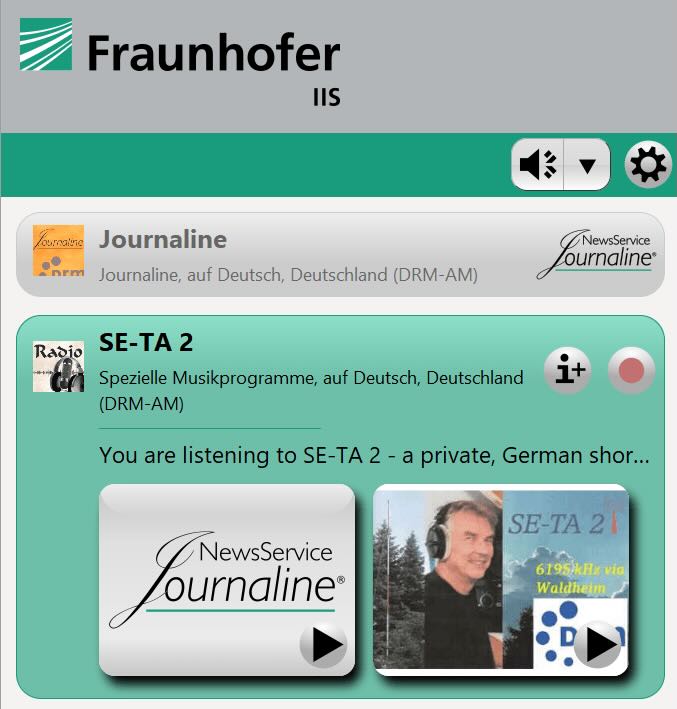
On 27 December, SE-TA 2, a private German shortwave radio station, will be on air with a 4-hour moderated music programme “Musikalischer Frühschoppen” from the Waldheim, Germany, transmitter.

The frequency will be 6195 kHz.

The two-hour programme will be played twice in succession within the 4-hour transmission windows. The DRM transmission will be in two different configurations:

09-11 UTC 16 QAM in MSC Mode B
11-13 UTC 16 QAM in MSC Mode C

Both featuring xHE-AAC audio, Journaline, DRM TextMessages with DL+ information, stations logos and Slideshow images.

RNZ Inaugurates New Analog and DRM Ampegon Transmitter

Many thanks to SWLing Post contributor, David Iurescia, who shares the following news release via the DRM Consortium

DRM RNZ Shortwave Transmitter For Pacific Inaugurated

On August 1st the New Zealand Deputy Prime Minister and Foreign Minister came to RNZ House in Wellington to mark the start of the use of the new analogue and DRM transmitter, replacing a 34-year-old transmitter at the Rangitaiki broadcast site.

In a $4.4-million-dollar project, the public broadcaster RNZ has installed a new Swiss-made Ampegon shortwave transmitter.

Chief Executive and Editor-in-Chief Paul Thompson said it’s a significant infrastructure upgrade and secures the future of the RNZ shortwave service into the wider Pacific.

RNZ Pacific broadcasts into the wider Pacific on shortwave 24 hours a day, broadcasting in English and Pacific languages, in collaboration with 22 broadcasting partners across the region.

“The attraction of the shortwave service is that it delivers our unique voice and content to all parts of the Pacific via a signal which can carry over great distances, and achieve good audiences,” said Thompson.

“RNZ Pacific is an essential source of information, especially so during the cyclone season or during a crisis such as the Tonga eruptions,” he said.

RNZ’s Transmission Engineer Specialist Steve White said the project to replace the 34-year-old transmitter at the Rangitaiki broadcast site near Taupo had gone smoothly – being on budget and achieved without disruption to service. “We have appreciated the close working relationship with Ampegon for the new transmitter installation,” he said.

RNZ broadcasts into the wider Pacific on shortwave 24 hours a day, collaborating with 22 broadcasting partners across the region.

Click here to read the original article at DRM.org.

Many thanks to SWLing Post contributor, Alan, who shares the following context:

Receiving Radio New Zealand Pacific’s new transmitter.

Please look for this signal from the newest brand new high frequency (SW) transmitter.

It’s on air 00:00 – 04:48 UTC daily on 17675 kHz AM aimed at the Southern Pacific Ocean from 66 Matea Rd, Rangitaiki, Bay of Plenty,  co-ordinates -38.8426 176.4297

 https://www.rnz.co.nz/international/pacific-news/523864/rnz-goes-live-with-new-pacific-shortwave-transmitter

 https://www.drm.org/radio-new-zealand-uses-new-drm-shortwave-transmitter-for-wide-coverage/
There is a link in that article which goes to the RNZ Pacific website which has not been updated for the new transmitter.

https://www.rnz.co.nz/international/listen shows no changes to duration and times of transmissions at all with the exception of a new time slot for the new transmitter outlined above.

https://www.rnz.co.nz/international/qsl to make reception reports.

The RNZ Pacific have been heard in both AM and DRM on the West Coast of North America and occasionally in Europe.
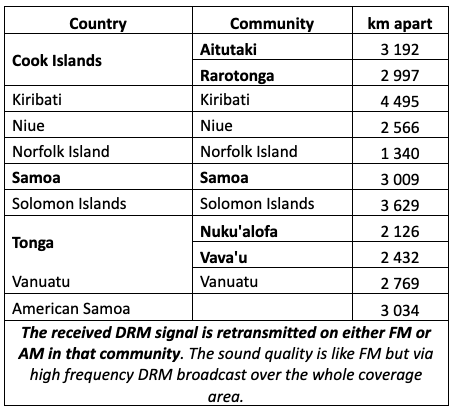
https://www.rnz.co.nz/international/rebroadcasters 

A DRM receiver including KiwiSDRs can receive the DRM signal anywhere in the coverage area not just in the communities.