
 Many thanks to SWLing Post contributor, David Iurescia, who shares this Radio World article, which reports that China has officially adopted the Digital Radio Mondiale (DRM) standard to modernize its AM radio bands.
The plan includes technical guidelines for analog/DRM simulcasting, requirements for provincial transmitters to deploy DRM systems, and a nationwide push for DRM-capable receivers in vehicles.
I wouldn’t hope for this announcement to be a signal of a breakthrough in DRM deployment coming soon. The history of failed hopes in anything related to DRM (announcements of receivers that do not materialize, of transmissions that aren’t launched etc.) is just too long to be ignored.
It’s also important to read the announcement carefully. It says that DRM has been authorized to be used for domestic broadcasting in China – full stop. It doesn’t signal a launch of a single additional transmitter, it doesn’t mean that any of the broadcasters operating there has (at this point) any intention of launching one. And this is quite telling – we’re talking about a one-party state where all media are fully controlled by the politicians. If there was a political will to launch DRM, it could have been done with a single stroke of a pen, but for now, they’re keeping it low profile.
Now, any decision maker there will have to consider what DRM can offer, both for the politicians and for the audiences.
The first of the group, especially in China, would surely love to see a system that allows to strengthen their control over what the listeners can hear. DRM can provide that, because DRM signals are extremely easy to jam. But achieving this goal would also require making sure that no other radio signals can be tuned in to, and that would require banning all analogue receivers, which I think even China cannot afford. On the other hand, this may be the reason why North Korea is also testing DRM.
Now, on the receiving part – one of the talking points made by DRM campaigners is that DRM allows to reach remote or underprivileged audiences. And this is obviously true, as shortwave signals can indeed travel really far. What they are always forgetting to mention is that wherever there are such audiences that have to be reached via long-distance radio, they’re already reached by analogue AM MW and SW radio. It’s been there since decades, it works and is readily accessible via easily accessible receivers (both new and used).
I think if members of such groups are to choose a device to buy, they are far more likely to want to get a smartphone (any type) with Internet access (again, any type, even the slowest one) than a DRM-capable radio (if there was any). The reason is pretty straightforward – a smartphone, even with limited Internet access, allows them to access government, financial services or just to maintain contact with their relatives and friends. On the other hand, a DRM receiver will allow to tune to two or three state-owned stations that they already can hear in analogue, and that’s all.
How the campaigners are going to persuade the ordinary listener to get a DRM receiver, once (if) it’s available, remains unclear.
That’s a very good news because it will drive on the market many news radios using this numeric standard. IT will then be adopted elsewhere in the world.
https://www.radioworld.com/tech-and-gear/digital-radio/solar-grove-introduces-a-personal-drm-receiver
https://cmlmicro.com/Content/Downloads/DRM1000Datasheet.pdf
https://www.mouser.com/new/cmlmicro/cml-micro-de9180-kit/?srsltid=AfmBOopdARzCJQ97yFuoXdn1CLEq8mfwW-tjZraguCPmVT02a5IEMJE8
Also kiwiSCR https://kiwisdr.nz/ will also receive DRM excluding VHF. There are many of these receivers can be remote controlled via the internet http://kiwisdr.com/.public/
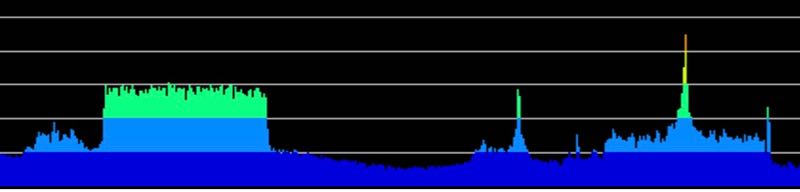
I like the spectrogram at the head of this post. The two mesa shapes with ‘grass on top’ are two different DRM broadcasts one weaker than the other, The far right is an Hybrid Digital radio signal in the AM band. The tallest part is an AM carrier. At its base is some analog audio surrounded by the digital signal. To the left is another similar HD signal with a trial narrow bandwidth digital signal. In HD Radio the lower frequency digital signal is identical on the higher frequency.
Not shown is VHF where DRM looks similar but wider, The HD signal looks quite different to the diagram above.
Good on China for yet again taking a logical step into the future with a proven technology. FM-quality sound on the MW band is something I really wish we had access to.
Meanwhile here in the US, DRM will never be adopted. Never. Simply because of the name.
I asked Mr Liang, head of Tecsun, on WeChat. It seems that for now he has no plans to produce DRM receivers. He said so far only Indians are hoping that Tecsun will produce DRM receivers. This is of course unofficial news.
On Chinese WeChat groups, there are talks of Gospell that has plans for DRM receivers.
In Wien arbeitet ein DRM Sender seit 3 Jahren auf 5900 kHz 24 Stunden.
Zumindest der KiwiSDR oe1xtu aus Wien empfängt auf 5900 kHz kein DRM-Signal.
Hopefully, this adoption will lead to mass production of DRM receivers, which will allow them to be sold outside of China at reduced prices and available in traditional stores.
I hope this means we’ll see DRM-capable receivers from the likes of Tecsun, XHDATA, and Sangean.