
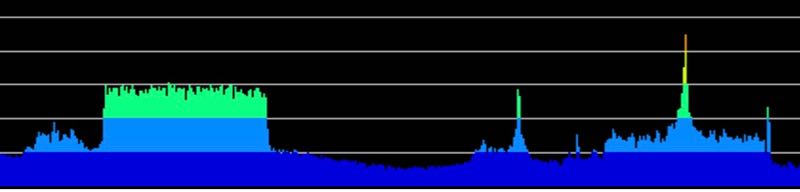
 Many thanks to SWLing Post contributor, David Iurescia, for bringing our attention to this recent roundup of developments in Digital Radio Mondiale (DRM) as the year comes to a close.
The article from RedTech.pro was written by Ruxandra Obreja, chairman of the DRM Consortium, and summarizes a range of DRM-related updates and activities in 2025, covering new broadcasts, technology progress, and announcements from stakeholders in the DRM community.
I think you’re right in naming this article an ad, although it is obviously written in a way that makes it sound somewhat neutral, at least for someone who’s not really familiar with the way of operation of the DRM consortium and its reputation of not delivering on any of its promises. What we are also seeing there is twisting the meaning of words.
For instance, the author claims: “In July, the Chinese government officially adopted the National DRM Standard for medium-wave and shortwave broadcasting.”. We know that Chinese government owns all radio stations in the country, so when we see the word “adopted”, we may think that they converted their extensive MW and SW networks to DRM, enabling digital reception of hundreds of stations. But what happened in fact is that they only *approved* the usage of DRM in the country, together with other digital modes. So in fact, nothing has changed on the ground, not a single new transmitter (apart from the currently running shortwave tests) was launched, even though they could order this to happen with a single stroke of pen.
The DRM consortium is also renowned for the constant shifting of its goalposts and promoting somewhat unreliable companies. This is shown in case of supposed “Solar Grove N88” receiver. It was supposed to be available in Q4’25 and now, in Q1’26, we’re hearing that they are now starting the manufacturing process, so there has been a delay. But I don’t really think they’ll be able to deliver it – their website lists some other products that do not seem to be available in retail online stores. This is the same pattern as in the cases of other companies that were supposed to bring DRM-capable receivers on the market and have spectacularly failed at doing so. However, that doesn’t stop the chairman from calling this receiver “launched”. With such approach, where “launching” doesn’t have to be aligned with any measurable or noticeable availability, or even the existence of a device, the DRM consortium can “launch” absolutely everything, ranging from a Dyson sphere to perpetuum mobile.
I think that in such cases where the bias is clearly seen, articles like this should be accompanied by a fact-check.
The article is written by someone who has a personal stake in DRM. It’s more like an ad, than a scientific analysis. I do see DRM making inroads in the US to the extent they have overseas. Nearly every car has AM/FM and the ability to receive XM/Sirius (for a price). We are a large country – there are still many places where AM rules and it will not be allowed to die. When I drive through the nearly empty stretches of northern AZ and other states, there is very little FM. AM is more prevalent, but listening to religious programming or commodity reports is not my thing. That’s where satellites make a huge difference. For small countries, DRM is fine, but people in the US don’t appreciate technology shoved down their throats.
Steve,
That article is an update. Not mentioned is India, the most populous country in the world at over 1.3 billion. (USA 0.34 billion) https://www.drm.org/drm-digital-radio-broadcasting-in-india/ people (look at the date) https://www.nautel.com/resources/webinars/am-transmitters/building-for-a-billion/
The most powerful USA AM broadcast transmitter is 50 kW not 1000 kW! In October 2025 there are 13 million Indian cars equipped with DRM included in the purchase price.
XM/Sirius only exists in North America as is HD Radio.
Outside of the USA AM is dying particularly in Europe. where it is being replaced by Digital Audio Broadcasting. Both DAB+ and DRM can carry 18 programs per transmitter along with data including images multiple pages of indexed text…
In 2017 Norway, population at the time 4 million decommissioned all network radio for DAB+ and within 12 months ratings returned to their previous levels and have been growing ever since. The EU in 2020 made terrestrial reception of terrestrial digital radio compulsory in all new passenger vehicles. There is a campaign to do this in the USA to do this with >100 year old AM!
There are only 24 % of USA broadcasters in HDRadio® and 95 million receivers mostly in cars in 23 years. How many of those have gone to the wreckers?
All digital radio systems can transmit digital only There is only one pure digital HDRadio® in the USA and it transmits an identical program in FM.
Thank you for your explanation. Things like DRM move very slowly in the US. I mount it will become the standard here in my lifetime.
There has never been a side by side trial of HDRadio® and DRM in medium and Very High Frequency bands to determine the best. Xperi bought HDRadio® and charges manufacturer for each transmitter and receiver produced. In addition the broadcaster is a percentage of the income from speech quality HD2 – HD4 channel. DRM is a non-profit multiple country consortium.
As for China, they have been broadcasting in High Frequency DRM for 7 years.
https://www.radioworld.com/tech-and-gear/digital-radio/china-makes-its-drm-move
https://new.hfcc.org/schedule/
It sounds much better than AM in HF & MF bands. The power transmitted is enough to provide reliable reception. The signals are aimed for internal coverage. The point is that car manufacturers will include DRM/CDR/analog receivers. Thus the huge increase in receiver numbers will, like India, will further reduce receiver prices.
As for China, the state-owned broadcaster China National Radio, which operates 17 radio stations, broadcasts one of them (CNR-1) in DRM on few of its shortwave transmitters. None of its 435 mediumwave transmitters (again, only referring to CNR-1, not other networks) have been converted to DRM. None of the other radio stations (mostly run by city or provincial governments) have adopted DRM. Looking from an ordinary listener’s perspective, this is less than a niche. No one can reasonably expect that people will flock to the stores to get a new device allowing them to hear a single radio station. This could have been a good selling point in early 1920s, but hardly so in 2026.
You’ve also mentioned that “huge increase in receiver numbers will, like India, will further reduce receiver prices”. May I then ask, how have the receiver prices in India reduced and what are they right now? Because for me, it seems that there are no DRM receivers available there. I went to some of the Indian electronics stores websites: Reliance Digital, Croma, Vijay Sales, Lotus and in each case, when you type “DRM radio” to the search box, there is nothing found. Same for Indian Amazon, no any type of DRM-capable receiver is offered. So how exactly did you manage to infer that the prices have already dropped?
The price reductions are going to car manufacturers who include DRM/AM/FM at no extra cost. The car manufacturers have done this in 13 million vehicles already. The future vehicle DRM receiver numbers depends on the number of vehicles manufactured for the Indian market. This is like the Australian market which has not manufactured vehicles since 2018 nearly all imports contain DAB+/AM/FM radios. This is because broadcasters have to broadcast using the new technologies before receiver manufacturers will ramp up mass production. As with the digital TV conversions receiver and STB prices only substantially dropped when analog switchoff dates were announced. This happened in Norway & Switzerland for DAB+.
Receiver manufacturers & retailers are not interested in supplying countries without coverage in the new technologies because there is nothing to receive.
Looking on line in foreign countries can be deceptive with large numbers of small traders.