
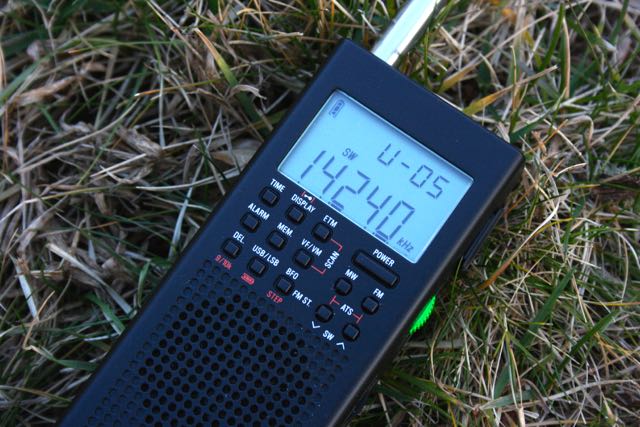
CountyComm GP5/SSB, aka Tecsun PL-to 365
Many thanks to SWLing Post contributor, Tom Kamp (PA/DF5JL), who shares the following brief report and video:
Today (September 21, 2022) around 2015 UT strong signal on 5006 kHz (CF) from JG2XA beacon from Japan (0.2 kW) near Den Helder, in North-Holland, The Netherlands.
JG2XA transmits continuously at 200 W on 5006 kHz and 8006 kHz. The type of radio signal is H2A (amplitude modulation with coded tones in the single sideband).
Received with the Tecsun PL-368 and the built-in telescopic antenna! The dBm display of the unit is very inaccurate (in USB), yet S5-S7 should be rated appropriately. Top signal, top RX ?
73 Tom Kamp PA/DF5JL
That’s quite a catch for the PL-365. Thanks for sharing this, Tom!
LOL nope XD
It’s an FSK modem so commonly found all over the place on SW that mostly originates from a Navy of a certain big country in the East of Europe which is too barbaric to spell its name out. Of course this country is not Poland either ?
After various TDoA tests, there is much to suggest that it is RUS Navy Kaliningrad CIS36-50 / 250 Hz Shift and not JG2XA. It seems that they have hitchhiked both channels, 5006 and 8006 kHz. Meanwhile I have received the callsign RJD69 in F1B with QTC at 2142 UTC on 26 SEP at 5006 kHz. It is a pity that it is not JG2XA. I had assumed that if there were two synchronous signals on the respective frequencies of JG2XA, they would also come from there. But that was a big mistake. Unfortunately, despite several enquiries, I have not yet received a reply from Japan about this frequency assignment from a third party.
It would have been so nice ? Unfortunately, some Polish station has hijacked the two frequencies of JG2XA and led me around by the nose. Lengthy locating attempts using TDoA yielded this disappointing result. Annoying. Sorry 🙁
It would have been so nice ? Unfortunately, some Polish station has hijacked the two frequencies of JG2XA and led me around by the nose. Lengthy locating attempts using TDoA yielded this disappointing result. Annoying. Sorry 🙁
Great intercept Tom. Beacons are always fun to log. Try also listening to ham beacons from 28.100 – 28.300 MHz also.
I love beacons and also the shortwave miracle that rather suddenly and suprisingly you can receive them with no patricular sophsticated instruments when “Mother Nature” is favoring you.
I love that they are weak-signal and the fact that reception simply works.
When I find a contact email from an amateur radio beacon, I like to send a SWL reception report.
Best 73!
I note the receiver was tuned to 5005 kHz on the video. Is this due to the transmission method, or was it not the Japanese station?
That is completely correct: An SSB receiver shows the frequency of the suppressed carrier of the signal. If you receive a carrier and set the frequency 1 kHz below or above the signal, the carrier can be heard as a 1 kHz signal.
There was a time when I drove in my car at night, even during the winter. Quite often I could hear Japanese radio amateurs in CW on 40 m with an 1.7 m long antenna and my FT-857.
Or read reports from the early 1920s when radio amateurs made the first intercontinental shortwave contacts: They started in the 160 m band.
Everything is easy if two conditions are met: Good antenna at the transmitter and low noise at the receiving end. A good antenna at the receiving end is not necessarily needed: The natural noise is easily much louder that the internal receiver noise. You only need a reasonable signal/noise ratio.
What did they transmit and how to decode it?
How do you identify the beacon? Do they ever transmit a call sign?