
by Dan Robinson
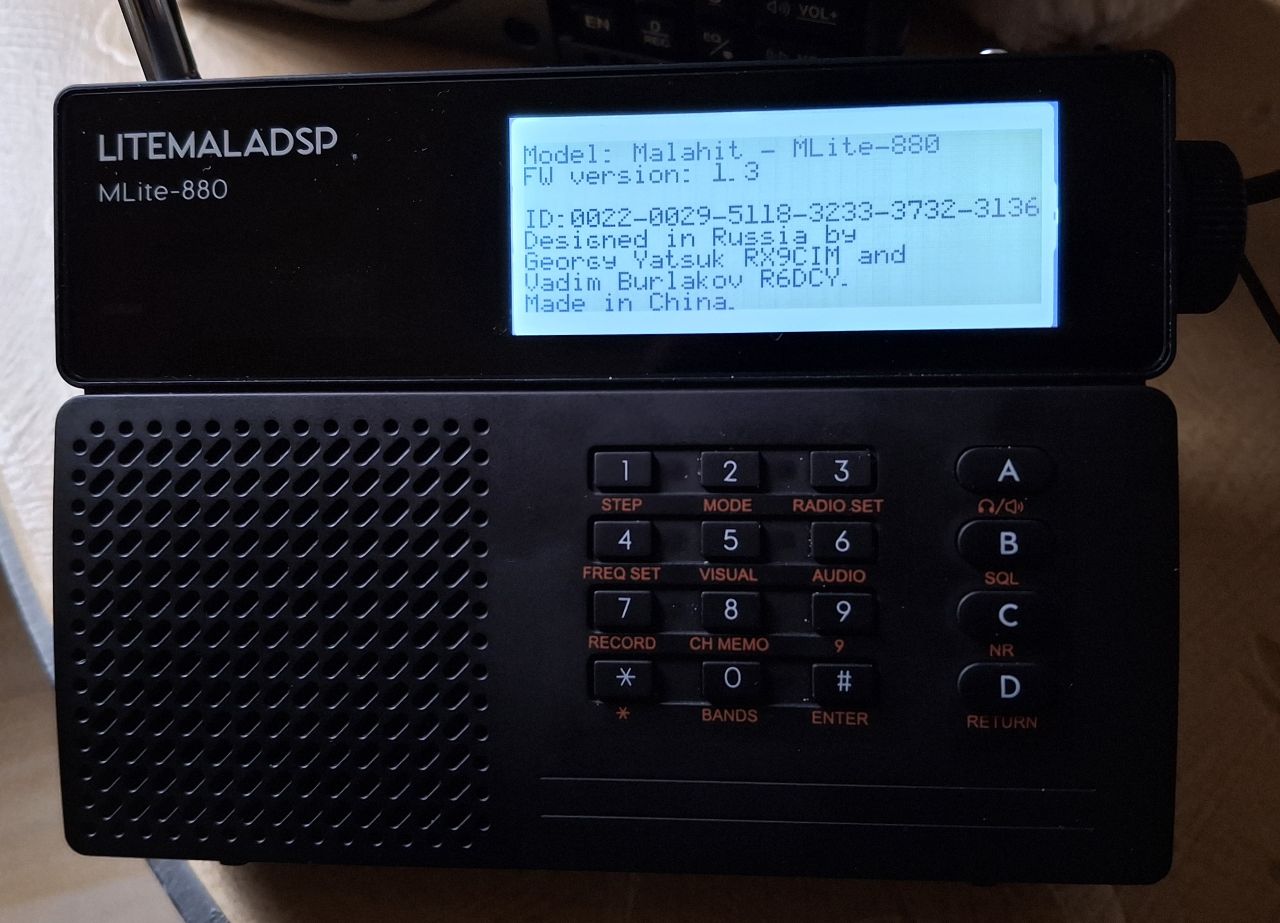
So, a lot of news to cover — thanks to MLite users on Facebook for some of the first alerts about firmware 1.3 now available for the MLite-880 on the Elecevolve website and this appears to complete without problems using the Windows app made available there. In attempting to upgrade with STMCube I ran into problems so I think the Windows app is the way to go — my issue with STMCube involved inability to connect with the receiver already placed in DFU mode via the 1 key so I am not sure what the deal is with that.
Thanks to Georgiy at Malahiteam for making the original 1.3 bin file available on the Malahit Telgram channel where discussions continue in addition to those found on the Facebook group for the receiver. In previous comments, he noted in response to a comment requesting coverage to include 55 mhz…that a “hardware limitation [involving] band pass filters and mixer circuit” prevents extension to that point.”
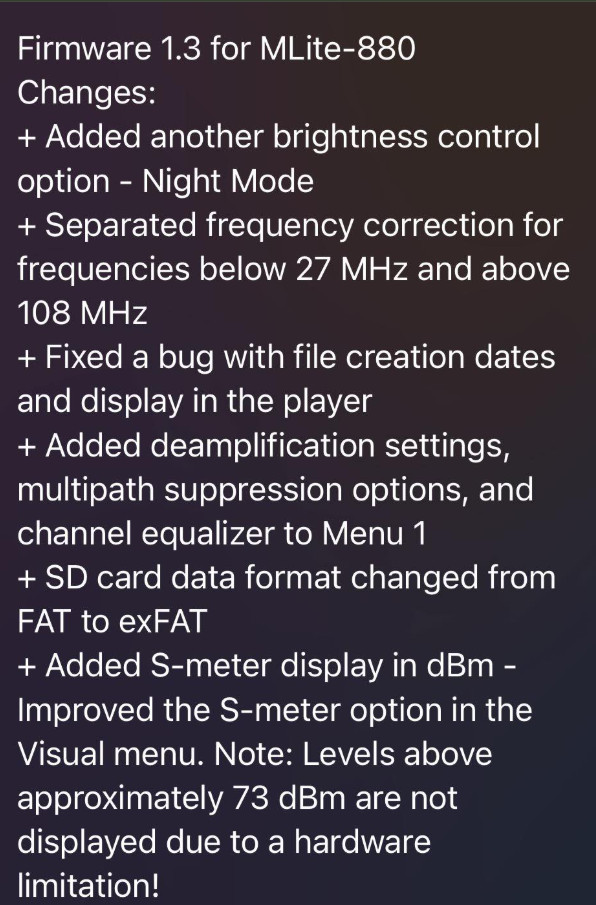
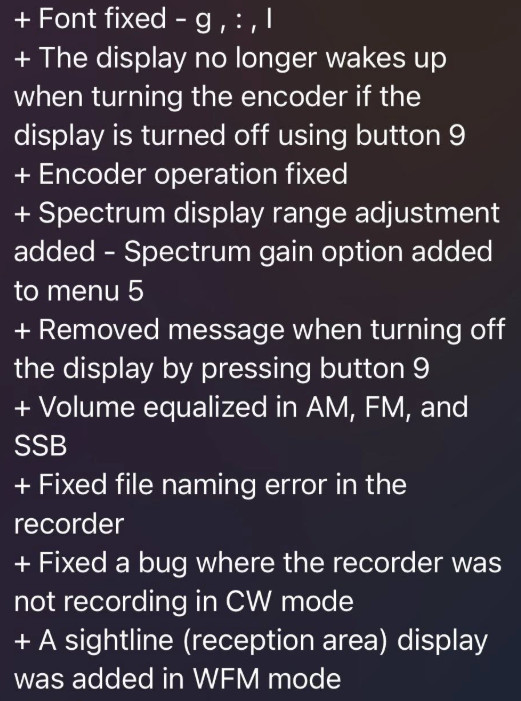
We see some very welcome changes including addition of a NIGHT display brightness mode and a “separation of frequency correction for frequencies below 27 mHz and above 108 mHz.” microSD card format has changed to exFAT. S-Meter now has a dBm display option with a note that levels above 73 dBm are not displayed due to “a hardware limitation.” Another interesting addition is SPECTRUM GAIN added under MENU 5. There is still no option for button-implemented selectable sideband in SAM mode, but as someone pointed out, it is possible to tune LSB/USB while in SAM by reducing STEP size.
Along with FW 1.3 for the MLite-880 comes perhaps bigger news from Malahiteam — they have announced initial stages of the DSP-4 receiver with the following information (NOTE: initial units are going to be limited to Russia).
Malahiteam Announcement: Due to the unavailability of the msi001 chip and its analogs, unfortunately, production of the Malakhit-DSP3 model has been discontinued.
However, I am very glad that my team and I were able to save the project. We have developed a new model, the Malakhit-DSP4. This model has the following features, differences, and similarities with the Malakhit-DSP3:
- The DSP4 has a wider bandwidth – 650 kHz instead of 192 kHz for the DSP3;
- The case dimensions and control layout are completely identical;
- The power supply circuit is completely identical – the DSP4 is also powered by one or two 18650 batteries connected in parallel;
- The dynamic blocking range is significantly higher than the DSP3 – at least 100 dB for the DSP4 compared to 85 dB for the DSP3;
- The DSP4’s IQ signal transmission bandwidth is slightly lower than that of the DSP3 – 162 kHz for the DSP4 versus 192 kHz for the DSP3;
- The DSP4’s power consumption is 1.5-2 times higher than that of the DSP3, depending on the operating mode. It’s worth noting that the DSP3 (yes, DSP3) is a low-power receiver, and few compare favorably to it;
- The DSP4 significantly improves RDS reception for FM radio stations;
- The DSP4’s frequency response bandwidth is somewhat narrower – from 100 kHz to 1.7 GHz, but it is continuous and does not contain “holes” like the DSP3;
- The DSP4 has better sensitivity than the DSP3 – no worse than -140 dBm on the HF band, and noticeably better sensitivity on the VHF band than the DSP3, reaching around -140 dBm in some VHF bands.
- The DSP4 has a built-in clock chip and Bluetooth module.
- The remaining functionality is the same as the DSP1-3, and the DSP processing quality remains just as high.
- The DSP4’s radio receiver solution is more sophisticated and advanced.
At the same time, we tried to keep the price low (by the standards of high-quality equipment). However, we still had to increase the price due to higher taxes. The Malachite-DSP4 is manufactured in Yekaterinburg, Russia.