
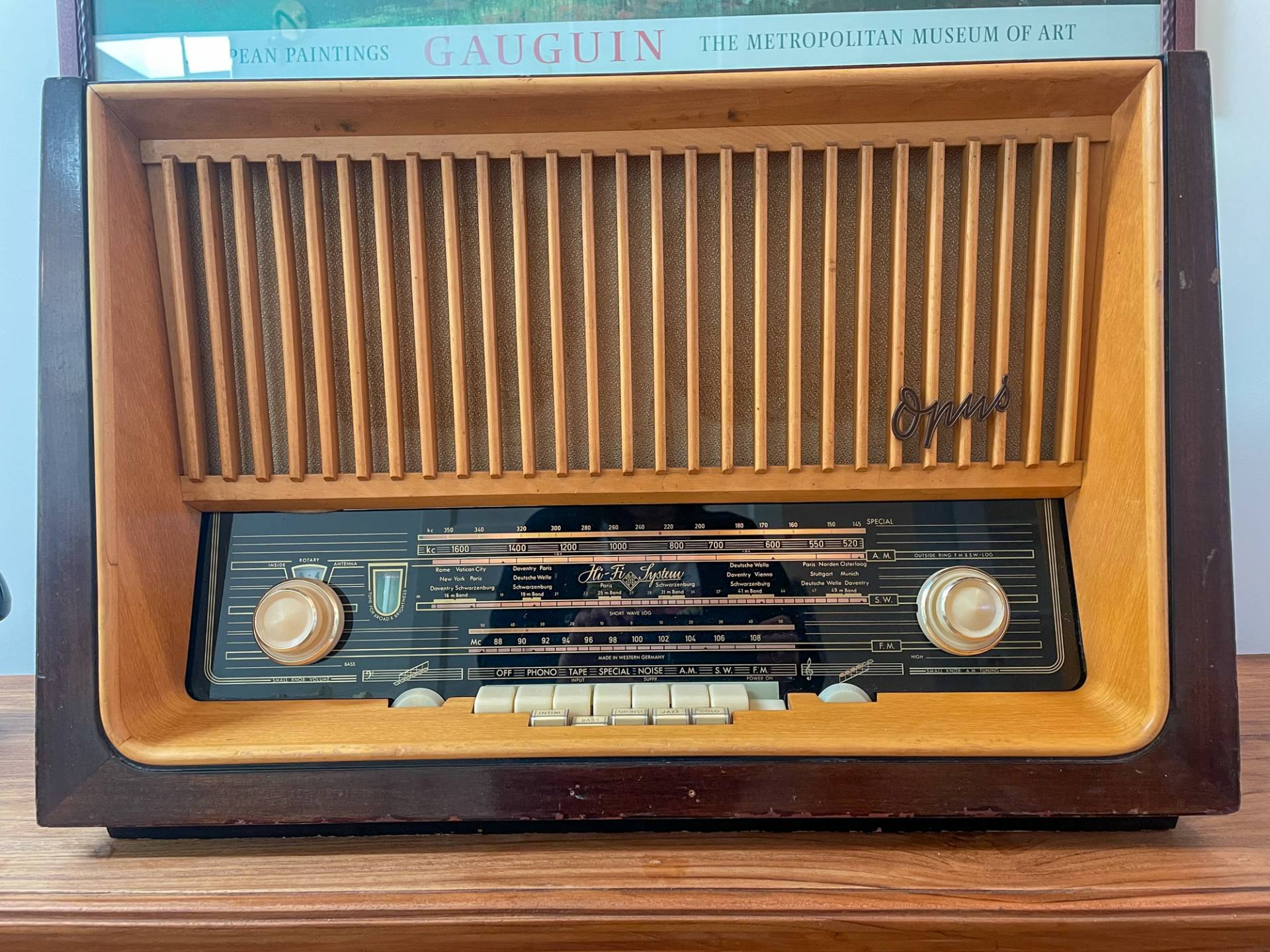
Rachael Myrow discovered her father’s Telefunken Opus 7. (Photo: KQED)
Many thanks to SWLing Post contributor David Iurescia for sharing this touching story from KQED: “How a 1957 Vintage Radio Rekindled a Daughter’s Bond With Her Dad.”
A beautiful piece about memory, connection, and the emotional power of radio.
Read it here: https://www.kqed.org/news/12047317/how-a-1957-vintage-radio-rekindled-a-daughters-bond-with-her-dad
Yes a wholesome,refreshing story,especially with all the negatives that seem to surround us all, these days.Just a simple turn on a tuning dial created the magic to time shift back to fond memories of a simpler, more innocent past and the loved ones that we shared it with.Thanks and Good Luck !
What a lovely story! This radio seems interesting for a couple of reasons:
1. This version of the Opus 7 may have been specifically made for the American market, IOW it could’ve been sold in the US via some importer/distributor.
2. Only checking the domestic version of the Opus7 reveals that “Noise Suppr.” (ession) is actually an IF bandwidth switch. Either Telefunken or their US importer did not trust their US audience to understand the abstract concept of “bandwidth” and christened the button for what it does. For some possibly strange reason they also did not dare to scare America by revealing that there is a long wave band underneath the AM band and called that band “Special”. That radio is quite special indeed: Consumer radios with 2 bandwidths were a rare exception in the 1950s and that underlines the particular attention they paid to the shortwave part of the radio just like the…
3. Bandspread dial. Note the little notches in the markings for the shortwave bands. That’s where you park the main AM dial in the band, then you can use the FM tuning knob to tune through the band with finer tuning and memorize the station with the ”LOG” scale going from -50 to +50. However, tuning it to some published frequency required conversion to wavelength, because the main SW scale sports only meter markings.
4. But don’t you worry, it has markings for all ze German SW transmitter sites on the bands and very selected other stations (where space permits) on the shortwave part of the dial window. The domestic version has the usual flood of names for all the European MW stations at that place, no names on SW and it looks so much more conservative and just like all the other grandma toob radios.
What a wonderful story to read! Thank you so much.
Thank you for sharing such a heartwarming story. What a treasure that radio must be!
Telefunken, Nordmende & Siemens were the, “Holy Grail” of the post war 2 immigrants and refugees..! I