
By Jock Elliott, KB2GOM
It was a remark from Sebastian Schlüter in response to this post – https://swling.com/blog/2025/10/some-really-inexpensive-ways-to-perhaps-improve-your-shortwave-listening — that sparked today’s post.
He said:
If your RFI is really high, your best weapon is a magnetic loop antenna aka small receive loop. At home, my RFI is so high that I don’t benefit from a larger/longer antenna. For example: Using the telescopic antenna (75 cm) vs using 3m of wire. Reason is that the signal-to-noise ratio is roughly the same in both cases and that all of those very weak signals are below the noise floor anyway, and the ones that make it through the noise are already strong enough to be received with the telescopic only. Conclusion: In a high RFI environment, it’s not about maximising the signal strength but maximising the SNR. You need to find an antenna type that will pick up less of that RFI. A cheap and simple antenna for this is the small receive loop. For a start, you can use a cheap wire terminal with 3.5mm mono jack. Using a 1:1 balun further improves the result.
What really struck my eye was this:
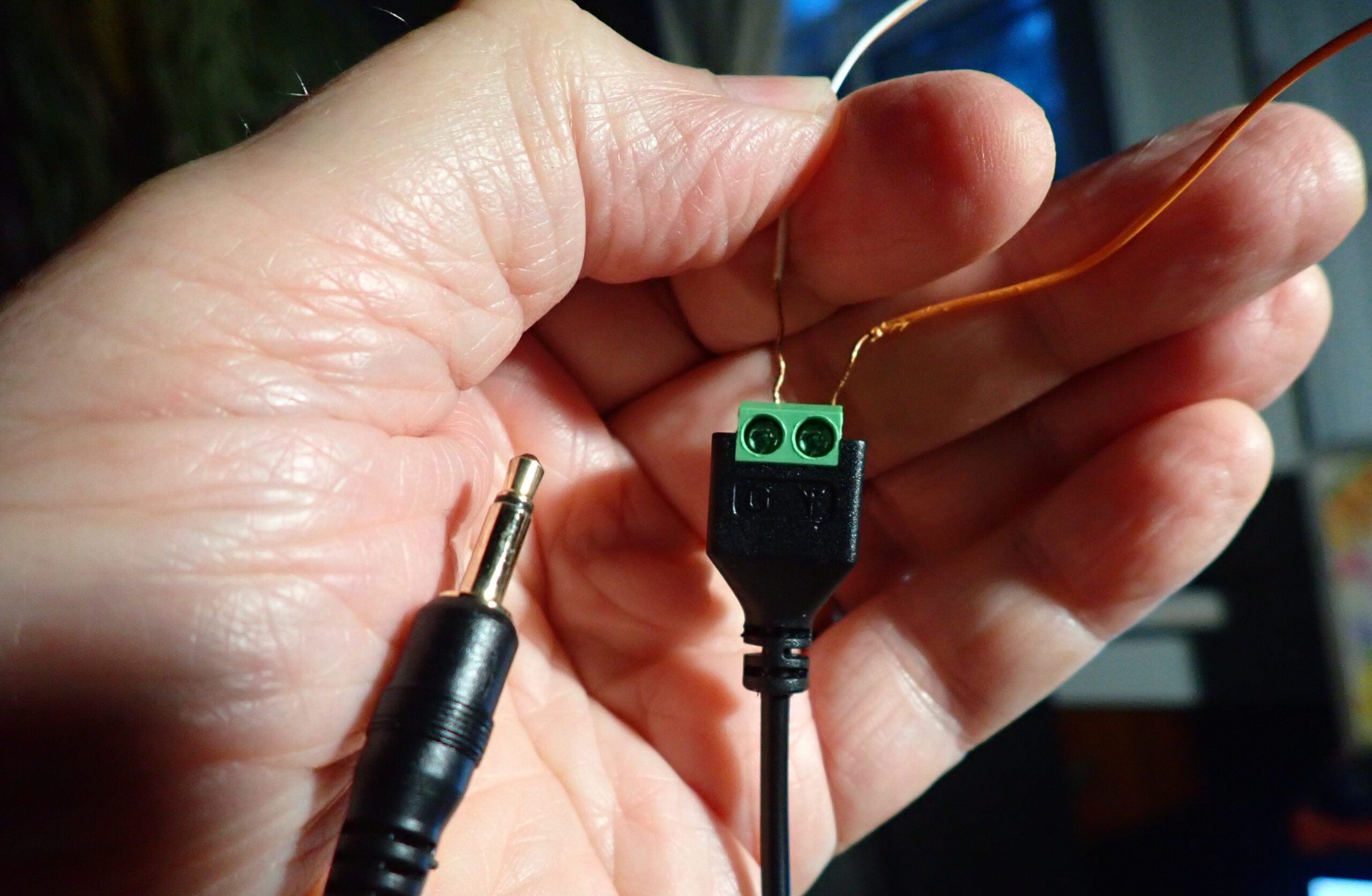
A cheap and simple antenna for this is the small receive loop. For a start, you can use a cheap wire terminal with 3.5mm mono jack.
My CCrane Skywave SSB 2 came with a wire terminal with a 3.5 mono jack, I realized. I hooked it up to my 45-foot horizontal room loop (a single strand of insulated wire run around the top of window frames and bookcases in my radio shack), and then ran the following experiment.
Using the scan function on the Skywave SSB 2, I scanned the shortwave bands using the whip antenna, and then I did it with the loop plugged into the external antenna socket.
The results:
CCrane Skywave SSB 2
Whip antenna: 4 stations detected. Loop antenna: 13 stations detected.
Then I tried the same experiment with a Tecsun PL-880.
The results:
Tecsun PL-880
Whip antenna: 8 stations detected Loop antenna: 15 stations detected.
Clearly, Sebastian’s suggestion of plugging in a simple wire loop makes a huge difference. And, I should note, I didn’t play fair. I did the test while 3 scanners, an LED light, and two UHF/VHF ham transceivers were operating in the vicinity and probably generating RFI.
So now the question: I ran the experiment with a 45-foot simple loop. What do you suppose would be the minimum wire length for an effective simple wire loop? I look forward to your input.
The Kiwa Pocket Loop produced thirty years ago is still impressive in its SNR.
A combination of a DIP switch set with a wooden “pencil” and variable capacitor allow tuning from 520 kHz to 30 Mhz. Gain is so high you have to off-tune from real frequency a bit.
Power was from a 9 Volt battery that lasted a surprisingly long time (unless you forgot to set switch to off).
Cost was $135 in 1990.
Forty years ago the Palomar Engineers SW electrostatic shield loop had low RF gain but good SNR. It tuned 5 Mhz to 17 Mhz. Loop.
This was a plug in “Box Loop” SW antenna that could be switched in to the plug on top of the amplifier/tunner box originally meant for the MW ferrite bar antenna.
I think the SW Box Loop was $30
and Tuner/Amplifier box $50 in 1980 dollars.
These two show up on eBay about once every 2 years or so, and sell fast.
A Kiwa Sync Detector,
and a Kiwa MW Loop
are presently on eBay at “Eye Watering” bid prices.
Hi Jock,
“What do you suppose would be the minimum wire length for an effective simple wire loop?”
That question does not compute well in context with the “mitigating noise” topic: The very simplified answer is that all antennas become efficient (as in “gain”) when they become resonant, loops at circumferences =/> 1/3 of the wavelength. But for reception this efficiency has very little meaning, particularly in the presence of noise, because it does not matter around what voltage level or S-meter reading your SNR remains constant, or constantly bad. How much antenna types and shapes can improve your SNR depends mostly on the specific composition (relative position in 3D space, distance (near- vs. far-field), polarity, bandwidth…) of your QRM sources and how much of your antenna is exposed them, to near-field sources in particular.
In plain English, a very lossy and small antenna at a place and orientation that takes it away from near-field noise sources could easily outdo a big and resonant antenna meandering through them. Or vice versa, a sad whip on a desktop among your other electronic amenities can suffer more than your wire (in whatever shape) running at least partially through electrically cleaner air.
That’s why small (<1/10th Lambda) "magnetic" loops are so popular: they are so lossy that they usually need a preamp but their properties are quite different from resonant loops and their compact size, sharp nulls and potential insensitivity to the E-field component of (only) close sources makes them often as much antenna as you can fit at the only quiet(er) place on your premises to fully exploit these properties. My experience with those is that making them smaller than 80cm/32" diameter doesn't really improve reception above 10MHz while the toll on LF/VLF reception becomes pretty noticeable.
On the other end, for full size general reception loops MW – SW, about 60' or 20m circumference seems to be the maximum to maintain a sweet spot between a) keeping the losses in check on (very) low frequencies where this loop is still small enough to act like a small loop and b) not yet having too much wire for the short end of shortwave, where 20m mean a 2 Lambda loop. Between this and a SML of 6' circumference, you can make your loop as small as you need to maintain sufficient gain on your lowest frequency of interest.
Much more than small loops, resonant horizontal wire antennas including loops require a certain (1/2 Lambda) height over ground for serviceable low angle radiation/sensitivity though, which usually takes them out of the house and away from noise too.
13dka,
Wow, that is really great information. Thanks!
I guess I got lucky with the my 45-foot horizontal room loop, which is simple insulated wire, has no amp, and simply plugs into the external antenna jack of my radios with the adapter shown at the top of the blog.
Incidentally, I ran the whip-vs-loop experiment with my Qodosen DX-286. On the whip, it detected 8 stations; with the loop, 20. Now some of those were at the extreme edge of detection (I could hear modulation, but it wasn’t really intelligible). Still, impressive, I think.
Thanks for your very useful comments.
Cheers, Jock
This, patently magical, behavior of loops has been well known to people with SDR receivers of various types. The “small magnetic loop” is otherwise known as MLA-30. Or K-480WLA. Or, if you want to bias it toward lower frequencies, YouLoop. All of these are freely available on Amazon. Or you can make one yourself. You will need:
1) ~3 meters of copper ground wire, found in hardware stores.
2) A balun, such as Nooelec 1:9 balun.
3) An LNA, such as Nooelec LanaHF.
4) Preferably, an FM filter, such as Nooelec Flamingo.
I am going to assume that your receiver has Bias-T feature and you know how to turn it on. If you do not have Bias-T, provide LNA with an external power source. Connect above pieces as follows:
Wire Loop => Balun => FM filter (if present) => LNA => Receiver
Then enable Bias-T, make sure LNA light is on, and enjoy.
I have tested several of the things mentioned here and my intermediate results differ in some details. Please note that these results only apply to my personal situation and may not apply to others, but I hope the following is still interesting to read. I also include some general thoughts 🙂
Regarding external LNAs / preamps: I have extensively tested some: MLA30+ (includes preamp), HFDY loop (includes preamp, knockoff of LZ1AQ’s design). Also some cheap external preamps added to Airspy Youloop. Result is that an external preamp does not seem to be strictly necessary in my situation. It may help in some cases but it may also cause issues in other cases. The main issues are: receiver overload due to wideband amplification, additional noise, broken longwave reception. Overall, it’s a mixed bag and I tend to NOT use an external preamp. General thought: my remaining noise floor (i.e. even when using a loop entenna for noise mitigation) is so high that the sensitivity of my radios is usually not the limiting factor anyway. And I think the amplification would make sense if it would be combined with an external prelesector (bandpass filter) so that only a certain range would be amplified. But just having a (strong) wideband amplification is a problem for today’s inexpensive radios that lack proper bandpass filters. At least, I think you can adjust the level of amplification on the MLA30+ if needed, but on mine the default level is not too strong. Also, bad preamps can add a lot of additional noise. My conclusion so far is: Either don’t use an external LNA / preamp at all or at least use a clean one with only modest levels of amplification. Example: In my experience, both HFDY loop and MLA30+ (maybe needs preamp level adjustment) are good. HFDY is a bit cleaner, though. My Lana HF was way(!) too strong and not adjustable, and it also died very quickly, so I can’t really comment on this one.
Regarding FM bandstop filters: Yes, I live very close to a strong FM transmitter and I have experienced FM breakthrough. In such case I use a general low pass filter for 30 Mhz. On the other hand, this only happens on some radios and only when I use an external preamp. No preamp, no preamp-related issues 😉
Balun: Definitely helps. It does not really matter if it’s 9:1 or 1:1. I have tested both. I now simply use a 1:1. Oh, and btw: My coax cable is very short (less than 2m) and it seems I don’t benefit from a common mode choke or galvanic isolator in addition to the balun in this scenario. I have tested both and there is zero difference either way.
“My Lana HF was way(!) too strong and not adjustable, and it also died very quickly, so I can’t really comment on this one.”
Did you per chance try to run it on 12V? The manual said to not do this for extended periods but the one I tried (to check if the gain dependency on input voltage extends in both directions) died within 3 seconds while I slowly increased the voltage beyond 9V. I would’ve expected at least enough time to read the S-meter. 🙂
LNA is not necessary as long as your receiver has good enough internal LNA and the cable to the antenna is reasonably short. Something like RSPdx does not need an LNA (although LanaHF adds less noise than RSPdx’s internal LNA). RTLSDR will need an LNA though.
I have no idea why you still have too much residual noise at your location, but here is a few things that may help:
1) Move the loop away from power lines. These tend to carry most of the interference inside a house.
2) If you have any powerline network adapters, throw them away immediately.
3) Try reducing internal LNA amplification and use LanaHF instead.
4) If you are using a modern power supply to power the receiver, try batteries instead.
5) Keep in mind that while these small loops are not resonant at HF, they act as regular dipole antennas at VHF, where some noise may get it.
Luarvique,
Thanks for the do-it-yourself instructions!
Cheers, Jock
The small receive loop I use is roughly 3m circumference, a triangle of roughly 1m+1m+1m with the feed point (balun) at the bottom. The loop is placed directly at a window. It works really well for frequencies up to around 10 Mhz. I guess for higher frequencies either the loop would need to be smaller(?) or impedance matching and/or active amplification would be necessary. Not sure, I haven’t explored this yet. But I am now listening to BBC WS in English on 17780 kHz and reception on the loop is much weaker than on the telescopic antenna. So, for now, I simply use two radios, one using its telescopic antenna and one using the loop. I have also done extensive comparisons of the simple receive loop described here with the original Airspy Youloop and found them pretty similar. The Youloop is also very weak on the higher HF frequencies. I will explore this further 🙂
Depends of the frequency you want to listen to. Bigger loops are better for lower frequencies and smaller for higher.
Oene,
Thanks for your comments.
Cheers, Jock
Hi Jock. Thank you for your posting. It always warms my heart when I see some positive news about loop antennas.
I find the underrated advantage of loop antennas is not what they hear but what they don’t hear, namely local noise. At home, I can greatly minimize local noise in an otherwise very hostile environment. Local noise is polarized and dynamic. It varies by direction and frequency and over time. Thus, if you can get your loop rotatable horizontally and vertically, it will perform marvelously. I “fly” my loops as I tune the receiver.
Bob,
I find myself getting addicted to loops . . . the horizontal room loop, the MFJ 1886, and the Terk AM Advantage.
All of them boost signals in the most marvelous way.
On MW, I can hold the Terk Advantage in my left hand, rotating the tuning knob with my thumb while adjusting the receiver with my right hand. And the difference that the loop makes is amazing.
In fact, all the loops I use are pretty amazing in the way that they boost signal-to-noise.
Cheers, Jock