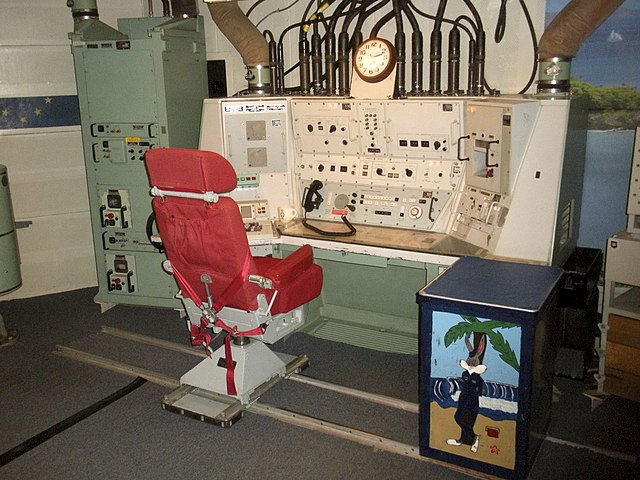
Oscar-Zero Missile Alert Facility Minuteman ICBM Launch Control (Wikimedia Commons)
Many thanks to SWLing Post contributor Dennis Dura, who shares the following article about Cold War–era low-frequency communications, from Hackaday:
During the Cold War, the U.S. developed the Survivable Low-Frequency Communication System (SLFCS) — a radio network designed to function even after a nuclear attack. Using long-wavelength LF and VLF signals that can travel vast distances through ground and ionospheric waveguides, SLFCS provided a way to deliver emergency launch orders when all else failed. The system’s immense towers and buried loop antennas reflect an era when reliability was paramount — even under atomic conditions.
1974 to 1980 Trained on and maintained the 487L SLFCS gear at the 15 Minuteman LCFs at Whiteman AFB. One afternoon, while doing maintenance in an LCF, a launch officer got excited that he was actually seeing a “last ditch,” Morse Code message coming in on the 487L’s panel’s blinker light! I was only a Staff Sergeant but I knew the code and tried, with little success, to explain to him that it was only random noise and NOT an emergency Morse test message blinking the light!
Guess those guys needed more training!
Needing to wear a 5-point seatbelt while operating a radio tells me all I need to know about that job.