
 by Thomas (K4SWL)
It’s been a long while since I’ve written a receiver review. Years ago, I cranked them out several times a year and genuinely loved the process–evaluating performance, quirks, economics, and overall user experience. Writing reviews is, to this day, one of my favorite things to do.
But over the past four years, my reviewing work shifted more toward amateur radio and portable operations, especially as my QRP activities ramped up. And as many of you know, the SWLing Post now has an incredible group of contributors who regularly write thoughtful reviews, taking some of the pressure off of me.
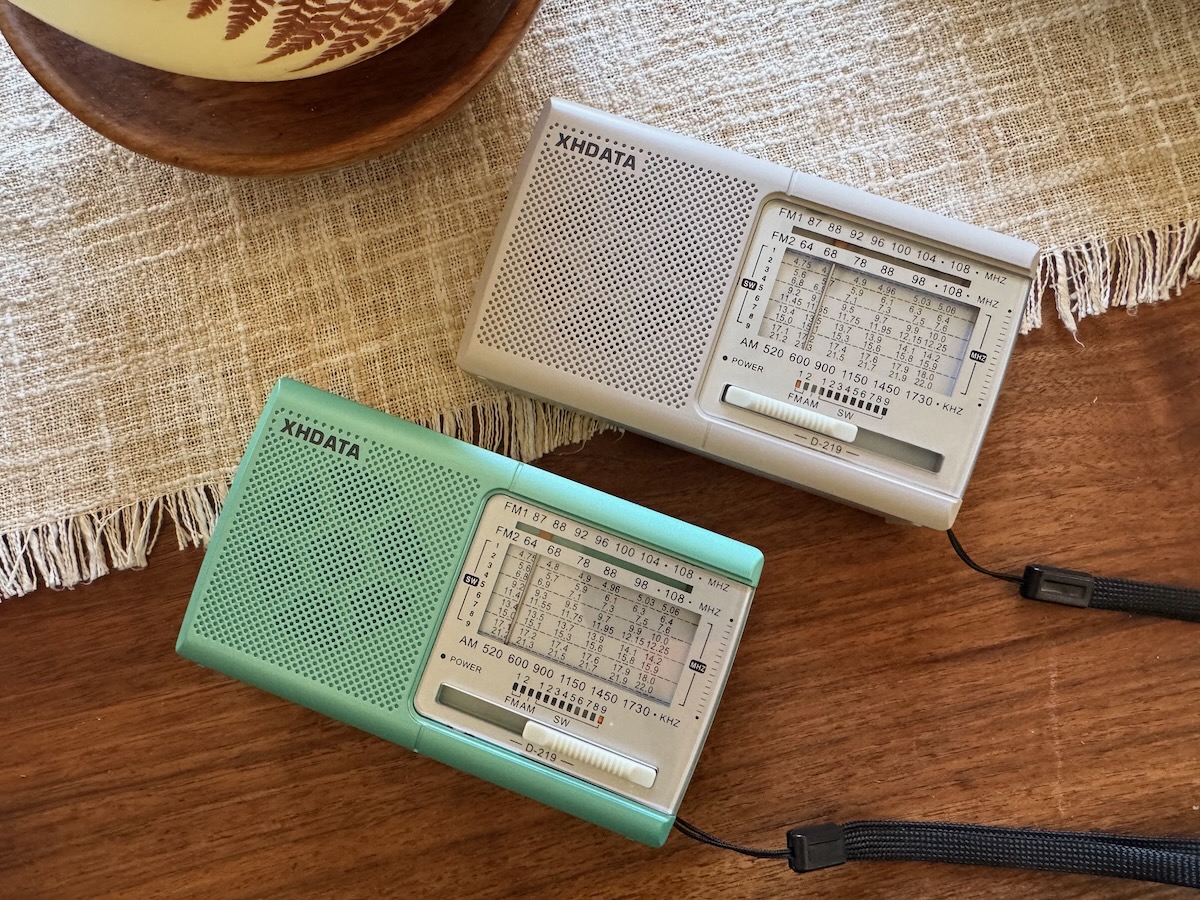
So when my contact at XHDATA reached out a few weeks ago asking if I wanted to try two new color variants of their ultra-affordable D-219, I surprised myself: instead of passing it along to one of our contributors, I decided I wanted the chance to revisit the world of simple, inexpensive portables firsthand.
Why? Because I’d been hearing surprisingly positive things about this little radio—and because it reminds me of the DX-397, a tiny analog portable I used for years after working at RadioShack right out of college.
 This review, then, is less about testing a product and more about rediscovering the joy of having a simple, super-basic radio at hand.
Disclosure: XHDATA is a generous long-time sponsor of the SWLing Post. They sent both of these D-219 radios free of charge. Honestly, I don’t know many companies that would send out a sub-$20 product as a review loaner–it probably costs them more in shipping.
As always, I’ll be gifting these units back out once I’m finished. And in this case, I’ll also be buying three more myself for Christmas gifts… one of those, I’ll keep.
Design & First Impressions
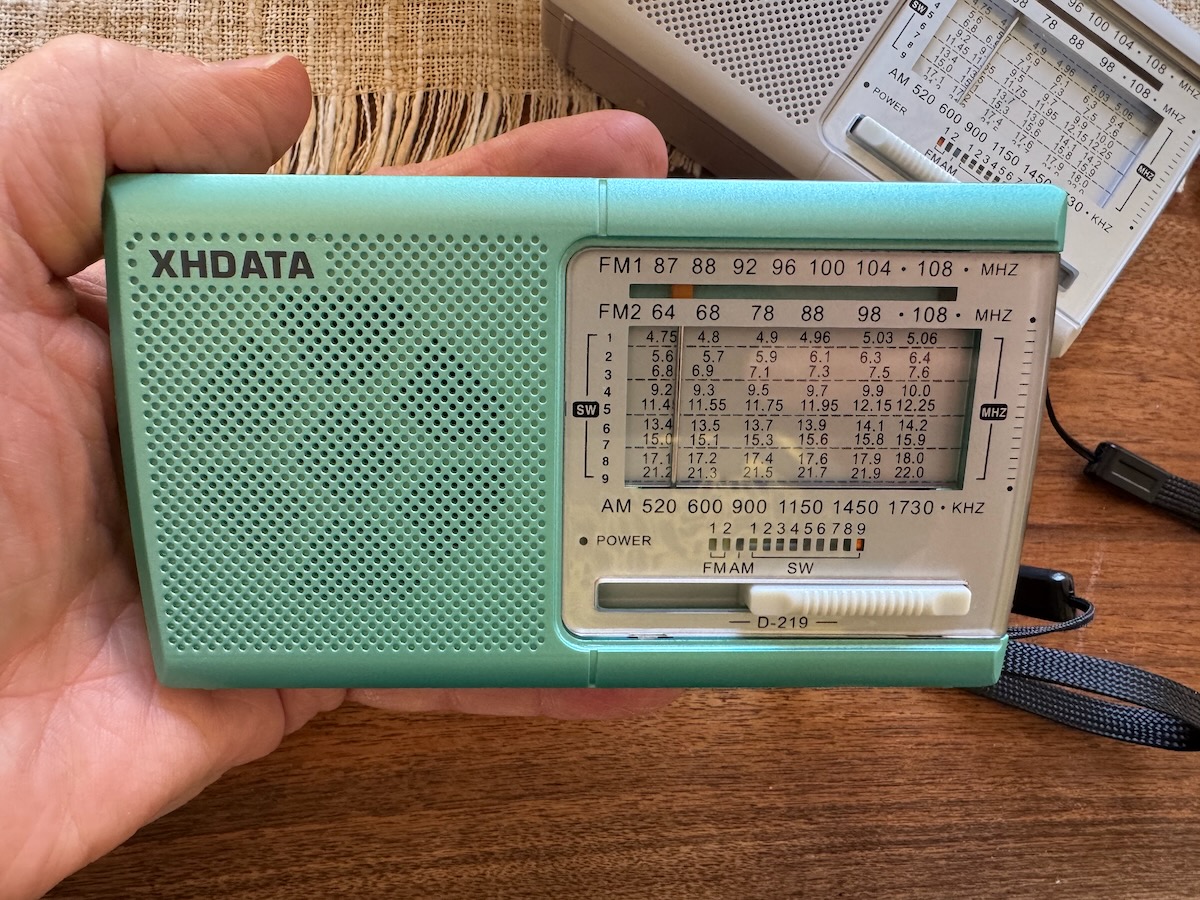 Let’s be clear: the D-219 is a simple radio. It looks like something straight out of the mid-1990s, with:
- an analog tuning dial
- band-switching sliders
- a dedicated on/off switch on top
- a small, lightweight plastic enclosure
But inside, it’s very much a modern radio. The D-219 is based on the Silicon Labs Si4825-A10 DSP chip, meaning that although tuning feels analog, you’re actually listening to a DSP-based receiver stepping through the band in predetermined increments.
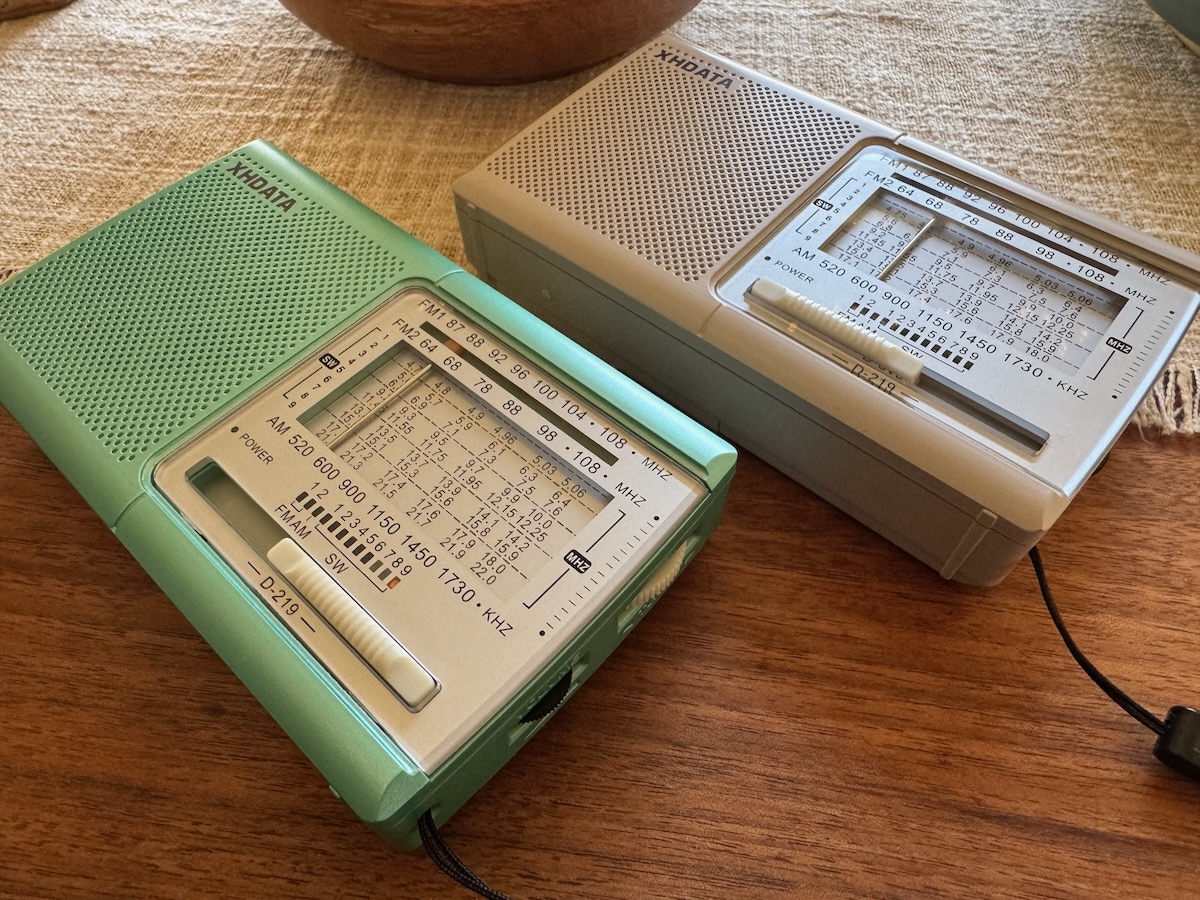
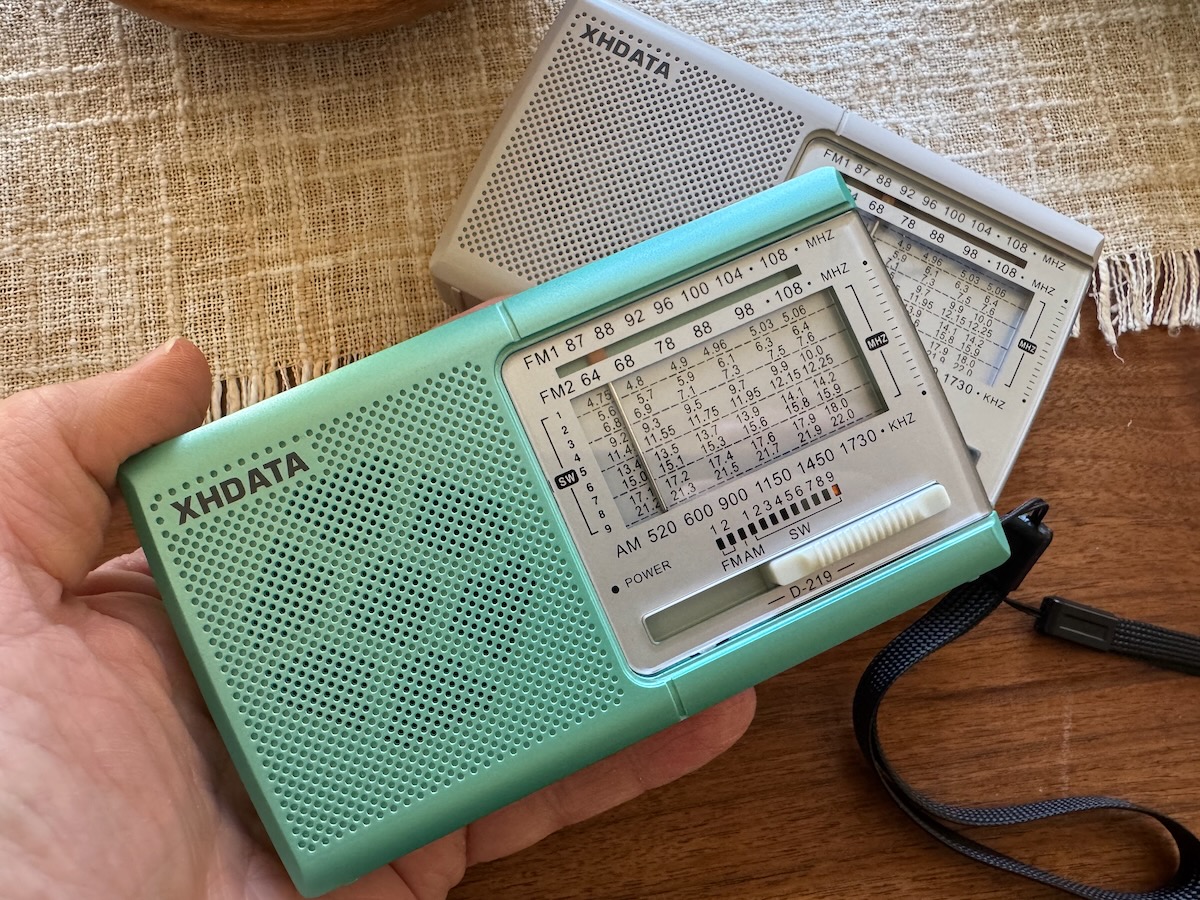
XHDATA sent me two new color options: off-white and light silver-green. Both look great in person.
Using the D-219 Outdoors
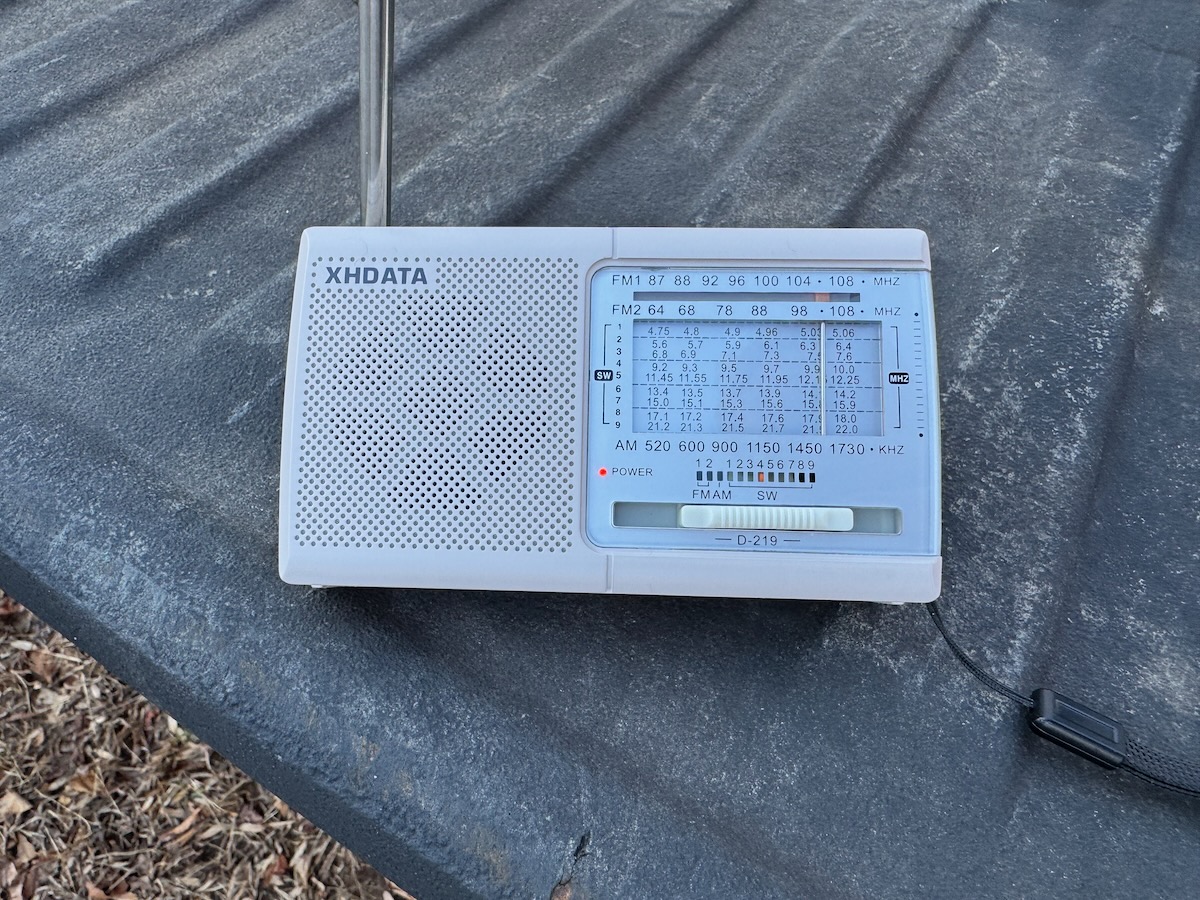
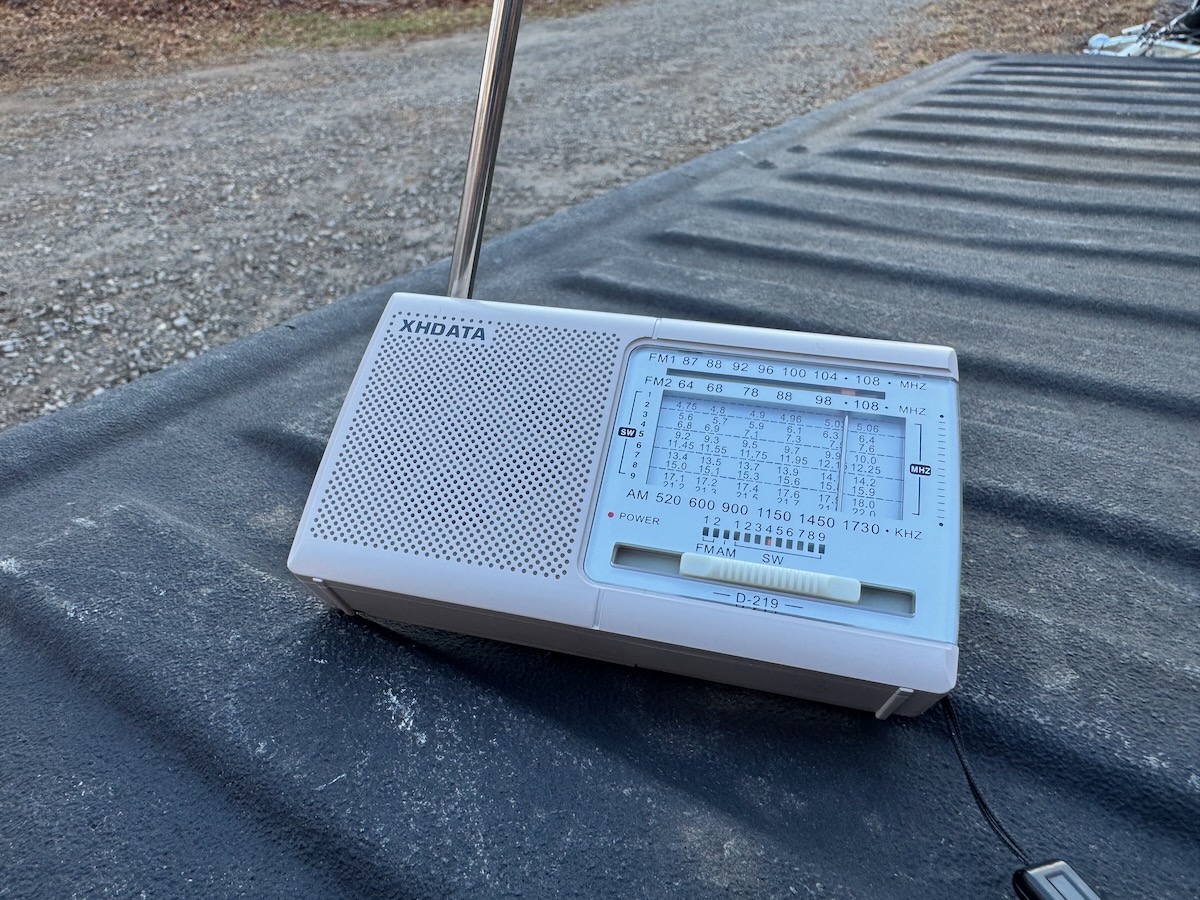
I used my truck tailgate to hold the D-219 while stacking firewood.
Over the past couple of weeks, I’ve been doing a lot of work outside—stacking firewood, yard projects, general winter prep. The D-219 became my little companion radio during all of it.
I mostly listened to:
- Mediumwave
- A bit of shortwave
- and FM radio
Audio Quality
The audio surprised me. It’s a tiny speaker, so don’t expect brilliant fidelity, but it’s perfectly listenable and cuts through outdoor noise when the volume is up.
Performance
 FM performance is excellent—far better than I expected. I have a handful of “benchmark” distant FM stations that many small portables struggle to hold onto. The D-219 locked onto them easily. DSP chips often shine in FM, and this was no exception.
Mediumwave was the biggest surprise. I have a regional AM station–WTZQ 1600 kHz–that I enjoy during the day, especially around the holidays. Only about half of my small portables receive it well enough to be pleasant.
The D-219 locked it in better than most of my other inexpensive portables.
That alone impressed me.
Shortwave performance is quite good for the price. Sure, it lacks an adjustable filter, and tuning steps mean you don’t get that smooth, fluid band-scanning experience like a proper analog receiver. But overall, it works pretty well.
On 31 meters, for example, tuning felt natural and not cramped–something many ultra-cheap shortwave radios struggle with. It helps that the selected shortwave bands have enough tuning bandspread that you don’t have to use micro adjustments during tuning (I’m looking at you, XHDATA D-220!).
Back in the Cold War era, when the bands were jammed shoulder-to-shoulder, a radio like this would have been harder to use. But today, with fewer simultaneous signals, it’s totally workable.
Real-World Utility
 In the aftermath of Hurricane Helene, I’ve become even more vocal about keeping at least one AM/FM/SW radio as part of your personal preparedness kit. The D-219 checks many boxes:
- Runs on AA batteries
- Very low power draw
- Lightweight and pocketable
- Small enough to disappear into a backpack or glove compartment
I’ve been using mine heavily for two weeks on a pair of Eneloop rechargeables and haven’t had to recharge yet.
 Two of the D-219s I’m buying will be stocking stuffers for my daughters, just so they always have a reliable source of news and info while at university–even if the power or internet goes down.
Why This Radio Works
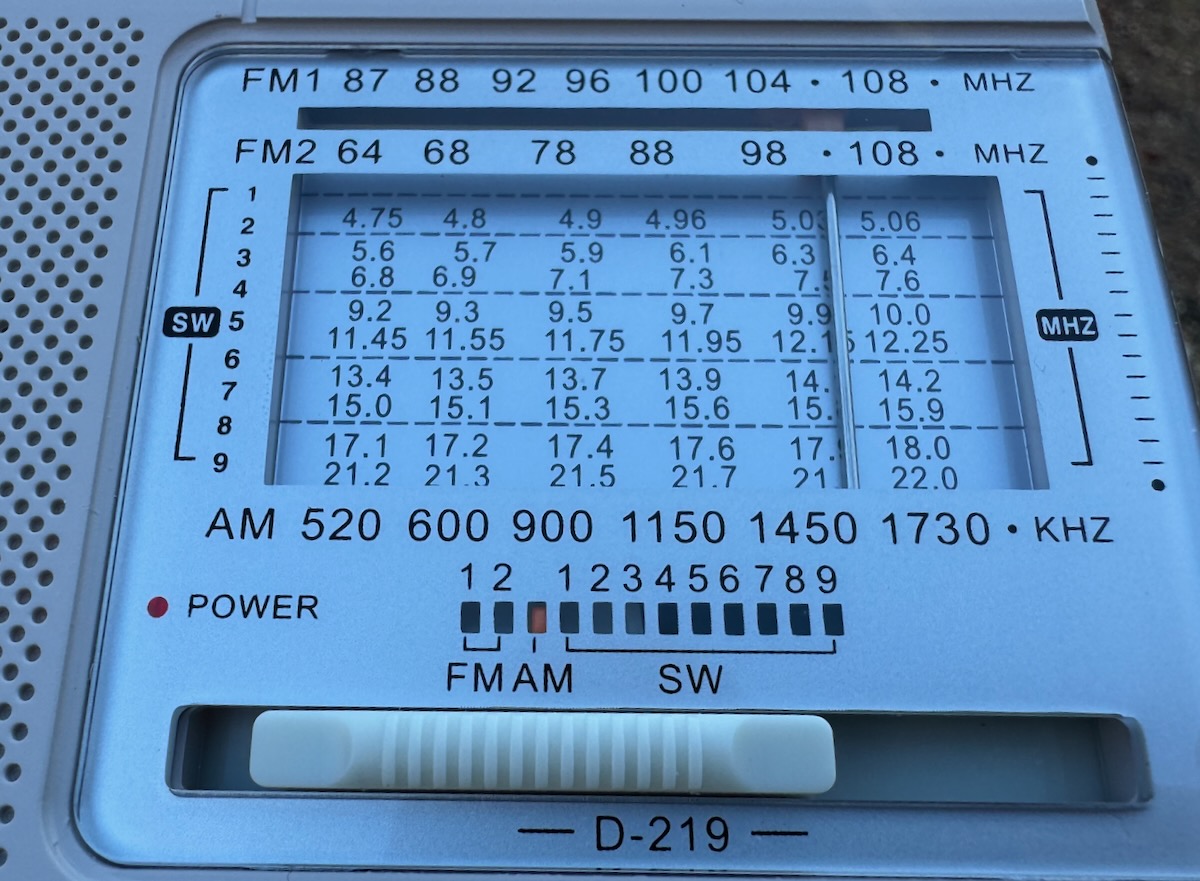
The band spread is generous compared to the D-220
I’m sure own more than three dozen portable radios here at SWLing Post HQ—from high-end benchmarks to tiny ultralights. Normally, I advocate for buying a good-quality receiver instead of “throwaway” electronics.
But I don’t think the D-219 is a “throwaway” radio; being based on the Silicon Labs DSP architecture, it doesn’t have an insane component density–inside, its board is almost roomy. Looking at it, I think I could make modest repairs myself as long as the chip still functions.
Sometimes simple designs translate into long life rather than an early landfill destiny. Of course, only time will tell, and I will post an update if my radio experiences any issues.
This is why I’m comfortable giving them to my daughters as everyday radios. And frankly, I’d much rather they lose or break a $13 D-219 than my old Panasonic RF-65B, PL-660, or ICF-SW7600GR–some of my most cherished (and irreplaceable) legacy portables.
The D-219 is also a perfect glove box radio. One to grab and listen to when you’re waiting on your spouse/partner to finish a yoga class, or waiting on your kids at schoool.
In Summary
 If you’re looking for a true benchmark portable, obviously, this isn’t it.
But if you want:
- a fun, capable, ultra-affordable little radio
- something to give as a holiday stocking stuffer
- a simple preparedness radio that uses AA batteries
- a pocketable MW/FM/SW companion
- a “leave-it-in-the-car” radio
…the XHDATA D-219 genuinely delivers for well under $20 each.
And as someone who hates e-waste and often avoids ultra-cheap electronics, I’m betting this radio will age better than most. Its internal design is refreshingly simple and built around the reliable Si4825-A10 DSP chip. There just isn’t much inside to fail.
For the price, performance, and sheer fun factor? The D-219 is a solid option.
Purchase options:
- Buy directly from XHDATA
- Purchase from Amazon.com (note: this affiliate link supports the SWLing Post)
Hello, I’m posting from Japan.?I recently got a 1khz model of this radio. Not to mention the sensitivity of FM, I was surprised at the high sensitivity of the medium wave band.
The short wave band is also easy to adjust the frequency, so I didn’t get confused. The short wave is also satisfactory performance as long as it doesn’t aim at extremely far broadcasting.
In the 1970s in Japan, there was a cheap analog shortwave radio called the Pansonic R299, which was welcomed by many listeners. The D-219 is the modern version of that.
Thank you for keeping up with my poor English. I hope you will enjoy this radio.
One problem I encounter with the D-219 is: if you are using the radio in a location near a powerful AM or FM transmitter, you will experience bleedover onto the shortwave bands.
Therefore, to avoid this problem, you should get best results on SW when you are listening far away enough from any local transmitters. Try listening in a different environment, away from noise sources–a park is a great place to get the best results possible.
Also, while the D-219 may give you good sensitivity on shortwave with just the whip antenna, you can hear more weak signals if you clip the wire antenna on the whip (be very careful when you connect the clip to the whip as it could snap!). I have not experienced overload problems with the wire connection on the ‘219.
It’s unfortunate that an antenna jack or dial light was not added to what is an impressive low-priced radio.
And another thing… Thomas, how cool would that D-219 be if it were worth donating to the Ears to Our World project?
Donating the ‘219 (likely the 1kHz or 9kHz version) with a 12 or 24 pack of AA batteries, to an African organization or charity (schools, churches etc.) would introduce young people, students etc to the world of shortwave radio. 24 AA batteries would provide a year of listening with this receiver.
It’s a small ultralight that can offer young people a way to learn about other countries in English and various languages spoken in Africa… and to stay informed through news and religious programs from many stations that reach out to areas of need.
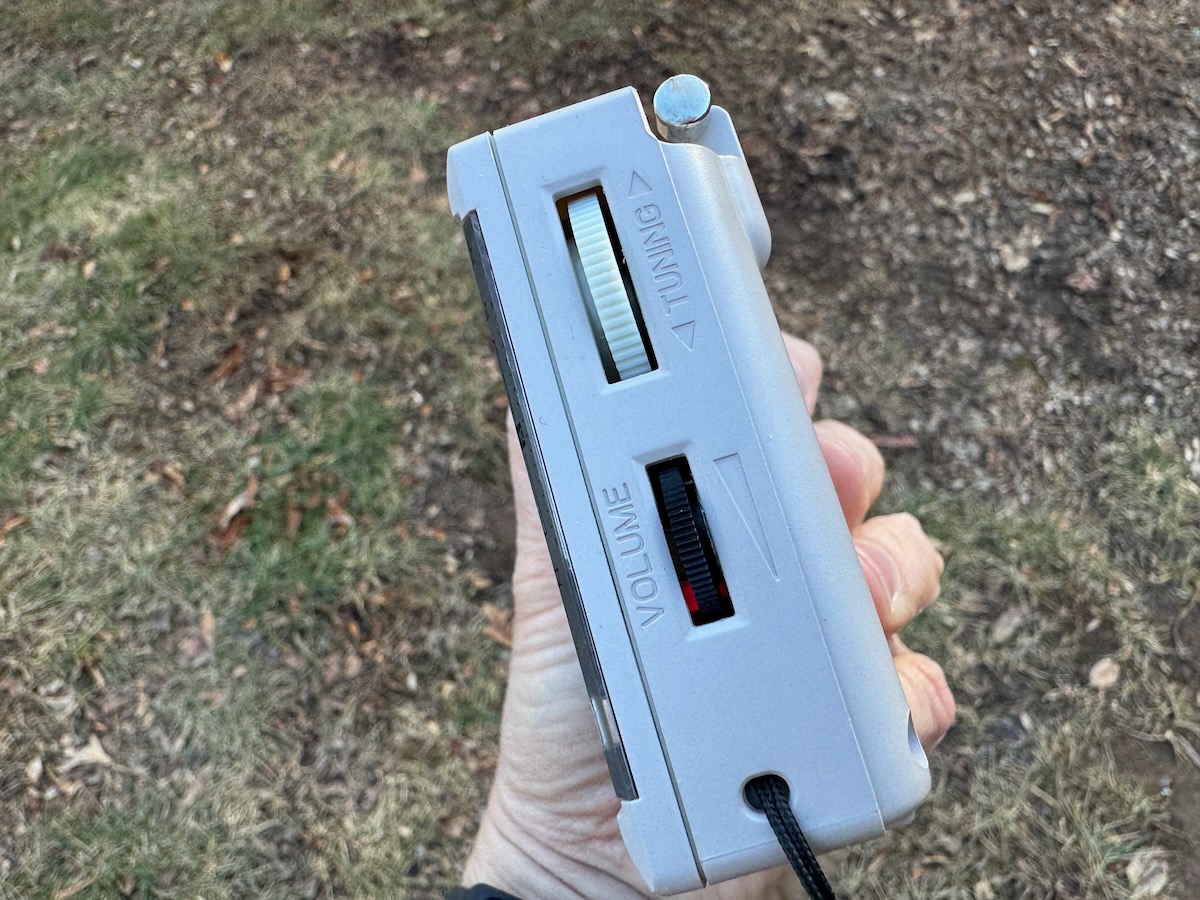
Great review! I have 4 of them 2 of the 10kHz and 2 of the 1kHz. Love them. I actually prefer the 10kHz for MW better. Seems to capture dx better, at least for me. It has become my favorite radio. I listen every night for about 10 or 15 minutes from a second floor bedroom with no RFI sources. At that time I probably pick up 40 stations across the MW band, most pretty audible, of course some fade in and out but that is normal dx. However on the low end of the band it does pick up “Brother Scare” from somewhere on the shortwave band and effectively blocks 540-610. It is quite sensitive, I have heard a station in Iowa, usually WSM booms in, Atlanta, St. Louis, many more from my home here in Pittsburgh. Selectivity is not the best . A trick I have found for tuning is to use my fingernail in one of the grooves of the tuning wheel–it allows for a little more precision. For me, at least, there is a kind of joy with using a simple radio like this that still performs pretty decently.
Nice review, I’m missing under the hood picture
Check the review by Radio Jay Allen.
Check out the review by Michael Marcus: https://www.amazon.ca/dp/B0BPKJ1XP1
Scroll down.
I’ve purchased about 8 of these, some stocking stuffers but also for around the house. They fit nicely in a portable USB hard drive case, as do several other. XHDATA models.
Living near Sacramento I would expect to get harmonics from local stations but NOPE. Even more expensive radios can’t filter that out, the D219 can. Yes I have pretty much every XHDATA model in my collection as well as Grundig, Tecsun, Panasonic, Honeywell, Radio Shack. Qodosen. National Electronics and Hallicrafters but the D219 really is impressive. My first few are still going strong at 3+ years.
“… although tuning feels analog, you’re actually listening to a DSP-based receiver stepping through the band in predetermined increments” -well then it’s fake analog!
Whoever thought that tuning confined to discrete increments was progress? The spectrum universe is infinite and infinitely divisible. Radio tuning ought to match that continuum as much as is humanly possible.
So I’ll stick with the old Heathkit that my grandpa built!
Yes, if you want the analog experience, the only way to do that now is via a more vintage radio. To my knowledge, all modern portables currently in production are DSP-based.
I have had a few of these radios. The most annoying feature has always been the tuning that uses a variable resistor for tuning, just as they do for volume. The tuning voltage is digitized and the binary value used to switch the synthesizer in 5 kHz steps. This means that you must hit exactly the right digital value or you are at least 5 kHz off and hear nearly nothing. This radio seems to be better – doing 2.5 kHz steps on shortwave?
Be aware that these radios have nothing that could qualify for preselection, they leave everything to the SDR: The telescopic antenna goes through a static discharge circuit and perhaps a simple 110 MHz low pass filter, then directly to the input pin of the RX chip. They are good for an emergency.
If you are an active shortwave ham, do yourself the favor to not give one of these radios to a neighbor. He will definitely hear you whenever you key your transmitter.
The United Nations World Radio Conference decided to channelise all High Frequency voice transmissions worldwide to frequency increments of 5 kHz. All transmitters must be accurately on their channel frequency. The best way to do this is to use a GPS receiver and divide its 1 MHz output down to 5 kHz as reference. Another oscillator operates at the ‘carrier’ frequency and is divided down to 5 kHz. The two 5 kHz frequencies are compared and the receiver oscillator is controlled so there is no frequency difference. The divide ratio determines the tuning frequency.
This also applies to the FM band but the phase locked loop operates at 200 kHz worldwide.
In 1975 WRC decided for the whole world except N & S America to reduce channel spacing to 9 kHz to increase the number of channels in the Low & Medium frequency bands. The Americas kept the spacing at 10 kHz at a time when most radios were and are voice quality only. To increase the number of channels you had to buy a new radio capable of tuning up to 1710 kHz.
Another difference is the Americas still use 75 µs pre emphasis where as the rest of the world uses 50 µs.
this means a non-American FM receiver will sound too tinny particularly in soft sounds. The opposite is also true.
It would be interesting to see how many DSP car radios have a tuned RF amplifier, rather than just relying on a large dynamic range analog to digital converter
For up to 108 MHz a simple crystal oscillator is good enough for any broadcasting system. Even SSB can easily be done with a calibrated crystal oscillator. A GPS time base is important for example using the geostationary ham radio satellite QO-100: uplink on 2,400 MHz, downlink at 10,000 MHz.
the 75 µs emphasis for FM in the US was defined when hardly any audio signal provided any signals above 10 kHz or so. Much energy at higher frequencies widens the signal bandwidth considerably, resulting in audio distortions. This was recognized in Europe when they defined the parameters for FM broadcasting. The 75/50 µs emphasis allows for attenuating the higher frequencies which reduces noise.
Alexander,
I did say the best way is to use GPS because it is of caesium beam accuracy. That is also used to produce UTC time worldwide along with being the SI world standard second.
This accuracy is required if digital transmitters are used in a single frequency network. ?It applies to DAB+, DRM and HDRadio® and allows repeaters for blackspots on the main transmitter’s frequency. The master and all repeaters have a common reference frequency, so listeners are unaware of the repeater’s presence. The program also has to be identical as well. It also means that every DSP receiver including analog also has to contain either a crystal or GPS phase locked loop to prevent miss-tuning. All smart phones and navigation systems contain GPS receivers, so they are complex but inexpensive
Thomas,
I bought one of these a while back, and it is, indeed, a neat little radio.
A suggestion for the season: pair this radio with an atlas like this — https://www.amazon.com/dp/1426217870. Then add a notebook and give the combo to a son, daughter, niece, nephew or grandchild. Add a note something like this: “With this radio, you can hear stations around the world. Listen to them, figure out where they are, find them in the atlas, and log them in the notebook. If you do that, you will have fun and learn some cool stuff.”
Cheers, Jock
Good review of a practical radio – as practical as a good hammer at a building site. Two of your bullet points from different lists are the key ones:
– Mediumwave
– Runs on AA batteries
At this near give-away price, I think I’ll pick up a couple (from your Amazon link of course) to try out and have on hand as hurricane season loaners.
The first D-219 that I bought was a 9K model that didn’t work well here in the USA.
I gave it to a kid, thinking it was defective. I bought the 10K model months later, which worked properly. Then I saw the color models and got the white one. I love it. I gave the gray one to my brother. I’m trying to get him back to AM Dxing, so I’ll be sending him a Tecsun AN-200 loop antenna for Christmas. Great review!
Great review, thank you Thomas. Why is it that we cannot buy this radio direct from XHDATA for shipping to the US? I have a coupon to use on their site.
I’m not sure. Perhaps it has to do with shipping individual items directly from China? I know some of that has changed this year.
Excellent review Thomas. It’s nice to see a review from seasoned veteran. Even if you’re not a SWL, the radio would be a great daily listener for those who enjoy AM and/or FM BC band reception. I might just get one and keep it in my toolbox when fixing things inside and outside the house. My favorite AM station is WOR-AM from NYC and I listen in daily.
Merry Christmas, Happy New Year and 73’s.