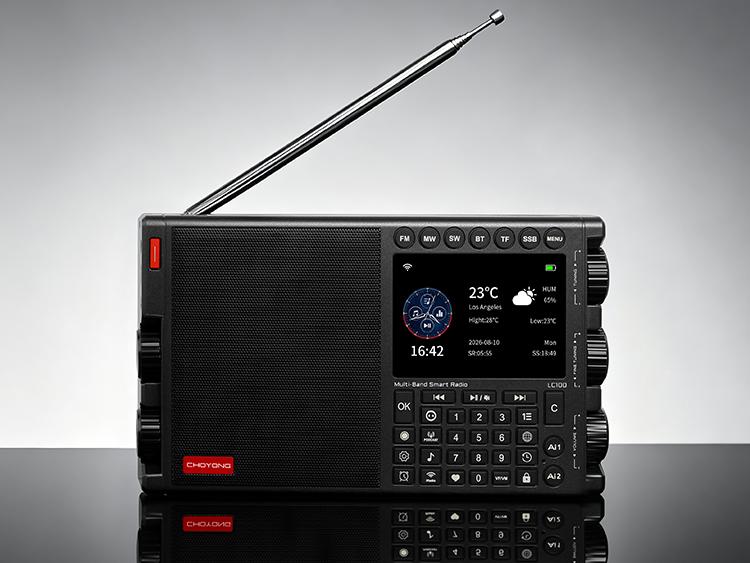
The LC100’s screen with the radio in standby mode.
by John Figliozzi
Until the Choyong LC90 was introduced in 2023, there were no radios on the market that simultaneously offered both shortwave and Internet streaming in one unit. Even three years later, Choyong remains the only “smart radio” manufacturer in the world. Now it has introduced an upgraded model – the LC100.
Bottom Line
This LC100 is attractively designed with a wide variety of features and tools. Like the LC90, it is solidly constructed and has a substantial feel in one’s hands.
The LC100 emits superior, even game-changing, audio — especially for a mid-size portable in a plastic enclosure. Its triple speaker design and the company’s refusal to attach a tilt support bale to the back of the radio lest audio response be even minimally compromised speaks to the effort that has gone into producing the radio’s stellar audio quality.
Wi-Fi Internet streaming and FM radio performance are flawless with quick Internet connections and stream buffering along with instantaneous access to FM stations selected.
The LC100 represents a substantial evolution of the LC90. But while much effort has been expended in achieving better SNR in the AM spectrum, it remains a difficult challenge, the enormity of which likely explains why no other radio manufacturer has yet to take on this task.
Nonetheless, inclusion of longwave (LW), medium wave (MW), shortwave (SW) and single side band (SSB) with Wi-Fi Internet streaming and FM radio in one construct – as well as some innovative features never offered before in any radio – remains a fascinating project. The LC100 will be especially attractive to consumers who value radio’s content and appreciate hearing all of it in a portable capable of excellent quality high-fidelity sound.
Review Methodology
Choyong provided me with an LC100 from regular stock. I tested the radio’s performance in all respects for about three weeks.
This LC100 was compared to the previous LC90, the Sangean ATS-909X2 currently on the market (the performance with which Choyong claims its LC100 favorably compares, especially on shortwave), two similarly sized legacy discontinued but acknowledged high-quality portable multiband radios — the Panasonic RF-B65 and Grundig YB-400 — and a more contemporary but recently discontinued Eton Executive Satellit.
I also monitored the many interesting and informative reviews of the LC100 posted on YouTube by various purchasers and analysts.
My observations and results of these tests and comparisons follow based entirely on this one sample with the presumption that its performance represents that of all LC100 units sold to consumers by Choyong.
Corporate Background
Established in 2009, Shenzhen Chaoyuan Technology Co., Ltd. is a small to medium sized enterprise of less than 500 workers operating out of a modest factory in Guangdong, China. It originally designed circuit boards, software, and audio hardware for major global headphone and speaker brands, but now specializes in advanced hybrid internet radios, multi-band receivers, and other network-connected communication devices.
It launched Choyong Radio, a consumer electronics and audio engineering brand, in late 2023 to focus, as described by Google Assistant, “on bridging traditional analog broadcast bands (FM, AM/MW, SW, SSB) with modern cellular and internet connectivity, incorporating Wi-Fi, 4G SIM/eSIM support, Bluetooth, and AI-assisted search functions (like ChatGPT-integrated voice commands) into portable radio receivers.”
The Radio
The LC100 is a paperback book-sized portable radio powered by two replaceable rechargeable 2500mAh Type 18650 lithium-ion batteries working in tandem for a total of 5000mAh. A Type-C charging cable attached to a 5V-2A (5-volt, 2 ampere) block and plugged into a normal wall outlet restores the batteries after up to about 50 hours of use, depending on volume, screen use, and reception mode. Full recharge takes about 2-3 hours depending on level of depletion.
The radio is shipped in an attractive black solid protective box with gold colored trim containing the radio, charging cord, small paper “user manual,” and a detachable carry loop. It’s available in two color case options – dark grey and silver. The unit I received is dark grey.
According to Choyong, “The goal of the LC100 is simple: to combine the spirit of traditional radio with the capabilities of a modern internet audio device.” It carries hybrid analog and digital features that are intended to add and improve on those provided in the LC90.
Able to receive and play Internet streamed, FM, LW, MW and SW radio, the LC100 also has AM SSB capability, access to podcasts and the ability to record, store and playback content on SIM and TF cards as well as play content from other sources through the LC100’s speaker via Bluetooth.
It provides multiple means of finding and storing any of over 50,000 radio stations and thousands of podcasts streaming on the Internet, including by voice requests using ChatGPT which responds promptly and accurately. Choyong also has a web page where owners can create an account and use or organize many of the radio’s features.
Finally, a firmware update (version 1.1) released on September 15 added an adjustable squelch to reduce noise when tuning and access to a company-maintained archive that can playback numerous stored historical broadcasts and recordings stretching back a century.
Choyong makes these claims for the LC100:
- A large 3.5-inch high-resolution color display. (2.4 inch on LC90.)
- Improved FM/LW/MW/SW reception over the LC90.
- “Advanced SSB features for radio enthusiasts”, including a manual SSB frequency calibration function.
- An upgrade to Wi-Fi 6 producing “a faster and more stable Internet radio experience”
- A redesigned sound system with bass and treble adjustment that “compared with the LC90, provides approximately 10Hz deeper low-frequency extension, delivering a fuller and richer sound.”
- More powerful Internet radio & AI features
- AI searches stations, podcasts and music via a ChatGPT voice interface with the user.
- A redesigned standby screen display that shows the time in analog and digital form, the local current outside temperature, humidity and weather with the day’s predicted high/low temperatures, sunrise/sunset times, date, day of week, battery and Wi-Fi strength levels.
I made these further notations:
- Internet access via Wi-Fi connection.
- eSIM capability providing cellular Wi-Fi service as an adjunct to home Wi-Fi service.
- AM (LW, MW, SW, SSB) and FM reception.
- SIM card and TF card slots to permit recording, storage, and playback of preferred content.
- Bluetooth reception and playback capability.
- SIM card and TF card content (music and speech) capability.
- Separate treble and bass controls.
- ChatGPT incorporated to permit voice selection of streaming content and general Internet-sourced information.
- Adjustable backlight time and brightness settings.
- Podcast preferred language setting.
- An “Auto Play” option that returns to the last Internet station selected when the radio is powered on.
- FM tuning step selection (50, 100, 200 kHz).
- LW/MW tuning step selection (9/10 kHz).
- FM ATS (automatic tuning system) sensitivity setting (very high, high, balanced, low, very low).
- MW/SW ATS sensitivity setting (same as above).
- AM Squelch setting (1-10).
- USB offset recalibration.
- LSB offset recalibration.
- Temperature unit display selection (Celsius or Fahrenheit).
- Firmware version information (with upgrades over Wi-Fi when made available).
- On the display screen and using the multifunction tuning knob, the user can select from:
- 7 bandwidths on MW/SW (6, 4, 3, 2.5, 2, 1.8, 1 kHz.)
- 6 bandwidths on SSB (0.5, 1, 1.2, 2.2, 3, 4 kHz.)
- 6 bandwidths on FM listed as (56, 107, 158, 209, 260, 311 KHz.) or Auto (radio select)
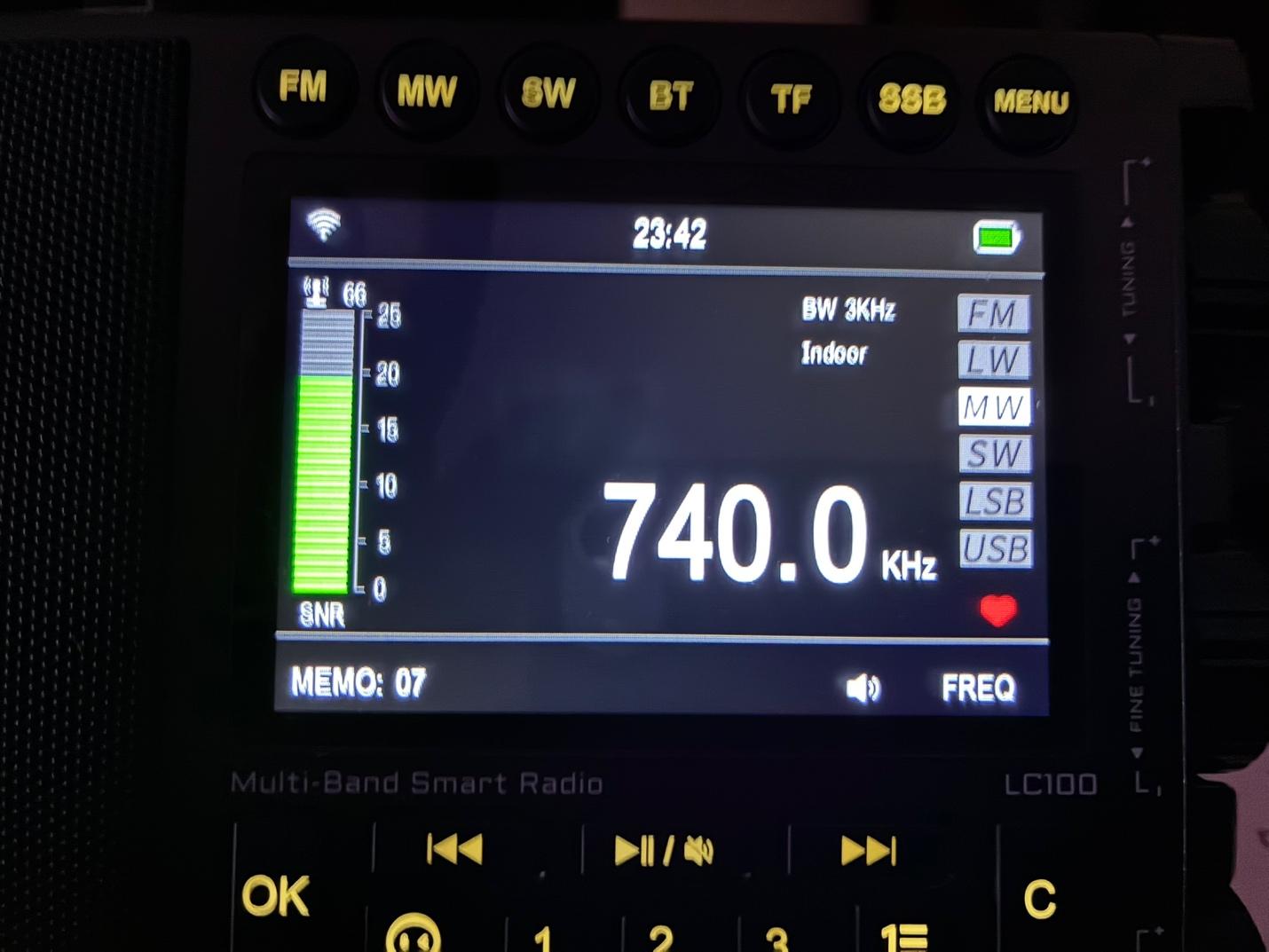
This is the display screen as it looks when listening to MW. The graph on the left uses a fluctuating green bar to show the station signal’s relative SNR. The number at the top of the graph also fluctuates showing signal strength. Elsewhere, the screen indicates Wi-Fi signal strength, local time in 24 hr. format, battery level, bandwidth, the (indoor ferrite) antenna in use, MW mode, whether & in what place the station is in memory and the frequency tuned. In this case, it was to CFZM 740 Toronto, 300 air miles west of my location, and using a Select-a-Tenna to maximize reception. The LC100’s display has a similar appearance when the radio is in LW, SW, SSB or FM mode.
Assessment
This is a sophisticated, multifaceted instrument that challenges the traditional definitions and parameters of radio. It possesses vast capabilities not resident in any other such unit – LW, MW, FM, SW, Internet, music, recording, playback, history, Internet-based information seeking, ChatGPT.
From this reviewer’s experience, the LC100 offers all the significant performance improvements over the LC90 the company claims, in addition to new and innovative features not offered in the LC90 or any other radio. Continue reading →

 Many thanks to SWLing Post contributor Gérard Koopal who notes that the Eifeler Radiotage will return to the airwaves October 16–18, 2026, with three days of special programming from the Eifel region of Germany.