
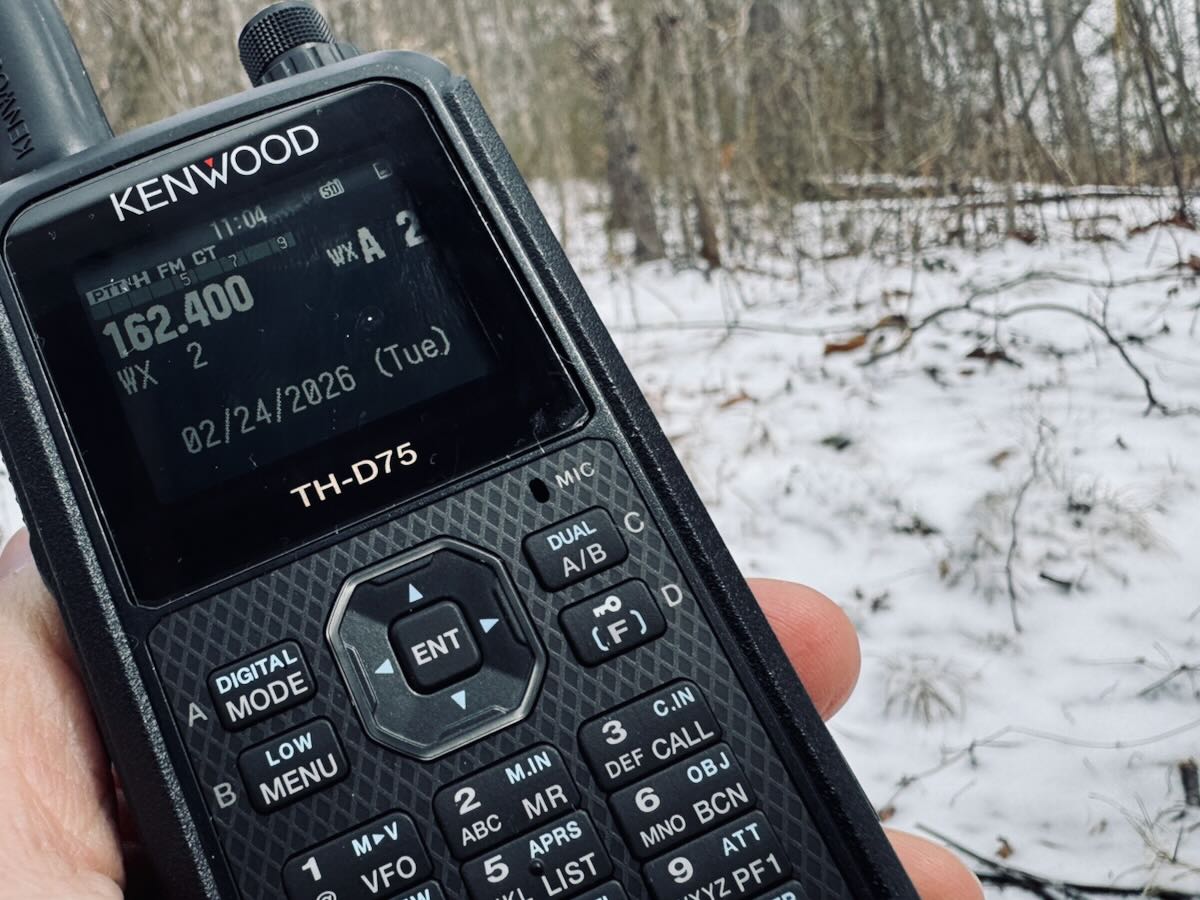
 Many thanks to SWLing Post contributor, Paul Evans, who first tipped me that Environment Canada is ending Weatheradio and the Hello Weather service effective March 16, 2026.
Environment and Climate Change Canada (ECCC) has posted the following notice:
Change to services:
Starting March 16, 2026, Weatheradio and Hello Weather services will be permanently disconnected.
You can get radio marine forecasts via the Canadian Coast Guard. For your local weather forecasts and alerts, visit the interactive weather map or download the WeatherCAN app.
If you use Weatheradio in Canada (especially for “always-on” alerting via a dedicated receiver), you’ll want to take note of what’s changing, what isn’t, and what alternatives ECCC is directing users to.
ECCC notes–on the same page as their announcement above–that over 90% of Canadians currently live within range of a Weatheradio transmitter, and that typical broadcast range is about 60 km (terrain, receiver quality, and antenna height can affect this). This network uses the familiar VHF weather frequencies in the 162 MHz range (including 162.400–162.550 MHz, depending on the transmitter)–the same frequencies used by NOAA in the US.
The Toronto Sun also picked up this news and notes that the service has been around for decades (launched in 1976, with a later upgrade in 2004 to include SAME-style alerting), and frames this as a significant change for Canadians who rely on weather radio for emergency alerting. Click here to read: https://torontosun.com/news/national/environment-canada-ending-weatherradio-forecast-service
Thomas’ Thoughts
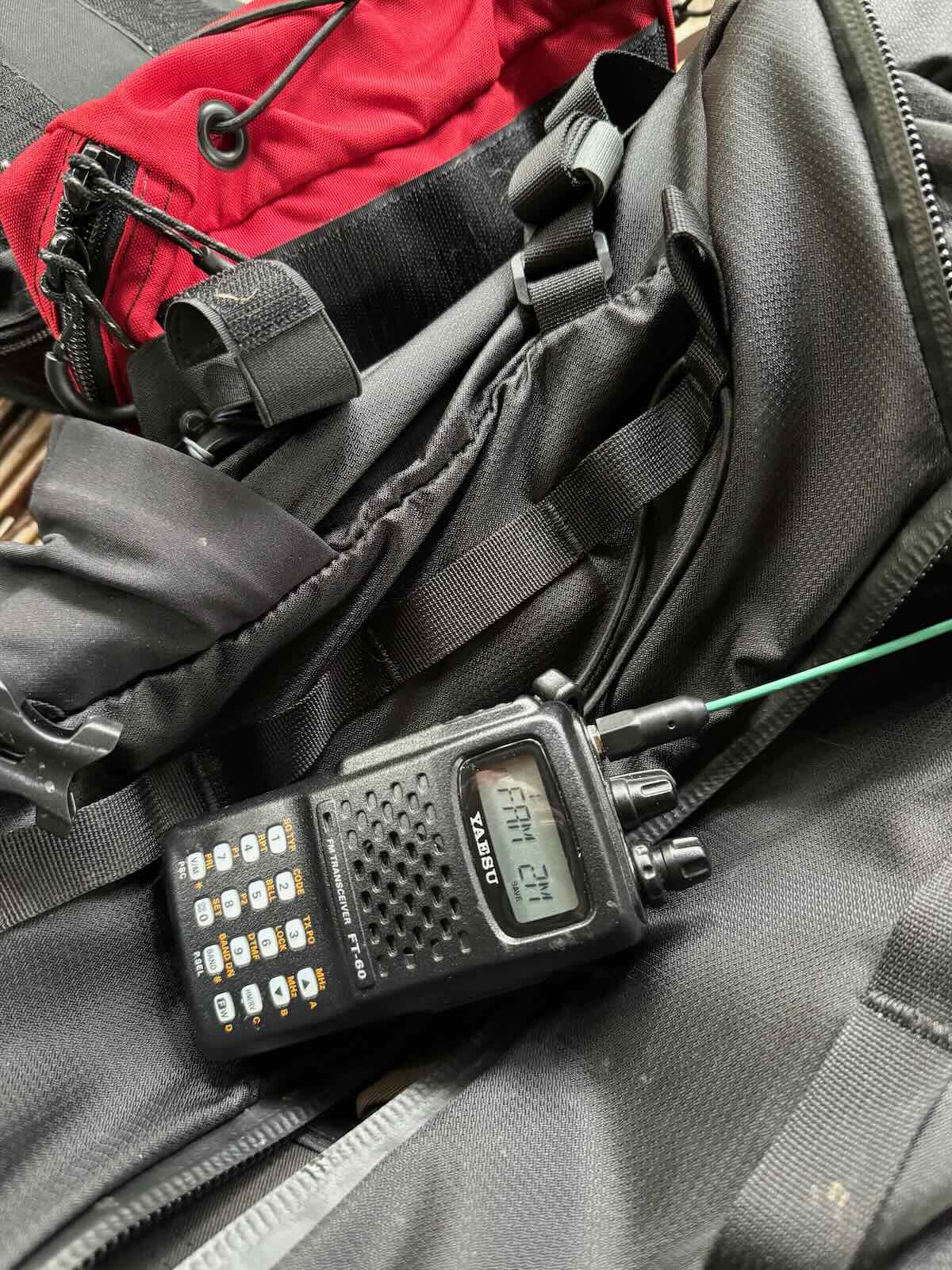
As we worked helping neighbors in our remote community in the aftermath of Hurricane Helene, we programmed NOAA Weather Radio on our handheld radios for reference.
I think this is a terrible idea—and I say that recognizing there are real costs involved in maintaining a nationwide radio network.
Relying only on online services for weather and alerting across a country as vast (and as frequently remote) as Canada feels short-sighted.
When a natural disaster hits (and it will) that’s exactly when internet access, cellular service, and even power can fail–and the “cost-benefit analysis” stops being theoretical.
Many of you know, I was personally in the path of Hurricane Helene in North Carolina, and my community was without power and without reliable mobile data for three weeks. During that time, we relied heavily on NOAA Weather Radio to keep receiving forecasts and updates. That experience really drove home something many of us in the radio community already understand: sometimes you invest in systems not because they’re used every day, but because they can be life-saving when everything else breaks.
In my opinion, removing a resilient, one-to-many broadcast alerting resource like Weatheradio is poor management of taxpayer funds–not because it’s cheap, but because the value shows up when you need it most.
Canadians: Take Action Now
Here are two official channels I could find to ask for the Weatheradio shutdown decision to be reversed:
1) Contact your Member of Parliament (MP)
- Find your MP (by name or riding) and get their email/phone info here:
Find Members of Parliament - MP directory search (another entry point):
Current Members of Parliament – search - Mailing an MP is postage-free: you can address mail to
[Name of Member of Parliament]
House of Commons
Ottawa, Ontario
Canada K1A 0A610 - The House of Commons also maintains addresses/phone numbers for current MPs:
Addresses for current MPs
2) Contact the Minister responsible
The Weatheradio decision falls under Environment and Climate Change Canada (ECCC). Readers can also write directly to the Minister of Environment, Climate Change and Nature: The Honourable Julie Aviva Dabrusin.
Please comment if you have other suggestions about how to take action.
“You can get radio marine forecasts via the Canadian Coast Guard. For your local weather forecasts and alerts, visit the interactive weather map or download the WeatherCAN app.”
While it will be possible for mariners to get forecasts by radio, that doesn’t help the general public. On the Coast Guard page, it states:
“All forecast and warning information will be found at the Government of Canada web page. Mariners should note, however, that the internet is not part of the Maritime Safety Information system and should never be relied upon as the only means to obtain the latest marine forecasts and warning information. Access to the internet may be interrupted or updated information delayed without prior notice.”
At least the Coast Guard knows not to rely on the internet. Too bad Environment Canada doesn’t.
Here are the details of the Coast Guard’s transmissions:
https://www.canada.ca/en/canadian-coast-guard/corporate/publications/radio-aids-marine-navigation/facilities-information.html
Digital Radio Mondiale has an announcement module for >7 x >7 km. In addition there is a Jounaline which consist of multilingual messages including pictures. Were as HD Radio wants to complain that it only has a symbol to advertise the broadcaster. The internet is used for the EWF & Journaline. bur DRM can do this without the internet.
Thomas, when I read news like this, I sometimes think that the authorities aren’t taking climate change seriously. I would call this measure by the Canadian government, at the very least, irresponsible. Both you and I, who have already experienced the devastating effects of climate change firsthand, know that radio is what you can rely on when there’s no internet or cell phone signal. One of the first things affected by storms is electricity. There was almost a week without power due to heavy rains here in Porto Alegre in 2024, and in other rural areas also affected by rain and floods, the power outages lasted even longer. Without electricity there’s no internet or telephone, and only radio can reach the people hit by the cataclysms. This seems obvious to me, but apparently, it’s not obvious enough for the Canadian government. Okay, time is king, as the old saying goes. Climate change is getting worse, day after day, month after month, year after year, and then we’ll see who’s right and who’s wrong.
That bears repeating:
“Many of you know, I was personally in the path of Hurricane Helene in North Carolina, and my community was without power and without reliable mobile data for three weeks. During that time, we relied heavily on NOAA Weather Radio to keep receiving forecasts and updates. That experience really drove home something many of us in the radio community already understand: sometimes you invest in systems not because they’re used every day, but because they can be life-saving when everything else breaks.”
In my opinion, removing a resilient, one-to-many broadcast alerting resource like Weatheradio is poor management of taxpayer funds–not because it’s cheap, but because the value shows up when you need it most.”
If you live in Canada, flood the zone with mail, email, calls, texts, telegrams, carrier pigeons; heck show up in your representatives office with a large protest sign and politely explain how wrong-headed this is.
Exactly Jock!This is literally a fight for one’s life.
I guess those Canadians aren’t so smart. VHF Radio with a generator back up is far more reliable than any cell network.
Many parts of Canada have no cellular coverage and thus people are not able to receive weather alerts via phone apps. We depend on weather radio as a dependable first line to receive notification of severe and dangerous weather. I live in an urban area where power outages due to severe weather are common. During many of these outages both terrestrial wifi and cellular are down. We depend on weather radio for lifesaving alerts. It is very shortsighted of the Government of Canada to discontinue this safety of life service. 73 de Greg VA7BC
What are they going to do with the money saved let’s hear a plan. How about fixing the Amazon echo forecasts. It’s takes to say a weather warning. is issued and then not tell you what it’s contents are
Thomas, What will be the effect of WBT going to FM only be?
Rich WD3C
I guess Canada gets fewer ‘minimum notification’ events (tornados, severe thunderstorms, etc) than the USA, but in the event of rarer but significant events like earthquakes, volcanic eruptions, tidal waves and the like, weather alerts available via battery or even crank-charging portable radios could be a life saver.
Unbelievably short-sighted, and dare I say, plain stupid. Of all places in North America, they would have been the last place I would have expected this. As you note, so much of Canada is remote enough that cell service, and especially internet service, is likely sporadic or fragile at best. I wonder which hare-brained politician or committee came up with this? I hope the people of Canada have the sense to demand this be stopped, but I won’t hold my breath.
If they are anything like many of my short-sighted fellow countrymen who experienced their “Internet Beds” being disrupted and inoperable when a couple of major Internet/Cell services went down recently, then they have already swallowed the blue pill believing the Internet and cell service is invincible.
Yes, this riles me even though it is not my country!
Amen, Brother, Amen!
Cheers, Jock