
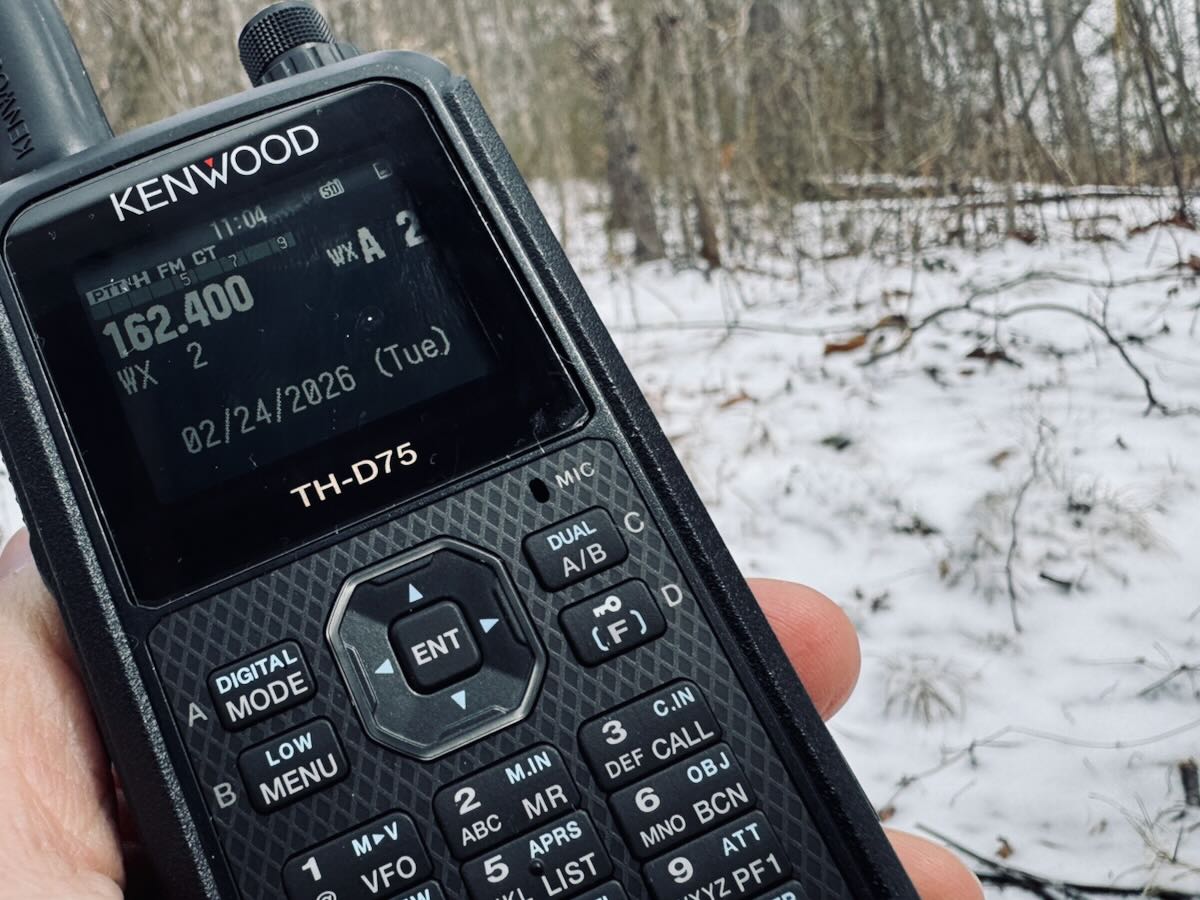
 Many thanks to SWLing Post contributor Richard Cuff, who writes:
Yesterday may have been the final day for WeatherRadio in Canada, as the shutdown is scheduled for today.
Meanwhile, in the USA, there’s a bill in Congress to fund modernization
of our VHF weather network…
House Committee Passes NOAA Weather Radio Modernization Proposal (Radio World)
The U.S. House Committee on Science, Space and Technology passed the NOAA Weather Radio Modernization Act at a committee meeting on Wednesday.
As we reported, the legislation directs NOAA to “modernize and expand” the VHF weather radio network that serves the U.S., with $100 million for FY 2026 authorized.
It was introduced by committee Chairman Brian Babin (R-Texas) and has bipartisan support. Cosponsors include Reps. Mike Flood (R-Neb.), Eric Sorensen (D-Ill.), Stephanie Bice (R-Okla.) and Gabe Amo (D-R.I.). [Continue reading…]
Thank you for sharing this, Rich! It’s nice to see a bi-partisan committee pushing this forward!
Hopefully modernizing will bring back real human announcers hihi. Just kidding. I have a few NOAA radios like the Realistic WeatherCube and Realistic Mini Weatheradio. They’re not the best performers compared to ones available today but still are fun to listen to.
Back in the 60’s when in it’s larval stage I recall listening to KWO-35 weather announcements from an xmitter atop a Rockefeller Center building in NYC.
I use weather radio daily, have a Midland clock / weather radio in the bathroom. It’s been my go to for weather info since I bought a WeatherCube at Radio Shack in the early 80’s. Honesly, it’s the only smart use of my federal tax dollars that I can point to without hesitation.
I would prefer to see the channels stay where they are. In addition, it would be nice to have it broadcast a data stream in something like MFSK64 or something of that sort. The software is available and open source. This could be used to draw maps, radar images, and other critical information in between the verbal broadcasts. Just to make things reasonable, send a CTCSS tone when voice is available and then remove the CTCSS when it transmits data.
A lot of boats have data screens and NMEA busses of data. This could perhaps be used by them in the event that something horrible is going on that inhibits satellite services, such as a massive solar flare.
I could receive the National Weather Service stations in Buffalo, NY and Erie, PA on 162 MHz from my QTH near Hamilton, Ontario back in 1974. Have a listen here:
https://archive.org/details/nws-buffalo-erie-1974
No regular person has a DRM radio. This service is for emergencies, needs to be lowest common denominator and able to be received when not perfect.
No one is proposing DRM for NOAA Weather Radio.
The NOAA weather broadcasts are FM.
Their main audience is boaters, who often have a VHF radio with the NOAA channels installed.
I am not seeing there being enough data to fill three audio channels.
You are talking about a lot of new infrastructure and millions of new receivers with no real benefit.
Instead of broadcasting in VHF AM, they should transmit on 48 – 50 54 -72, 76 – 88 MHz on selected Digital Radio Mondiale transmitters. A single transmitter uses 100 kHz channel containing upto 3 audio channels and a data channel which can contain a coloured weather map along with emergency announcements when required.
That’s an interesting idea, and I agree it would add some compelling functionality. The challenge, though, is the scale of change it would require. Moving to a DRM-based system would mean a complete overhaul of both transmission infrastructure and the installed base of receivers, which is a very heavy lift—especially in the current U.S. environment where funding tends to favor maintaining and incrementally improving existing systems rather than replacing them outright.
I’m actually encouraged that there’s bipartisan support for modernizing the current NOAA Weather Radio network—that alone is a significant step forward. Enhancing what’s already widely deployed and relied upon has a much clearer path to implementation.
There’s also the practical matter of receivers. At present, there aren’t widely available, affordable DRM-capable weather radios in the U.S. market, so any transition would face a real adoption hurdle. It becomes a bit of a cart-before-the-horse scenario.
In the near term, it seems far more likely—and realistic—that we’ll see improvements built on the existing VHF framework rather than a wholesale shift to a new broadcast standard.
A CBC, commercial and a community station ca be carried a,ong with a data channel carrying DRM for coloured weather maps. Emergency Warning Function can carry warnings.
Alternatively, a single transmitter can carry up to 6 broadcasters with 18 programs and 6 datastreams.