
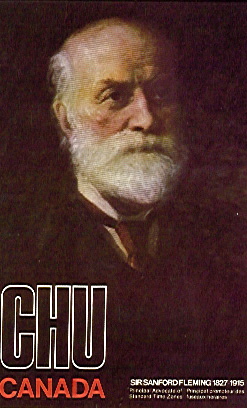
CHU’s QSL card used in the 1980s, depicting Sir Sanford Fleming, father of uniform time zones.
I was saddened to learn this morning (from multiple readers) that Canada’s venerable shortwave time station, CHU, may soon fall silent.
According to a notice posted by Canada’s National Research Council, CHU’s shortwave broadcasts are scheduled to end on June 22, 2026.
For many listeners outside of the shortwave community, this may seem like an insignificant footnote in a world dominated by smartphones, GPS timing, and internet-connected everything. But for those of us who have spent decades tuning the HF spectrum, stations like CHU and WWV are far more than the typical gov’t/utility broadcasts.
They are constants.
When I tune to CHU or WWV, I’m not simply checking propagation conditions or listening for a time tick. I’m reconnecting with something deeply familiar—something that has changed very little since the very first days I turned on a shortwave radio as a child. Their steady pulses and calm voice announcements have always been there in the background of the hobby: reliable reference points amid an ever-changing radio landscape.
In many ways, they are the sonic equivalent of “all things held constant” on the shortwaves.
A year ago, we experienced an unexpected loss of both power and mobile internet service in my neighborhood. The timing was unusual enough that the very first thing I did was tune to CHU. The moment I heard its steady, metronomic broadcast, I knew instantly that what I was experiencing wasn’t some larger, global outage—just a freak local loss of both services at the same time.
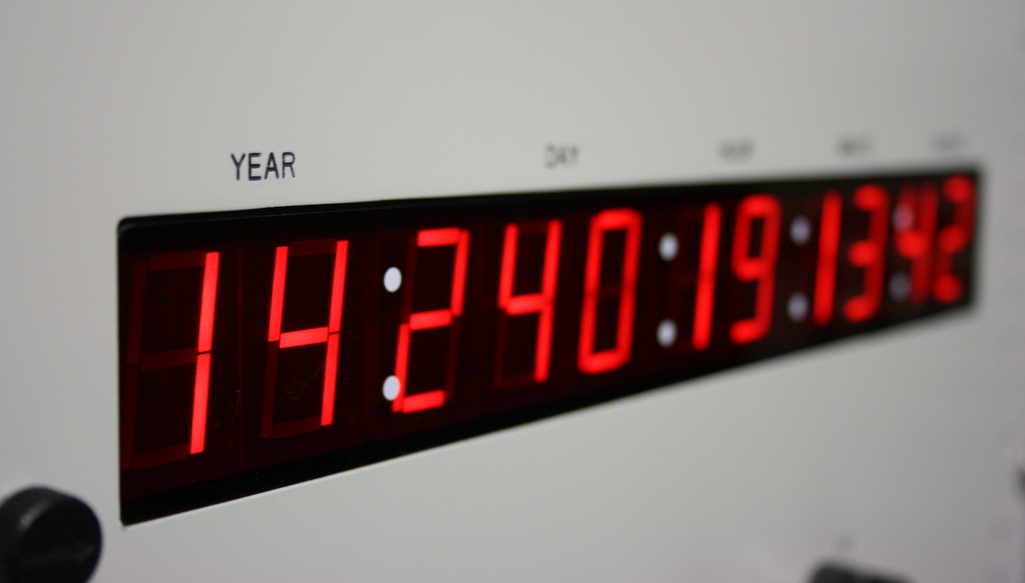
A WWV Time Code Generator
This news feels especially discouraging, coming so soon after Canada discontinued much of its weather radio service earlier this year. One can’t help but wonder how many legacy public-service broadcasts remain vulnerable simply because they no longer fit modern cost-benefit calculations.
In the United States, we narrowly avoided losing WWV nearly a decade ago when funding for the station was threatened. Thankfully, enough support emerged to keep it alive. I sincerely hope we never lose WWV—or NOAA Weather Radio, for that matter. These systems still serve practical purposes, especially during emergencies and outages, but they also represent something more difficult to quantify: continuity.
Services like CHU also remind us that resilient communications infrastructure still matters. A simple shortwave time station can provide a reliable point of reference completely independent of local internet providers, cellular networks, and modern digital systems. In an age when so much depends on fragile, interconnected infrastructure, there is real value in maintaining at least a few systems that remain accessible with nothing more than a basic radio receiver.
If CHU truly does go silent next month, the shortwaves will feel just a little emptier.
And for many of us, that steady Canadian voice and ticking seconds will be deeply missed.
I was saddened to learn that CHU was going to be — and now has been — unplugged. When I started shortwave listening circa 1975, CHU was one of the first signals I heard. I came to rely on it for setting clocks and estimating propagation conditions, in large part because reception of WWV is not always reliable on the US east coast. For 50 years it was familiar friend on the bands.
Beyond CHU, I used to regularly listen to Radio Canada International (RCI) and Canadian Broadcasting Corporation (CBC) shortwave broadcasts, but those, too, are now gone. That’s a shame, since RCI and CBC programs were always informative and well-produced. They gave the teenage me an awareness and understanding of the world beyond the US.
-Dave, K3WQ
So there is no explanation as to why the decision was made. Canadians need to stop accepting policy where a Government decides to just do things without any type of input from the community. This is the problem in the coutry.
73. VE3RSI.
How can I get a QSL card from CHU? I looked for an Email address but didn’t one
Radio CHU Audio Demodulator/Decoder
This driver synchronizes the computer time using shortwave radio transmissions from Canadian time/frequency station CHU in Ottawa, Ontario. CHU transmissions are made continuously on 3.330, 7.850 and 14.670 MHz in upper sideband, compatible AM mode. An ordinary shortwave receiver can be tuned manually to one of these frequencies or, in the case of ICOM receivers, the receiver can be tuned automatically as propagation conditions change throughout the day and season.
https://www.ntp.org/documentation/drivers/driver7/
Such memories. I first heard CHU in 1957 with an old radio I had just fixed. Just thinking about it, I can hear the beeps followed by the authoritative voice announcing the next minute. ??
VE3SUN
I’ve visited the station and seen the equipment. It is no more expensive to keep going than a well-provisioned amateur radio station. The atomic time reference has to be kept anyway at the NRC.
Is the government so poor that it doesn’t have the budget of a ham radio operator?
Nigel Johnson VE3ID
Does anyone know what time the shutoff is? I want to capture the last moments. Thanks,
Here in New England the WWV is often weak or nonexistent. CHU however was always consistent, strong and reliable. It has been my go to frequency to confirm “everything’s working.” A real loss.
Standing up for CHU his isn’t a mere nostalgia thing. Maintaining and distributing measurement standards is one of a handful of legitimate functions of governments, one of the things that differentiates them from being surveillance cartels, or whatever the current fashion in ‘modern’ government may be. Governments that shirk any of these basic functions undermine their legitimacy.
This is a symptom of a deeper problem, as was the US’s attempt to shut down WWV a decade ago. Good luck to our Canadian neighbors – they’re going to need it.
First our weather radio system is tanked and now CHU. Geeeeeez.
73
Greg VA7BC
Are there any petitions on the go that might help prevent this?
I, for one, regularly use CHU for both a propagation and time beacon.
Graham
VO1DZ
They aren’t asking for anyone’s opinions – from what I read, the decision is made. Just like how they turned off all the VHF weather radios in Canada recently. No public input was asked for or desired.
Shouldn’t you at least try to change a few minds up in Ottawa? I’ve already sent my comments to NRC and sent a note to Prime Minister Carney. Until they pull the plate voltage, people should try to keep this ‘beacon’ from Ottawa on the air. I could see them pulling 14670 off the air. But the 3330 and 7850 are still a valuable resource for both amateur and commercial radio use. It can’r hurt to contact them at CHU. I’d hate to see it go. I’ve been listening to CHU since 1967.
And don’t forget that today (5/22/2026) is the last day that CBS radio will broadcast news. Been on the air for 98 years. Very sad.
I understand that the last news will be at 11 PM EST and a 1 minute broadcast at 11:31 PM.
https://www.npr.org/2026/03/20/g-s1-114631/cbs-shuts-down-radio-news-service
It hits the same nerve as the BBC’s latest decision to shut down the 198 kHz longwave transmitter on June, 27th, a nerve that nobody in our circles wants to have even touched. It’s not only killing the last connections to our youth, you know, the last things that have always been there that didn’t suck, and in these cases with all the history surrounding them it’s like demolishing a monument, a piece of the world’s cultural heritage. The untransmitted last message this sends out into the world is not good news for our hearts, or my blood pressure.
Here in the eastern US, reception of WWV can be challenging. Sometimes it comes in; sometimes the propagation doesn’t work and you can’t receive it. CHU has always been there for us. I will miss it.
I will sorely miss them. Decades of them being a touch stone and a test for SW listening.
Sad news, indeed. One of my fondest memories of 60+ years of shortwave listening was taking a personal tour of CHU facilities in Ottawa by then station manager Sid Spear. After the tour he kindly let me borrow a package of slides for presentation at a radio club meeting. This was a good fifty years ago and I remember it as if it were yesterday!
Say it isn’t so.
Sacre bleu!
Not surprised as it’s only been about a year since most/all Canadian LW beacons were also shut down.
When you get a new radio what do you do? Check both WWV and CHU. Then if the radio has SSB capabilities, you check that CHU comes in only in USB. Then you can say “It’s working”…
Agreed! This is how I make sure my receivers are calibrated correctly as well.
Yes, I saw this today on the UDXF group. Very sad. It was one of the first stations, including WWV, that I heard after discovering shortwave.
Another radio service being removed and cancelled by the Canadian Government that puts the safety of its citizens at risk
Thank You Thomas for the awareness lacking on Canadian web sites
John ve3ips
Come on! Keep CHU on the air! I’m sure there are plenty of us who will gladly contribute substantially.
Canada would lose one of its most essential sites. Let me know where to send monthly donations
and I will happily send along whatever will help.
WA9LAE