
By Robert Gulley K4PKM
Power supplies have come a long way since I started in amateur radio, and the behemoths of old are quickly being replaced with smaller, more efficient, switching power supplies.
I know, I know – those of us who have been around long before these little units became what they are today, cursed them with not-so-very-kind epithets because of the noise (read “dang blasted, infernal interference!”) generated by leaky components and poor design. Things have changed, and, as a rare example of something changing for the better, many modern power supplies are not only quiet both literally and electronically, they are easily portable and space-saving.
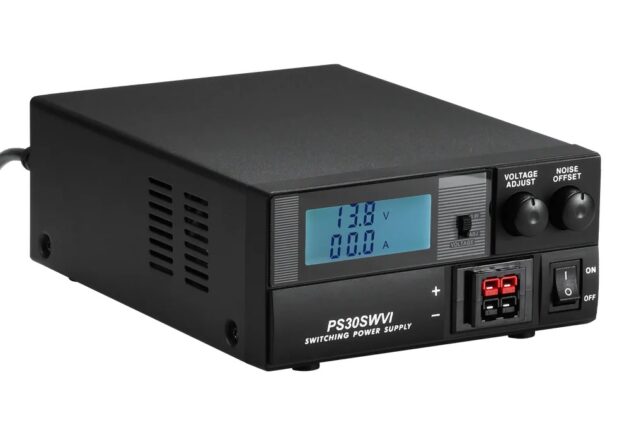
Enter the Radioddity PS30 Switching power supply. I asked Radioddity for the opportunity to test out this unit for review, mainly because I have had several friends get similar power supplies and they have been enjoying much success operating in various modes and bands without issue. None. Okay, that made me curious indeed. As always, I list pros and cons at the end of the review.
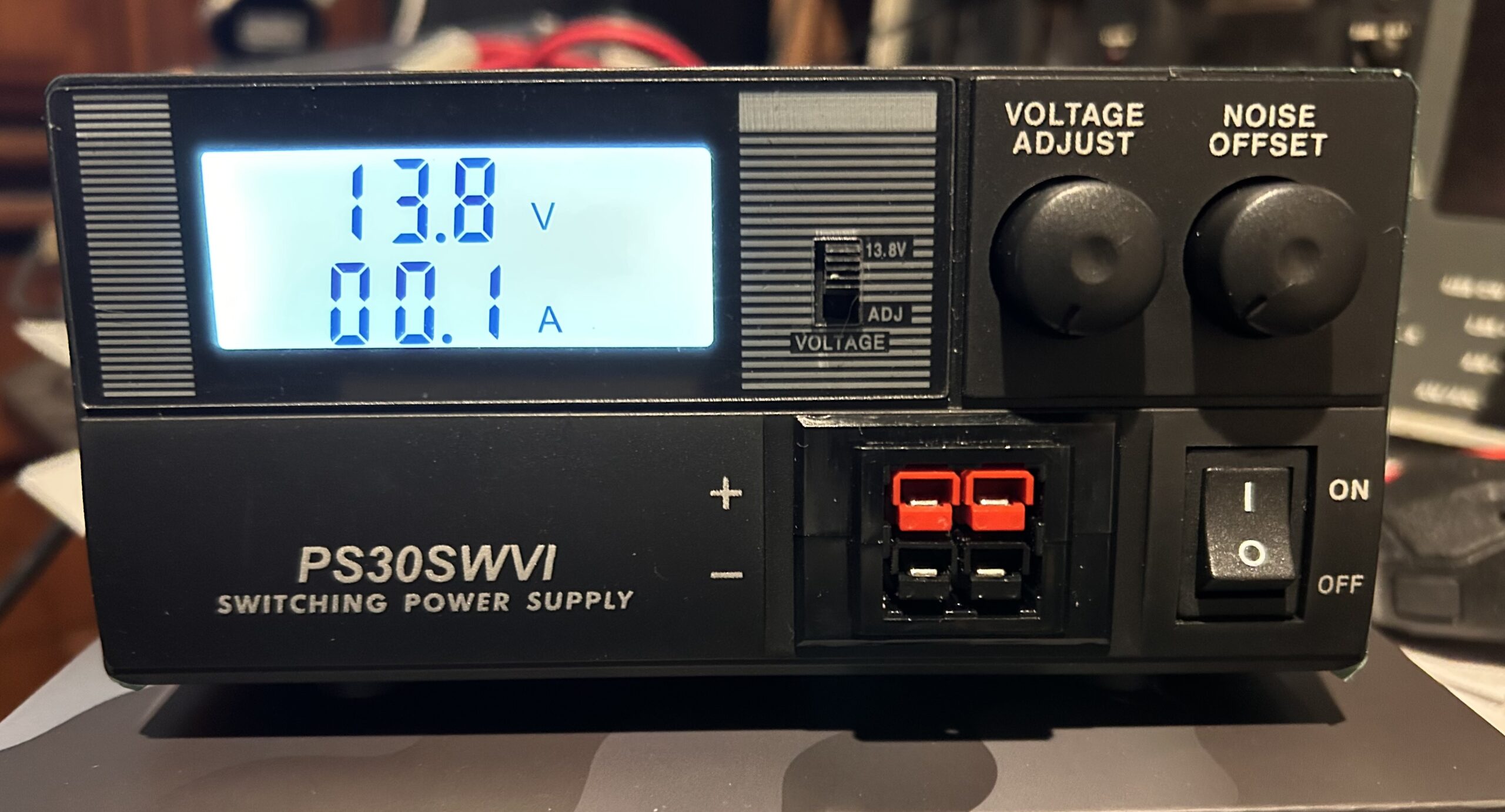
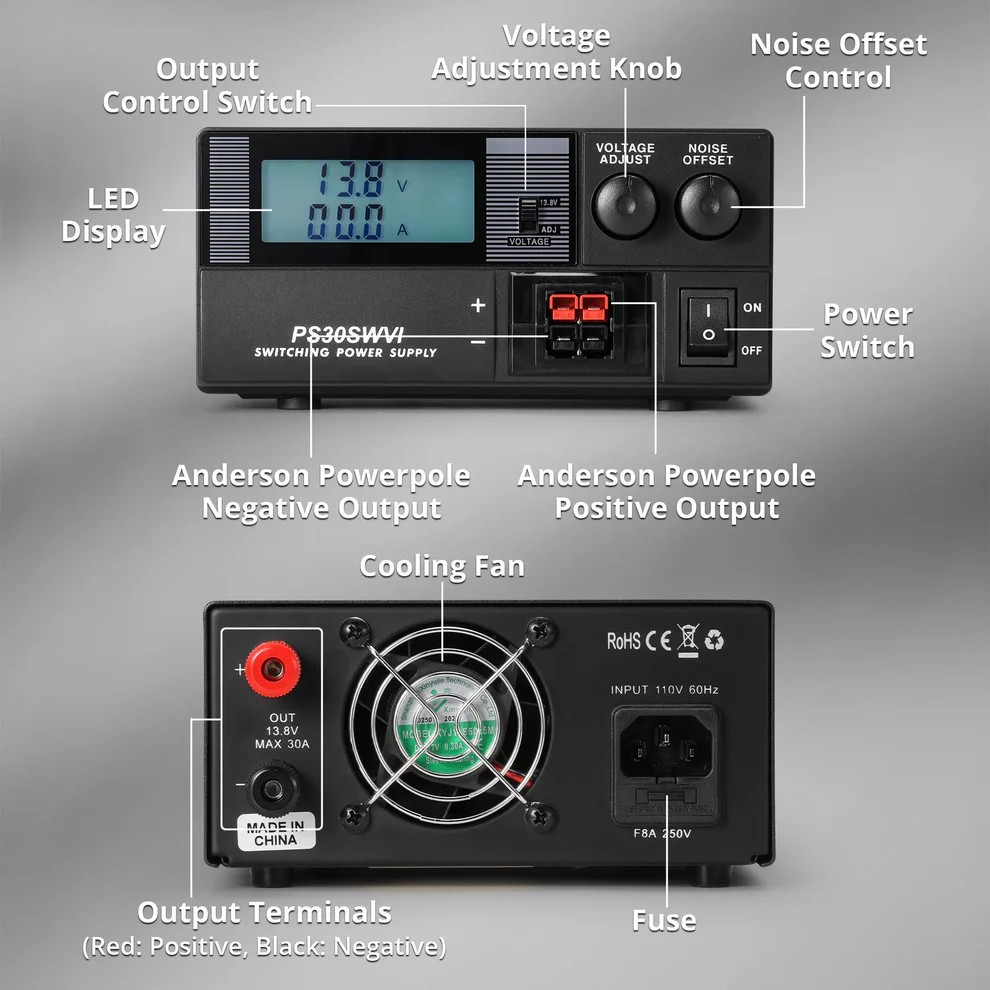
The unit is solid and the controls are responsive without any play. The unit sports a very nice LCD screen, allowing one to see at a glance how power is being used in volts and amps. There is a noise offset control to move a birdie should one appear on a desired frequency. That is, if you experience noise on your connected gear that you suspect is originating from the switching power supply, use the Noise-offset control to reduce it to a minimum.
There is also the ability to vary the voltage. With an adjustable 8–15V DC output (a fixed option at 13.8V for most radios) and up to 30A peak / 20A continuous current, it easily supports ham radios, CB radios, HF transceivers, and other DC-powered devices. Short-circuit and overload protection is built in via a fuse on the backside.
The unit sports two sets of Anderson Power Pole™ connectors on the front, and a set of terminals on the back that also allow 4mm banana-plugs to be inserted. Personally I like the multiple power connection options as I use all three options depending on the radio I am connecting at the time.
Reliability
For those who have been around a while you know reliability in power supplies is measured in years rather than months or days, so I cannot speak to the expected lifetime of the supply. However, in the months I have had the unit I have seen no issues with fluctuating power, noise (physical or electrical), or the controls. The unit seems well made, heavy enough to give it a sense of solid design, but not so heavy it would be an issue taking it portable, depending on your specific needs, of course.
Pros and Cons
Pros:
- Small footprint
- Solid Design
- Multiple Connections
- Adjustable controls for Power and electrical noise offset
- Bright LCD Display
- Quiet Fan
- Detachable standard computer-style power cord. A simple, but nice touch I wish most equipment manufacturers would embrace.
Cons:
- Front power connectors not aligned in the usual fashion. Traditional designs have the red and black connectors next to each other rather than above and below. Not really a big issue, but some folks have reset them (I would check before doing so to ensure that it does not void your warranty!)
Conclusion
I am impressed with the power supply and see no reason not to recommend it. With the cost of linear power supplies having skyrocketed over the last few years, modern switching supplies have much to offer, and the price makes them very appealing. Frankly, even if you had to replace one after a few years, you still would not come close to the cost of a linear supply (especially as there seems no end in sight to their cost increases!). Radioddity definitely has a nice offering here in the PS30. 73, Robert K4PKM
It is the same design look and display of Alinco DM30. May be the same Chinese manufacturer who supplies to Alinco made it for Radioddity also. I am using it for the last two years with my FT891. Only problem to report is once are twice it stayed around 3V and repeated switching on and off came back to 13.8V.
What is the RFI like?
No reportable RFI on all HF bands including 6m. Also no qrm in 2m and 70cm. I am using the lookalike Alinco DM30- de Partha VU2GPS
Nothing noticed here on any bands, even with unit in very close proximity to my main radio, scanner, or 2m/440 rig.