
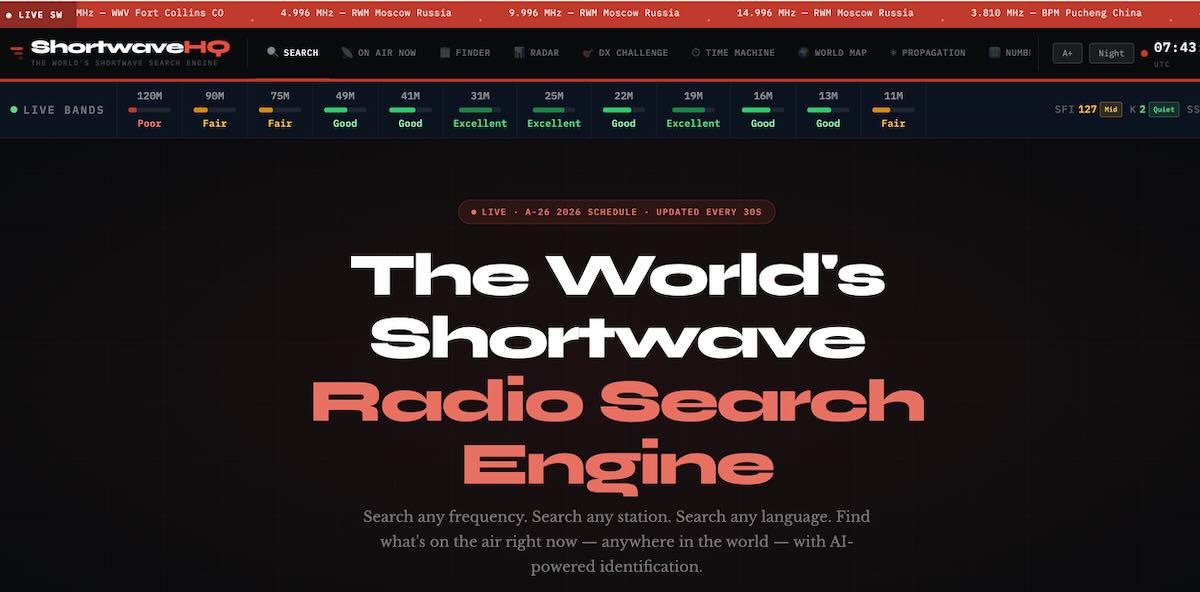
 A reader, Michael, recently shared a new online resource he created for the shortwave listening community called HQ Shortwave Radio: https://hqshortwaveradio.com
According to Michael, the site lets users enter a frequency and uses AI to help identify what’s currently on the air. It also incorporates current broadcast schedules, propagation information, station listings, maps, and a variety of other tools designed to help listeners explore the bands.
I’m traveling, so I haven’t had an opportunity to put it through its paces and can’t offer an evaluation. That said, while I’m generally not a fan of AI-generated writing, YouTube videos, or artwork, I do think AI can be a genuinely useful tool for organizing, searching, and presenting complex datasets. This seems like an interesting application of that idea, and I’m curious to hear how well it works in practice.
If you give it a try, please share your impressions in the comments. I’m sure Michael would appreciate constructive feedback from fellow SWLing Post readers.
I just check this website, typed in 3330 kHz, and it came back with chu (which is no longer in operation).
Thanks Dave — you’re exactly right, and good catch. CHU went silent on June 22nd after nearly a century on the air, so that 3330 entry was stale. I’ve pulled it from the database along with its other frequencies (7850 and 14670). Genuinely appreciate you testing it and flagging it — that’s how this gets more accurate. End of an era for that one. 73.
Hi Thomas,
As always, I find your blog very interesting.
I had a quick look at the mentioned website. It has a very nice appearance and a very professional look.
You know, nowadays, with the support of AI coding tools, the quality of websites is becoming really impressive, and our role as developers is changing a lot.
I experienced something similar with my personal website: it used to be an old, struggling WordPress site, and now it looks much better, although I feel it has lost some of its original personality and human touch.
Regarding Michel’s website, I have to say that, at first, I was a bit skeptical that it was actually using AI to provide the answers.
My doubts came mainly from the fact that the costs involved in using an LLM on a public website can be quite high, even when using a model hosted on your own server.
Our hobby is a relatively small and non-commercial one; the website does not seem to have subscription fees or advertising, so I was wondering how sustainable this approach could be in the long term.
However, I had to reconsider my first impression. I analysed the request flow and it does indeed appear that the website is using Anthropic.com and the Claude Sonnet 4 model.
Unfortunately, I noticed that some requests to Anthropic seem to fail due to an authorization issue (HTTP 401 error). It may be that some limits have been reached.
The website still provides results, but in my opinion they are not always as complete as I would expect, considering the databases that should theoretically be available (EiBi and Aoki).
Of course, I only made a very quick review and I would like to spend more time exploring it.
Having some experience with the EiBi and Aoki databases, I would like to suggest to Michel — if he has not already considered it — to include these databases directly in the website and perform the main queries using traditional methods. Then, AI could possibly be used to process the results and add an extra layer of value or interpretation.
Since we are mainly dealing with schedules and structured data, many filtering operations can probably be handled efficiently with conventional programming.
I understand that nowadays there is a tendency to integrate AI into many applications, but the main challenge is always balancing the costs with the actual benefits.
Anyway, the website is very nice, and the ideas behind it are really interesting. I wish Michel all the best in continuing to develop his project.
Stefano
Hi Stefano,
Thank you for taking the time to look at the site so carefully — this is exactly the kind of feedback I was hoping for, and I really appreciate the depth of it.
You’re right on both counts. The 401 errors you spotted were a real issue on my end, and I’m getting that sorted. And your bigger point about architecture is well taken — you’ve correctly identified that I’m leaning on the AI more than I should for what are really structured-data lookups.
That’s something I’m actively changing. The plan is exactly what you described: query the EIBI and Aoki data directly with conventional code for the schedule and frequency lookups — fast, accurate, and free and reserve the AI only for the interpretive layer where it actually adds something a database query can’t. You put it better than I would have: balancing cost against actual benefit is the whole challenge, and for a small non-commercial hobby site, AI has to be the garnish and not the engine.
I’m a one-person operation still learning a lot of this as I go, so honest technical feedback from someone with real EIBI/Aoki experience is genuinely valuable. If you’re ever open to sharing more of your thoughts as I keep developing it, I’d welcome it.
Thank you again and thanks for the kind words about the design.
73,
Michael