
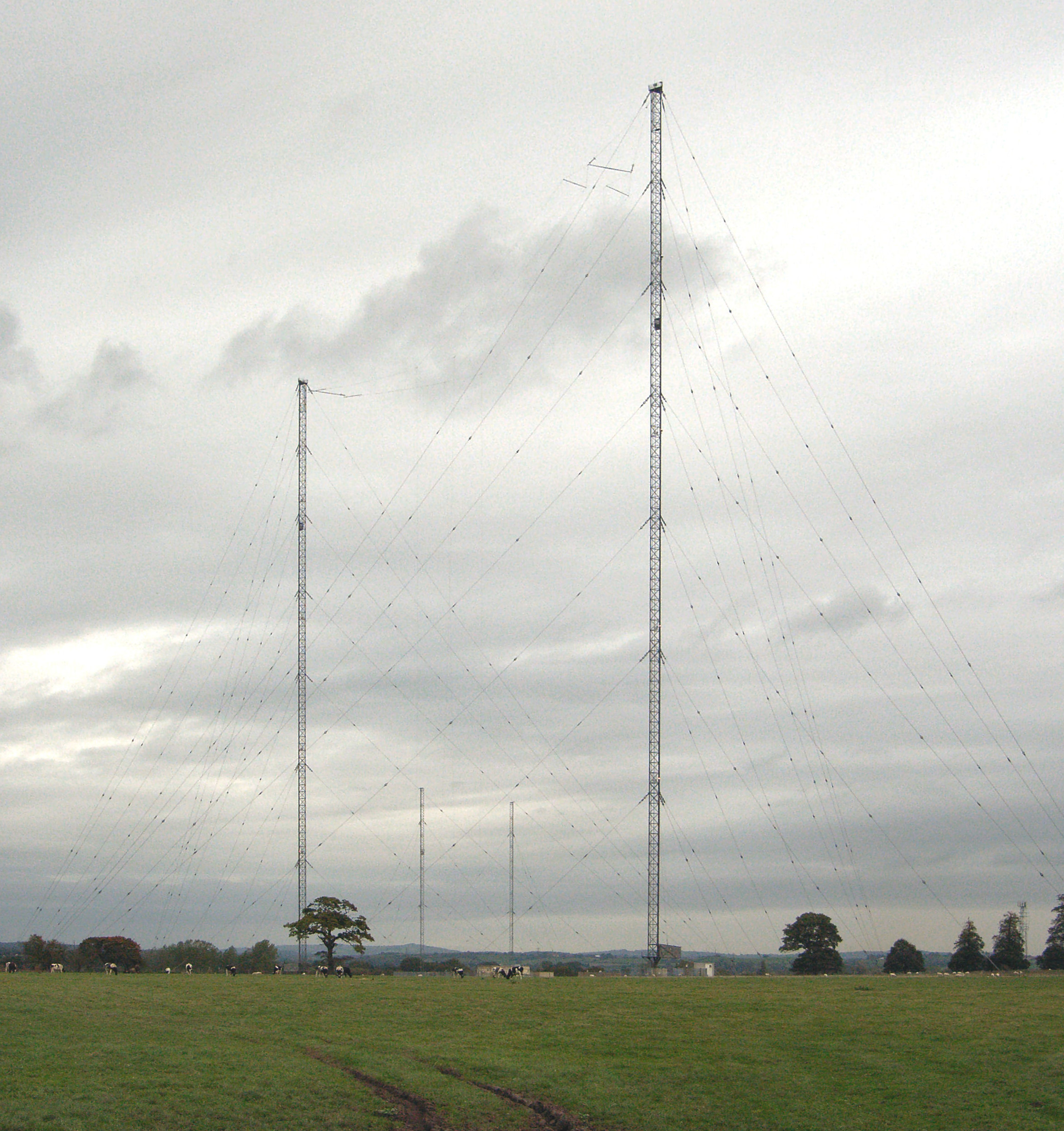
Droitwich Transmitter Site (Source: Wikimedia Commons)
Many thanks to SWLing Post contributor David Iurescia, who shares this BBC article about the end of an era in British broadcasting: the BBC has permanently switched off its longwave Radio 4 service after nearly a century on the air. The closure marks the end of longwave broadcasting in the UK, with the historic 198 kHz transmitters at Droitwich, Westerglen, and Burghead now falling silent after decades of service.
For many radio enthusiasts, this represents far more than the retirement of an aging transmission system—it is the closing chapter of one of broadcasting’s most iconic services, one that carried everything from the Shipping Forecast to Test Match Special and reached listeners across the British Isles and beyond.
Click here to read the article.
Many thanks as well to SWLing Post contributor Andy Wang, who shares this off-air recording capturing the final hours of the BBC’s longwave service before the transmitters went silent:
This prompted me to do a Google search for broadcast stations still operating on longwave. The results:
Europe
• Romania: Radio România broadcasts on 153 kHz from the Bod transmitter (SSR Antena Satelor).
• France: The station at Allouis transmits on 162 kHz, though it is now primarily used for time signal data by TDF rather than traditional audio broadcasting.
• Poland: Polskie Radio operates on 225 kHz from the Solec Kujawski transmitter.
Asia & Africa
• Mongolia: The country still utilizes a few longwave stations to broadcast national radio across its vast, sparsely populated landscape.
• Algeria: Transmits on 252 kHz from Kénadsa, covering parts of the African and Eurasian broadcast ranges
While never the favored ground of SWLs, I remember several of the high-powered outlets making it across “The Pond” to the east coast of North America on a regular basis – usually in the early evening hours. They were fun catches. The irony is the significant number of current multi-band radios that cover longwave – all dressed up and no where to go.
Particularly the Shipping forecast and other content should be transmitted on medium frequency Digital Radio Mondiale so that the coloured weather maps could be transmitted to ships.
They could be transmitted, but not received since there are no DRM receivers capable of displaying coloured weather maps. The BBC has also tested domestic MW DRM in 2009 and decided not to go for it, mostly due to nighttime reception issues. Now, almost 2 decades later, none of the problems with DRM appear to be solved.
Sorry but I get frustrated by people suggesting things like this. Ships don’t need “coloured maps”, and any that want a free or backup method for weather data will already have a NAVTEX receiver, which will give them all sorts of other relevant warnings as well (search online for live data).