Tag Archives: Carlos Latuff

CGTN versus BBC: China, UK, and Soft Power in Africa

by Carlos Latuff

I found it strange to come across interference from a Chinese radio station on the BBC’s shortwave broadcast. For about a month, between April and May 2026, I was monitoring this special BBC radio service, transmitted from a station in Madagascar and aimed at Sudan and Gaza in Arabic. Aside from some technical and propagation issues, this was the first time I had encountered this kind of interference.

At first, I thought it was some sort of technical problem. The interference from the Chinese radio made it impossible to understand what was being said on the BBC broadcast. I tried again on other days, and the problem persisted. On May 25 at 17:00 UTC, I tuned into another BBC broadcast, this time transmitted from Ascension Island and aimed at West Africa in English, on the frequency 17780 kHz. To my surprise, the BBC broadcast was once again overpowered by the signal of a Chinese station — I couldn’t tell whether it was China National Radio or China Radio International (also known as CGTN Radio).

This monitoring was done on an Ecopower EP-F23B radio — a white-label model — with DSP technology and manual tuning. I wondered if it might be a problem with the device itself. So I used a digital Xhdata D808 radio, and when I tuned precisely to the frequency, I determined that the issue wasn’t a technical fault with my equipment, but rather deliberate interference with the BBC broadcast.

Faced with this situation, I started to believe this wasn’t a technical problem but an intentional act. I decided to investigate online, and it didn’t take long to find confirmation of my suspicions.

I found an article written in 2021 by two communication scholars, Yanqiu Zhang and Daniel Oloo Ong’ong’a, titled “Unveiling China’s digital diplomacy: A comparative analysis of CGTN Africa and BBC News Africa on Facebook.” It became clear to me that radio waves were once again the stage for geopolitical rivalry. The article focuses on the clash between the two broadcasters on social media, but clearly, this battle isn’t limited to the internet.

Continuing my research, I found news reports that illustrated this conflict well. On February 4, 2021, The Guardian reported: “Chinese state broadcaster loses UK licence after Ofcom ruling; Regulator concludes news network CGTN is ultimately controlled by Chinese Communist party.

Well, well, ladies and gentlemen — we’re back to the good old days of the Cold War, aren’t we?

Following this arbitrary decision by the British government, the Chinese government quickly responded, as reported by the BBC itself on February 12 of that same year: “China bans BBC World News from broadcasting.”

Despite the differences between the BBC (a public service broadcaster) and CGTN (a state broadcaster), the fact is that both represent the interests of their respective nations.

In the 19th century, the British Empire — “on which the sun never set” — had colonies in Africa. The BBC, founded in 1922, was the voice of that empire. Indeed, in 1932 it created the Empire Service, the forerunner of the World Service. The British crown thus exerted its soft power through the microphones of the BBC and its hard power through the rifles and bayonets of its soldiers.

But the days of the redcoats are long gone. After much struggle and much bloodshed, African peoples expelled their British colonizers. However, the post-colonial BBC continues to defend the interests of the British state, even as it faces major financial difficulties. Due to budget cuts, the BBC has bet on digital platforms, cut radio programs in other languages, reduced its shortwave presence, and has been carrying out mass layoffs.

In contrast to the British broadcaster, Chinese CGTN has expanded its reach across the African continent, investing in digital platforms, but also in radio transmitters, programming in multiple languages, and the production of low-cost radios — with AM, FM, and shortwave, plus a flashlight and solar panel — taking into account that a large portion of Africa’s population has limited access to electricity and the internet.

A Chinese-made radio, with a solar panel, flashlight, AM, FM and shortwave bands, advertised by an electronics store in Nigeria for the equivalent of US$11.

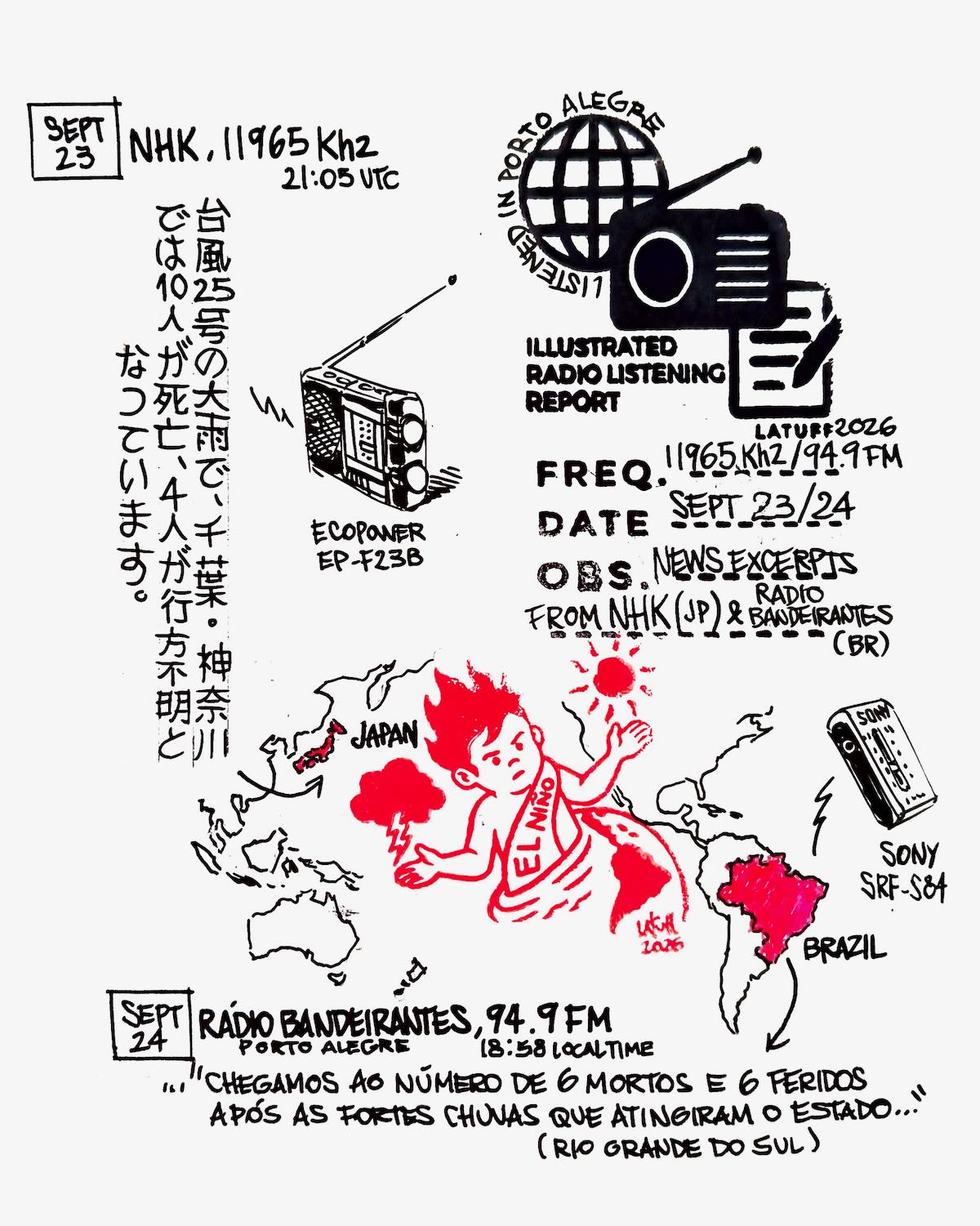
Illustrated Radio Listening Report related to CGTN broadcast in Arabic. While the BBC announced in 2023 the end of its Arabic broadcasts, CGTN broadcasts in that language on 7 different frequencies daily.

The BBC’s soft power in Africa was built in the wake of Britain’s colonial past. CGTN, on the other hand, reflects the relationship China has consolidated with the African continent as its largest trading partner.

The BBC, like the United Kingdom, is no longer the empire it once was, struggling to maintain what little influence it has left with whatever budget remains. CGTN, however, is the portrait of a rising economic power — a China that builds its soft power the same way it built its economic leadership: with persistence and patience.

In January of this year, UK Prime Minister Keir Starmer visited the president of China Xi Jinping in an attempt to resolve differences between the two nations. Meanwhile, the shortwave battle between the CGTN and BBC continues. A clash between a declining power and an emerging one. This isn’t about chasing ratings. It’s geopolitics, played out on the radio waves, before the ears of the world.

In any case, these are conclusions I drew from the recent history of animosity between the United Kingdom and China, notably involving the BBC and CGTN. It’s possible the interference I detected is just technical problems, who knows? Perhaps a simple coincidence.

Carlos’ Illustrated Radio Listening Reports and Recordings of the BBC (May 19 & 22, 2026)

Many thanks to SWLing Post contributor and noted political cartoonist, Carlos Latuff, who shares the following illustrated radio listening reports of recent BBC World Service broadcasts.


Carlos notes:

Ebola outbreak in D.R. Congo via BBC

Click here to view on YouTube.

Click here to view on YouTube.

Monitoring the BBC’s Emergency Radio Service for Sudan and Gaza (A Few Considerations)

by Carlos Latuff

I bring to the brothers-in-radio of SWLing Post a short report on my recent listening sessions of the BBC’s emergency radio service, which broadcasts half an hour of Arabic-language programming from Sunday to Thursday to Sudan and Gaza on the frequency of 15280 kHz. The programming consists of a podcast entitled “Middle East Diaries,” which can be accessed on the BBC Arabic website. Basically, it consists of news about Gaza, the West Bank, Lebanon, Sudan, and other regions of the Middle East, and in one specific case, a public service announcement teaching water purification techniques, vital information for those who live (or try to survive) in regions whose civilian infrastructure has been destroyed by bombings.

These listening sessions were conducted between April 20th and May 21st of this year, in front of the Guaiba River in Porto Alegre, Brazil. The receiver was the reliable Xhdata D-808, and a 3-meter long wire antenna. Transmissions always begin at 12:00 PM Brasília time (3:00 PM UTC), the worst time since the sun is at its zenith, which negatively impacts shortwave reception. The signal is weak; most of the time, it was only possible to save a few audible fragments, and in some cases, it wasn’t possible to record anything; it was almost all noise. Reception usually improves slightly after 12:30 PM. Now, the transmitter, located in Talata Volonondry, Madagascar (about 9800 km from Porto Alegre), is directed towards Sudan and Gaza, so receiving this signal in Brazil is already a stroke of luck!

(Listening session held on May 1st, one of the days with better reception)

One problem I detected was on April 30th, when the Radio Romania interval signal interrupted the end of the programming. Radio Romania broadcasts in Arabic on the same frequency, but at 12:30 PM. The interval signal started at 12:27 PM, when the BBC program had not yet finished.

I also noticed interruptions that seemed to stem from technical problems and/or power outages, as happened on May 4th, when I missed the first three minutes of the broadcast due to a signal interruption.

Four days ago, I was in another city in southern Brazil, Florianopolis, 463 km from Porto Alegre, and there, on the campus of the Federal University of Santa Catarina, I tried to listen to the BBC broadcast but noticed strong interference from a Chinese radio station (CNR ?) on the same frequency. I imagined it was something related to my geographical location. However, today, May 21st, back to Porto Alegre, I found the same problem, which practically made listening impossible. I’m not sure when I’ll be able to listen to those broadcasts again.

Too bad, ’cause I was really enjoying listening to the BBC’s emergency radio service, as it became the only time BBC broadcasts in Arabic, since the station ended its regular service in that language in January 2023. I’m making available here a PDF with all the illustrated radio listening reports I produced during this period.

Click here to download the PDF.

P.S.: I have tried to contact the BBC several times, either by email or through their social media.

All in vain.

Carlos’ Illustrated Radio Listening Report and Recording of Vatican Radio (May 18, 2026)

Many thanks to SWLing Post contributor and noted political cartoonist, Carlos Latuff, who shares the following illustrated radio listening report of a recent Vatican Radio broadcast.


Carlos notes:

11.5 million people threatened by famine in Sudan, Vatican Radio, 11870 kHz

Click here to view on YouTube.

Carlos’ Illustrated Radio Listening Report and Recording of BBC Afrique (May 10, 2026)

Many thanks to SWLing Post contributor and noted political cartoonist, Carlos Latuff, who shares the following illustrated radio listening report of a recent BBC broadcast.


Carlos notes:

Emmanuel Macron in Kenya: “We are the true pan-africanists”. BBC Afrique, 15490 kHz”

Click here to view on YouTube.

Carlos’ Illustrated Radio Listening Report and Recording of the BBC Emergency Radio Service (May 6, 2026)

Many thanks to SWLing Post contributor and noted political cartoonist, Carlos Latuff, who shares the following illustrated radio listening report of a recent BBC Emergency Radio Service broadcast.


Carlos notes:

BBC Emergency Radio Service

Click here to view on YouTube.

Carlos’ Illustrated Radio Listening Report and Recording of the BBC Emergency Radio Service (May 5, 2026)

Many thanks to SWLing Post contributor and noted political cartoonist, Carlos Latuff, who shares the following illustrated radio listening report of a recent BBC Emergency Radio Service broadcast.


Carlos notes:

BBC Emergency Radio Service

Click here to view on YouTube.