
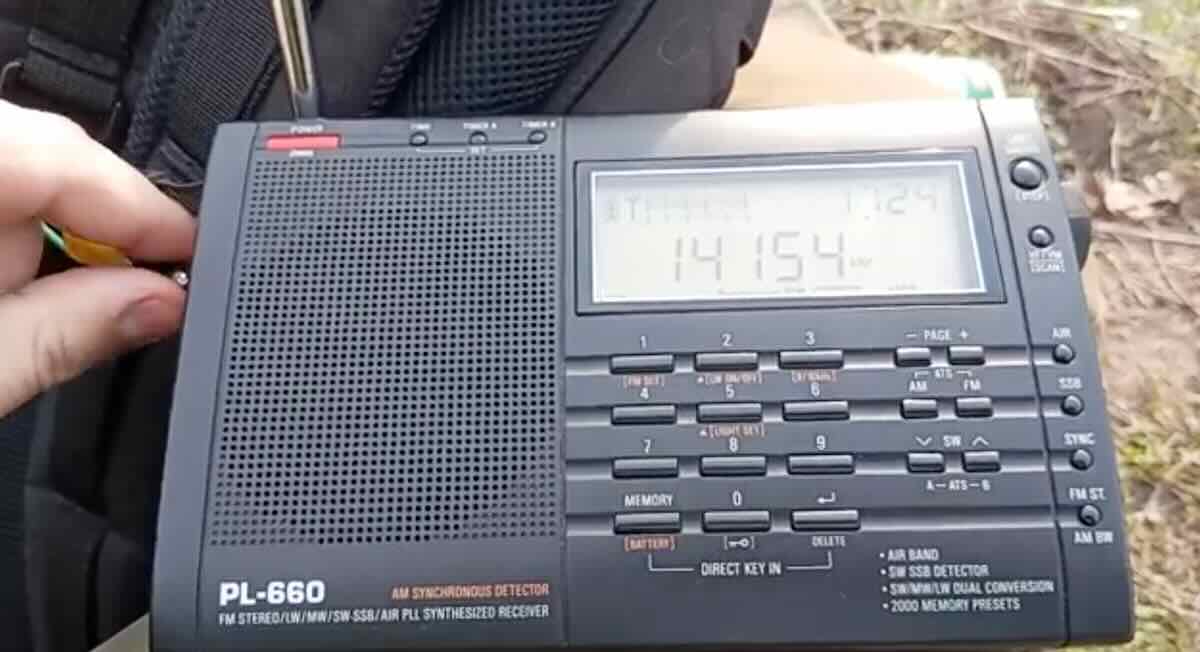
 Many thanks to SWLing Post contributor, Vladimir, who writes with a tip:
I’d like to share a very simple lifehack for improving reception on a regular radio broadcast receiver. I’ve been reading SWLing Post for a long time and I remember that you already had something similar, but I’m not sure how much it’s the same.
The method involves using a “virtual ground” – a quarter-wave resonant wire connected to the receiver’s “ground”, while the antenna itself remains a standard telescopic one. In amateur radio practice, this is widely known, but, as I see, it is very rarely used for SWLing, and meanwhile, it gives a good increase in performance without overloading the input circuits of the receiver. Of course, we are talking about reception at a known frequency and does not imply broadband.
My video about it:
I apologize that the experiment here is not entirely clean, since the “virtual ground” was made at a frequency of 13650 kHz, and the video shows reception at 14154, but I recorded this video spontaneously and did not prepare. But the result still pleased me.
As you can probably see, a male banana plug with a wire is used, and it is recessed into the antenna socket just enough to touch only the “ground” of the receiver, without touching the antenna contact. If you need to avoid electrical interference along the “ground”, for example, near power lines, then you can connect a second similar wire to the same point, stretched in the opposite direction.
There is an important nuance regarding the length of the wire. If it is located close to the ground, then its resonant length will be shorter then ?/4, but approximately ?/5, because the proximity of the ground greatly reduces the resonance. How do I know this? I experimented with resonant dipoles lying on the ground, measuring the resonance with an antenna analyzer directly at the feed point. It is important that the analyzer can measure and display separately active and reactive resistances, I used “Sector-200+”, the closest analogue of FAA-450, design EU1KY. Selecting the lengths by zero reactive resistance (i.e. by resonance), on my soils I got a shoulder length of 4.0 m for a frequency of 14150 kHz and 8.25 m for 7175 kHz, i.e. approximately ?/5. For comparison: a 5 m long wire lying on the ground resonates at about 9.7 MHz, and this is far from where we need it on the 20 m range, for example. Since then, I only use resonant radials on field trips with the GP antenna, but that’s another story. Those who have a similar antenna analyzer can get more accurate values ??for their area and height above the ground.
Thank you so much for sharing this hack with us, Vladimir!