
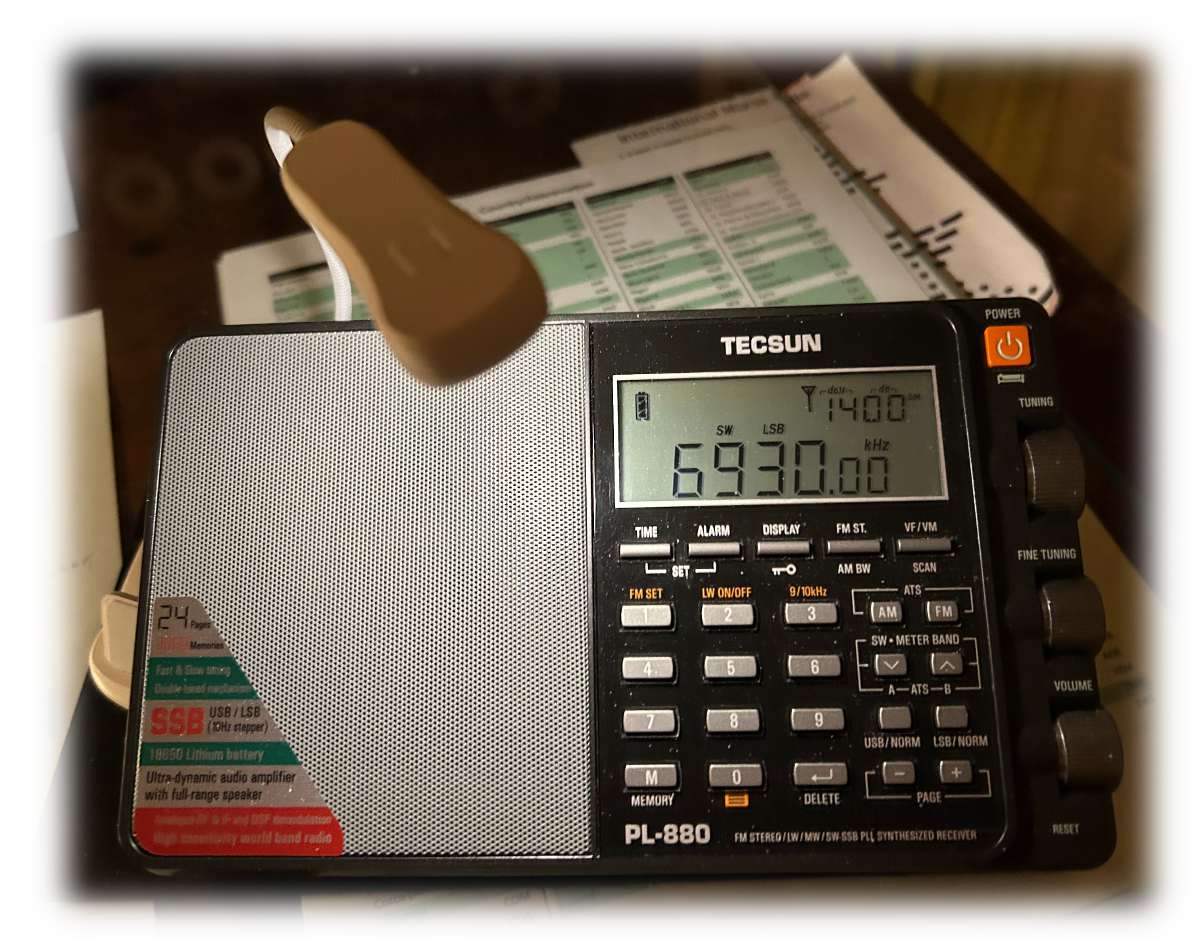
 Reported by Bob Colegrove
Incurable DXers are always looking for new challenges. So it was, I recently did some scanning between 42 and 45 meters (~6600 to 7000 kHz). Trenton Military on 6754 kHz and the MARS net on 6913 kHz are regulars here, as are a selection of pirates above 6900 kHz. However, I have never experienced anything like this. It took me a while to sort things out. A pirate on 6930 kHz was quickly detected on the upper sideband, but there was some garble slightly lower. It turned out to be a few folks having a QSO in Spanish on the lower sideband of 6930 kHz.
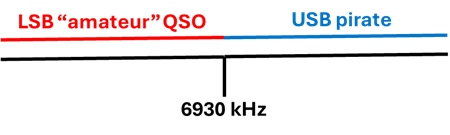 Two transmissions both squatting on the same frequency. The irony was, sans carriers, there was absolutely no mutual interference. Each signal was clearly received by alternately pressing the USB and LSB buttons. Likely the QSO folks were somewhat out of band for 40 meters, and it goes without saying that the pirate shouldn’t have been there. Nevertheless, I would call that efficient use of the spectrum.
Date: October 11, 2025
Time: 0030 until 0100 UTC
Receiver: Tecsun PL-880
Antenna: Bob’s Updated Passive, Resonant, Transformer-Coupled Loop Antenna for Shortwave
Rather common on 6925. Peskies on LSB and pirates on USB. Tends to be okay unless a LSB op cranks all the knobs to max and starts splattering on USB.
ISB is possible from two transmitter sites now provided the carriers to be suppressed are locked to the same reference. That is GPS satellites. This is the frequency synchronism systems used in Single Frequency Networks used in DVB terrestrial TV systems and DAB+ and DRM.
In SSB with full carrier 20 % of the transmitted power contains intelligence. The rest is the carrier contains no intelligence. Full carrier is required for reception using the millions of AM receivers. Suppress the carrier, then 100 % of the transmitted power contain information.
In addition for music all of the other sideband must be removed in ISB. It is difficult to remove all frequencies down to nearly DC.
Pure digital radio is a better option. It is noise and interreference free at lower power levels. This is because it contains forward error correction.
Wow, I never ran across 2 people using the same frequency as USB & LSB. Thanks for the report!
Wow, I never ran across 2 people using the same frequency as USB & LSB. Thanks for the report!
Why would that be efficient? Both voice channels occupy approximately 3 kHz. It doesn’t matter if it’s 2 x LSB, 2 x USB, or LSB/USB. The occupied spectrum remains the same. Only the suppressed carrier is sometimes on the higher side of the sideband and sometimes on the lower side. 73, Tom DF5JL
He’s not talking about efficiency from an engineering/RF standpoint, but more along the lines of two pirates, bumped up against each other and not interfering sideband to sideband. 🙂
i.s.b.
indipendent side band.
it was used by some broadcaster till a couple of decades ago, out of BC bands, just a “low cost radiolink” pre-satellite era.
some not-so-old high power Nato hf radioset had the ISB option for e.g. “audio+rtty”
iu1dzz gianfranco
USB and LSB on the same ‘carrier ‘ frequency for me brings back a query of mine from some decades ago.
There were talks about stereo AM but all the modes were technically complicated , costly and some used very wide bandwidths . I proffered the idea of stereo AM with the use of the two sidebands for left and right channels , with perhaps a reduced carrier to save power .I never really got sensible comments about this and now I wonder if with modern circuitry would this Independent sideband stereo be practical. Mono and stereo range of service would be similar I am sure , unlike broadcast FM .
Has anyone any ideas about this ?
Des Walsh EI5CD
Des,
There were 4 competing systems. The FCC would not run comparative tests, leaving it up to the market!
Receiver manufacturers only wanted a single system to minimise costs. Belatedly the FCC adopted Motorola’s CQUAM. It was all too late for commercial success.
Note: Single sideband is always transmitted without a carrier. As a result is no reference for the receiver to accurately recreate it. Hence SSB is always used for voice because there is no bass, which is in music .
Broadcasters want the carrier maintained, for mono reception on older AM receivers.
CQUAM transmits the mono (Left + Right) in conventional AM and phase modulates the carrier with the Left – Right signal. When the two signals are added you get the Left signal.(L- R) – (L + R) =2R. This also is used in FM stereo.
CQUAM also adds a weak 25 Hz tone to switch on the stereo coding.
The sound quality is poorer than FM.
I always enjoy those serendipitous moments on radio! Nice catch!!!
Ditto!
I will have to check this out.
Thanks, Bob.
Cheers, Jock