Tag Archives: Bob’s Radio Corner

Bob’s Radio Corner: Pittsburgh

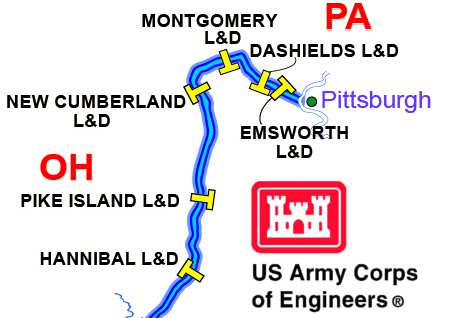
Emsworth Locks and Dam (Ohio River, Mile 6.2) Source: U.S. Army Corps of Engineers

By Bob Colegrove

If you happened to tune 8213 kHz during the ‘50s or ‘60s, you might have heard a dialog something like this:

Boat: “Pittsburgh, this is the Mary Alice, upbound at mile 14, request lock status.”

Pittsburgh: “Mary Alice, Emsworth has a two-tow delay. Recommend holding below the wall.”

Boat: “Roger, Pittsburgh. We’ll hold.”

You would have heard one of the U.S. Army Corps of Engineers’ HF River traffic control stations that operated on the Ohio River system. This station was not called “Pittsburgh Radio;” nor was it called “Radio Pittsburgh.” It had no known K… or W… call letters. Instead, each of these stations identified itself by city name only. In this case you might hear, “Pittsburgh calling downbound tow at mile 12…” or “Pittsburgh to all traffic: lock delay at Emsworth…”

From the 1940s through the late 1960s, the Corps of Engineers operated a network of HF shore stations along the Ohio and Mississippi river systems. These stations coordinated tow and barge movements, lock traffic, river closures, weather and river-stage reports, and emergency traffic.

From the earliest time, I was enthralled by the international shortwave broadcast bands and had spent most of my time listening to the usual stations most of us remember. Since my old console radio had continuous coverage from 5.5 MHz through 18 MHz, I was curious about what lay between the broadcast bands.

I stumbled across “Pittsburgh” very early in my SWLing life. Pittsburgh stood out clearly. Along with WWV, it was the only other utility station I was able to identify during that time. I was fascinated by the conversation.

The Corps used a cluster of HF frequencies in the 8 MHz band for long-range river communication. These were not publicized like marine ITU channels; they were internal government/industrial channels. The 8 MHz band was chosen because it propagated well along the river valleys; it worked day and night; and it reached 100-to-300 miles reliably.

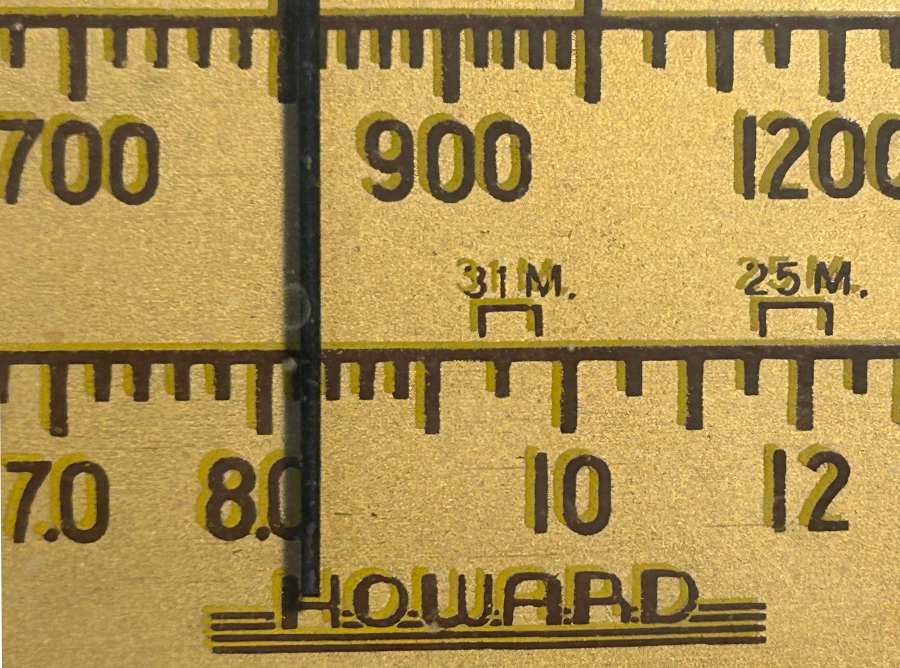
I don’t know how I ever determined the frequency. It was never announced, and I certainly couldn’t determine it on my old radio. The entire span from 5.5 MHz to 18 MHz covered a mere 4 inches on the dial. The pointer itself was about 100 kHz wide at this range. Somehow, I was eventually able to determine 8213 kilocycles.

Note that the frequency of 8213 kHz did not conform to the 32-channel duplex frequencies which eventually were carved out of this band. Pittsburgh was born out of necessity at a time when radio was still young and offered a ready solution to an age-old problem.

Before VHF towers lined the river in the late ‘60s and ‘70s, HF was the only way to maintain continuous communication along the entire Ohio River. The Pittsburgh District of the Corps oversaw the Emsworth Lock (Mile 6.2), Dashields Lock (Mile 13.3), and Montgomery Lock (Mile 31.7).

Pittsburgh Engineer District 2026

Commercial riverboat life on the Ohio River in the ‘50s and ‘60s was a world in transition. Just as the keelboat days and the legendary Mike Fink had given way to steamboats, by the early 1950s the Ohio River was shifting decisively from classic steam navigation to diesel-powered towboats pushing long strings of coal and freight barges. However, pockets of river-based living, indigenous to the previous age, were still hanging on.

The U.S. Army Corps of Engineers began replacing the old 19th-century lock-and-dam system with modern locks and dams in the early 1950s, creating deeper, more reliable navigation channels and enabling larger commercial traffic. These improvements supported the rise of large commercial operations, such as American Commercial Barge Line (ACBL), which maintained marine equipment registers and fleets during this era. Coal, petroleum products, aggregates, grain, and manufactured goods formed the backbone of mid-century river commerce moving between Pittsburgh, Cincinnati, Louisville, and down to the Mississippi.

The river had its share of hazards with winter ice and spring floods. The new lock-and-dam system gradually tamed these extremes, but the river remained unpredictable.

Life aboard a mid-century towboat was demanding. Crews worked long shifts. Work included line-handling, engine maintenance, navigation, and barge assembly. The river was both workplace and community. Small towns along the Ohio still remembered their steamboat heritage, shipyards, and wharf culture.

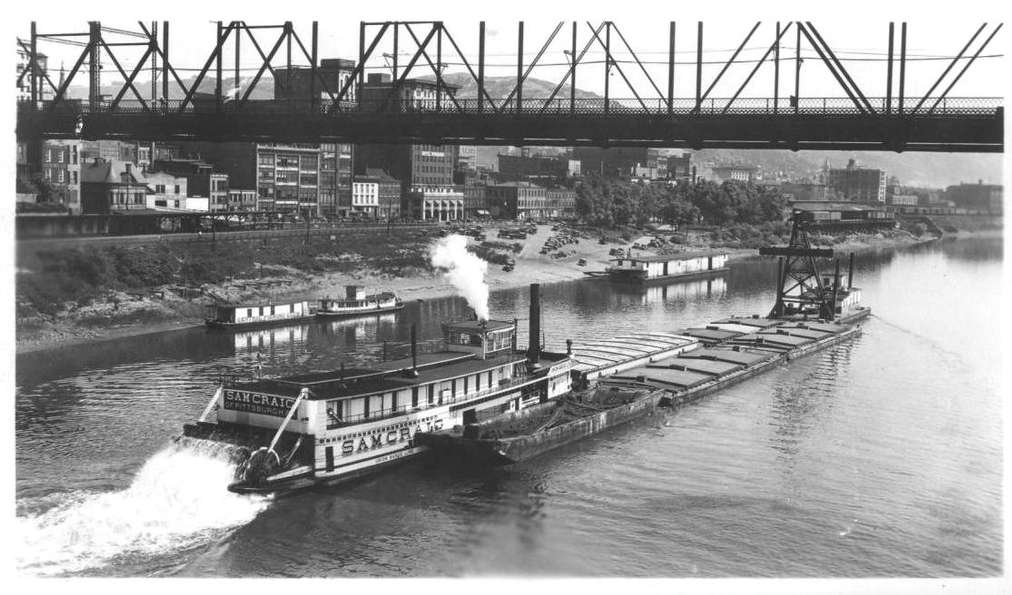
Sternwheel Towboat on the Ohio River – (Source)

The Ohio River, just like the Mississippi, was the life and livelihood of the people who lived along it. During the ‘50s and ‘60s HF radio was an essential part of this enterprise. Even more than medium wave broadcast radio of that time, the folks on boats depended on two-way communication over the HF airways.

Pittsburgh was not just a dispatch or control station for river traffic. It became a fountain of essential information, a clearinghouse for important messages. It was the cornerstone of social interaction for a population in constant transit.

Listeners in the 1950s often reported towboat captains calling dispatch, barges reporting position (“Upbound at mile 412…”), lockmasters giving traffic instructions, and weather and river-stage reports.

HF channels were shared working channels, not strictly controlled like today’s VHF marine channels. Besides traffic between the boats and Pittsburgh, there was also boat-to-boat communication. This was not chatty; it was disciplined, brief, and functional. There was a sense that HF radio was a valuable resource not to be abused. Before the modern lock system and before VHF towers lined the river, HF was the only way to maintain continuous communication along the entire 981-mile length of the Ohio River.

HF could skip over hills and valleys, reach hundreds of miles, work during floods, storms, or power outages, and connect boats to company headquarters far from the river. At a time before single sideband was in general use, Pittsburgh and riverboats operated with amplitude modulation (AM). Of course, there were no cellular telephones. Instead, HF radios afloat would occasionally contact shore-based stations which could then “patch” communications between ship and other shore locations over phone lines.

Many of the towboats and packets were family-owned and operated. The inland river system was one of the last major American transportation networks where family companies remained dominant well into the mid-20th century. These were not “packet boats” in the old passenger sense — by the 1950s, packets were gone — but family towboat companies were everywhere. Family crews were the norm. Several major river companies began as family outfits.

The boat was a floating extension of the family house. Kids often grew up on the river. Wives sometimes handled the books, payroll, or provisioning. Sons learned to steer before they learned to drive a car. Daughters often knew how to splice line or cook for a crew before they were teenagers.

Life aboard a family-run towboat was unlike anything in modern transportation. It was part workplace, part household, part floating village, and part family legacy. What you got was a blend of hard labor, deep routine, and a kind of river-born intimacy that only comes from living and working together in a confined space for weeks at a time.

Today, the U.S. Coast Guard works jointly with the U.S. Army Corps of Engineers, National Weather Service, and industry groups to manage the two river systems. It oversees marine safety, pollution response, and towing vessel incidents. It regulates, supports, and protects navigation on the Ohio and Mississippi Rivers, primarily through aids to navigation, safety enforcement, and emergency coordination.  Meanwhile, river communication has migrated to the VHF marine band.

Conclusion

The HF radio was a riverboat’s lifeline. On a family-run towboat, the HF AM radio was the telephone, dispatcher, news source, and emergency line. HF was the way to talk to the Corps (Pittsburgh) or to the company office, which might be someone’s house.

By the late ’60s or early ’70s VHF towers went up at every lock. Companies built microwave and landline dispatch networks. AM operation faded; finally, the last HF river channels went silent. Today, almost nobody remembers that era.

I have never listened to a station quite like Pittsburgh. It was a delicious slice of human experience. Unfortunately, it is an artifact of a time that has now passed. Still, I find myself absentmindedly punching in 8-2-1-3 on a DSP portable radio with the irrational belief that I will hear Pittsburgh. If it is true that a radio wave, once modulated, continues to travel forever, I like to think some being in a distant world may someday have their sense of imagination entertained as mine was many years ago.

Good DXing.

Bob’s Radio Corner: Where are the Broadcasters?

Source: NASA

Where are the Broadcasters?

As posed by Bob Colegrove

Whenever I ask myself that question, I can’t help thinking of a couple analogies.  Let me explain one.  In the mid-80s, there were three contenders for the home computing market: IBM, Apple, and Commodore.  There were others, but those were the main ones.  It was not uncommon for entrepreneurs to rent out halls and host fairs at which vendors for all three platforms would display the latest peripherals and software.  The IBM PC was incompatible with the Apple IIe; each, in turn, was incompatible with the Commodore 64.  Most of the software came at premium prices.  Why?  I was told that developers had to recoup their cost from the existing group of owners of each specific platform.  Being the early days of home computing, these groups were relatively small, and consequently, this determined the cost of software.  This situation was euphemistically known as the “installed base” ? an existing population of users who owned computers for the targeted software.

Applying this to radio, is there an installed base to warrant more international shortwave broadcasting?  From all appearances, there are more shortwave radios being marketed now than I can ever recall.  I searched for “shortwave radios” on Amazon, hoping to get a reasonable model count, but soon gave up.

Without getting into the politics of the issue, the Chinese are the dominant player in shortwave use today.  They are making most of the shortwave radios and doing most of the shortwave broadcasting.  The targeted audience is both domestic and international.  The radios they make are marketed around the world, apparently quite successfully.  An AI inquiry on the Internet can’t put a number on it, but states that there has been a resurgence of interest in shortwave, particularly since the COVID-19 pandemic and subsequent global conflicts.  Isn’t it reasonable to assume there is now a sizeable installed base of potential shortwave listeners?

If I may be allowed one more analogy, in 1950 the physicist Enrico Fermi asked the cosmic question, “But where is everybody?”  He was referring to the scope of the universe, the real probability that there are enough other habitable planets such that some others should support life.  His paradox is that we have not yet heard from anyone else.

Again, translating this to radio, given the proliferation of shortwave radios and listeners, where are all the broadcasters?  Hasn’t the quality, performance, reasonable cost, and availability of shortwave radios been the seed to start the resurgence of shortwave broadcasting?

The well-worn argument is that times have changed.  We now have the Internet and cell phones to instantaneously bring us an incomparable mass of information and entertainment, all of this on demand. Why contend with noise, interference and weak signals?  Why wait for desired content to be available on a certain day at a certain hour?  Further, and just as important, public broadcasting is costly in terms of production and delivery.  To put a face on it, shortwave radio does not permit one to fasten a $200 GoPro to the front of his bicycle, video his ride, post it on YouTube, and garner thousands of likes.

All of that is strong poison.  On the other hand, radio waves are an immutable form of electromagnetic radiation.  The medium is not going away.  With a high degree of certainty, it will eventually be repurposed, possibly in digital form or with some method of modulation which is yet unknown.  The content may be commercial, military, private, or public.  Someone is going to figure out a way to use it.

In the meantime, why can’t we use it just the way it is?  One advantage of radio is real-time broadcasting – talk radio, spontaneous news reporting, and emergency information.  While this is possible on the Internet, its implementation has been tangential.  For example, I can go for a live cab ride with a truck driver, watch trains run around Horseshoe Curve, or listen to a techno-specialist field viewer questions – all live it’s true, but still not quite the same thing.  Perhaps it is just a matter of time for the Internet to catch up.

The Internet is better for drawing maps and ordering products for home delivery.  Ultimately, however, it fails to engage the imagination.  Instead, the world is presented to us in vivid color leaving no detail in question.  With radio, the listener’s faculties are permitted much wider freedom.  One is allowed to color between the lines, “a fiery horse with the speed of light, a cloud of dust…”  Even the fading or hollow aural echo of a distant shortwave signal can stimulate further vision. That is radio’s ace in the hole.  It just needs the initiative of one visionary to give the ball a push and start it rolling.

Bob’s Radio Corner: What Is It About Radio Dials?

– Recollections of Bob Colegrove

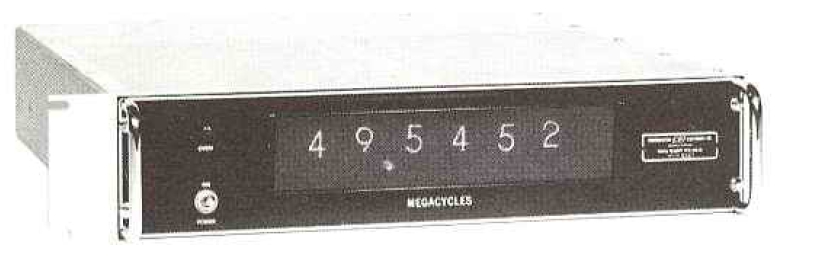
In the late ‘60s, I worked as a mechanical assembler at Communications, Electronics Inc. (CEI) in Rockville, Maryland (acquired by Watkins-Johnson Company).  We produced military-grade receivers, mainly for the military (whom else?).  These covered the spectrum from VLF through microwave.  It was the early days of electronic digital readouts.  There were no LEDs or LCDs.  Instead, some of our models featured the Numeric Indicator eXperimental, or “nixie” tubes.  These were glass tubes filled with low-pressure neon/argon gas, featuring stacked wire cathodes shaped like numerals (0-9) and a mesh anode.  An analog-to-digital circuit encoded the frequency to illuminate the correct digits.

Below is shown a DRO-50 Digital Readout from the 1968 CEI catalog.  It contained 6 nixie tubes for the frequency display, and the unit had an accuracy of ±100 Hz.  Interestingly, this frequency display was designed specifically for the Hammarlund SP-600 Receivers (R-274A/FRR (Army), R-274B/FRR (Navy)).  I never saw a DRO-50 come across our line and suspect it may not have gone beyond the prototype.  About that time, the SP-600s were ending their military service, so there wasn’t much of a market for upgrades.  It would still be a few years before I owned an SP-600 of my own, but how would I love to have one fitted with a DRO-50.

What I had instead of nixie tubes were variable capacitors or inductors, which changed the tuned frequency through a kluge of pulleys and strings, all these hidden behind a Raymond-Loewy-designed bezel and operated by the tuning knob.

What was visible on the front of the radio was an irregular representation of frequencies covering the tuning range of the radio, in other words, the dial.  As you rotated the tuning knob, you set the whole tuning mechanism in motion.  Signals were progressively tuned, processed, and reported through the speaker or headset as you advanced higher or lower.

Somehow the frequencies never quite agreed with the numbers or divisions on the dial.  It could be that the circuits inside the radio were out of alignment.  Just as likely, the design of the dial was determined using a preproduction prototype which could not possibly account for the tolerances of the components used on the assembly line.

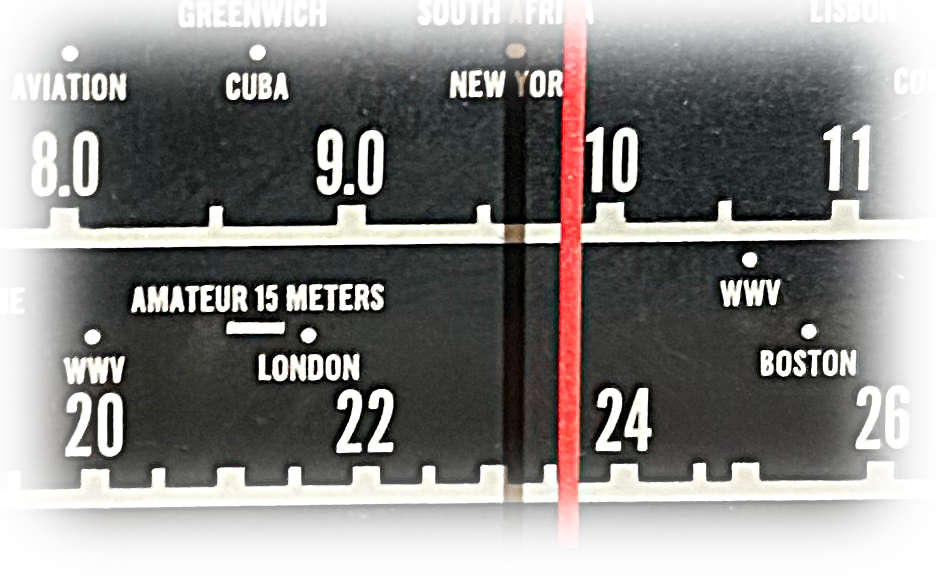
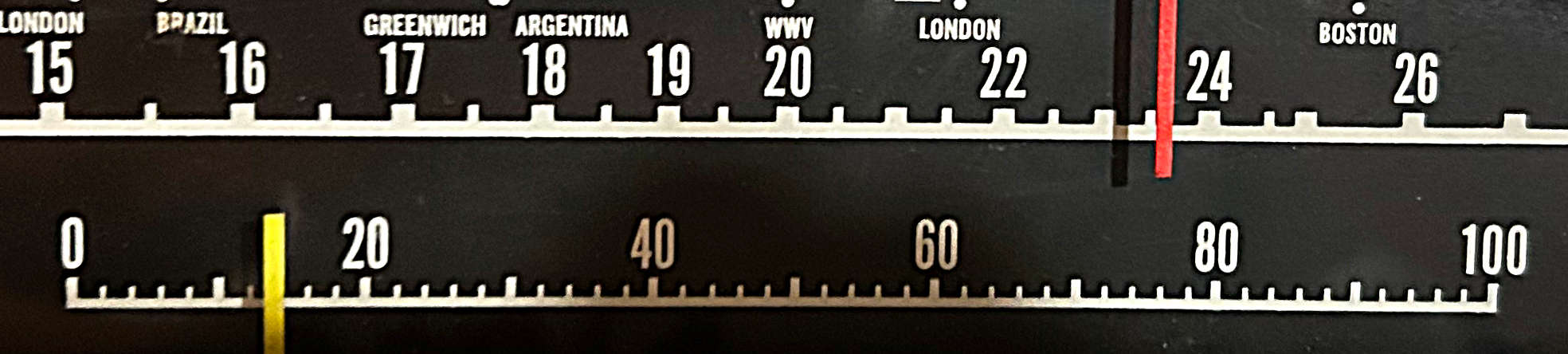
Consider the figure at the beginning of this posting.  It is a portion of the dial on a Hallicrafters S-38E – magnified somewhat.  The full dial on the E model was big and bright.  It extended across the front panel of the radio and presented frequency readout about as well as was possible.  Nevertheless, there were real shortcomings.

The figure is not only typical if communication receivers of the time but also living room console radios of an earlier period.  Take the 31-meter band as an example.  Broadcast stations were bunched roughly between 9400 kHz and 9800 kHz.  At 5-kHz channel spacing, this resulted in roughly 80 channels.  Of course, not all were in use at any given time, but still a smidgeon turn of the knob could traverse two or three stations.

This situation was relieved somewhat on communication receivers by the addition of a bandspread – a separate tuning mechanism which could effectively magnify a small portion of the main dial.  The idea was to place the main tuning dial at the high end of the desired band and the bandspread at 0.  Then, by tuning the bandspread toward the other end, lower frequencies could be tuned with greater separation.

Since the bandspread could be used at any place within the tuning range of the radio, a separate dial became a problem, so it was usually annotated with a simple logging scale incremented linearly from 0 to 100.  Thus, one had to compile a log-to-frequency conversion table or graph to interpret the frequency.  More sophisticated receivers could display the 80- through 10-meter ham bands on the bandspread dials.

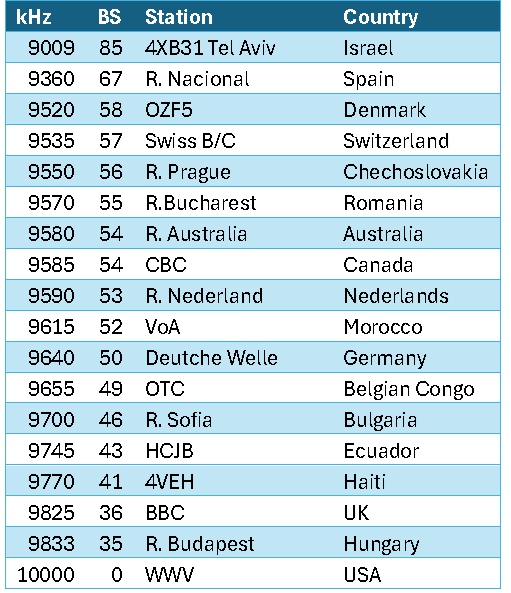
As an example, I located some notes made in 1959 using the S-38E.  The table shows the frequency, bandspread reading, station and country.  Thirty-one meters was an easy match for the bandspread, as WWV on 10000 kHz was a steady marker which you could use to calibrate the bandspread with the main tuning.  For all practical purposes, the band was bounded by the Voice of Spain on 9360 kHz and R. Budapest on 9833 kHz.  For many years, Tel Aviv was an outlier on 9009 kHz.

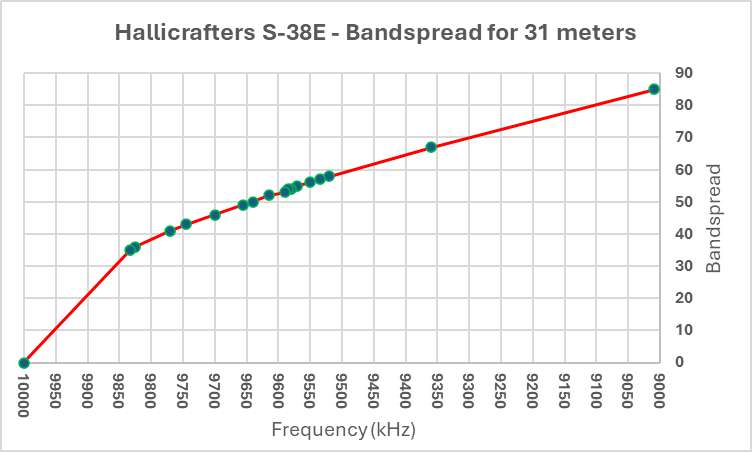
Alternately, one could construct a graph as shown below.  Unfortunately, most inexpensive radios did not produce linear tuning, so you couldn’t simply draw a straight line between two points on a graph and expect to interpolate the intermediate frequencies with accuracy.  Instead, graphs were constructed laboriously by hand adding intermediate points for known frequencies.  The figure shows the resulting parabolic function where the slope is greater on higher frequencies and gradually levels off as the bandspread is tuned lower.  Notice that most of the activity was mashed between 40 and 60 on the bandspread, then compare this with the picture of the bandspread above.

On the S-38E a bandspread was something of an improvement, but not the complete answer.  The problem only got worse as you went higher in frequency.  At 19 and 16 meters the band compression became quite severe.

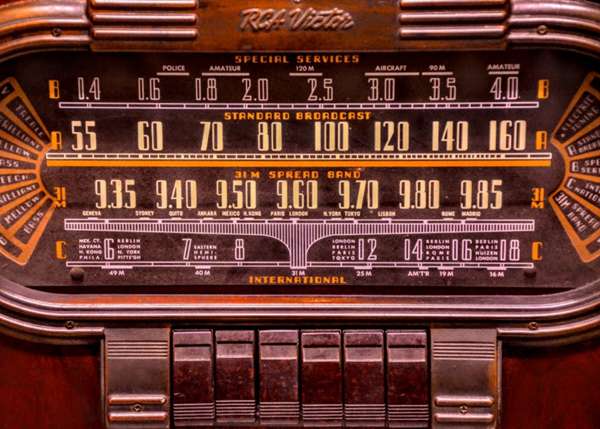
Our esteemed leader, Thomas, occasionally uses a picture of the dial shown below as a lead figure of a posting.  It is possibly an RCA Victor Model 110k console radio.  When I see this, I think, who wouldn’t give a king’s ransom to own that radio in its fully restored condition?  Note the 31-meter band has been magnified as its own separate band and appears in a near linear progression.  Thirty-one meters was arguably the center of international shortwave broadcasting in the golden age.

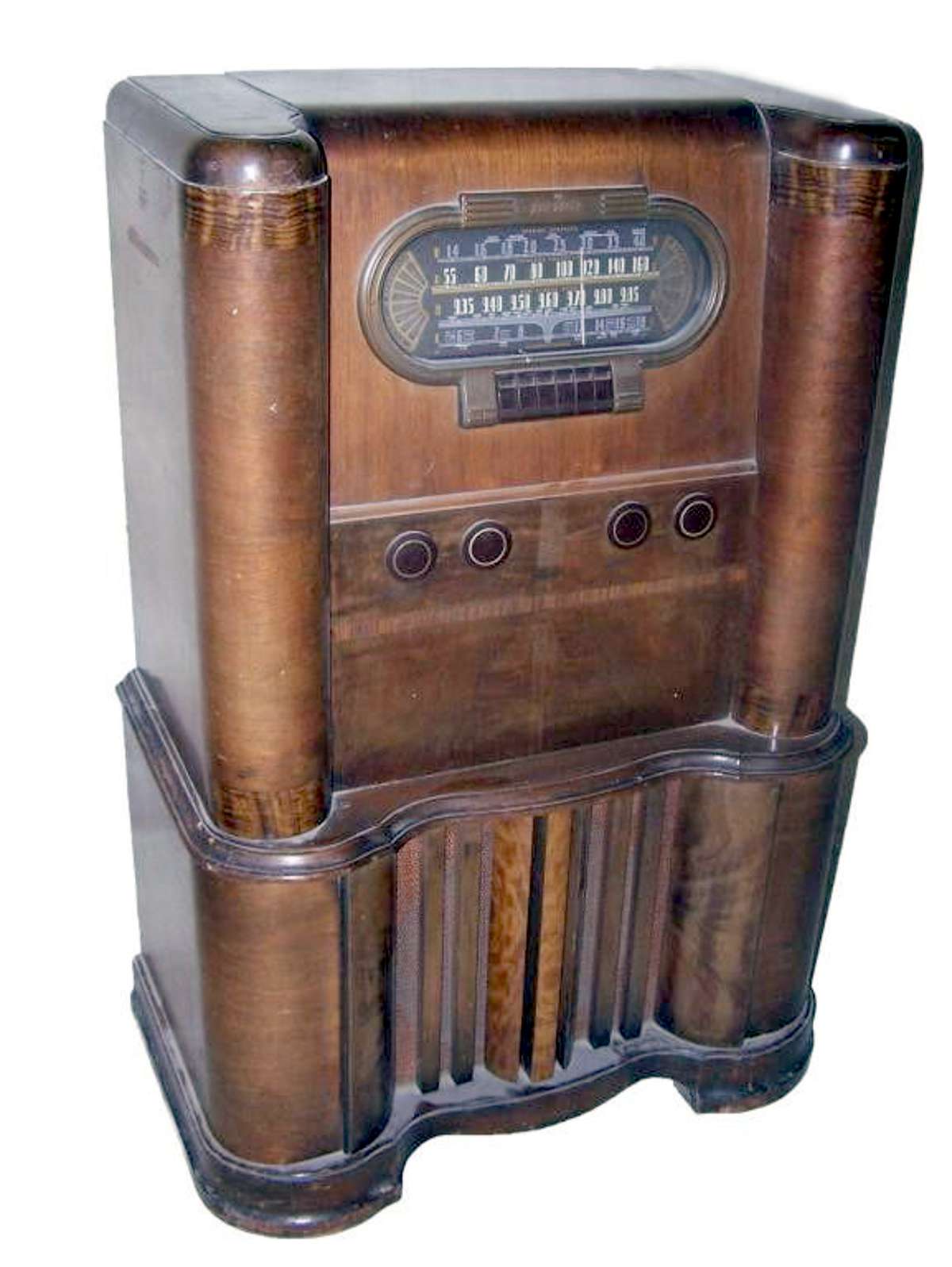
Have you ever wondered what the rest of that radio looks like?  Here’s one in sore need of some Pledge.  Now imagine yourself, perhaps 11 or 12 years old, perched in front of it on your grandmother’s needlepoint stool tweaking the dial.  If you have experienced this, no explanation is necessary.  If you haven’t, none is possible.

So, as it turns out, I have tempered my earlier conviction that a digital frequency readout is necessarily better than a classic dial.  Not to say you can easily pry the PL-880 with 10-Hz resolution from my cold, stiff hands, but I have come to realize that intrigue and mystery of shortwave listening rested in the uncertainty of knowing exactly what frequency you were on.  There was always the possibility that the elusive Nibi Nibi Islands lay somewhere near the shadow cast by the dial pointer.  It was a land of enchantment, and once you left its borders, you could never return again.

Bob’s Radio Corner: It’s DX Season

Noted by Bob Colegrove

In the Northern Hemisphere the nights continue to get longer as we approach the winter solstice; we gain an hour of early evening darkness on Sunday, November 2nd; the summer atmospheric disturbances are nearly gone; propagation is better.  It’s time to set aside the activities of summer and once more dive underneath the headsets.

DXing is not the same thing as listening.  For listening you position yourself in a nice recliner with the radio on a table beside you.  You set the radio to ATS and scan the available fare.  You select one of the more interesting results and, together with your favorite beverage, listen to the programming.  DXing, on the other hand, requires well planned work and lots of patience.  Critics might say it also requires some imagination; however, I have always tried to be honest with myself and ask if what I am hearing is truly QSLable.

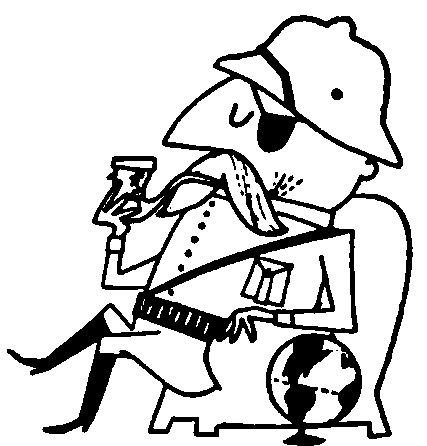
Sir Oswald Davenport, intrepid DXer and Chairman,
National Association of Armchair Adventurers

Don’t get me wrong, I listen a lot, but I also DX.  Living on the East Coast of NA, I often direct my antenna toward Asia and the Pacific hoping to hear Japan and New Zealand.  However, more often than not, these have proven to be illusive.  DXing is like fishing.  Often, you pull up an old boot or find the bait is gone.  Further, the sound quality of a true DX signal will have no appeal to an audiophile.  It is intentionally weak and subject to fading.

So, you get your wins when you can.  Last February I scanned the 49-meter band stopping at 6130 kHz to identify some faint pop/rock music.  There were two possibilities, a Chinese station and Radio Europe.  If you have never heard of Radio Europe, it is in Alphen aan den Rijn, The Netherlands, and has a rather imposing name for a modest 1 kW station.  It is targeted to Western Europe, and is listed in HFCC, B25.  The station is identified periodically in English by a dramatic baritone male announcer.  The recording was made at 0211 UTC on February 6, 2025.  The announcement begins 9 seconds into the clip; Radio Europe is mentioned at 23 seconds.

The curious thing is Radio Europe is not necessarily well received at the U. of Twente SDR site just 100 miles away.  Science notwithstanding, there is simply no accounting for propagation.

Well, Radio Europe is back this season as strong as I have heard it, and if you’re a NA East Coaster, you might give it a try from 2300 UTC on.  I see it was reported in Florida in 2023.  Using exalted carrier single sideband (ECSS) (SSB in simpler terms) seems to produce the best results.  Despite low power and long distance, it’s occasional stations like Radio Europe that keep this DXer fishin’.  For a clear sample, it streams here http://p.liveonlineradio.net/?p=radio-europe.

Good DXing ’25-’26.

Dexter D. Xer

Bob’s Radio Corner: Shortwave Multiplex?

Reported by Bob Colegrove

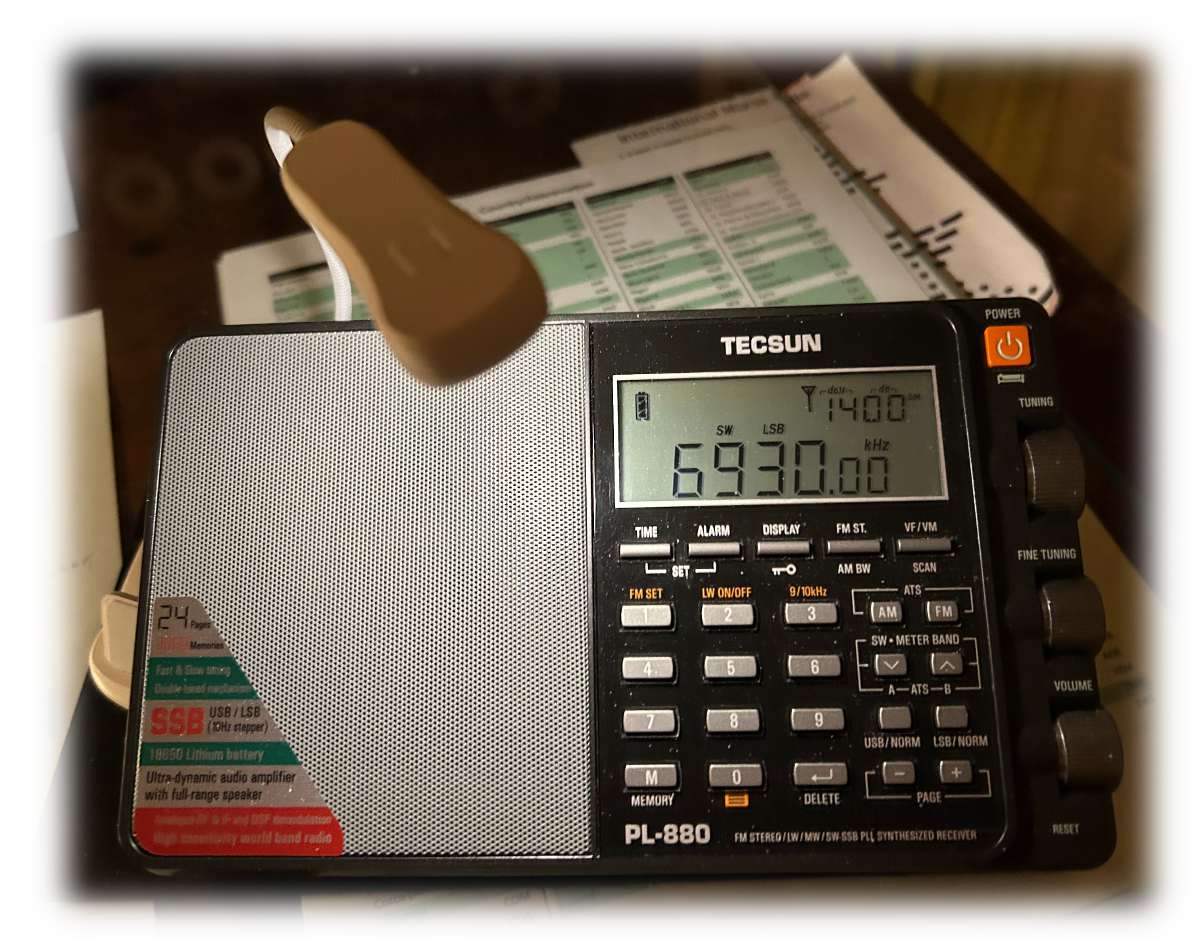
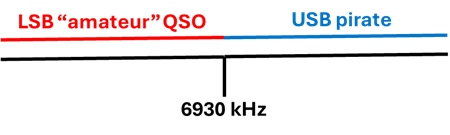
Incurable DXers are always looking for new challenges.  So it was, I recently did some scanning between 42 and 45 meters (~6600 to 7000 kHz).  Trenton Military on 6754 kHz and the MARS net on 6913 kHz are regulars here, as are a selection of pirates above 6900 kHz.  However, I have never experienced anything like this.  It took me a while to sort things out.  A pirate on 6930 kHz was quickly detected on the upper sideband, but there was some garble slightly lower.  It turned out to be a few folks having a QSO in Spanish on the lower sideband of 6930 kHz.

Two transmissions both squatting on the same frequency.  The irony was, sans carriers, there was absolutely no mutual interference.  Each signal was clearly received by alternately pressing the USB and LSB buttons.  Likely the QSO folks were somewhat out of band for 40 meters, and it goes without saying that the pirate shouldn’t have been there.  Nevertheless, I would call that efficient use of the spectrum.

Date:  October 11, 2025

Time:  0030 until 0100 UTC

Receiver:  Tecsun PL-880

Antenna:  Bob’s Updated Passive, Resonant, Transformer-Coupled Loop Antenna for Shortwave

Bob’s Radio Corner: Uncle Clayton and His National NC-188

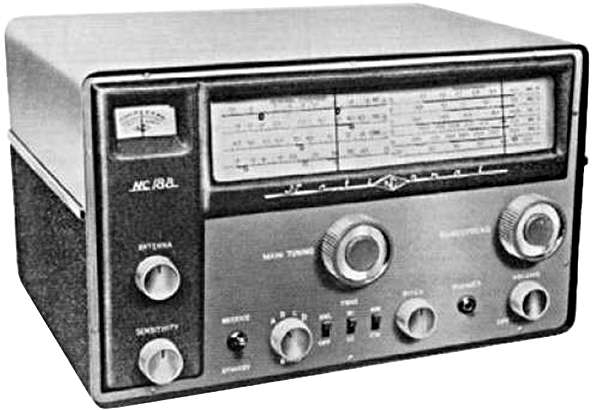
National NC-188

As recalled by Bob Colegrove

Uncle Clayton was my very first SWLing buddy.  In the late ‘50s there was no Internet – very few ways for SWLs to interact with one another.  There were clubs that published mimeograph bulletins every month or so.  These were mailed to SWLs across the country and around the world.  To come across a fellow SWL in your own town was rare.  As chance would have it, Uncle Clayton and I quite independently discovered our interest in SWLing about the same time, and then only after knowing one another for several years.

Uncle Clayton was not my real uncle.  He and his wife, Evelyn, were dear friends of my mother and father.  You see, there was a social decorum at that time which frowned upon members of the younger generation from referring to members of an older generation by their first name.  At the same time, “Mr. Smith” and “Mrs. Smith” (not their real surname) were regarded as unnecessarily formal; so, for this situation “Uncle Clayton” and “Aunt Evelyn” became the accepted form of address.

My story begins with television, not radio.  By mid-1950 both the Smiths and the Colegroves had acquired their first black and white TV “sets,” theirs a 12-inch RCA and ours a 12-inch Arvin.  Each of these occupied 8 to 12 cubic feet of space and required two well-fit individuals to move them.  Ironically, they were termed “portable” in that they required a low table or stand for proper positioning.  This contrasted with “console” models which incorporated the stand and the TV in a single cabinet.

One must understand that television at that time was what computers would become a generation later.  The nation was on the cusp of a TV frenzy.  My dad and Uncle Clayton jumped into it with both feet.  They couldn’t let the darn things alone.  Antennas were the most obvious source of tinkering.  “Rabbit ears” were the customary solution but adjusting them was a skill rivaling that of playing a cello.  Later, attic designs were fabricated for the new channel in Bloomington, Indiana.

Vaccum tubes, both necessarily and unnecessarily, became questionable components, and Uncle Clayton and my dad developed well-stocked arsenals of spares.  In retrospect the pair were, well…a couple of hacks, and I say that lovingly.  Picture two large, middle-aged men behind the RCA with the back cover off alternately trying to get a 9-pin peanut tube aligned and reinserted into its socket in the very front of the chassis – all this while trying to avoid the high-voltage discharge from the picture tube.  I still recall the looks of frustration and muffled puffs of blue air.  After some time, Aunt Evelyn appeared, looked over the dilemma, grabbed the tube, and jabbed it into the socket on the first try.

SWLing came along several years later.  I discovered it in the fall of 1958 while idly tinkering with the Howard Radio Co. Model 308 radio-phonograph console, which by that time had been relegated to the basement.  After moving it to my room and stringing up a long wire I was forever captivated.  The single SW band covered 5.5 MHz through 18 MHz across a dial a mere four inches long.  I milked that old radio relentlessly finally coming up with about 20 or 30 SW broadcast stations, all in English.

I have no recollection of how Uncle Clayton and I discovered we were going down the same path.  He had already purchased his National NC-188 with a matching speaker and set up his shack in an unused upstairs bedroom.  How I envied him.  His NC-188 was everything I envisioned in a SW radio. I was still earning my way towards purchasing a Hallicrafters S-38E.

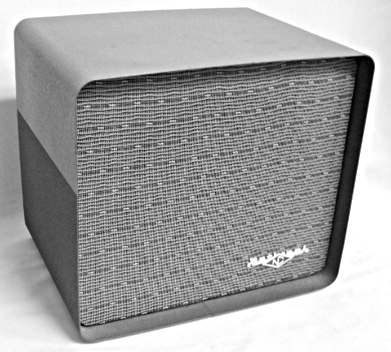
National NTS-1 Speaker for the NC-188 and NC-109.
Better radios had separate external speakers, the claim being that there was insufficient space in such feature-packed units

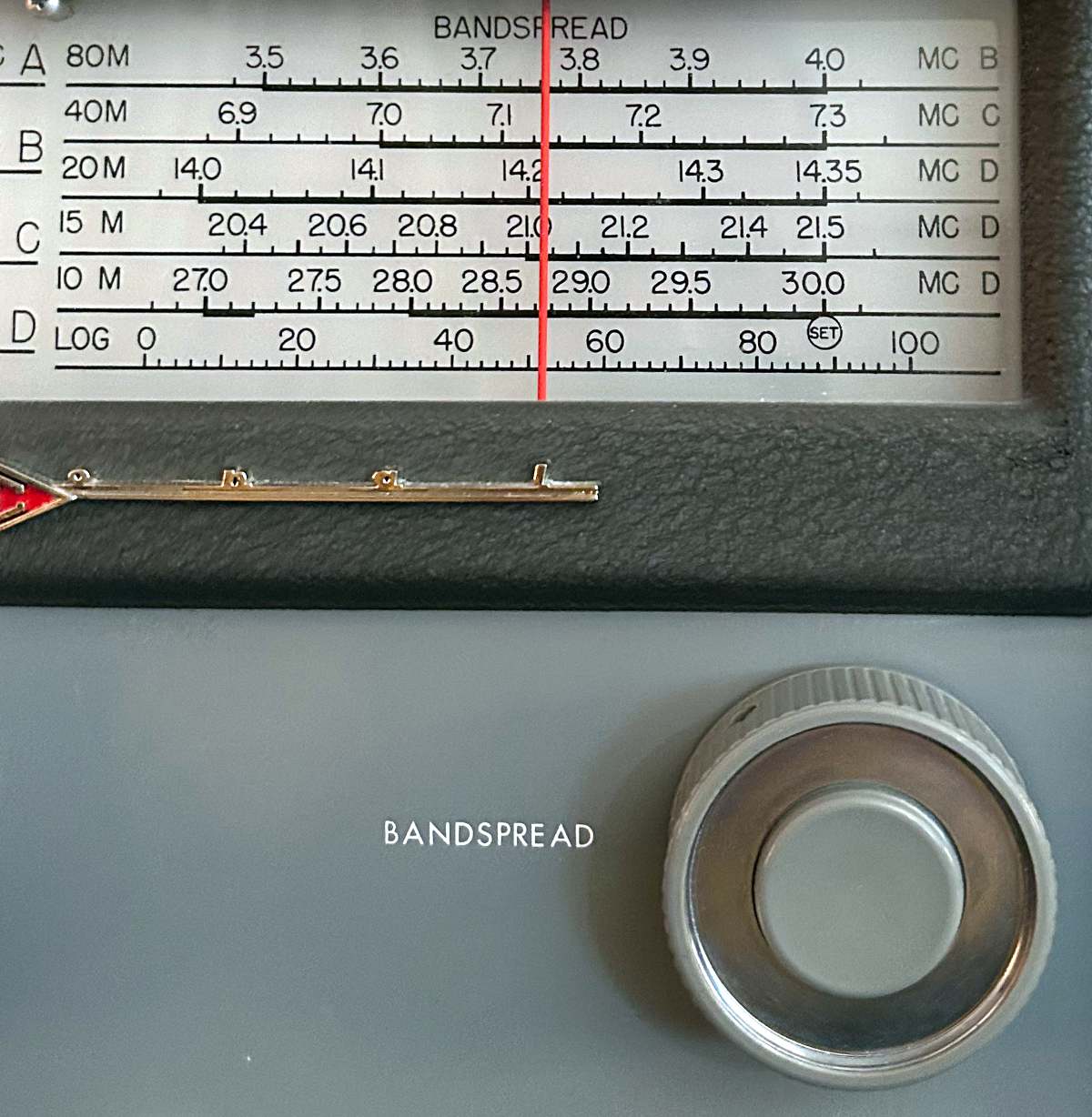
Uncle Clayton’s NC-188 was my first encounter with a bandspread – a term which has virtually gone out of existence.  I immediately knew what it did, but it would take me a while to understand just how it worked.  On my old Howard console, the dial pointer travelling less than a 16th inch could cover 100 kHz or more, conceivably containing 10 or 20 stations.  Furthermore, this range was traversed by a nearly imperceptible rotation of a small knob.  Conversely, the NC-188 might cover the same tuning range over a space two inches long and require four full rotations of a 2-in diameter knob.  That was an incredible mechanical advantage.

For SWLs, there was a restriction on the use of the bandspread.  Most receivers had scales neatly calibrated for the 10-, 15-,20-, 40-, and 80-meter ham bands.  This provided reasonable frequency readout – not the precision we have with today’s digital radios, but close enough.  For international broadcast bands, the listener had to rely on a 0 to 100 linear logging scale which bore no relation to frequency.  This required the listener to generate several lists or graphs translating log readings to frequency.

The NC-188 and -109 had 4.5” bandspreads, not as long as some, but the 2” knob required 9 full rotations to traverse end-to-end.

Everything I have described so far depended on the position of the main tuning dial.  The bandspread operated electronically in parallel with the main tuning.  In short, the main tuning dial had to be positioned precisely at the high end of the tuned band for the bandspread to produce the same results.  Within these restrictions, a bandspread was still a marvelous device.

Uncle Clayton and I were still in our formative SWLing period when our family would visit him and Aunt Evelyn.  I remember him patiently tuning across portions of the SW spectrum oblivious of the international band boundaries slowly rotating the main tuning dial and stopping at points that interested him.  When my turn at the helm came, I would often seek out the General Overseas Service of the BBC and listen to the football scores or Victor Sylvester and his Ballroom Orchestra.

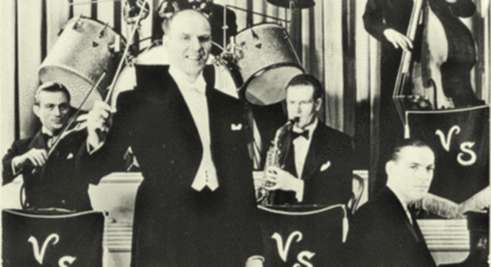
Victor Silvester conducting his Ballroom Orchestra in 1938. His orchestra was still a fixture on the BBC in the ‘50s and ‘60s. Source:  Victor Silvester and His Orchestra – You’re Dancing on My Heart

Neither Uncle Clayton nor I set the bar very high in terms of DXing prowess.  We had fun and made a lot of interesting discoveries.  Isn’t that what it’s all about?

Some years ago, I had the opportunity to buy a fairly clean National NC-109.  The -109 is an upscale version of the -188.  It has a crystal filter, an early SSB product detector and a voltage regulator.  Otherwise, the two radios are virtually identical.  I did all the usual things, cleaned it up, performed an alignment, and restrung the main tuning and bandspread dial cords.  Later I found a matching speaker.  When I was finished, I had what I regard as a museum-quality radio.  It occupies a prominent corner of the shack, but I don’t operate it that much.  Sometimes I just sit in front of it, spin the dials and remember Uncle Clayton and how it all started.

National NC-109

Bob’s Radio Corner: Illuminating Radios

An operating 50C5 pentode is a thing of beauty.

The Book Lamp; or Shedding Some Light on a Radio

Illuminated by Bob Colegrove

There was a time in this writer’s memory when radios were well lit – well, at least the ones with glass tubes.  Tubes emitted a warm glow which made the radio come alive, generated some heat on a cold winter night, and created an aura of mystery revealing signals from faraway places.  Besides glass tubes, a #44 or #47 incandescent bulb was likely inserted just out of sight beside the dial.  This illuminated the dial information, which, however, required some mathematical interpretation.

Today’s radios are dark.  Inside them, circuit boards and ICs look like an unanimated scene from Tron.  Most often, the only illumination is from the LED or LCD display, and that is often weak, or lasts just a few seconds.  Unlike the old dials, displays do convey some useful information; but they have shortcomings which can be summarized into three general categories:

  1. Some displays are very dimly lit.
  2. Some displays don’t have continuous illumination.
  3. Some displays have continuous illumination, but their use consumes power.

I have radios in each of these categories.  A desk lamp, if available, can’t always be placed in the right position relative to the radio.

Having a natural bent to fabricate things, I began to conjure a solution.  This would require three components:

  1. An independent source of light,
  2. a bracket to hold the light in place, and
  3. a stand to counterweight the light and bracket.

I quickly began to see mechanical problems attendant to fabrication, plus the realization that construction would demand some effort on my part.  My project quickly transformed into a search for a product on the Internet which would satisfy the requirements without me expending any work.

I found a book lamp has the advantage of illuminating the entire radio keyboard, not just the display.

There is a wide selection of book lamps.  My search focused on LEDs with rechargeable lithium batteries.  That didn’t narrow things down very much.  There are a lot of them.  My choice without a whole lot of research was a Vekkia 3000-K Warm LED Rechargeable Book Light [SWLing Post affiliate link].  It has not disappointed.

  • It’s the right size for most portable radios, ~7-in long flexible gooseneck, 2.01-oz weight.  The clamp opens about 1.8 inches.  It folds up into a compact bundle and it would be no problem to pack for a trip.
  • There are six 3000-K LEDs having three brightness levels.  Some of the other models have multiple color temperature settings.  3000 K is relatively warm, easy on the eyes during long use.
  • The vendor claims up to 80 hours of operation at the lowest light level.  I have been operating mine at the middle level.  Full charge is claimed to take 1.5 hours.  A short USB-C cord is supplied.
  • The clamp and battery assembly are heavy enough to serve as a stand and can support the lamp without clamping.
  • The clamp will fit on the end of the radio kick stand.  This might be the preferred way to operate the radio if it is being handheld.
  • Most importantly, the lamp was operated separately near the radio and the antenna and did not produce any noise.  This would not be the case during charging with a USB wall wart.

The photo below shows how the problems listed above have been resolved with a book lamp.  The arrangement is complemented with a 7-inch Kindle Fire tablet displaying a current shortwave broadcast listing – a nice package at home or away.

Tecsun PL-990 with its switch-settable continuous light turned off

There is a certain charm operating the radio with only a book lamp for illumination – certainly not like vacuum tubes, but charm, nonetheless.  Improving the radio listening experience is an on-going process.