
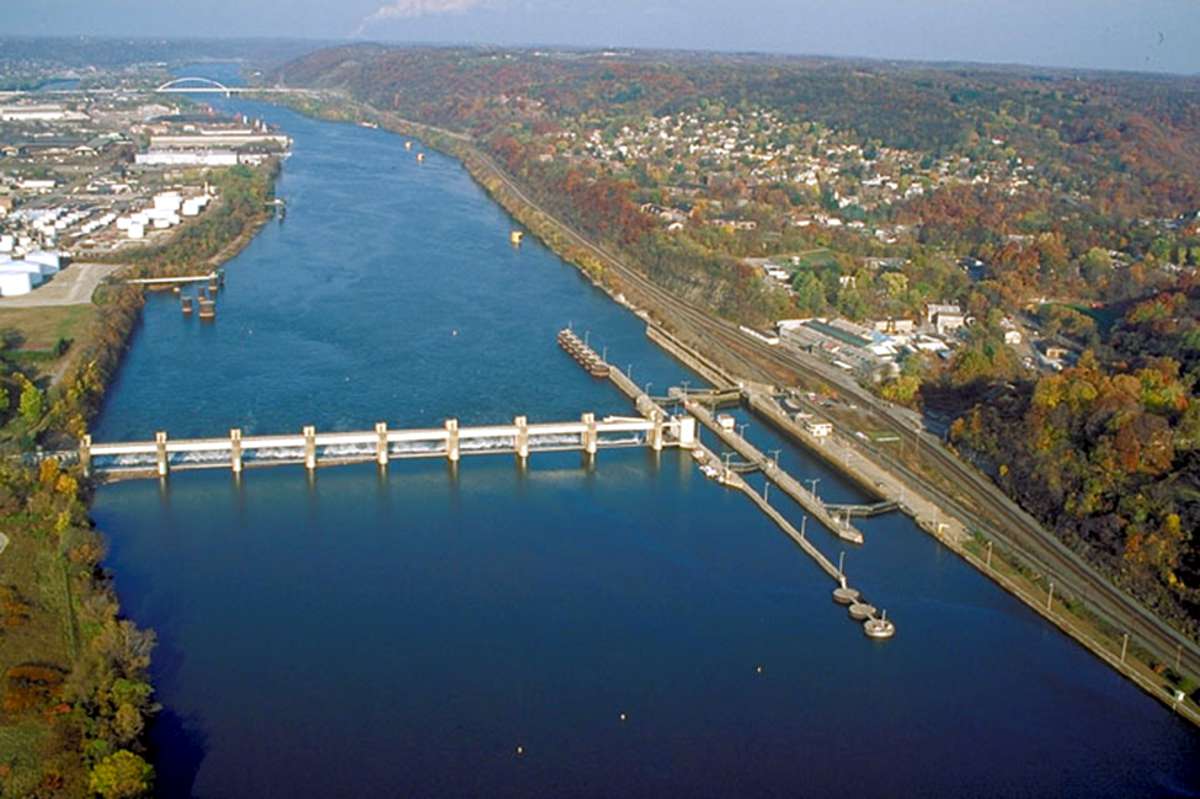
Emsworth Locks and Dam (Ohio River, Mile 6.2) Source: U.S. Army Corps of Engineers
By Bob Colegrove
If you happened to tune 8213 kHz during the ‘50s or ‘60s, you might have heard a dialog something like this:
Boat: “Pittsburgh, this is the Mary Alice, upbound at mile 14, request lock status.”
Pittsburgh: “Mary Alice, Emsworth has a two-tow delay. Recommend holding below the wall.”
Boat: “Roger, Pittsburgh. We’ll hold.”
You would have heard one of the U.S. Army Corps of Engineers’ HF River traffic control stations that operated on the Ohio River system. This station was not called “Pittsburgh Radio;” nor was it called “Radio Pittsburgh.” It had no known K… or W… call letters. Instead, each of these stations identified itself by city name only. In this case you might hear, “Pittsburgh calling downbound tow at mile 12…” or “Pittsburgh to all traffic: lock delay at Emsworth…”
From the 1940s through the late 1960s, the Corps of Engineers operated a network of HF shore stations along the Ohio and Mississippi river systems. These stations coordinated tow and barge movements, lock traffic, river closures, weather and river-stage reports, and emergency traffic.
 From the earliest time, I was enthralled by the international shortwave broadcast bands and had spent most of my time listening to the usual stations most of us remember. Since my old console radio had continuous coverage from 5.5 MHz through 18 MHz, I was curious about what lay between the broadcast bands.
I stumbled across “Pittsburgh” very early in my SWLing life. Pittsburgh stood out clearly. Along with WWV, it was the only other utility station I was able to identify during that time. I was fascinated by the conversation.
The Corps used a cluster of HF frequencies in the 8 MHz band for long-range river communication. These were not publicized like marine ITU channels; they were internal government/industrial channels. The 8 MHz band was chosen because it propagated well along the river valleys; it worked day and night; and it reached 100-to-300 miles reliably.
I don’t know how I ever determined the frequency. It was never announced, and I certainly couldn’t determine it on my old radio. The entire span from 5.5 MHz to 18 MHz covered a mere 4 inches on the dial. The pointer itself was about 100 kHz wide at this range. Somehow, I was eventually able to determine 8213 kilocycles.
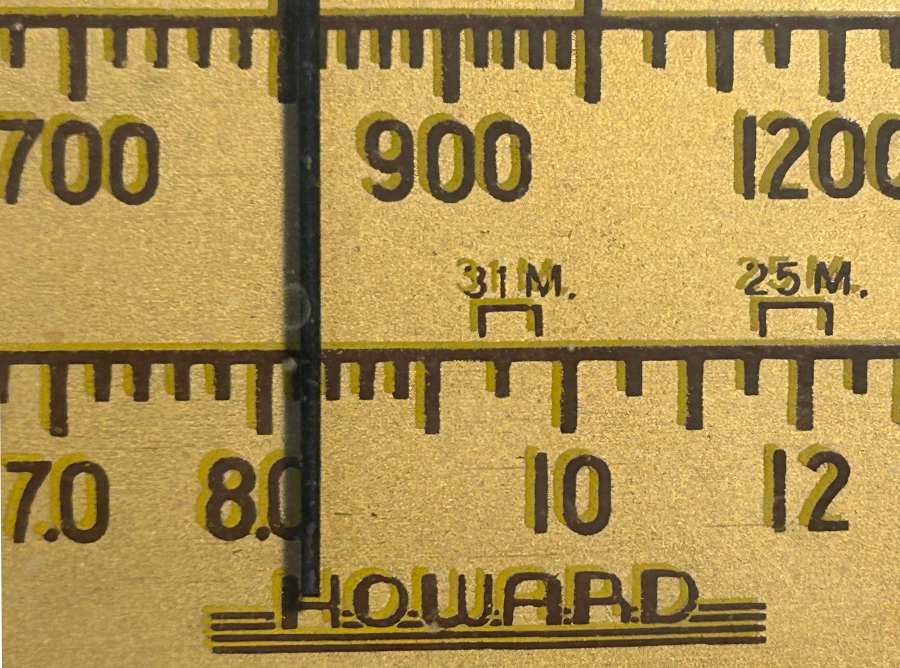 Note that the frequency of 8213 kHz did not conform to the 32-channel duplex frequencies which eventually were carved out of this band. Pittsburgh was born out of necessity at a time when radio was still young and offered a ready solution to an age-old problem.
Before VHF towers lined the river in the late ‘60s and ‘70s, HF was the only way to maintain continuous communication along the entire Ohio River. The Pittsburgh District of the Corps oversaw the Emsworth Lock (Mile 6.2), Dashields Lock (Mile 13.3), and Montgomery Lock (Mile 31.7).
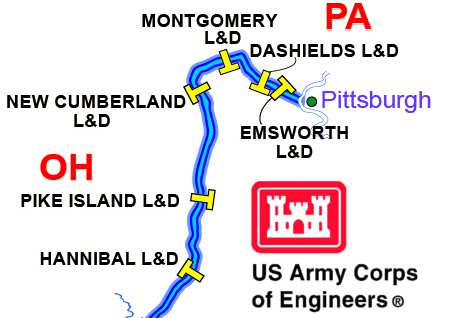
Pittsburgh Engineer District 2026
Commercial riverboat life on the Ohio River in the ‘50s and ‘60s was a world in transition. Just as the keelboat days and the legendary Mike Fink had given way to steamboats, by the early 1950s the Ohio River was shifting decisively from classic steam navigation to diesel-powered towboats pushing long strings of coal and freight barges. However, pockets of river-based living, indigenous to the previous age, were still hanging on.
The U.S. Army Corps of Engineers began replacing the old 19th-century lock-and-dam system with modern locks and dams in the early 1950s, creating deeper, more reliable navigation channels and enabling larger commercial traffic. These improvements supported the rise of large commercial operations, such as American Commercial Barge Line (ACBL), which maintained marine equipment registers and fleets during this era. Coal, petroleum products, aggregates, grain, and manufactured goods formed the backbone of mid-century river commerce moving between Pittsburgh, Cincinnati, Louisville, and down to the Mississippi.
The river had its share of hazards with winter ice and spring floods. The new lock-and-dam system gradually tamed these extremes, but the river remained unpredictable.
Life aboard a mid-century towboat was demanding. Crews worked long shifts. Work included line-handling, engine maintenance, navigation, and barge assembly. The river was both workplace and community. Small towns along the Ohio still remembered their steamboat heritage, shipyards, and wharf culture.
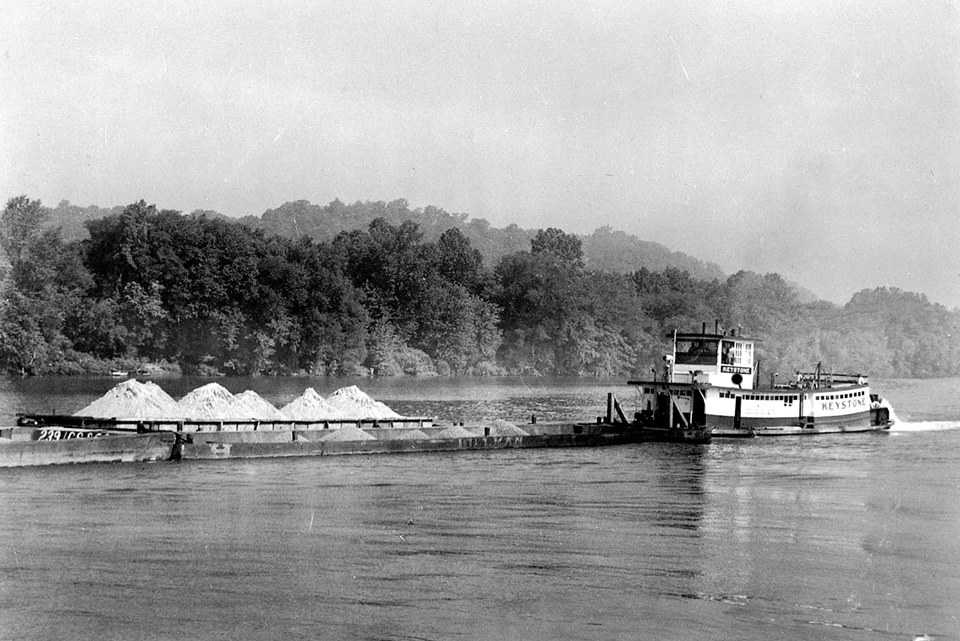
Sternwheel Towboat on the Ohio River – (Source)
The Ohio River, just like the Mississippi, was the life and livelihood of the people who lived along it. During the ‘50s and ‘60s HF radio was an essential part of this enterprise. Even more than medium wave broadcast radio of that time, the folks on boats depended on two-way communication over the HF airways.
Pittsburgh was not just a dispatch or control station for river traffic. It became a fountain of essential information, a clearinghouse for important messages. It was the cornerstone of social interaction for a population in constant transit.
Listeners in the 1950s often reported towboat captains calling dispatch, barges reporting position (“Upbound at mile 412…”), lockmasters giving traffic instructions, and weather and river-stage reports.
HF channels were shared working channels, not strictly controlled like today’s VHF marine channels. Besides traffic between the boats and Pittsburgh, there was also boat-to-boat communication. This was not chatty; it was disciplined, brief, and functional. There was a sense that HF radio was a valuable resource not to be abused. Before the modern lock system and before VHF towers lined the river, HF was the only way to maintain continuous communication along the entire 981-mile length of the Ohio River.
HF could skip over hills and valleys, reach hundreds of miles, work during floods, storms, or power outages, and connect boats to company headquarters far from the river. At a time before single sideband was in general use, Pittsburgh and riverboats operated with amplitude modulation (AM). Of course, there were no cellular telephones. Instead, HF radios afloat would occasionally contact shore-based stations which could then “patch” communications between ship and other shore locations over phone lines.
Many of the towboats and packets were family-owned and operated. The inland river system was one of the last major American transportation networks where family companies remained dominant well into the mid-20th century. These were not “packet boats” in the old passenger sense — by the 1950s, packets were gone — but family towboat companies were everywhere. Family crews were the norm. Several major river companies began as family outfits.
The boat was a floating extension of the family house. Kids often grew up on the river. Wives sometimes handled the books, payroll, or provisioning. Sons learned to steer before they learned to drive a car. Daughters often knew how to splice line or cook for a crew before they were teenagers.
Life aboard a family-run towboat was unlike anything in modern transportation. It was part workplace, part household, part floating village, and part family legacy. What you got was a blend of hard labor, deep routine, and a kind of river-born intimacy that only comes from living and working together in a confined space for weeks at a time.
Today, the U.S. Coast Guard works jointly with the U.S. Army Corps of Engineers, National Weather Service, and industry groups to manage the two river systems. It oversees marine safety, pollution response, and towing vessel incidents. It regulates, supports, and protects navigation on the Ohio and Mississippi Rivers, primarily through aids to navigation, safety enforcement, and emergency coordination. Meanwhile, river communication has migrated to the VHF marine band.
Conclusion
The HF radio was a riverboat’s lifeline. On a family-run towboat, the HF AM radio was the telephone, dispatcher, news source, and emergency line. HF was the way to talk to the Corps (Pittsburgh) or to the company office, which might be someone’s house.
By the late ’60s or early ’70s VHF towers went up at every lock. Companies built microwave and landline dispatch networks. AM operation faded; finally, the last HF river channels went silent. Today, almost nobody remembers that era.
I have never listened to a station quite like Pittsburgh. It was a delicious slice of human experience. Unfortunately, it is an artifact of a time that has now passed. Still, I find myself absentmindedly punching in 8-2-1-3 on a DSP portable radio with the irrational belief that I will hear Pittsburgh. If it is true that a radio wave, once modulated, continues to travel forever, I like to think some being in a distant world may someday have their sense of imagination entertained as mine was many years ago.
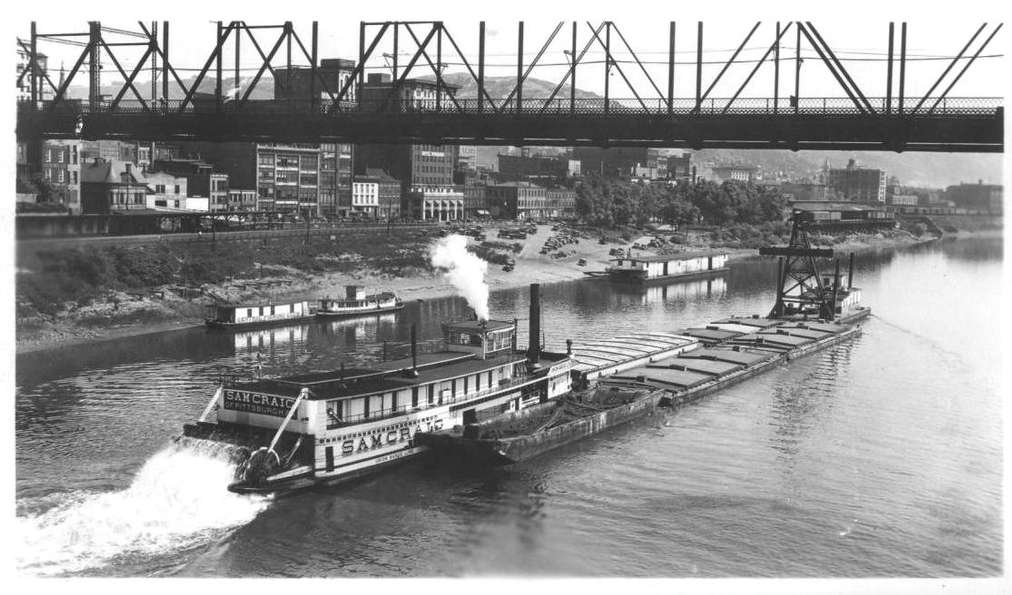
The Sam Craig (Source: Ohio County Public Library, Wheeling, WV)
Good DXing.
Here on the West Coast, 1950s-60s, HF was used similarly by boats servicing the various offshore oil drilling platforms. Thanks for the informative article.
Thanks so much for this article! As a young SWL with a Hallicrafters S-40A receiver I would listen to the towboats on the Ohio River communicating with nearby Paducah, KY. My favorite was to listen to the “grocery boat” and the towboats putting in their grocery orders (which involved huge amounts of food). I’m thinking they were somewhere in the 4 Mc range, and I see Jock mentioning 4125 Kc. (Using “cycles” in keeping with the era of the story. 🙂 )
About a dozen years ago, I was working on an FAA ADS-B system at Port Sulphur, LA, where I came across a small Mom and Pop VHF radio dispatch company on the Mississippi that served the grain carriers in and out of New Orleans and Baton Rouge, they had about three repeater sites using Moto GP radios along with dispatchers out of Baton Rouge that would supply the ships with fuel / groceries etc. for quicker turn-around. The owner expressed concern about a larger company with fancier equipment trying to move in on his humble business model. Ten years later it didn’t matter, as everything is replaced with cellular or satellite.
Bob, Bob, oh Bob! — you made my heart “soar like an eagle.” What a wonderful article!
I used to tune the Missipp towboats on 4125 . . . I love listening to people doing their jobs on the radio, and you took me back there .
Put a Gold Star on your chart, a smile face on your cubby — ya done good.
For fun, I will leave you with the lyrics for Steamboat Whistle Blues by John Hartford:
Well I started out to be a towboat man
But I never got the hang of a ratchet bar
I was a -growin up a-deckin in the
Illinois trade with coal dust in my ear
I got stuck in the ice on Christmas Eve
And I froze my ass it’s true
Just a shiv’rin and a-shakin with a Down South case of them
Steamboat whistle blues
Oh Captain Way I’m sorry, my hat is off to you
You’ve been a-hanging out by the old cook stove
With the steamboat whistle blues
For the really curious, here’s the video: https://youtu.be/Dj1CJpUUaRo?si=hLCH7IdPtp3blAjb
Cheers, Jock
Hi Jock,
I surely miss John Hartford. He was a fine musician and poet.
My favorite:
PS
I meant to add this to my post
Aviation pioneer and British immigrant to The Lucky Country (Australia) Nevil Shute Norway, better known by his pen name as the novelist Nevil Shute, in “Beyond The Black Stump” and also in “A Town Like Alice” captures the significance of HF radio in remote rural Australia in the 1950s
Nevil Shute is known to generations of Americans for his post-apocalyptic novel “On The Beach”, set in Melbourne, Australia….
73
Julian
Thank you for your marvellous evocative memory of HF ricer traffic.
It puts me in mind of the Australian HF network maintained by the Royal Flying Doctor Service that covered much of the interior of Australia – the so called “outback”.
The Aussie HF network served a similar multiple communications role including a school on the air for children on remote properties (equivalent to ranches in North America). FYI Australia’s a continent about the size of the lower 48 but even in the 1960s with a population in single digits – even today Australia has less than 30 million people mostly concentrated in and around five or six coastal cities….
Like you I too sometimes key in an old frequency to hear a station that’s gone off air ages ago.
73
Julian