
Industrial, Scientific, and Medical (ISM) Bands
Noted by Bob Colegrove
This is not the sort of thing you might consider typical DX. One reporter traced a signal like the one I describe here to the innocuous utility box at the corner of his lot. No, it is not noise. It is an RF signal, essentially a shortwave station.
With the dearth of stations on the international shortwave bands, my attention often turns to the vast swaths of frequencies in between. These are still commonly referred to as “utility” bands, and were once themselves filled with industrial, marine, aviation, and military signals using all manner of transmission modes. Like the international shortwave bands, they are now mostly intergalactic space open to an occasional user.
Among these are the Industrial, Scientific, and Medical (ISM) Bands. The ISM bands are defined by the ITU Radio Regulations. Individual countries use the bands in different ways. The table below shows the ISM bands within the shortwave spectrum. Besides these, there are ISM bands extending up through the gigahertz range.
| Frequency | Band Width |
||
| Low | High | Center | |
| 6.765 MHz | 6.795 MHz | 6.78 MHz | 30 kHz |
| 13.553 MHz | 13.567 MHz | 13.56 MHz | 14 kHz |
| 26.957 MHz | 27.283 MHz | 27.12 MHz | 326 kHz |
Unlicensed operations are typically permitted in these bands; therefore, communication devices using the ISM bands must tolerate interference from ISM equipment. Examples of devices that may use ISM frequencies include common household appliances such as microwave ovens, cordless phones, Bluetooth devices, garage door openers, and wireless computer networks.
But more prevalent signals reaching the radio are identified as coming from locally positioned telecom company equipment such as those of Fios or Xfinity. Several years ago, both providers in my area switched to fiber optic distribution, which does not radiate RF. Thus, the source of my signals remains a mystery.
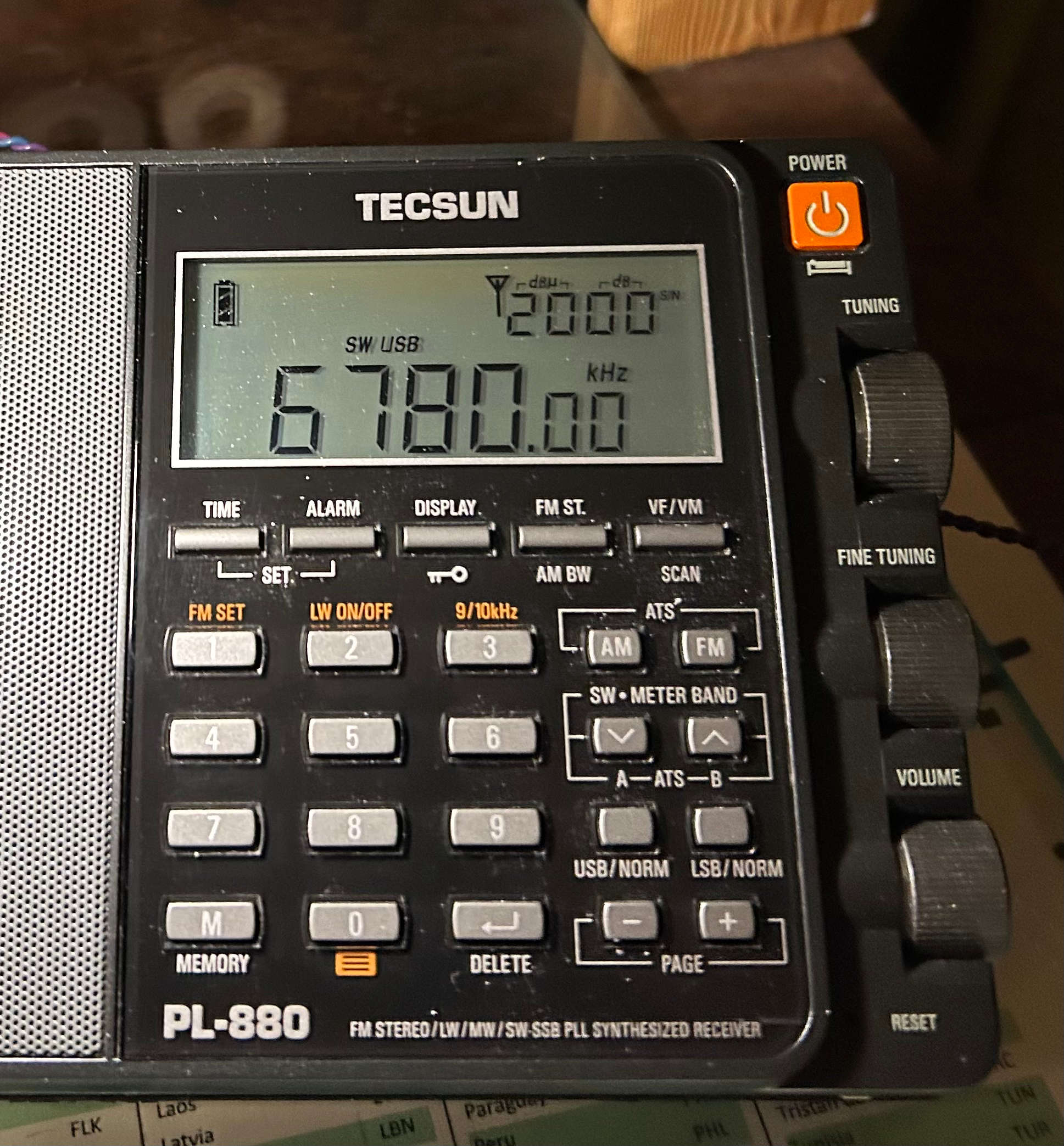
My attention was drawn recently to a very strong continuous wave (CW) signal operating on 6780 kHz. Further tuning turned up progressively weaker signals on 13560 kHz (2nd harmonic) and 27120 kHz (4th harmonic). Note that these frequencies are squarely in the center of each ISM Band. A signal was also heard on 20340 kHz (3rd harmonic), which was not in any ISM band.
Poking around the Internet, I found that others had similar experiences in recent years. As expected, the signal I received did not provide any identification during my monitoring. As stated, transmissions were continuous wave and pulsed at 1-second intervals much like a time signal. At irregular intervals, there would be a skip beat followed by a longer beep. After long intervals, the 1-second pulses would be replaced by a steady continuous wave lasting a couple of minutes, then return to the 1-second time-pip pattern. The signal remains on throughout the day and night.
The signal was tuned as any other CW station by setting the radio to either USB or LSB and tuning slightly down or up from the carrier. Note in the recording that there are not always the same number of time-pips in each set, and that the longer beep between sets can differ in length. Perhaps this is some sort of data encoding.
Besides my own reception in Central Maryland, a weak “time signal” could be heard at the WEBSDR site in Central Pennsylvania (http://k3fef.com:8901). There was a steady CW signal at 6780 kHz from the U. Twente WEBSDR site in the Netherlands, possibly indicating another type of ISM application.
What’s in your ISM Band? You may or may not hear a similar signal at your location. Let us know.
Bob, had a listen this morning from NE Maryland. Did not hear CW on 6780 was a signal though but could have been data or just noise.
I did copy 3 beacons. VE3DJI/B on 6789, KA5 on 6783 and ODX on 6782.19 all in CW mode.
I used my KiwiSDR locally. The address is, http://wd3c.ddns.net:8073/
Rich, WD3C
Very interesting, Bob.
I tuned to the 13.560 (and around) and didn’t hear anything. But on 6.780 (and around) I was able to hear two faint competing CW signals, very hard to copy. However, I finally decoded one. The letters were D A S repeated twice, and then a long continuous tone for roughly 5 seconds.
The other signal was fading in and out too much to copy the whole thing.
Interesting, as I am in a rural area with no typical industry around, cable companies, etc. The utilities are using wireless, so their signals are going to be much higher.
I will be investigating! Cheers!
Great info! I am sitting down having my cup of coffee at 6 AM in Dallas reading this and I tuned and I have exactly what you described! 13.560 was identical to your description of the beeps and tone sequence. Then I tune to 6.780 and I got a different beep tone sequence, it was a quick double beep and a pause and then it changed to single beeps and then it changed back. Great catch thanks for sharing. There is hardly anything to listen to out there anymore and I always welcome the opportunity to hear new signals. Thank you again.
Despite these bands being license free, there are still rules to be observed. For example in a part of the (European) 868 MHz ISM band each device may transmit for 1% of the time only. This is often used for home automation.
As the microwave ovens on typically 2.4 GHz show, you can do a lot more than transmit data. Just an idea: If you have a wire antenna hanging quite low over your garden you might use it as intruder watch: Send a few mW on 13,56 to your antenna and evaluate any variance of the SWR.