
Tag Archives: QRM

The truth about portable amplified shortwave antennas

In the past week, I have had no less than 3 email inquiries from readers regarding which amplified antenna to purchase for their portable shortwave radio.  My short answer? None.

In my opinion, there’s one fatal flaw with amplified antennas: they amplify noise just as much as they do the signal you wish to hear.
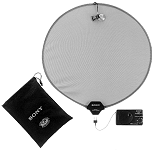
The Sony AN-LP1 is the best amplified antenna I've ever used, but that's not saying a lot.The only portable amplified antenna I’ve had any results with is the Sony AN-LP1 (now only available in Japan), and I attribute this success mainly to the fact that a suction cup, mounted at the top of the loop, allows it to be mounted on a window. Even then, results are often only marginally better than with the telescopic whip.

There may have been a time when portable amplified antennas made sense–a time prior to noisy AC adapters, flat screen TVs, and other consumer electronics which spew RFI (Radio Frequency Interference), polluting our shortwave bands. Today, however, you’ll be disappointed with the results of one of these, particularly if you travel–turning on the amplified antenna in a hotel room will increase the noise you hear two-fold, while weak broadcasters will remain lost in the static.
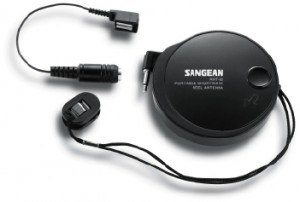
RollUpAntennaReelSangean

The Sangean ANT-60 is inexpensive and vesatile

So what can you do to improve the performance of your portable while traveling or at home? I’m still a fan of the roll-up antenna; like the Sangean ANT-60.  They’re inexpensive ($12 US), packable, and versatile–the clip on the end of the reel allows the antenna wire to be clipped to curtains and blinds. Place it near a window, or even hang it outside. Antennas love being outside–just take it down when not in use.

In lieu of buying a roll-up antenna, you could simply attach an alligator clip to the end of a 20′ (6 meters) length of wire.  The alligator clip can then attach to the end of your telescopic antenna, and you now have the same properties of a roll-up antenna for pennies. This is possibly the most cost-effective way to improve the performance of your portable shortwave radio. One note of caution: don’t get too generous with the length of your antenna wire. Some portable radios lack a robust front-end and a wire that’s too long could actually overload the receiver. Some Grundig G5’s were even sensitive to static discharges over a wire antenna. If uncertain, I would not exceed 20 feet in length (6 meters).
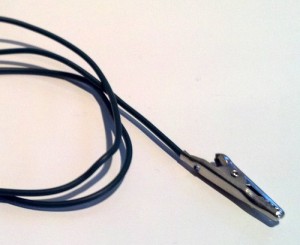
An alligator clip offers serious bang-for buck--especially if you already have the parts lying around

An alligator clip offers serious bang-for buck–especially if you already have the parts lying around!

I’ll never forget:  one of the first email questions I received on SWLing.com was from a fellow listener in Washington state who wanted to hear stations better on his Sony portable. I suggested the alligator clip/antenna wire. He wrote back enthusiastically, “This is the most cost-effective improvement I have ever made to anything!” He was so encouraged with the performance improvement, he invested in a tabletop and a proper outdoor antenna with grounding.

So, I urge you to try a roll-up antenna or the alligator clip antenna before you waste money on a portable amplified antenna.  Just my two cents.
UKQRM And The Fight Against Noise

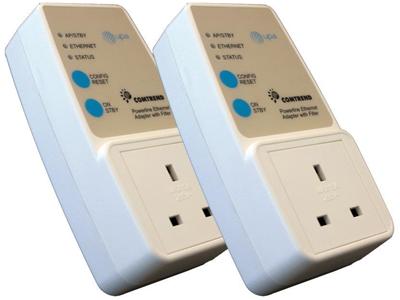
The noisy cuprits. Comtrend's power line adapters.

The noisy cuprits--Comtrend's power line adapters.

Whether you’re new to shortwave radio listening or have been an amateur radio operator for years, more than likely you’ve occasionally encountered electrical interference, that annoying hum or buzz that permeates your listening experience. This noise can often be difficult to pinpoint or eliminate. For most of us, the common culprits are fluorescent lights, computer monitors, televisions or even so-called “wall warts” (those ubiquitous AC adapters we use for most consumer electronics). For those of us living in sparsely populated rural areas, we can more easily find noisy interference in our own homes or on our farms (electric fences are notorious sound interrupters). If you live in an urban area, identifying interference can be a constant battle, since it may be the new LCD TV of the couple living in the apartment above you.

Or, even worse, the source of radio interference could be installed in your neighbors’ homes, in the form of a nationally mass-marketed home entertainment device promoted by your telephone company. That was the case for SWLer Mike Trodd in the United Kingdom; his neighbors installed a “BT Vision” multimedia entertainment package with Comtrend power line adaptors offered by British Telecom. “I switched on my short wave set to find a loud +20db screaming noise on all HF frequencies,” Mike describes. “Initially I suspected the actual home hub, but soon worked out it was the power line adaptors that were the cause.”

Figure 1 - Shortwave interference from PLT devices.

Figure 1 - Shortwave interference from PLT devices. Click to enlarge.

The fact is, these power line adapters use a smaller scale, more local version of a technology that amateur radio operators have long fought–namely “BPL”, or Broadband over Power Lines. In this case, though, Comtrend’s power line adapters turn your home’s electrical system into a communications system–also called Power Line Telecom (PLT). This novel (and possibly illegal) device has one crippling side-effect:  loud broadband noise across most of the shortwave radio listening spectrum (see figure 1).

What did Mike do after discovering the source of his interference? He contacted the authorities, and upon learning that, despite laws protecting radio, there is no effort being made at enforcement, he founded a program to fight the interference. “I created UKQRM because once I discovered the source,” he says, “I was disgusted that it was being allowed and nothing was being done at all!”

So, how bad is the noise, anyway? Take a look at Mike’s first homemade video:

It’s pretty obvious that the interference is substantial and will deafen shortwave and ham radios. How did British Telecom respond to Mike’s well-documented evidence of the problem?  “[They] were dreadful!” he exclaimed.”Initially you just can’t get any information out of anyone. Their dreadful overseas call centres are a waste of time. Only when a letter was sent to the chairman was any kind of reply received.”  But even this was less than satisfactory.  “To date,” he adds,”BT has never communicated its point of view.”

Are you safe from PLT interference if you don’t live in the UK? “PLT is already rolling out, uncontrolled,” Mike states, “across the EU. Portugal is suffering greatly as there are not even notches. In the US, PLT again is gathering speed. As successive governments give this illegal equipment the green card; I see a day when the HF spectrum is lost to us all.”

I asked Mike what radio operators and listeners can do? “We need support from radio listeners; in the main, this needs to be [in] an education role. Tell anyone who will listen about this. Point out that PLT does not meet regulations and laws and yet it’s being driven by the EU and governments, driven over the people with no regard at all.”

I urge you to take a look at UKQRM’s website (15 Oct 2011 update: site now called “Ban PTL) and see what you can do to fight interference on our radio spectrum.

Mike, on behalf of all radio listeners, thank you for fighting the good fight!