Category Archives: Articles

The MLite-880: A more thorough performance assessment

By 13dka

Following up on the article I recently wrote about the MLite-880, I still had a comparison with a reference radio on a proper antenna on my to-do list. I wasn’t in a hurry because I got pretty fascinated with exploring what I can get out of various magmounts on my car with this radio, which is quite a lot and it never gave me the feeling of missing out on something. I was also a bit hung up on the idea of comparing the MLite with the Belka because, you know, same price level and all, but that’s a bit iffy with my little passive splitter and 2 different input impedances.

Then a claim was made on the interwebz that the MLite-880 would be just a mediocre radio that would not stand scrutiny without its outstanding noise reduction, to summarize that in my own words. My experience is obviously very different and it made me curious how much truth could be in this claim. So I just took the ingenious Icom and the mediocre MLite to the dike to slip in a little shootout and then maybe give the loser a Viking funeral on a little raft I improvised out of flotsam and jetsam while making a lot of recordings to give my findings a whiff of evidence.

Both radios were connected to my lazy 10m/33′ monopole antenna via a Diamond SS-500 splitter and 15m double-shielded and common-mode choked coax. Both were recording to their own SD cards, but unfortunately, the recorded audio from the Icom does not represent the live audio off the radio on AM recordings because it records to an SD card with an 8 kHz sample rate, and that limits the audio bandwidth to at best 4 kHz.  The deciding thing to listen to in these recordings is the noise and sometimes the pure existence of a signal, though, and lower bandwidth is almost an advantage in this context.
oznorWO

Sensitivity Test

Since the question is really the practical sensitivity and, therefore, how dependent this radio is on its noise reduction to get good results, I’ll start with the IBP beacons, which were recorded without NR, of course. To spot and quantify SNR/sensitivity differences you can use the four -10dB stepped (100W, 10W, 1W, 0.1W) dashes the IBP beacons transmit after their callsign.

The most grassrootsy first: OA4B in Peru (10,800km/6,700mi) on the 17m-band. MLite first, then the Icom. Both radios receive the second (10W) dash as faintly as the 100W dash, but with too little SNR left.

5Z4B beacon in Nairobi, Kenya (6,600km/4,100mi with a 3rd dash = 1W!) informing a silent 15m band about the opportunity around sunset. MLite starts again, then the Icom. The latter has the 3rd dash faintly but clearly and the former leaves some more ambiguity about that. Demonstrates again the minuscule difference.

5Z4B again, but on 20m with a 4th dash to count, whether or not the last one is really from 5Z4B or just interference doesn’t matter; what counts is that both radios heard it. The 1W dash was clearly received by both, starting with the MLite.

Here’s one where only the MLite heard an interference, and I’m not sure it imagined it (absolutely unavoidable pun) – VK6RBP in Australia for the 10,000 miles bragging rights.

I think the conclusion here is that we could probably agree on “same ballpark”, right?  I don’t know about you, but imagine my surprised Pikachu face!

The AF SNR difference, which is probably all that counts in sensitivity tests, is within 3dB between the two, not to be confused with RF power decibels (but reflected on the RF side in comparably small amounts). For the interested:I did take day/night variations of the noise floor above 10MHz into consideration, with a decreased noise level around midnight on 21MHz, the MLite still matches the Icom, which is all that counts in this comparison (not absolute measurements) context.

The magic button

Another claim was made about the noise reduction, that it would only work with signals of a certain strength. While it is technically correct that it needs a minimum SNR to improve upon, my experience is that it is effective with almost any remaining SNR, provided the signal is fed into the NR with sufficient levels, and it exceeds all my expectations at that. Here are a few recordings of CHU demonstrating both points:

CHU 14670 kHz in Ottawa (5,800km/3,600mi) in bad enough conditions. The same announcement from the IC-705, then the MLite with NR at ?  of its range. Note how difficult the French announcement at the end of the transmission is for both radios. I will miss that station. The noise, not so much.

This is just the announcement a minute earlier, when the signal dipped below the noise floor. Nothing gets really recovered, but nothing gets lost either, and what’s left stands out more:

However, if you only look at its inability to cheat physics, you could be missing the point of a good noise reduction in this particular “shortwave radio” context. Restoring fidelity, removing masking noises and generally increasing the SNR and thus ease of listening is having a massive impact on how at least I can enjoy programs or conversations and there’s more: After a few decades many of us (particularly 2-way) radioheads have gotten their auditory cortices hardwired to make a connection between noise and signal strength and then pushing this NR button might feel like witchcraft when it makes a bloke driving around on the other side of the globe sound like he’s just passing your local highway intersection.

In the following sound clips you will hear both radios taking turns in 5-second chunks as if I switch forth and back between them, in some of them I will play the same bit of transmission twice, first from the one, then the other radio so you can e.g. make out differences quite precisely. Continue reading
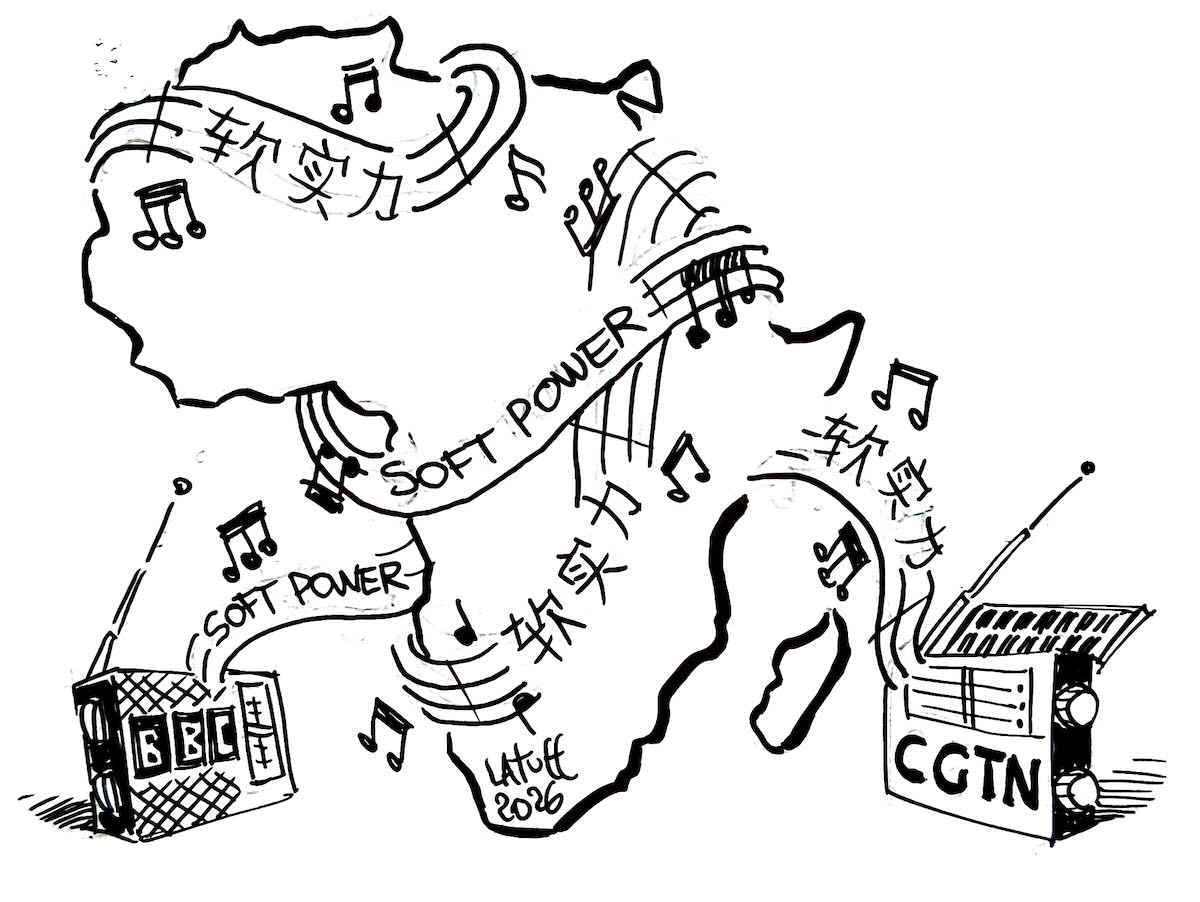

CGTN versus BBC: China, UK, and Soft Power in Africa

by Carlos Latuff

I found it strange to come across interference from a Chinese radio station on the BBC’s shortwave broadcast. For about a month, between April and May 2026, I was monitoring this special BBC radio service, transmitted from a station in Madagascar and aimed at Sudan and Gaza in Arabic. Aside from some technical and propagation issues, this was the first time I had encountered this kind of interference.

At first, I thought it was some sort of technical problem. The interference from the Chinese radio made it impossible to understand what was being said on the BBC broadcast. I tried again on other days, and the problem persisted. On May 25 at 17:00 UTC, I tuned into another BBC broadcast, this time transmitted from Ascension Island and aimed at West Africa in English, on the frequency 17780 kHz. To my surprise, the BBC broadcast was once again overpowered by the signal of a Chinese station — I couldn’t tell whether it was China National Radio or China Radio International (also known as CGTN Radio).

This monitoring was done on an Ecopower EP-F23B radio — a white-label model — with DSP technology and manual tuning. I wondered if it might be a problem with the device itself. So I used a digital Xhdata D808 radio, and when I tuned precisely to the frequency, I determined that the issue wasn’t a technical fault with my equipment, but rather deliberate interference with the BBC broadcast.

Faced with this situation, I started to believe this wasn’t a technical problem but an intentional act. I decided to investigate online, and it didn’t take long to find confirmation of my suspicions.

I found an article written in 2021 by two communication scholars, Yanqiu Zhang and Daniel Oloo Ong’ong’a, titled “Unveiling China’s digital diplomacy: A comparative analysis of CGTN Africa and BBC News Africa on Facebook.” It became clear to me that radio waves were once again the stage for geopolitical rivalry. The article focuses on the clash between the two broadcasters on social media, but clearly, this battle isn’t limited to the internet.

Continuing my research, I found news reports that illustrated this conflict well. On February 4, 2021, The Guardian reported: “Chinese state broadcaster loses UK licence after Ofcom ruling; Regulator concludes news network CGTN is ultimately controlled by Chinese Communist party.

Well, well, ladies and gentlemen — we’re back to the good old days of the Cold War, aren’t we?

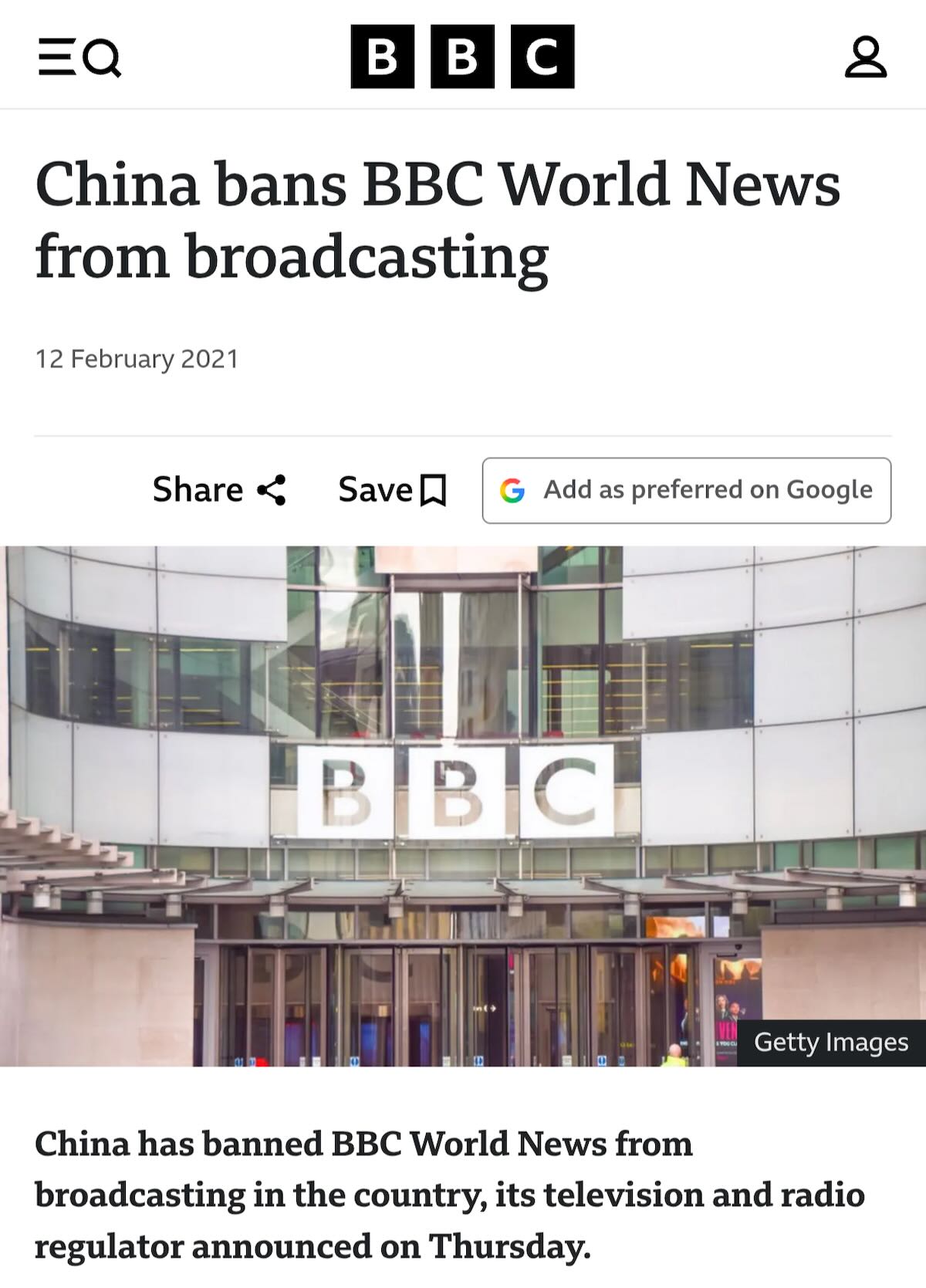
Following this arbitrary decision by the British government, the Chinese government quickly responded, as reported by the BBC itself on February 12 of that same year: “China bans BBC World News from broadcasting.”

Despite the differences between the BBC (a public service broadcaster) and CGTN (a state broadcaster), the fact is that both represent the interests of their respective nations.

In the 19th century, the British Empire — “on which the sun never set” — had colonies in Africa. The BBC, founded in 1922, was the voice of that empire. Indeed, in 1932 it created the Empire Service, the forerunner of the World Service. The British crown thus exerted its soft power through the microphones of the BBC and its hard power through the rifles and bayonets of its soldiers.

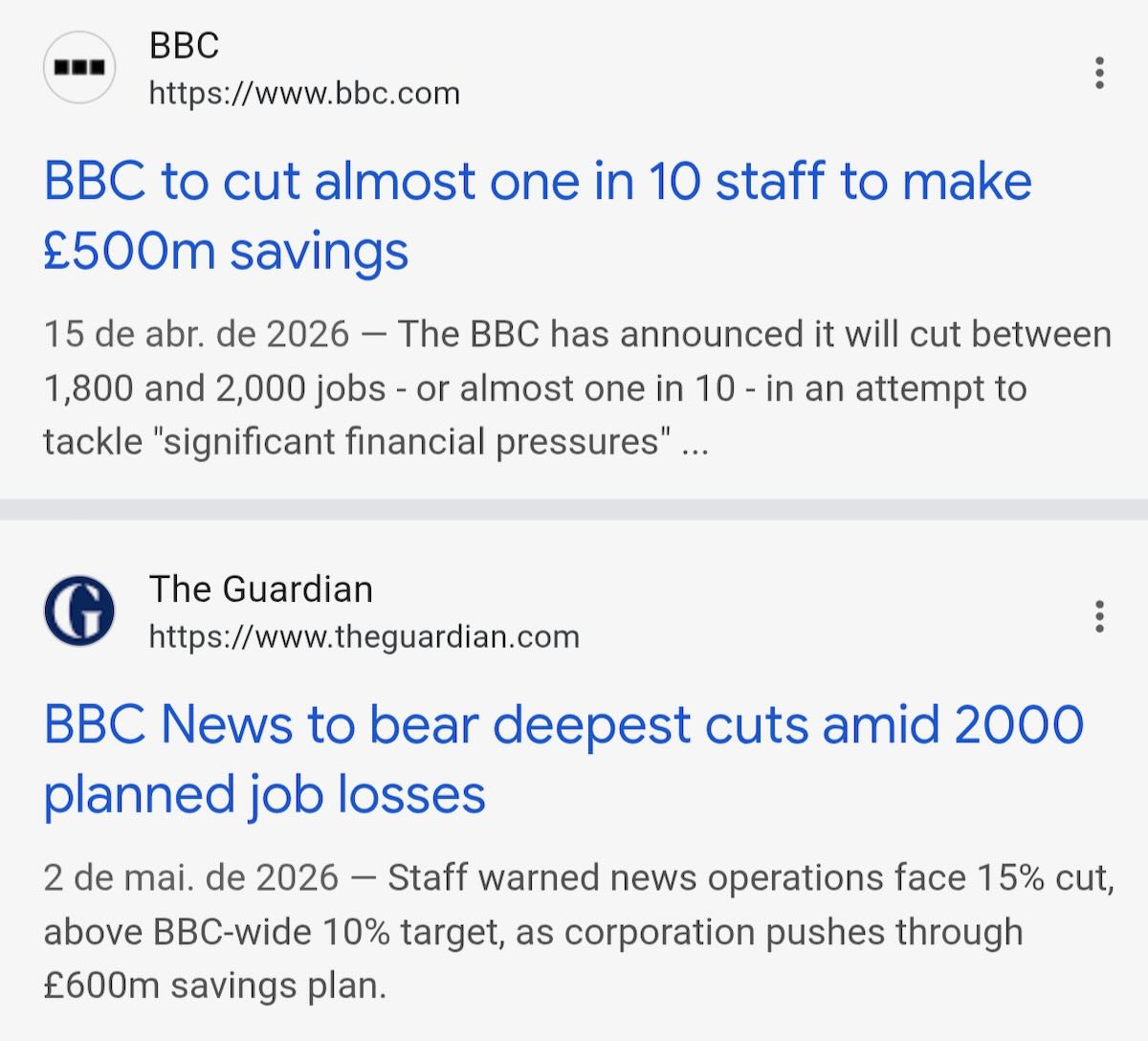
But the days of the redcoats are long gone. After much struggle and much bloodshed, African peoples expelled their British colonizers. However, the post-colonial BBC continues to defend the interests of the British state, even as it faces major financial difficulties. Due to budget cuts, the BBC has bet on digital platforms, cut radio programs in other languages, reduced its shortwave presence, and has been carrying out mass layoffs.

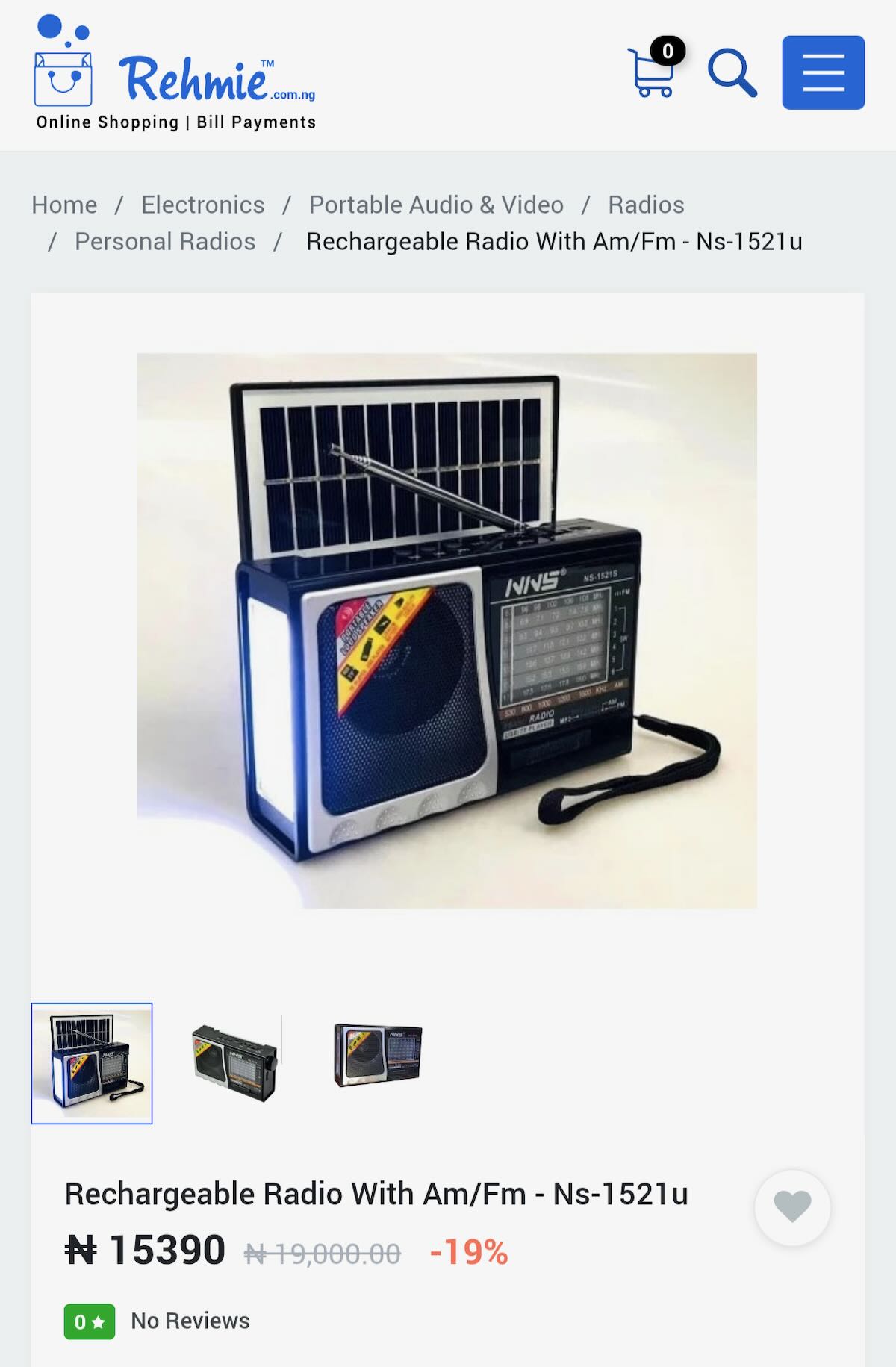
In contrast to the British broadcaster, Chinese CGTN has expanded its reach across the African continent, investing in digital platforms, but also in radio transmitters, programming in multiple languages, and the production of low-cost radios — with AM, FM, and shortwave, plus a flashlight and solar panel — taking into account that a large portion of Africa’s population has limited access to electricity and the internet.

A Chinese-made radio, with a solar panel, flashlight, AM, FM and shortwave bands, advertised by an electronics store in Nigeria for the equivalent of US$11.

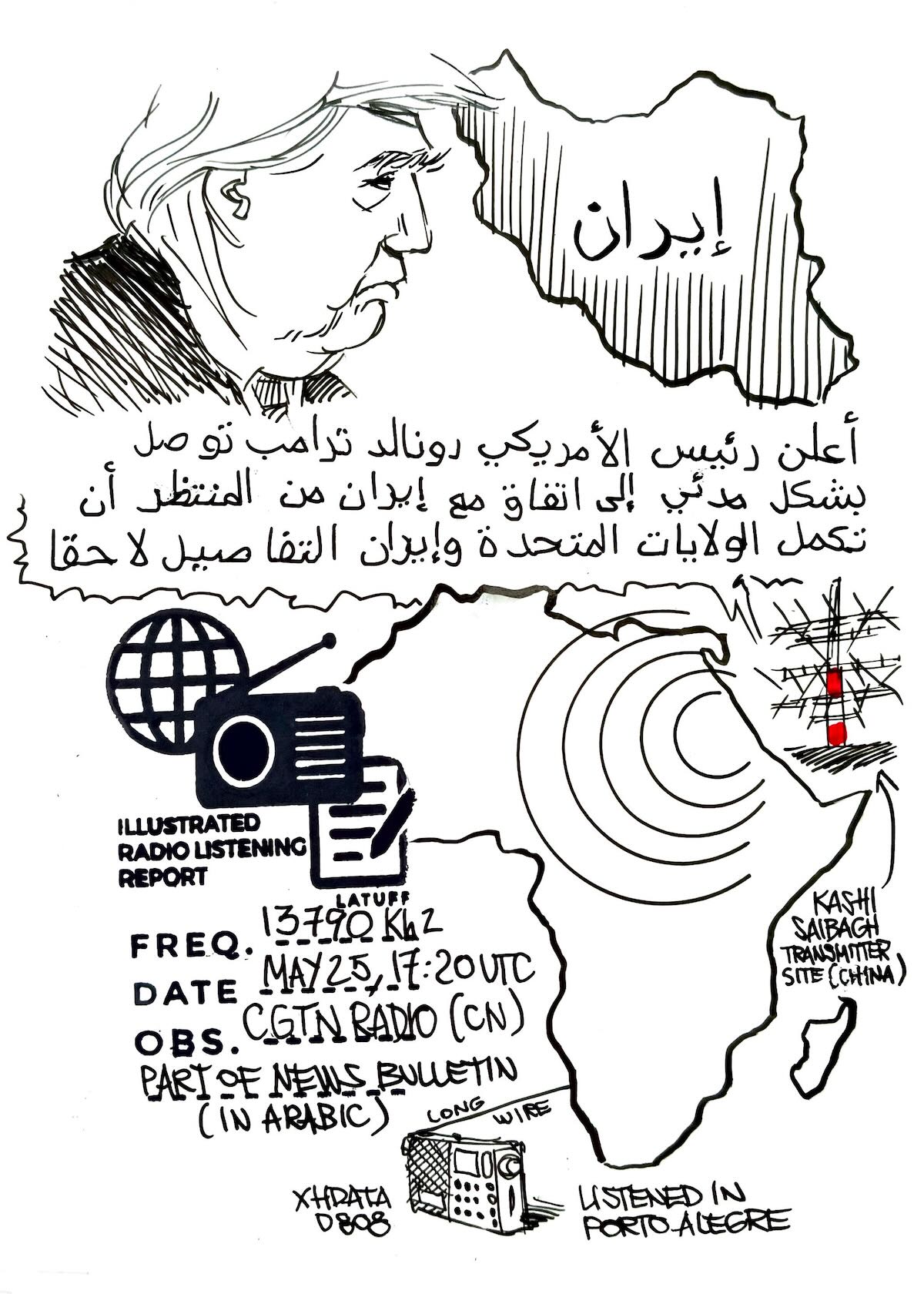
Illustrated Radio Listening Report related to CGTN broadcast in Arabic. While the BBC announced in 2023 the end of its Arabic broadcasts, CGTN broadcasts in that language on 7 different frequencies daily.

The BBC’s soft power in Africa was built in the wake of Britain’s colonial past. CGTN, on the other hand, reflects the relationship China has consolidated with the African continent as its largest trading partner.

The BBC, like the United Kingdom, is no longer the empire it once was, struggling to maintain what little influence it has left with whatever budget remains. CGTN, however, is the portrait of a rising economic power — a China that builds its soft power the same way it built its economic leadership: with persistence and patience.

In January of this year, UK Prime Minister Keir Starmer visited the president of China Xi Jinping in an attempt to resolve differences between the two nations. Meanwhile, the shortwave battle between the CGTN and BBC continues. A clash between a declining power and an emerging one. This isn’t about chasing ratings. It’s geopolitics, played out on the radio waves, before the ears of the world.

In any case, these are conclusions I drew from the recent history of animosity between the United Kingdom and China, notably involving the BBC and CGTN. It’s possible the interference I detected is just technical problems, who knows? Perhaps a simple coincidence.

Don Moore’s Photo Album: Old Radios in Salamanca

By Don Moore

More of Don’s traveling DX stories can be found in his book Tales of a Vagabond DXer [SWLing Post affiliate link]. If you’ve already read his book and enjoyed it, do Don a favor and leave a review on Amazon.

I’m spending April and May wandering around northern Spain and northern Portugal. My goal is to visit places I haven’t been to before, but I also have to return to Salamanca. I had been there twice before, but Salamanca is the kind of place that draws a person back. I love to wander the back streets of the old city. I also wanted to find some things I hadn’t done before, and that’s how I came across the Museo del Comercio (Commerce Museum) in a modern neighborhood east of downtown. That may not sound very interesting, but I knew immediately that I would have to go. One of the two main permanent exhibits is a collection of old radios.

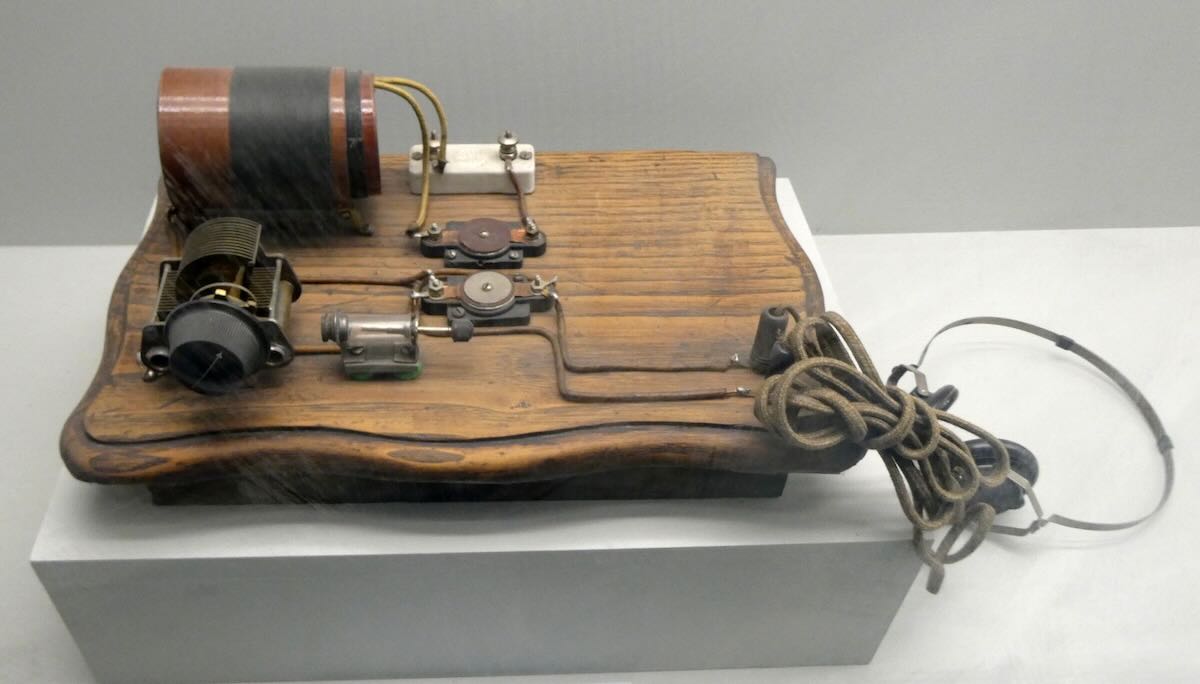
Most of the items on display came from the collection of Agustín De Castro. Agustín was born in Salamanca in 1928 and began building radios when he was eight years old. Here’s one of his early radios.

As a young man, he went into electronics and eventually operated his own radio store and radio repair business in Salamanca. He donated his vast collection to the city in 2002, and in 2006, it became part of the new Museo del Comercio, which was opened in Salamanca’s old underground brick water cistern.

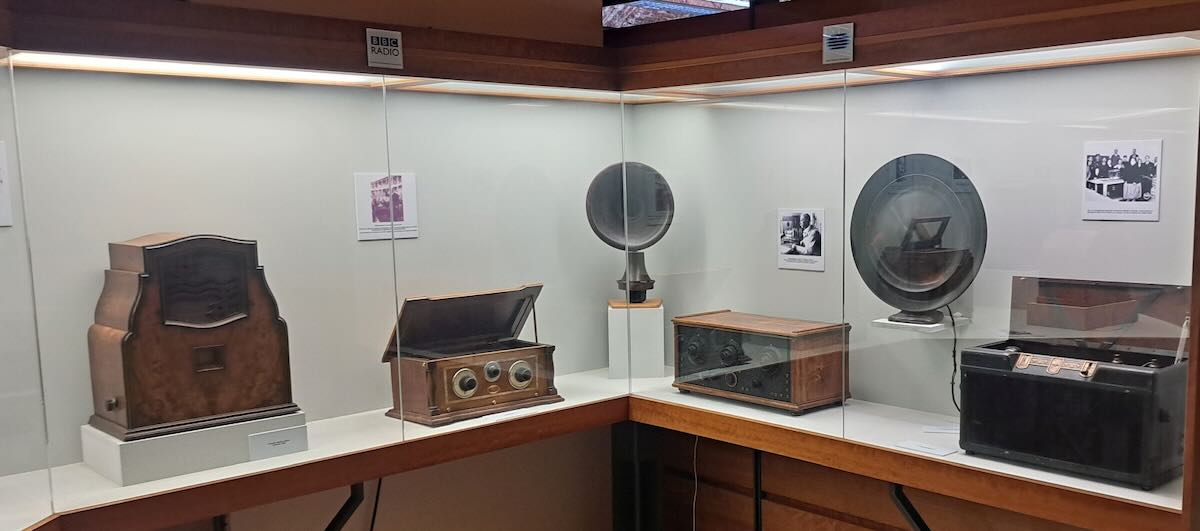
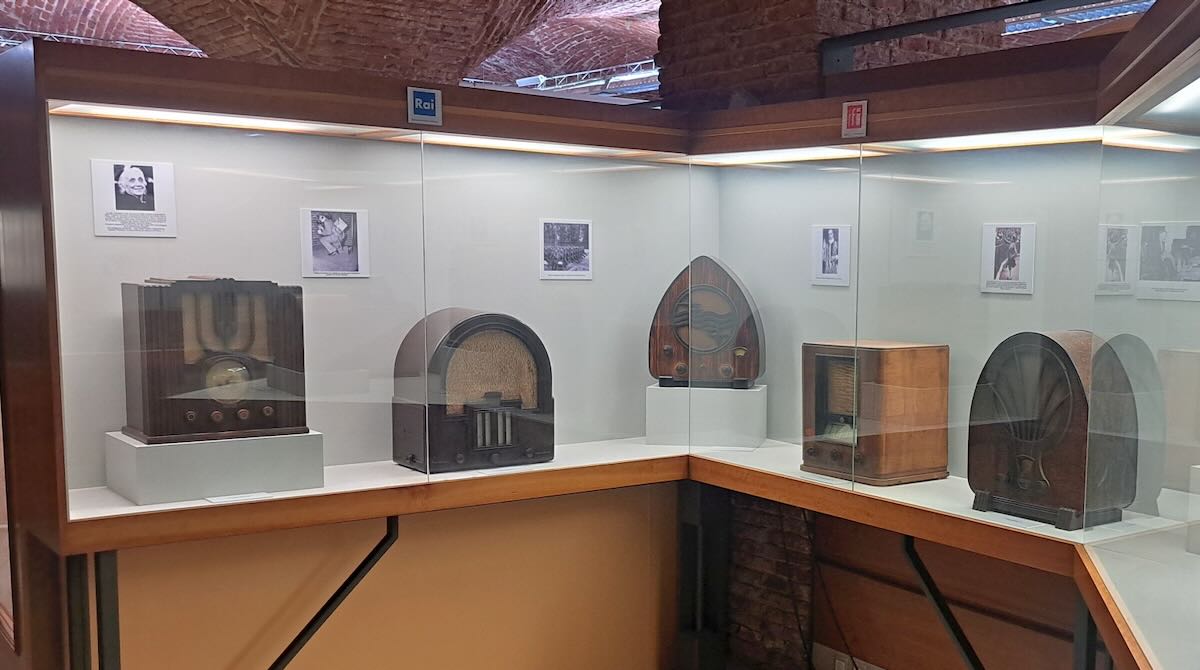
I might only DX on modern SDRs these days, but I still love looking at old radios. Everything here is in excellent condition and is kept in glass display cases to keep it that way. Unfortunately, that does make it harder to get good photos without getting glare or reflections. But I think these came out pretty well.

Let’s start with a closer look at a few of the more usual pieces.

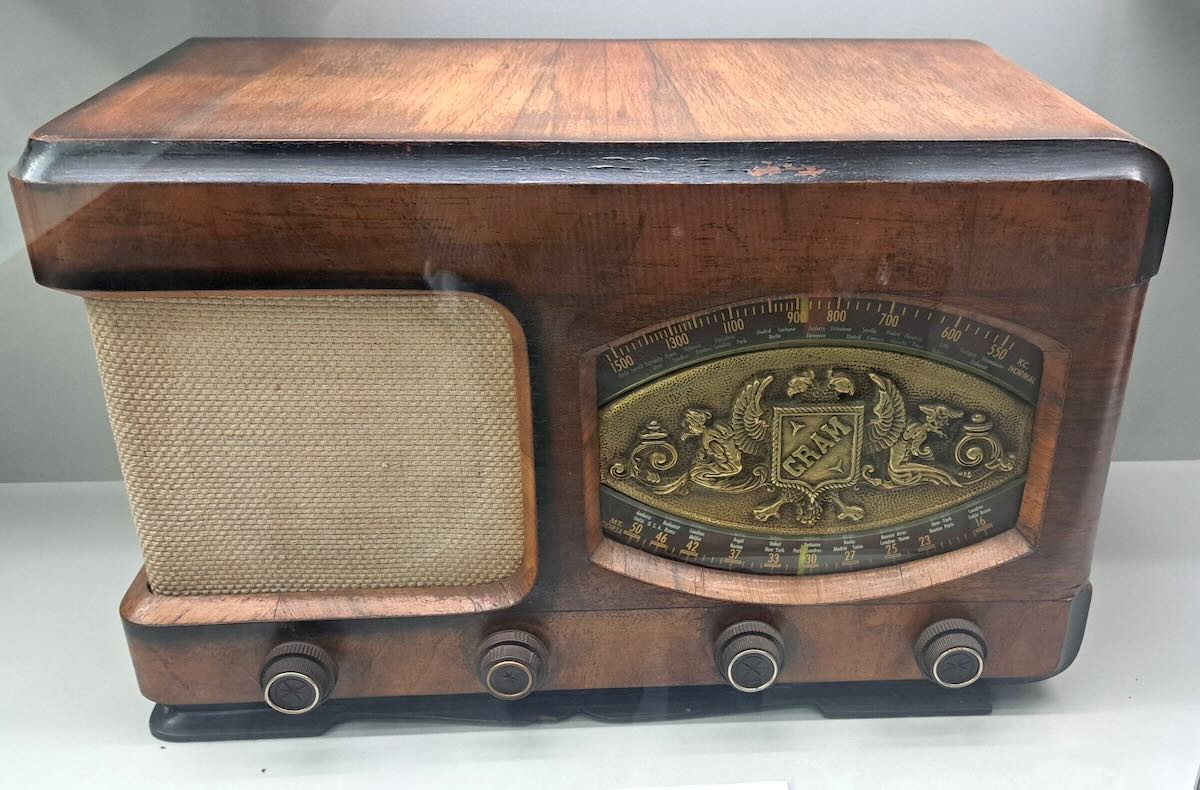
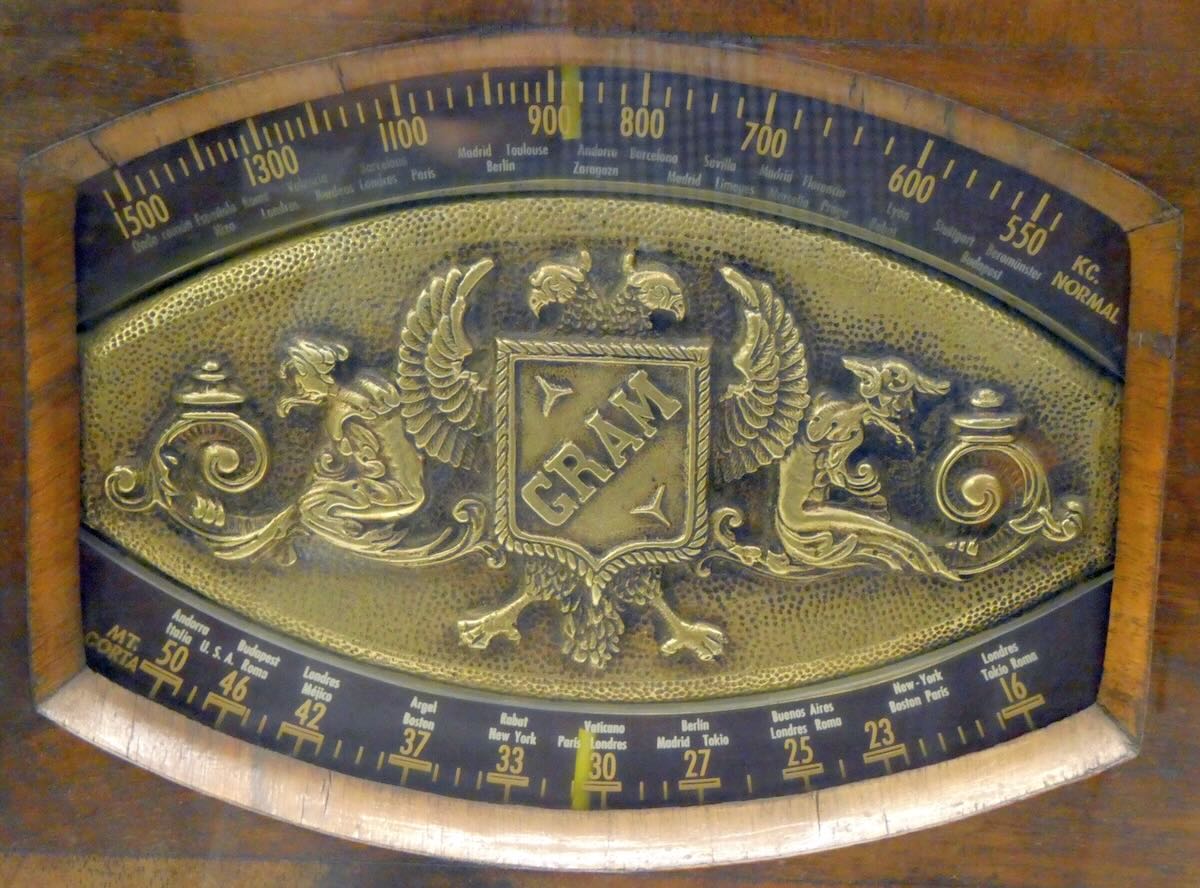
The Gram Model 157 was built in Spain in 1947. I liked this one for the fancy logo on the dial. Note that while the medium wave band at the top is marked in kilocycles, the shortwave band at the bottom still used meters.

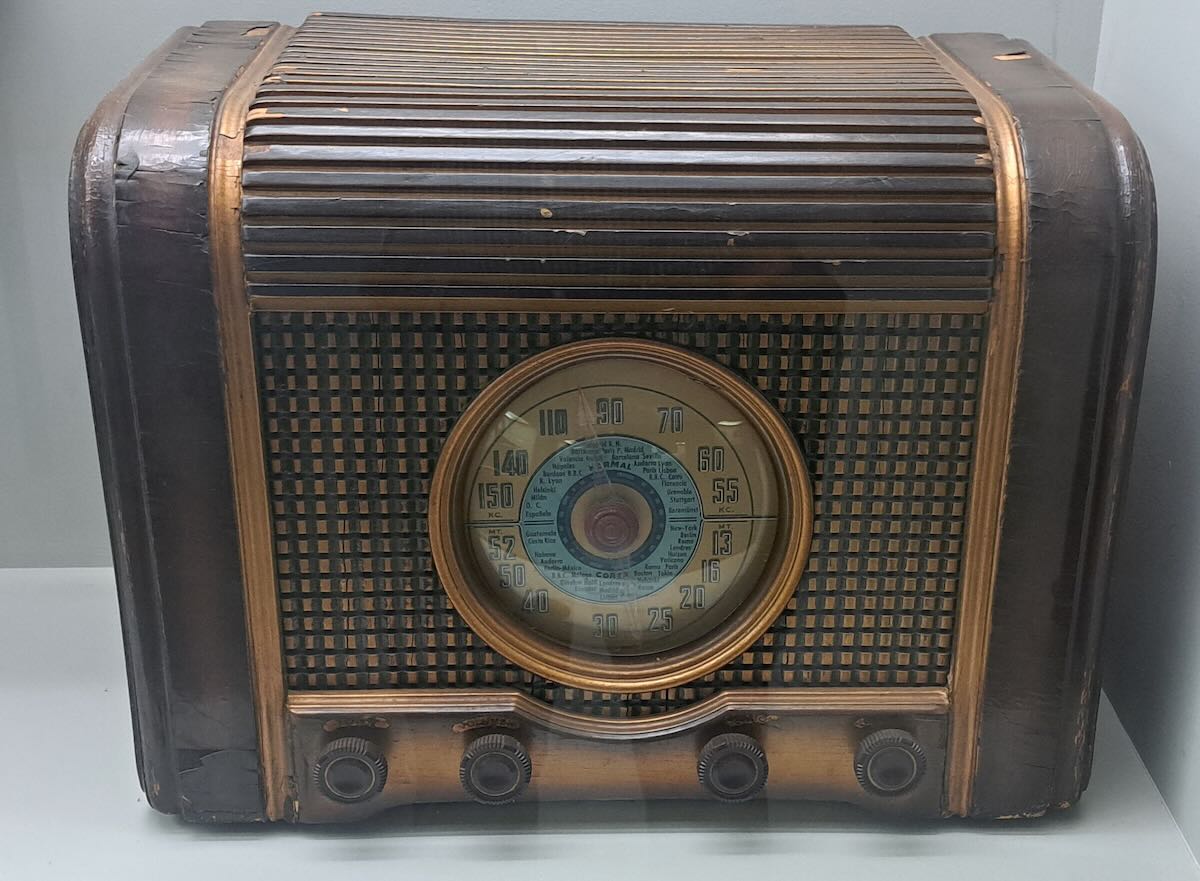
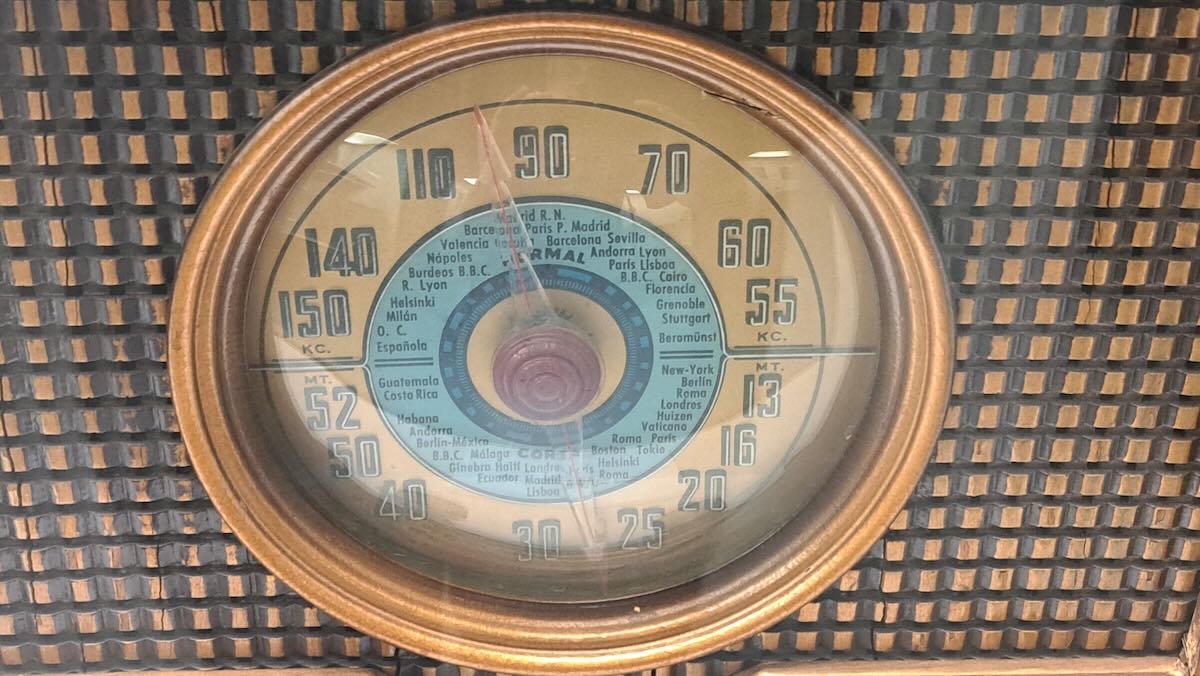
The Fono model 140 was also made in Spain in 1945. Again, the dial used kilocycles for medium wave and meters for shortwave.

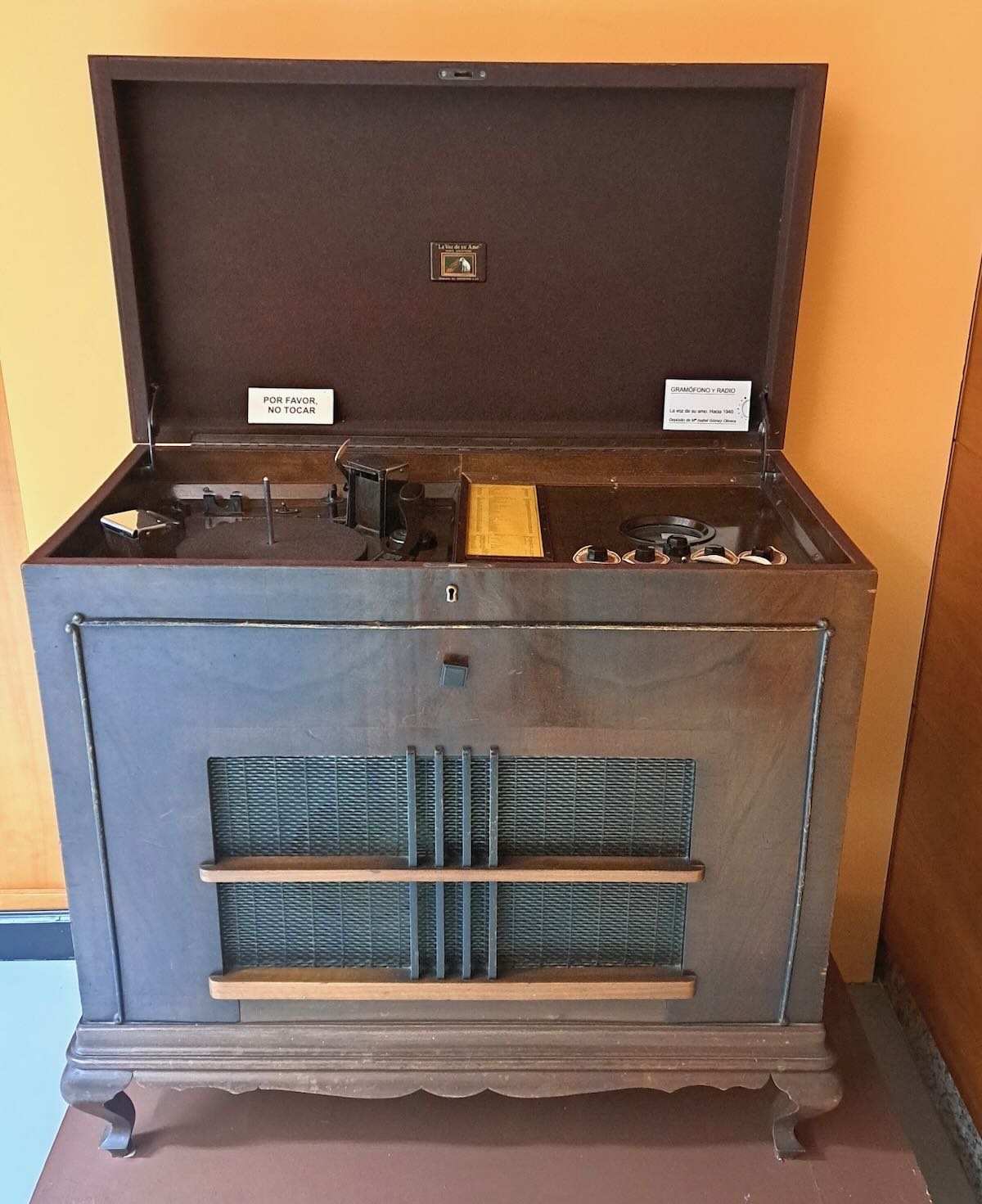
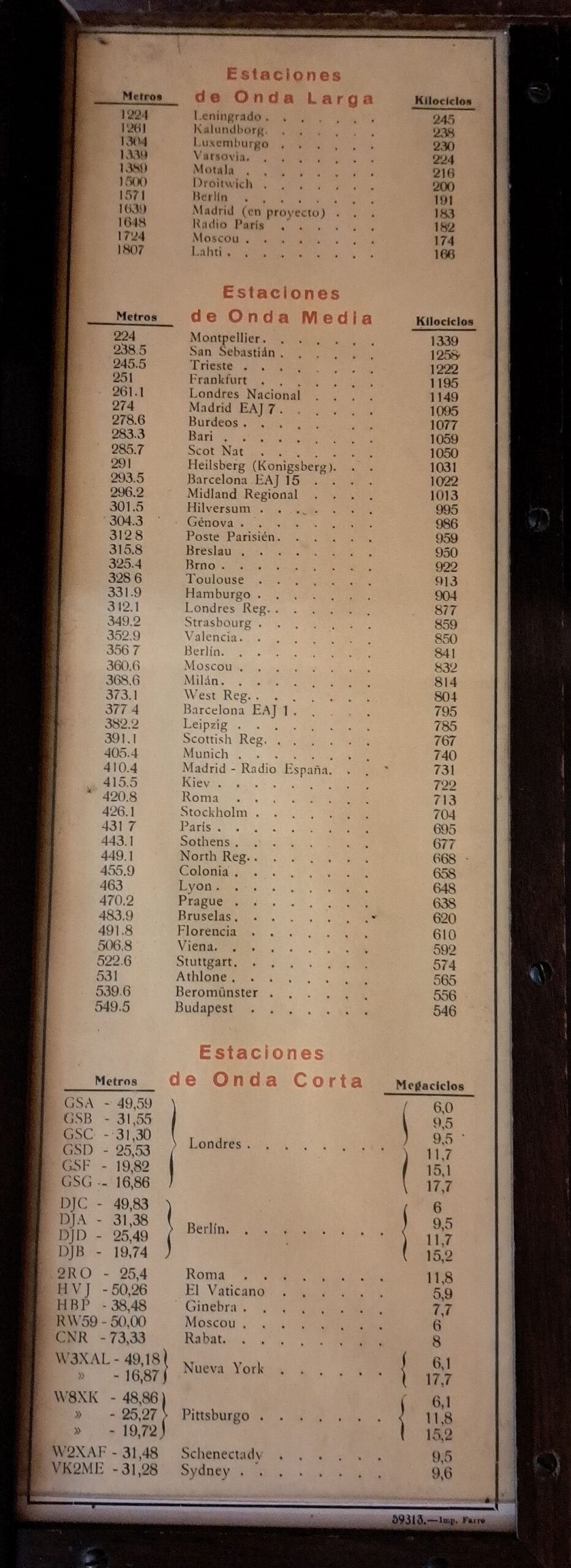
This 1940 RCA radio/phonograph is one of the few items that didn’t belong to Agustín De Castro. What caught my eye was the original station list inside.

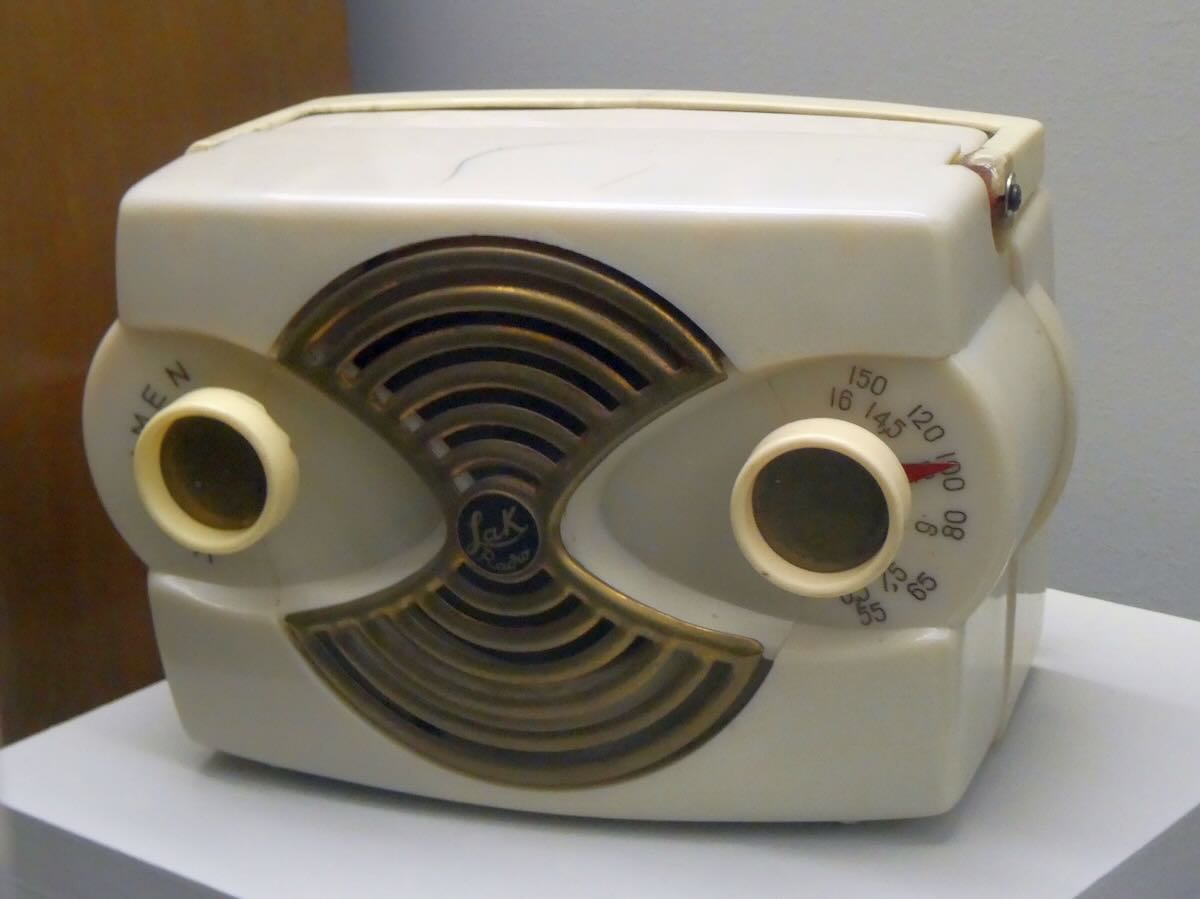
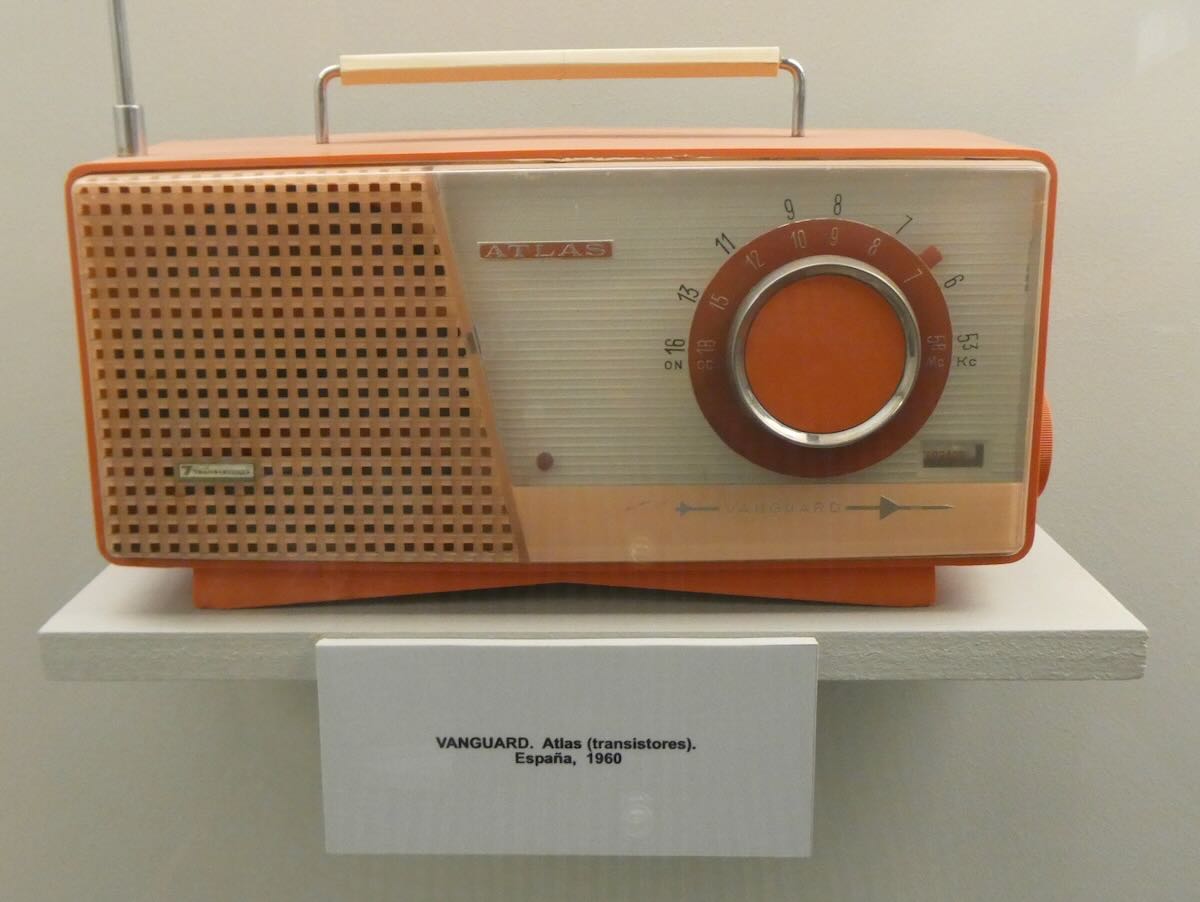
The LAK Radio was a small set made in Spain in 1950. It’s also medium wave and shortwave, but now the shortwave dial has frequencies instead of wavelengths. Likewise, the 1960 Vanguard Atlas from Spain uses only kilocycles.

Two Unusual Designs

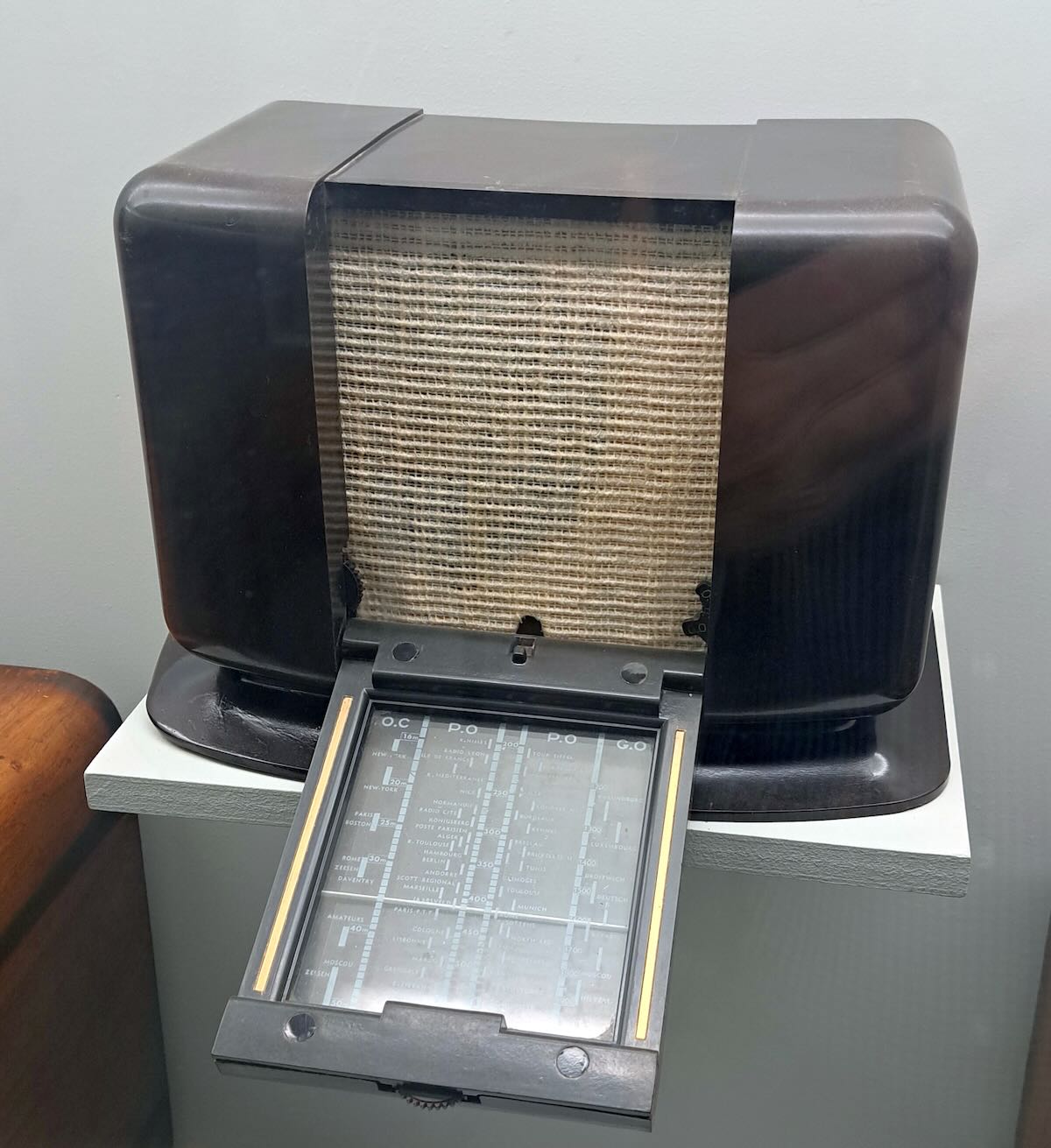
The next two sets will show that there were some rather unusual designs coming out of France. This first set is a Philips A-48-U made in France in 1942. The dial is on a panel that folds down when the radio is being used and then snaps back up when it’s not in use. I think the idea is to give the user a way to put the radio away without having to move it. Notice that the knobs are also mostly hidden. The tuning knob just barely sticks out from the front of the fold-down panel. Two other knobs are at the bottom of the speaker grill on either side.

I wish I could have gotten a better picture of the dial markings on this, but there was too much glare at other angles. The A-48-U was only produced in 1941-42 in Paris, which would have been under Nazi occupation at the time. Nevertheless, the dial still lists Daventry, London, and Droitwich, although it would have been illegal to listen to those British stations in occupied France. The dial also shows New York, Boston, and Moscow, but it’s possible the plates were made before the USA and USSR were part of the war. Continue reading
Portable Antennas for Serious DXing: Don’s Field Tests from Parks to the Open Road (Part 1)

Many thanks to SWLing Post contributor Don Moore–noted author, traveler, and DXer–who shares the following post:


Two Portable Antennas for Remote DXing (Part One)

By Don Moore

Don’s traveling DX stories can be found in his book Tales of a Vagabond DXer [SWLing Post affiliate link]. If you’ve already read his book and enjoyed it, do Don a favor and leave a review on Amazon.

Once upon a time, I had a traditional DX shack with an L-shaped desk and shelves of receivers, radio gadgets, and DX books. Everything I wanted or needed as a DXer was right at hand. Then I retired and was finally able to pursue my lifelong itch for serious travel. But there was no way to carry that DX shack along with me. Fortunately, modern technology was there to help. SDRs are significantly more travel-friendly than my old Sony ICF-2010 (let alone the Drake R-8). Instead of books and bulletins, my DX reference materials are websites and PDF files on my laptop.

I spend several months a year traveling internationally with just a suitcase and knapsack. That doesn’t leave much room for DX equipment. Several years ago I described my approach to vagabond DXing in an article here.

https://swling.com/blog/2019/03/radio-travel-a-complete-sdr-station-for-superb-portable-dxing/

Since writing that article in 2019, I’ve continued to work on making my portable DX shack better and more compact. Recently, I replaced the Elad FDM-S2 with three Airspy HF+ Discovery SDRs. Not only are they smaller and lighter, but I can record three different band segments at once. Next up was rethinking my travel antennas. A wire loop with the Wellbrook ALA-100LN is still, in my opinion, the best travel antenna. But the components are heavy and are now irreplaceable since they are no longer made. So over the summer, I set about testing and comparing both old and new options. But you don’t have to wander the globe for my findings to be useful to you. This can be just as helpful for DXing from a nearby park. That’s how I did my testing.

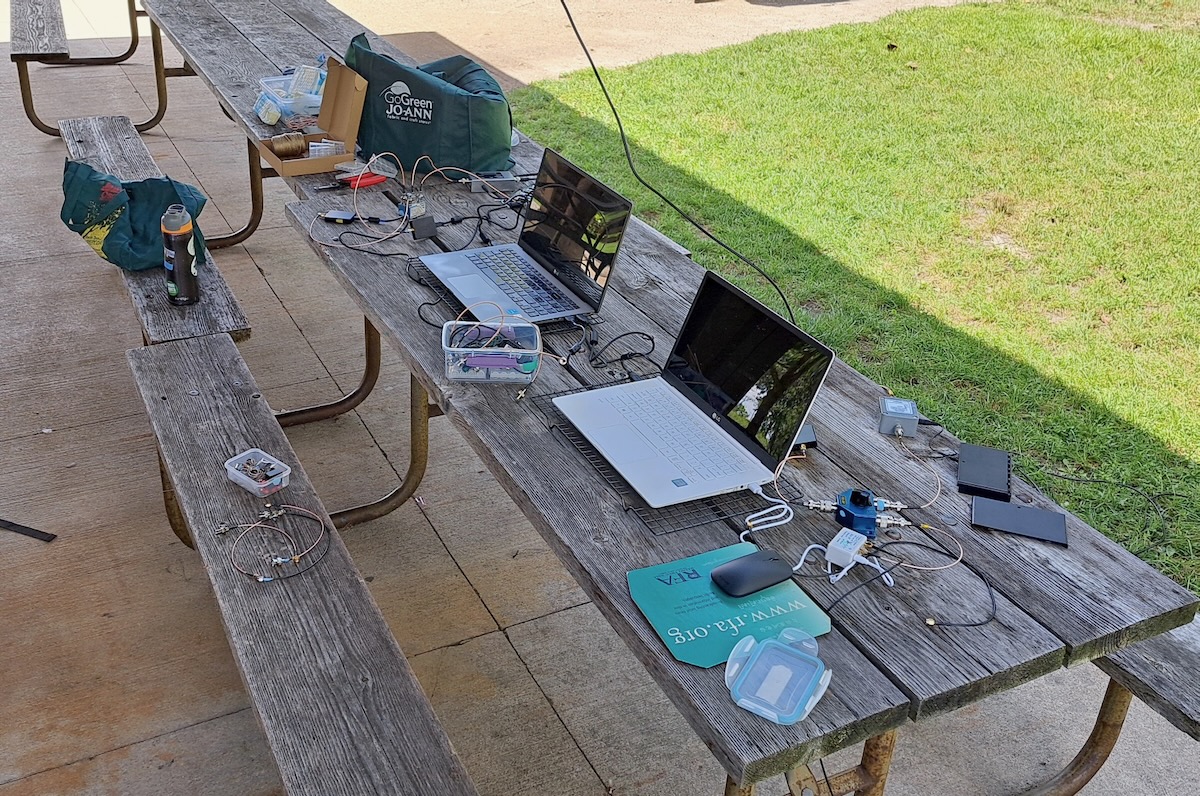
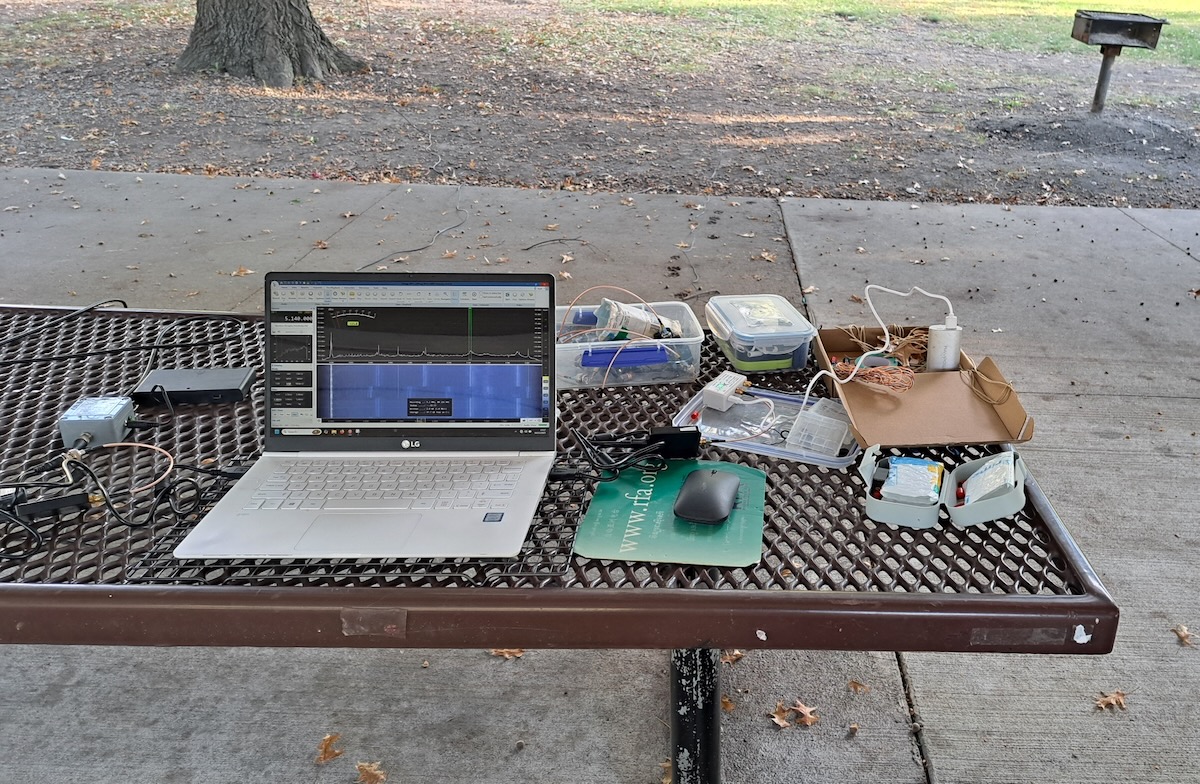
I spent the past summer staying at an AirBnB in the north Chicago suburbs. I wanted a better location for testing so I checked out parks in the area and finally settled on Preserve Shelter B (42.26797, -87.92208) at the Old School Forest Preserve, east of Libertyville in northern Illinois. The shelter was entirely wood, with standard asphalt shingles (rather than steel), and had no nearby power lines. I made four daytime DXpeditions there to do some utility DXing and to run my tests. Here’s a photo of my setup.

I decided I should rerun the tests at least one other location. So while driving across the US in mid-October, I stopped for a few hours one morning at Park Shelter A (39.11144, -94.86629) in Wyandotte County Park, just west of Kansas City, Kansas. There, I just had a minimum setup.

The Antennas

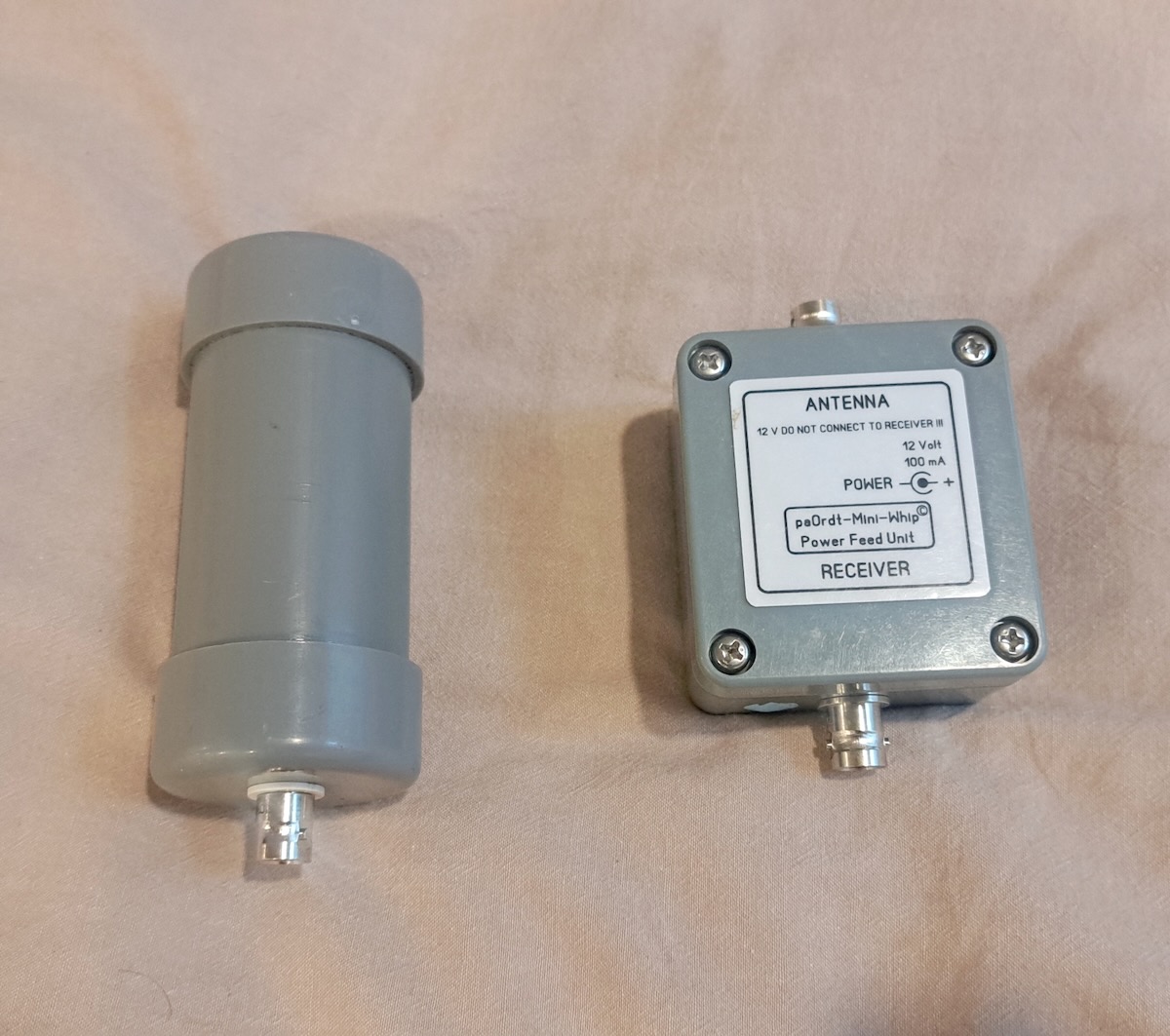
So, what were the antennas I was testing? The first was the tried-and-true PA0RDT mini-whip from Roelof Bakker. The PA0RDT is described in my 2019 article and is probably the most portable quality antenna you can get. To power it I use a battery box and eight rechargeable lithium-ion AA cells.

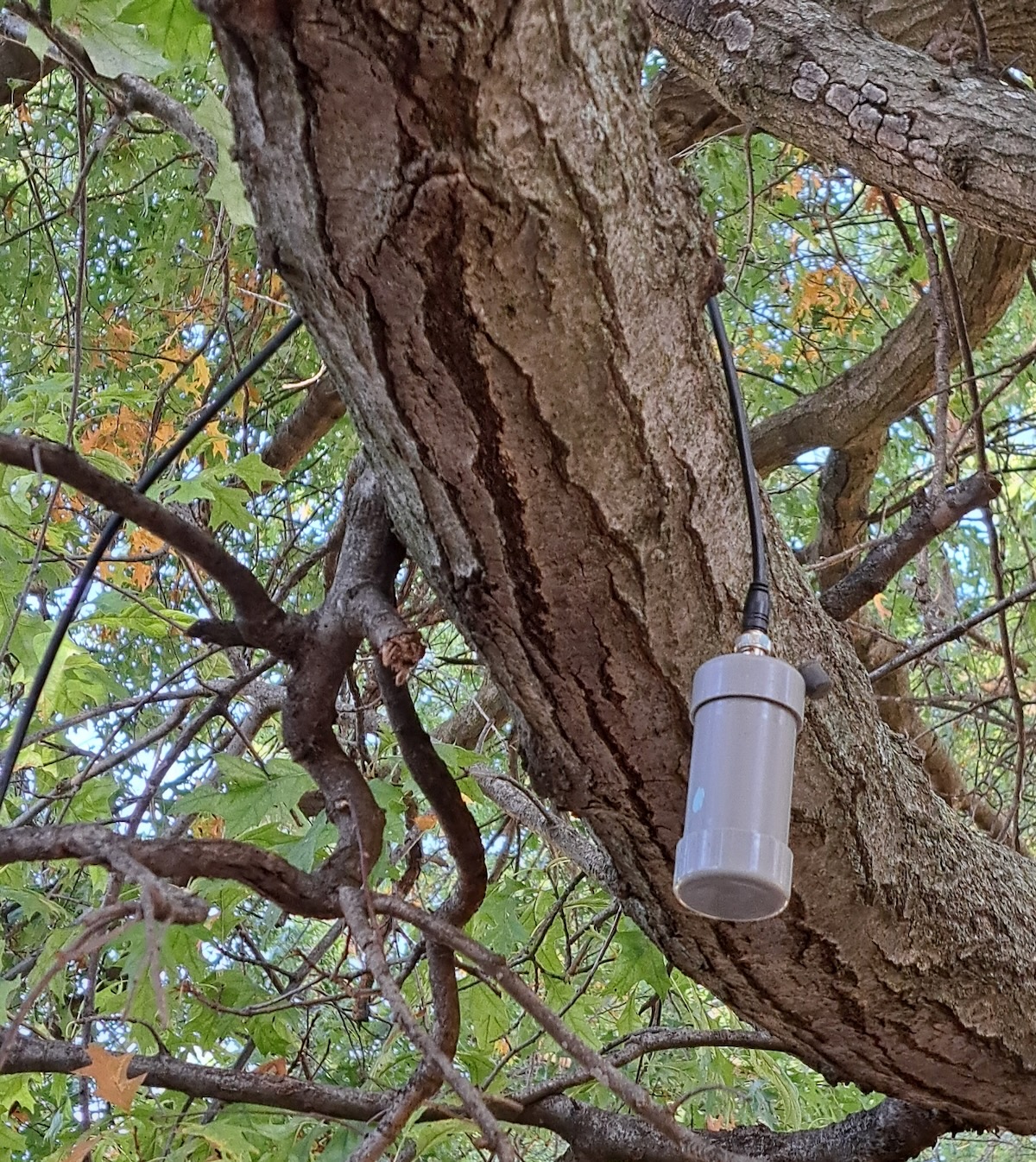
 For the traveling DXer, setting up the PA0RDT is as easy as it comes. I just attach the coax cable and throw it over a support, such as a picnic shelter beam or a tree branch.

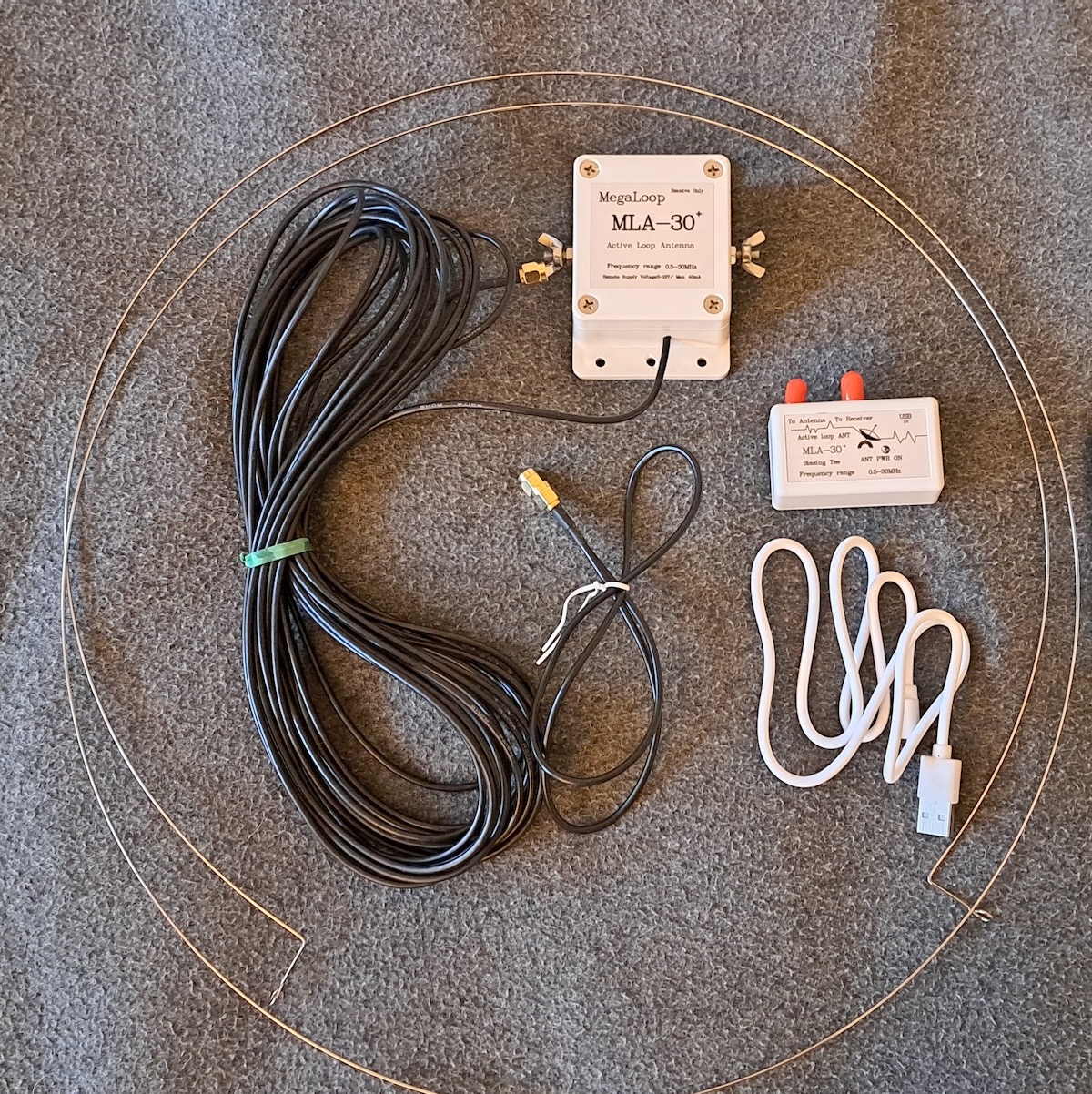
But I’ve always believed that the best antenna is another antenna. That is, every antenna works differently, and therefore the more options you have, the more likely you will have something that works well in any situation. So if I wanted to leave the Wellbrook at home, what might complement the PA0RDT? I contacted my friend Mark Taylor, who I knew had a large collection of the various inexpensive Chinese-made amplified loops. With his help, I settled on the MLA-30+ MegaLoop from DmgicPro.

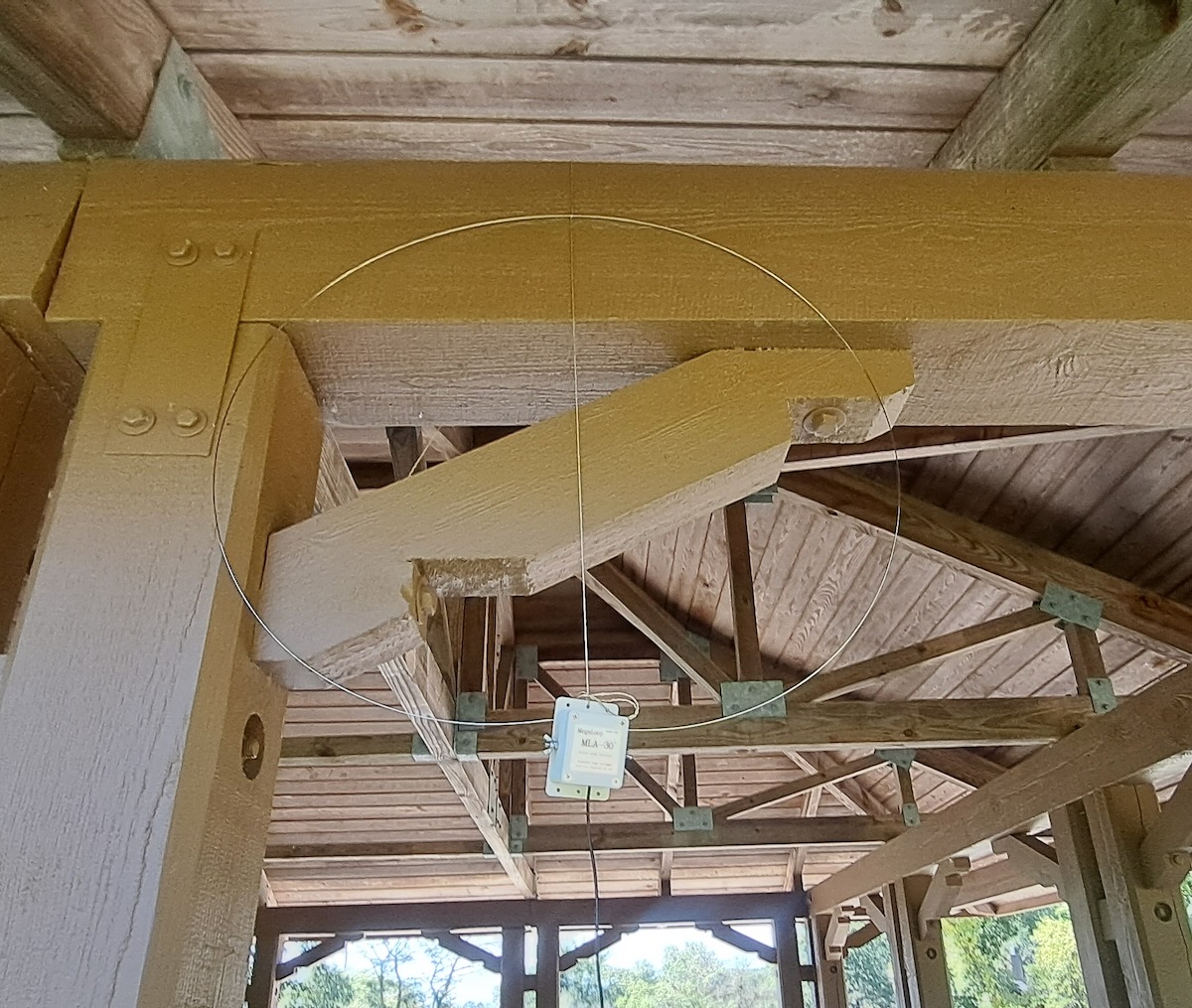
This antenna consists of a steel wire loop that connects to terminals on the amplifier box. The amplifier has a ten-meter coax cable, which in turn is connected to a small bias-T power supply, which gets its power via a USB connection. The MLA-30+ is designed to be used in a permanent installation with some sort of vertical support, such as a PVC pipe. Some users replace the wire loop with copper tubing.

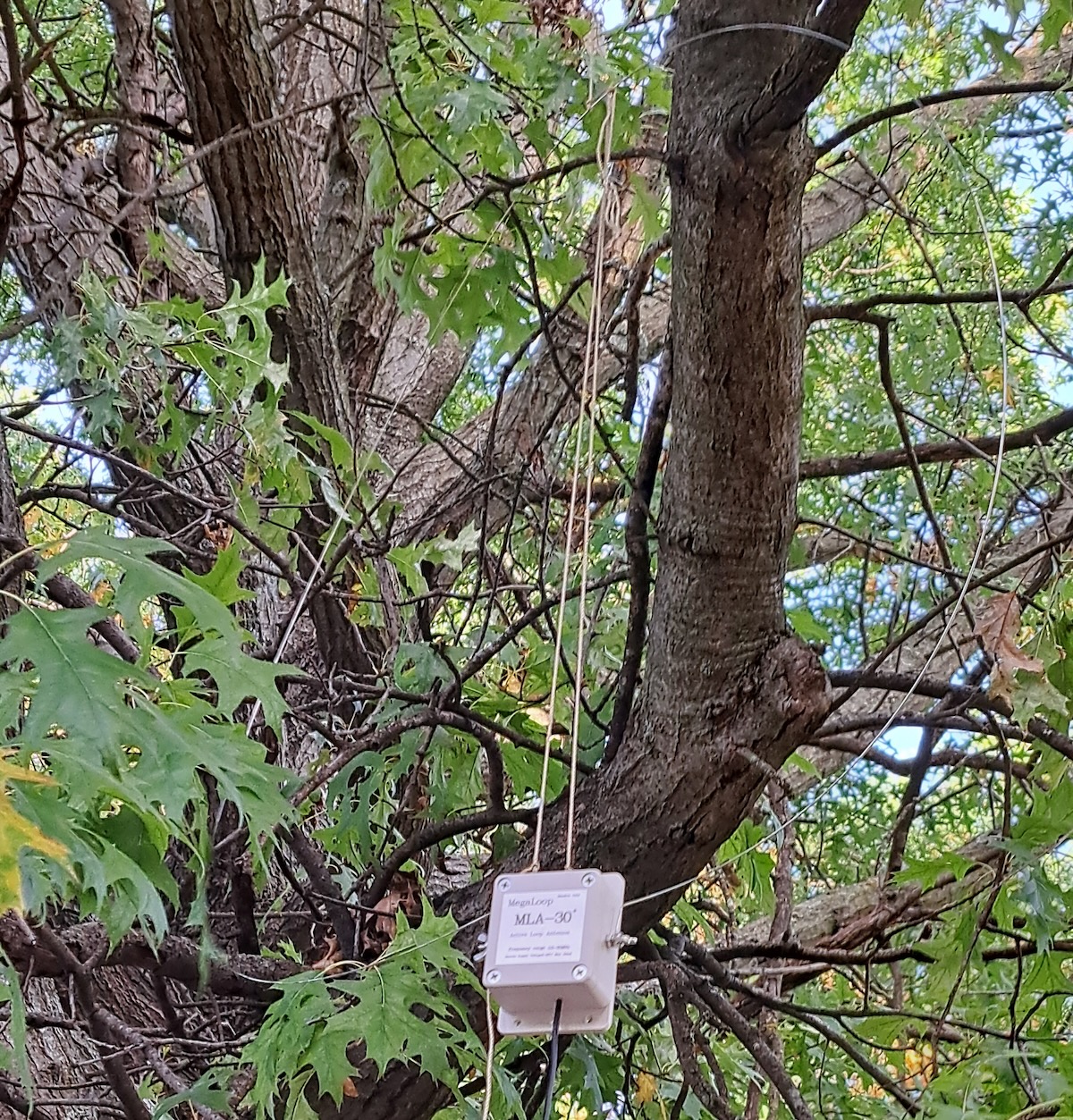
Those options aren’t practical for me, and simply hanging the antenna from the top would cause the steel loop to stretch and deform. So I came up with the idea of tying a strong cord from the top to the bottom of the loop so that the cord, and not the loop, bears the weight. To hang the antenna, I throw the cord over the support, attach the antenna, and then pull it up into place. That works well if you have rear support to hold it in place, such as the beams of a picnic shelter.

It’s a bit more difficult to mount the MLA-30+ in a tree.

Comparing the Antennas

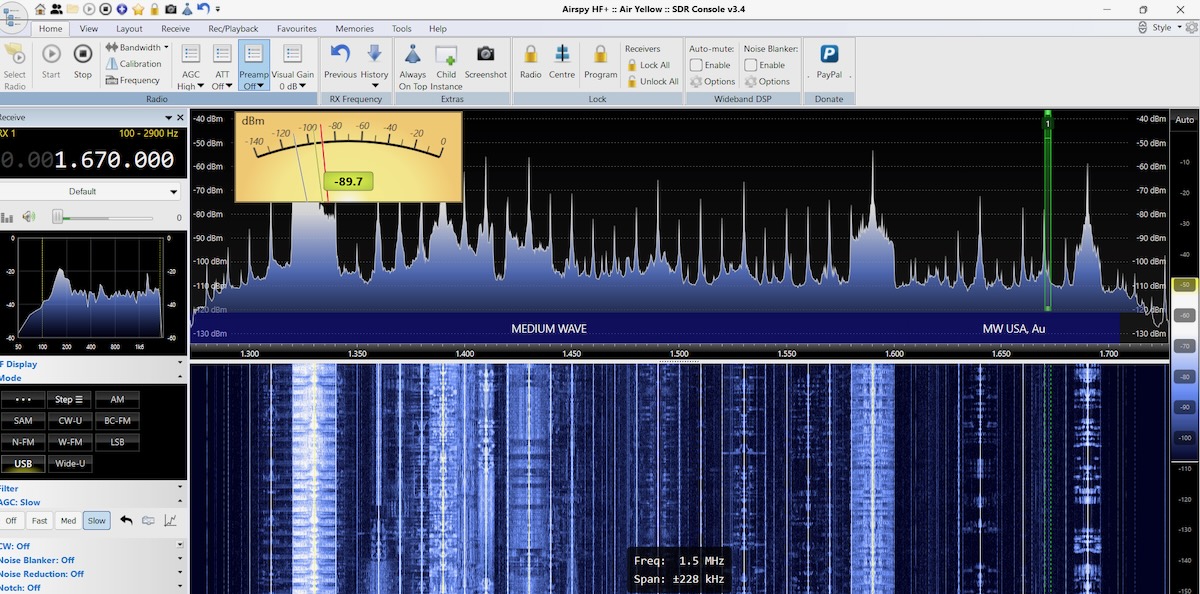
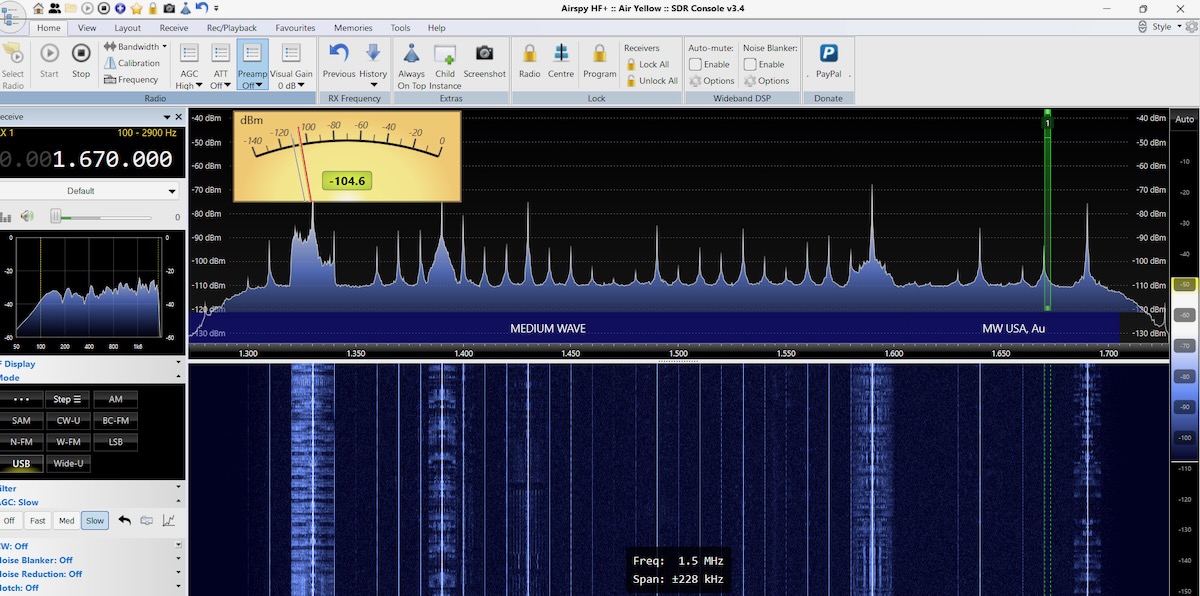
I ran comparisons between the antennas several times at Old School Forest Preserve and then again at Wyandotte County Park. The results were practically the same every time. The images below were made at Old School unless otherwise stated.

The PA0RDT was designed to be a good performer on longwave and medium wave. Unsurprisingly, it shows a lot of signals on the upper end of the medium wave band, even during the daytime. Except for being non-directional, the PA0RDT is an excellent MW antenna.

The MLA-30+, on the other hand, isn’t good for much beyond hearing the strongest local signals on medium wave.

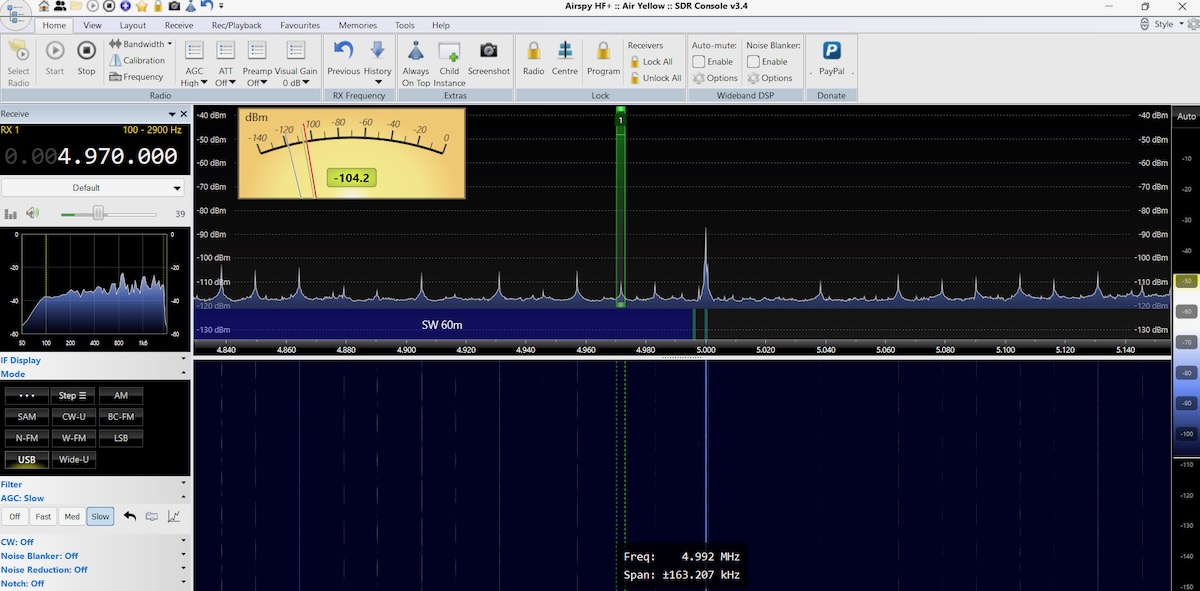
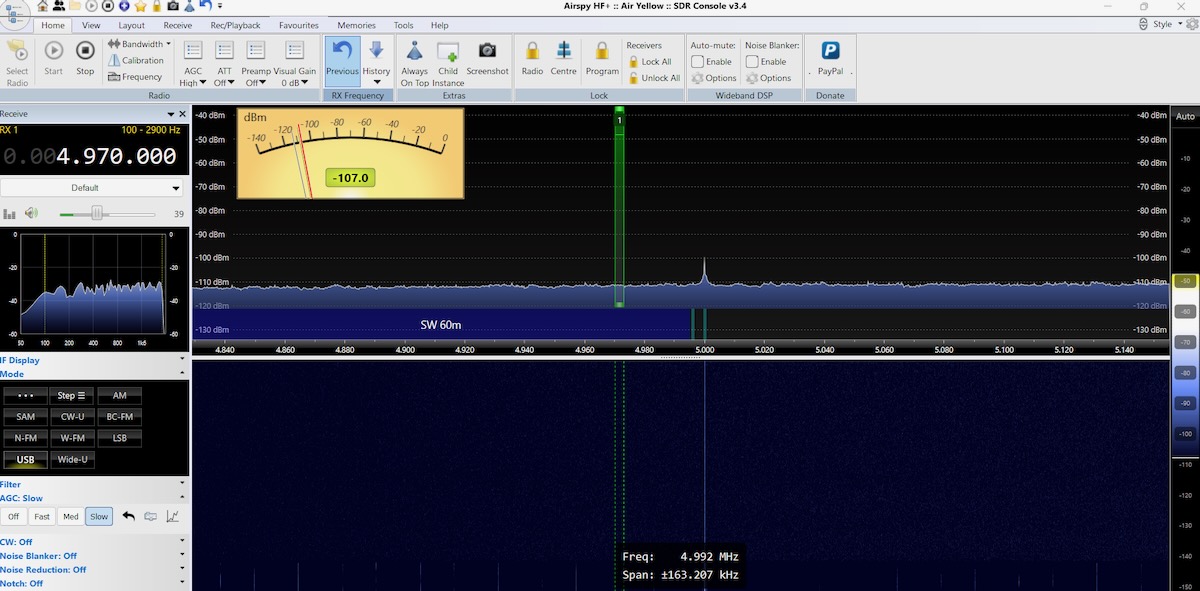
When I ran these tests in the late morning, WWV on 5 MHz was the only signal in the 60-meter band. It had a very listenable signal on the PA0RDT.

But on the MLA-30+, WWV was barely there.

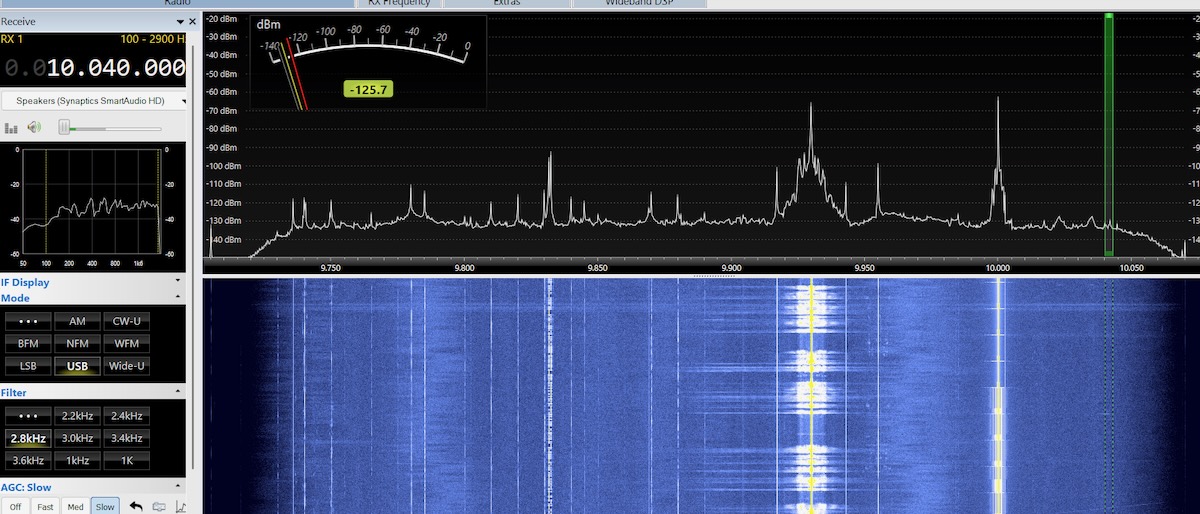
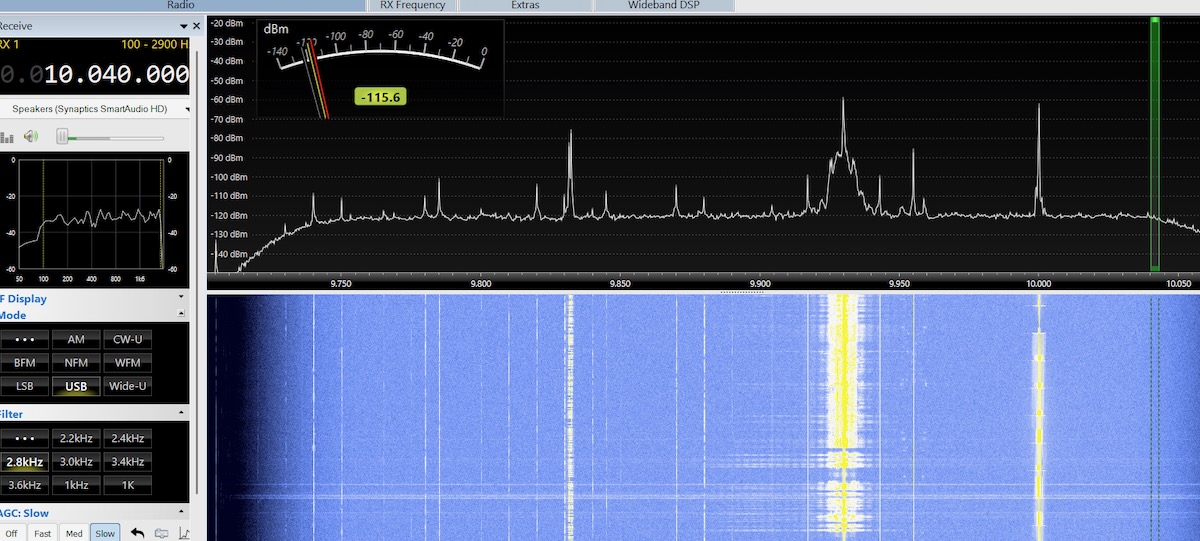
Likewise on 49 meters, CFRX on 6070 kHz was very clear on the PA0RDT but barely listenable on the MLA-30+. But when I moved up to 31 meters, the difference between the antennas mostly disappeared, as in these images made in Kansas. The PA0RDT is top and the MLA-30+ on the bottom.

On 25 meters, the PA0RDT is picking up a lot of noise and the signals are not that strong. Nor were signals very strong on 19, 16, 0r 13 meters.

However, on 25 meters with the MLA-30+ there isn’t much noise and the signals are booming in. And 19, 16, and 13 meters likewise had strong signals.

So the PA0RDT is clearly the best antenna for MW and the lower shortwave bands, but it doesn’t do as well on the higher bands. This wasn’t a surprise to me as I’ve always felt that the PA0RDT underperformed above nine or ten Megahertz. The MLA-30+ was abysmal at the lower frequencies but worked better or just as well in the middle and higher shortwave bands. The best antenna is another antenna. Each one performs better in different situations. But I couldn’t help but wonder … was the problem with the MLA-30+ that small steel wire loop?

Look for Don’s Part 2 article next weekend on the SWLing Post!

Meeting WavViewDX Developer Reinhard Weiß, and Visiting Akihabara With Him (A Totsuka DXers Circle Article by Kazu Gosui)

Many thanks to SWLing Post contributor Nick Hall-Patch, who has kindly provided a translation of this article from the Japanese-language publication PROPAGATION by the Totsuka DXers Circle (TDXC). Here, Kazu Gosui recounts his meeting with WavViewDX developer Reinhard Weiß during his visit to Tokyo .


Meeting WavViewDX developer Reinhard Weiß, and Visting Akihabara With Him

by Kazu Gosui

I first learned about WavViewDX in January of this year on the mailing list of the American radio club IRCA. It was described as “analysis software compatible with I/Q WAV recordings created with almost all SDR software,” so I was intrigued. I quickly downloaded it and tried it out, and I was immediately impressed.

In early February, I emailed the developer, asking, “I’m amazed at how easy it is to use and how powerful it is. It works fine with PERSEUS and AirSpy HF+, but are there any plans to support WiNRADiO’s DDC format?” Reinhard Weiß (hereafter referred to as Reinhard) responded that same day, “I’m actually currently working on adding support for WiNRADiO’s G33DDC. I should be able to send you a test version tomorrow.” The email carefully explained the import procedure and important points to note.
The text, the web page description, and the tone of the expression conveyed a sincere and attentive personality. The next day, I tried out the sample version and reported some concerns. Reinhard quickly fixed them, and where he couldn’t immediately fix them, he supported me by sending files via the cloud or screen capture videos. As I continued to request things like adding a shortcut for switching receive modes, I gradually became fascinated with WavViewDX and, before I knew it, became a heavy user.


The first email also asked, “I’m planning to visit Japan in May or June. Are there any ham or BCL (Broadcast Listener; SWL) events in Japan around that time?” In response, I suggested that if Reinhard could come to Tokyo, we could hold an offline meeting with members of TDXC! Through our exchange, I realized that Reinhard is quite knowledgeable about Japanese affairs. He knows Akihabara very well, and even knows Hard Off as a good place to get BCL radios. He loves hot springs and enjoys talking about Japanese food. When I asked him, “Is your wife Japanese by any chance?” he replied, “Yes.” No wonder he’s so knowledgeable! He should have told me sooner! (lol) So, we made an appointment for an offline meeting in Akihabara, Tokyo, in late May.

On the day, we met at the Electric Town exit of JR Akihabara Station. Our four attendees were Hiroo Nakagawa, Satoshi Miyauchi, Fumiaki Minematsu and myself. When I arrived at the meeting point five minutes early, they were already there. When I asked him, “Excuse me, Reinhard-san?” he replied, “Yes, that’s right,” in Japanese. His Japanese was fluent! Up until now, emails had been in English, as I don’t speak German, so I had no choice but to communicate in English… I was completely surprised because I had been counting on the others and Google Translate on my smartphone to converse in English! You should have told me sooner, Reinhard! (lol) Needless to say, from then on, the entire conversation was in Japanese. The meeting venue was a pub near the station. He could read the Japanese menu, and thanks to his wife, who is apparently a good cook, Japanese food was also OK, so no problem.

We spoke about radio and BCL. Reinhard started medium wave DX about three years ago.  He has been interested in radio since he was a child and actually worked as a BCL radio broadcaster. He has had a long career. His job is developing debuggers for testing and verifying the operation of in-vehicle electronic devices and measuring instruments. He says that both his work and his hobby are focused on developing easy-to-use hardware and software integration. He developed WavViewDX while studying the programming language Python, and runs it at home using two PERSEUS devices.

He said he would be happy if many people use it. Currently, WavViewDX has 200 users, 25 of whom are active worldwide. Incidentally, the mailing list has 102 subscribers (as of June 10, 2025).

Over lunch, we had the opportunity to use WavViewDX on the PC we brought with us, and it was extremely valuable to have the developer himself explain how to use it, provide an overview of its functions, and explain the development concept.  We also received copies of the German BCL magazine “Radio-Kurier” (a radio delivery service?). This magazine apparently publishes an astounding 2,000 copies per month, demonstrating the depth of Germany’s BCL population. The most active BCLs are few, and 80% of the articles are written by one person. That’s impressive.

The second half of the meeting was a tour of Akihabara’s famous shops. We visited the Radio Center rental showcase, Uchida Radio, Radio Department Store, Rocket, Fuji Musen, and Akizuki Denshi. Reinhard has a keen interest in vintage Japanese BCL radios and boomboxes, and his eyes lit up as he looked at rare radios and boomboxes. At Uchida Radio, he even negotiated the price of a radio cassette player he was interested in.    Unfortunately, the deal fell through, but he apparently toured Hard Off stores around Tokyo the next day, so he must be a die-hard enthusiast. He also seemed to love the Fuji Wireless and Akizuki Electronics stores on the second floor, saying, “Their unique products are what keeps them going, and I can see why they’ve survived.” He bought a large breadboard (brand new!) for 50 yen on the second floor of Akizuki and then we took a break for tea in the cafe.

We had a great time chatting there, too. Reinhard is, in a word, a nice guy. A German who speaks Japanese, loves radio and BCL, and develops software for BCL—an extremely rare and valuable person. He’s fluent enough in Japanese to even tell jokes, and he’d laugh along with us at our old-man jokes. He was friendly and fun to talk to, and we shared the same values as fellow enthusiasts. It felt like we were old friends.

He apparently returns to Japan every year with his wife, but he hasn’t done a DX expedition yet. Maybe the next one will be the Chigasaki expedition?! So we parted ways, hoping to see each other again next year.

(l-r: Kazu Gosui, Satoshi Miyauchi, Hiroo Nakagawa, Reinhard Weiß, Fumiaki Minematsu) —Hiroo Nakagawa photo

(l-r: Kazu Gosui, Hiroo Nakagawa, Reinhard Weiß, Satoshi Miyauchi) —Fumiaki Minematsu photo


These English translations were prepared for IRCA’s DX Monitor, and are used with the kind permission of  IRCA as well as of the authors and the editor of the Totsuka DXers Circle publication, PROPAGATION.

Ultra Convenient, The Benefits of WavViewDX: Visualizing Reception Conditions (A Totsuka DXers Circle Article by Satoshi Miyauchi)

Many thanks to SWLing Post contributor Nick Hall-Patch, who has kindly provided a translation of this article from the Japanese-language publication PROPAGATION by the Totsuka DXers Circle (TDXC). In this piece, Satoshi Miyauchi explores how WavViewDX can revolutionize SDR analysis by making propagation and reception conditions instantly visible–and shares some remarkable reception examples.


“Ultra” Convenient, The Benefits of WavViewDX: Visualizing Reception Conditions 

by Satoshi Miyauchi

After recording bands using SDR’s such as Perseus or HF Discovery, I was informed by Kazu Gosui via email of a new program that’s “ultra” convenient for analyzing them. When monitoring in real time with Perseus, I have a general memory and notes of what was received at what time.  However, when recording reception data without real-time monitoring, such as during nighttime hours, verifying and analyzing the data across all frequencies takes time. Knowledge and intuition about where to listen are also important elements. While all of this is a skill, I believe that previous tools have been unable to provide a comprehensive view of the day’s conditions. Since I started using WavViewDX, I’ve been using it every morning, efficiently analyzing the SDR recordings I’ve collected.

By the way, recently I’ve been using a timer (the “Scheduler” of SDR Console) to check if the TWR-Africa signal transmitted from Benin, West Africa, is reaching me in the middle of the night. My analysis showed a significant reduction in the time required for confirmation that TWR-Africa was being received before and after WavViewDX was installed, and I’d like to share this with you.

Just to be clear, this article is not intended to be a tedious rehash of the user manual. Rather, it is intended to provide useful, pinpointed tips for use.

  1. I’ll introduce a method I think might be best based on my current setup.
  2. I’ll share some reception reports from my recent morning routine.
  3. I’ll touch on the mysteries of radio wave propagation, a realization I believe is unique to WavViewDX.

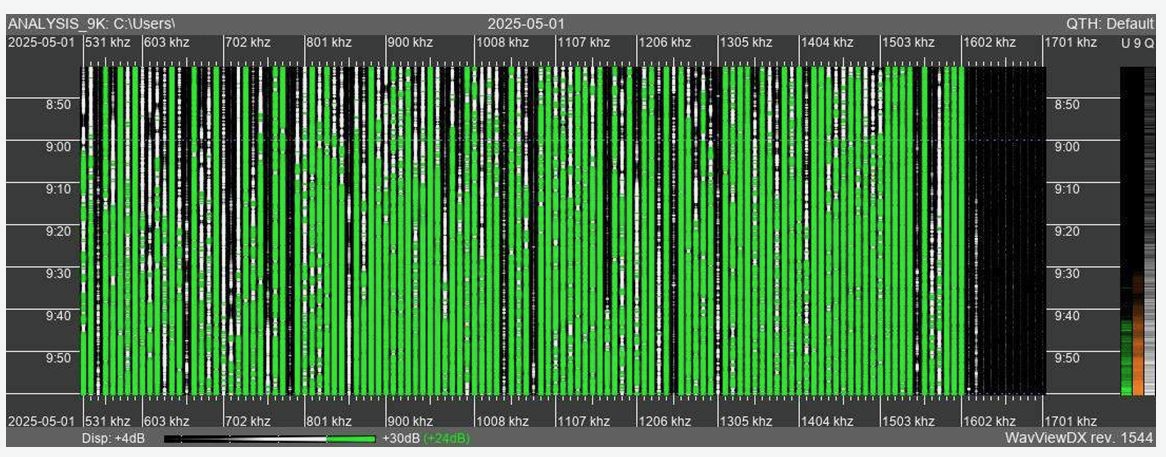
But first, a word about WavViewDX: seeing is believing. As shown in the sample image in Figure 5, it visually displays the status of stations received at each frequency, using green bars or white lines, in chronological order, from the lowest frequency band (left) to the highest (right). You can even customize it to analyze North and South America at 10 kHz intervals for TP reception.

The author is Reinhard Weiß from Germany (please see accompanying related articles).  It is an incredibly easy-to-use and intuitive software. Once you start using it, you’ll definitely want to keep it.

Figure 5

First, let’s assume you’ll be importing and analyzing data into WavViewDX.

1.) Timer Reception Tips, Using SDR Console

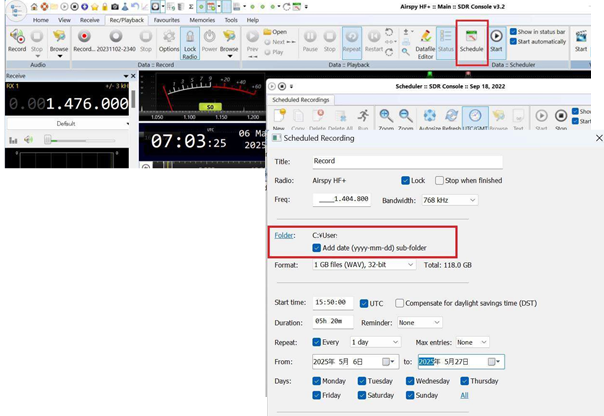
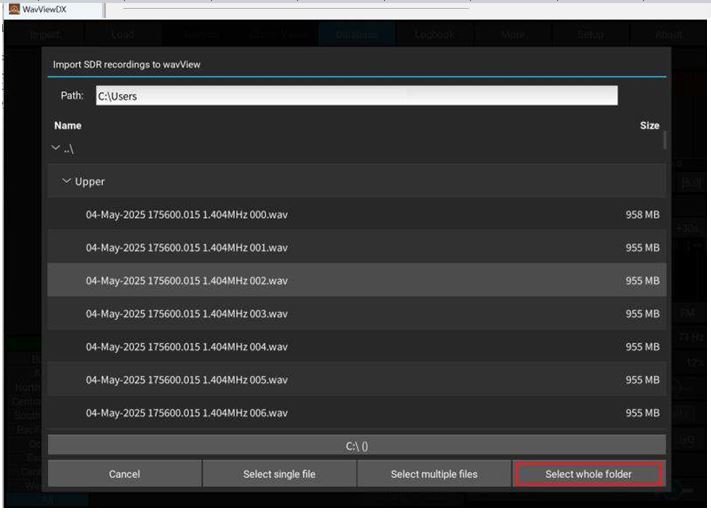
This is a backward-thinking approach based on the fact that WavViewDX can import files in “folders.” The golden rule is simply to store all files from a single session in a single folder. I’ve been using SDR Console as my primary SDR program for a while now, so when I register a scheduler (for timer scheduling), I click “Add date (yyyy-mm-dd) subfolder” under “Folder”, in Figure 6. This allows me to import the entire folder of recording files from that day into WavViewDX, saving me a lot of time. WavViewDX has a “Select Whole Folder” button, which allows me to import files into WavViewDX with a single click (Figure 7). How amazing! Incidentally, I set up bandwidth recording files to be stored in separate 1GB files. The moment I wake up, the files are instantly imported into WavViewDX, allowing me to quickly check the conditions from midnight to dawn before work.

Figure 6

Figure 7

2) TWR-Africa Reception Recording

Even on shortwave, it’s rare to see signals from Africa, let alone on mediumwave. Until a few years ago, I thought this was impossible. However, I discovered that I could record pre-dawn signals from Africa on my home K9AY loop, including the VOA of the Sao Tome and Principe relay on 1530kHz, as well as the famous TWR Africa (Benin) on 1476kHz. Of course, it’s not easy to receive signals every day, so I was not motivated to record them regularly However, after installing WavViewDX, I was able to easily grasp the pre-dawn conditions, and I set up a scheduler to record as many times as possible every day.

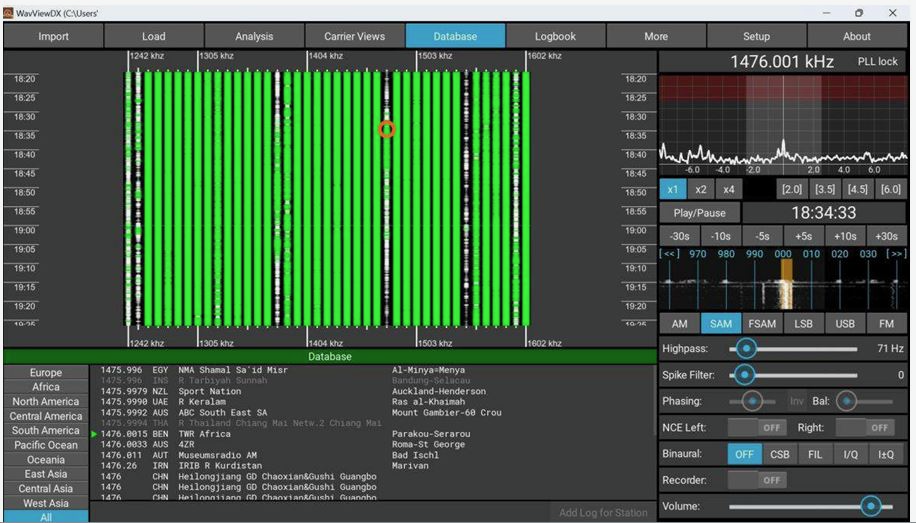
Then, one morning, right around 3:30 AM, on the morning of the March vernal equinox, I noticed a very clear bar on the 1476kHz using WavViewDX (Figure 8). By working in conjunction with WavViewDX, it automatically checks offsets in exact carrier frequency being received against the MWList database, and the > mark quickly lights up in WavViewDX, indicating that it’s TWR Africa! I was surprised when I heard the audio. I was impressed by the exceptionally clear reception. There was a slight beat, and it seemed like at least one other carrier was also in the mix. How such clear audio managed to reach and be heard across nearly 13,300 km as the crow flies is a mystery, but it’s still a moving experience.

Figure 8

I asked @lft_kashima LFT Kashima Fishing Radio, who regularly posts information on X, and he said that the signal wasn’t as good on that day at his location. Since we’re both in the Kanto region and a little farther apart, perhaps that’s the problem, or perhaps it’s just the antenna. He uses a north-south loop antenna, while I use a vertical AOR SA-7000.

While I don’t know the full reason or answer, one possible guess: – Wasn’t the arrival direction north-south? – Did it arrive through a duct somewhere? However, there’s no way to know why the duct ended up at this receiving point. It’s a wonder that I was able to receive such a DX station at this point in the solar cycle, when the number of sunspots is almost at its maximum and the A/K Index was far from calm. This makes daily reception all the more meaningful. It’s a moment that makes me admire nature, the work of radio wave propagation.  I was able to receive this station again in April, and the links to those two results from 1476kHz – TWR Africa are below:

3) The Mysteries of Radio Wave Propagation Discovered Only with WavViewDX

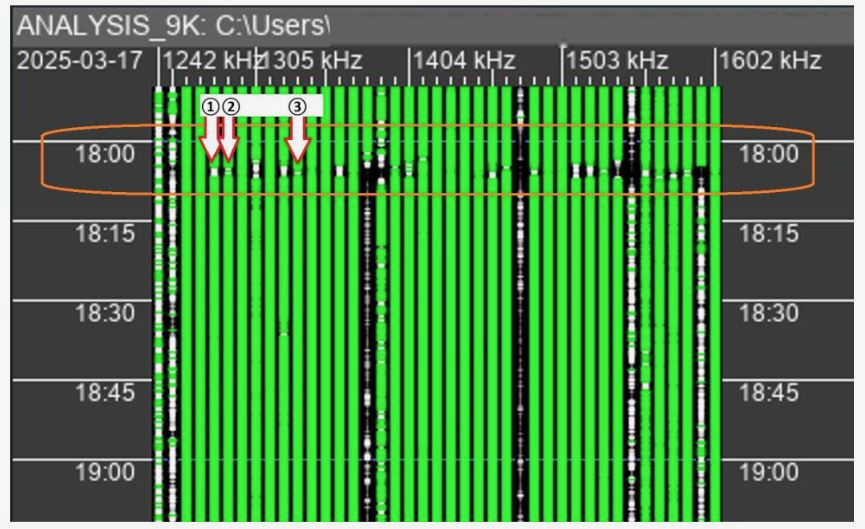
WaveViewDX already clearly shows the reception status on the vertical time axis, but just before the vernal equinox, a phenomenon in which the propagation conditions deteriorated simultaneously across multiple frequencies occurred, albeit for a short period of time. (Audio Sample https://youtu.be/XhXSQFiGQeo) What is this? Figure 9 shows the actual situation at my location on March 17, 2025, after 18:00 UTC.

Figure 9

  1. 1278kHz JOFR Fukuoka RKB Mainichi Broadcasting System 50kw (about 900km distance, 245°)
  2. 1287kHz JOHR Sapporo HBC Hokkaido Broadcasting System 50kw (about 1000km distance, 340°)
  3. 1332kHz JOSF Nagoya Tokai Broadcasting System 50kw (about 270km distance, 270°)

(*Note: The leftmost bar (1242kHz in the Kanto region) is attenuated with a notch filter)

One of the benefits of WavViewDX is that it visually showed the simultaneous drop in signal strength from domestic and international stations, which had been arriving almost smoothly until 18:00 UTC.

I asked Perplexity AI and searched the literature. These possibilities were listed:

“Regarding the phenomenon of simultaneous attenuation of radio signals in all directions for several minutes during nighttime propagation in the medium frequency band (MF band),” it is believed to be primarily caused by the combined effects of the following factors: –

  • Ionospheric Variation Mechanism Sudden E-Layer (Es-Layer) Formation A localized increase in electron density in the upper E-layer of the ionosphere (at an altitude of 100-120 km) at night. This thin ionosphere strongly reflects signals, blocking the normal F-layer reflection path. One measurement data showed signal attenuation of up to 20 dB when the Es layer occurred.
  • F-layer altitude fluctuations: When the F layer (altitude 250-400 km), the main nighttime propagation path, rapidly rises due to thermal expansion, the reflection angle changes, creating a “propagation hole” that causes signals to deviate from the receiving point.
  • Earth’s magnetic field fluctuations disrupt the electron distribution in the ionosphere, causing a sudden increase in absorption.
  • Instantaneous changes in solar activity: The emission of X-rays and charged particles associated with solar flares suddenly changes the electron density in the ionosphere, destabilizing the reflection coefficient and resulting in short-term propagation loss.

Although it was able to provide various possible explanations, I was unable to perform any further verification of these answers myself.


These English translations were prepared for IRCA’s DX Monitor, and are used with the kind permission of  IRCA as well as of the authors and the editor of the Totsuka DXers Circle publication, PROPAGATION.

An Introduction to WavViewDX SDR Playback Software (A Totsuka DXers Circle Article by Kazu Gosui)

Many thanks to SWLing Post contributor Nick Hall-Patch, who has kindly provided a translation of this article from the Japanese-language publication PROPAGATION by the Totsuka DXers Circle (TDXC). In this piece, Kazu Gosui introduces WavViewDX, an impressive SDR file playback and analysis tool developed by Reinhard Weiß of Germany.


About WavViewDX, SDR File Playback Software

by Kazu Gosui

Introduction

“WavViewDX,” developed by Reinhard Weiß of Germany, is SDR file playback software. It maps the received signals from SDR-recorded files into bar graphs, with time on the vertical axis and frequency (channel) on the horizontal axis, for each of the following channel separations: medium wave (9/10 kHz), short wave (5 kHz), and FM (50/100 kHz).  Clicking the cursor (blue crosshair) plays the received audio. By “visualizing the received signal” through mapping (see also the separate article by Satoshi Miyauchi), you can see at a glance the start and end times of broadcasts, fade in, fade out, channels you should listen to, and channels you don’t need to listen to.

Basic Usage and Screen Description

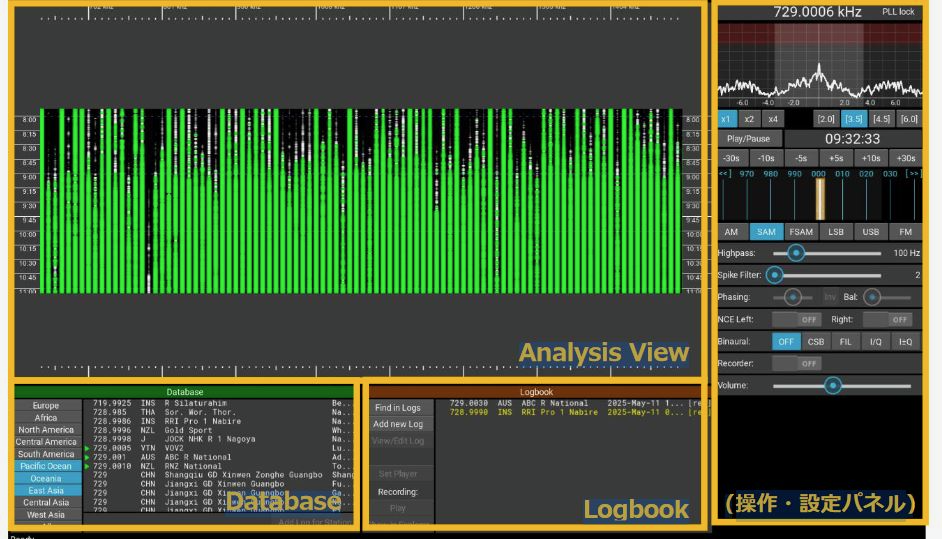
First, download and install WavViewDX from the WavViewDX webpage (https://rweiss.de/dxer/tools.html). The latest version is version was 1544 as of June 8, 2025, when this was written, but version 1662 is available in October 2025. When you launch WavViewDX, the Main Window (Figure 1) will appear, showing Analysis View, the Operation/Settings Panel, Logbook and Database.

Figure 1

To play back recorded files, you must import them. Click Import to display the Import SDR Recording settings screen. Source files can be selected as single or multiple files, or by folder. Set the reception location, time, channel separation, etc., and begin importing. A progress percentage will appear, and green and white bar graphs will appear on the Analysis View screen. Hovering the cursor over a bar graph and clicking will display a red circle, and the audio recorded for that channel and time will play. Scrolling the mouse will allow you to zoom in and out of the Analysis View.

When you import, a WVD format file is created. Once you’ve imported the files, you can simply load the corresponding WVD file at another time, and the files will be available to play immediately.

In addition to Import and Load, the following settings are available at the top of the Main Window.

  • Analysis: Allows you to select the file/folder and frequency separation when importing.
  • Carrier Views: Displays offset frequencies to identify and estimate the received medium wave station.
  • Database: Links with the MWLIST webpage (https://www.mwlist.org/ul_login.php) to identify and estimate the received medium wave station.
  • Logbook: For documenting stations heard, along with creation of audio recordings during playback.
  • More: Allows you to set multiple options, such as manual tuning and contrast setting.
  • Setup: Allows you to set the sound device and select the file format for recording audio clips during playback.
  • About: Allows you to select the software version, Help, etc.

The Main Window also displays the frequency list linked to the aforementioned Database and the Logbook.  The database frequency list can be selected by region, such as Europe or East Asia. The Logbook allows you to record reception records and associate recorded audio files.

The right side of the Main Window contains the operation and settings panel. At the top are the Frequency Display and Spectrum View. Hovering the cursor over Spectrum View allows you to select PBT (Pass Band Tuning) and NOTCH.

Below these are:

  • Spectrum Zoom (x1, x2, x4), which expands the spectrum;
  • Bandpass Bandwidth Presets ([2.5] etc.), which change the reception bandwidth;
  • Player Time Controls (Play/Pause; -30s etc.), which control the playback time;
  • Carrier View, which displays the offset frequency; (+/- 30Hz, and can be shifted above and below the nominal .000 frequency)
  • Demodulator Modes, which change the reception mode.

(Keyboard shortcuts are available for the above functions.)

  • The AF Highpass Filter adjusts the audio frequency passband to improve intelligibility.
  • The Spike Filter reduces popping during reception.
  • Phasing combines two synchronized recording files to reduce same-frequency interference and noise.
  • NCE (Neighbor Channel Eliminator) reduces interference from adjacent channels.
  • Binaural allows you to select the sideband of the AF output during playback.
  • The AF Audio Recorder allows you to record by clicking during playback. Recording formats include WAV, FLAC, and MP3.

As you can see, there are so many features it’s impossible to introduce them all. Detailed adjustments to each function make it even easier to use; it may seem tedious at first, but give the features a try. The user interface is intuitive, so you’ll quickly get used to it. If you’re unsure how to use something, just press the F1 key and refer to the Help.

Actual Usage 

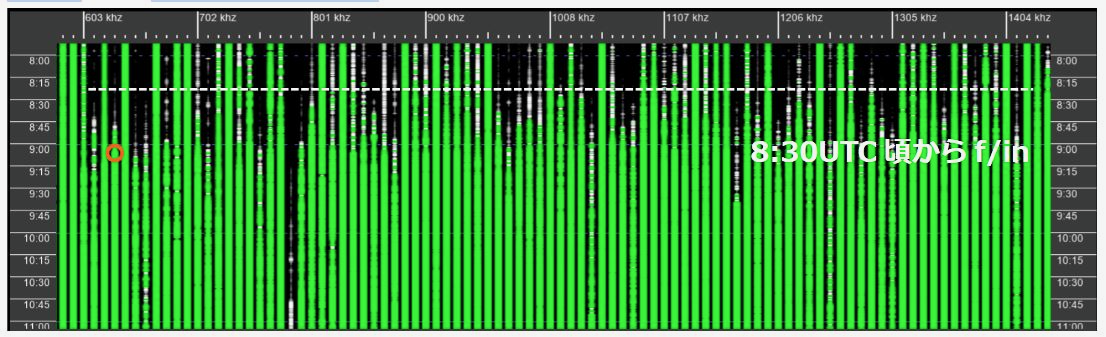
Let’s try it out. The import settings are set to MW 9+10kHz Channel Analysis Configuration. Configuration, and other settings are set to default. (editor’s note:  “SDR Calibration” allows the use of reference carrier frequencies in the data, for those SDRs without a frequency standard, so that each carrier frequency in the passband will be displayed accurately.)   Once the import is complete, a bar graph will appear. Figures 2 and 3 show the analysis view of the actual file import from early May 2025, during the Hachijojima DXpedition showing evening reception; time is UTC.

Figure 2

Figure 3

9kHz separation is used in Figure 2. You can hear the audio from 630kHz at the time indicated by a circle. Black areas of the bar graph indicate no signal, while white to green indicates good signal reception. If you miss an ID during reception, press the up arrow key to rewind the time by 5 seconds and listen again.   Click Recording to record the ID.

As you can see, the bar graph color changes from black to white and then white to green over time. This indicates that as the day turns from daytime to evening and then nighttime, channels that previously had no reception begin to receive broadcasts. Sunset on this day was 9:29 UTC (18:29 JST), and the received signal fade in was between 8:30 UTC (17:30 JST) and 9:15 UTC (18:15 JST).

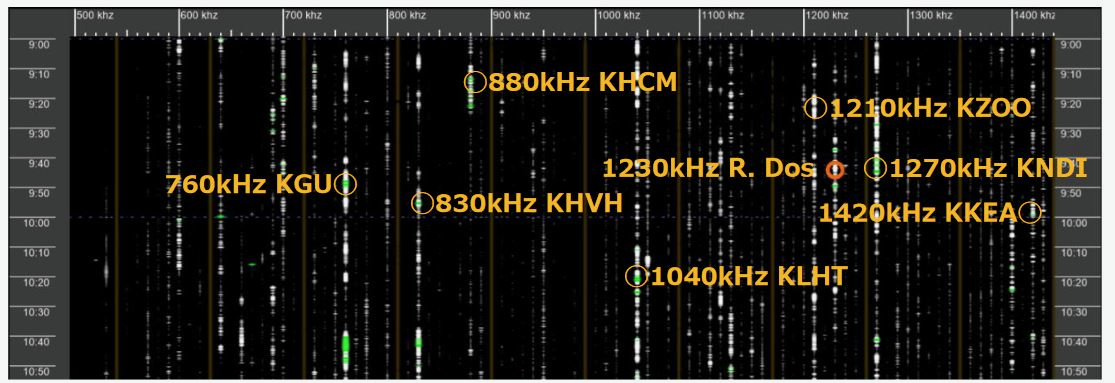
Next, click Analysis and switch to MW 10kHz channel analysis. The Analysis View after switching is shown in Figure 3. This shows the reception status with 10kHz separation. Most channels are black, with a few white spots. There is very little green. In this image, there are certainly no 10kHz channels with good audio, but by clicking on the white, we can see some with faint English talk and music. I checked the database and found that these channels appear to be Hawaiian stations (see orange circle marks in Figure 3) that have been active since around 8:30 UTC.

Also, Latin music was heard on 1230 kHz (Orange circle in Figure 3). This may be Radio Dos from Argentina. By visualizing reception status like this, I was able to determine where to listen and where not to listen. During the Hachijojima expedition in May, I was blessed with outstanding reception conditions from the evening through the early morning hours of the following day, and was able to track 187 overseas medium wave stations, including 165 in Australia, 5 in New Zealand, 2 in Papua New Guinea, Solomon Islands, Tonga, Marshall Islands, Kiribati, Palau, Fiji, Tuvalu, Indonesia, and the Philippines, achieving significant results. Playback and analysis took about a week, which was shorter than usual, thanks to WavViewDX.

Summary 

As mentioned above, WavViewDX has proven to be an efficient tool for analysis, allowing users to discover previously unnoticed stations. Since it can play files recorded with various SDRs, we hope that many DXers will use it. WavViewDX is compatible with multiple PC operating systems, including Windows, Linux, and macOS, and is freeware. According to Reinhard Weiß, additional features and enhancements are planned for the future, so we look forward to seeing its future developments. Finally, we would like to express our gratitude and respect to Reinhard Weiß for developing such useful and excellent software.

Reference Materials 

Table 1. Supported IQ Formats

ELAD FDM-SW2 Generic RAW recordings
GQRX recordings HDSDR
Jaguar Linrad RAW, single and dual-channel
recordings PERSEUS (*.wav)
PERSEUS P22 (*.P22) SDR#
SDR Console SDR Uno
SDRconnect SpectraVue
WiNRADiO DDC WiNRADiO RXW (only for G33)
Winrad

Trying WavViewDX on FM 

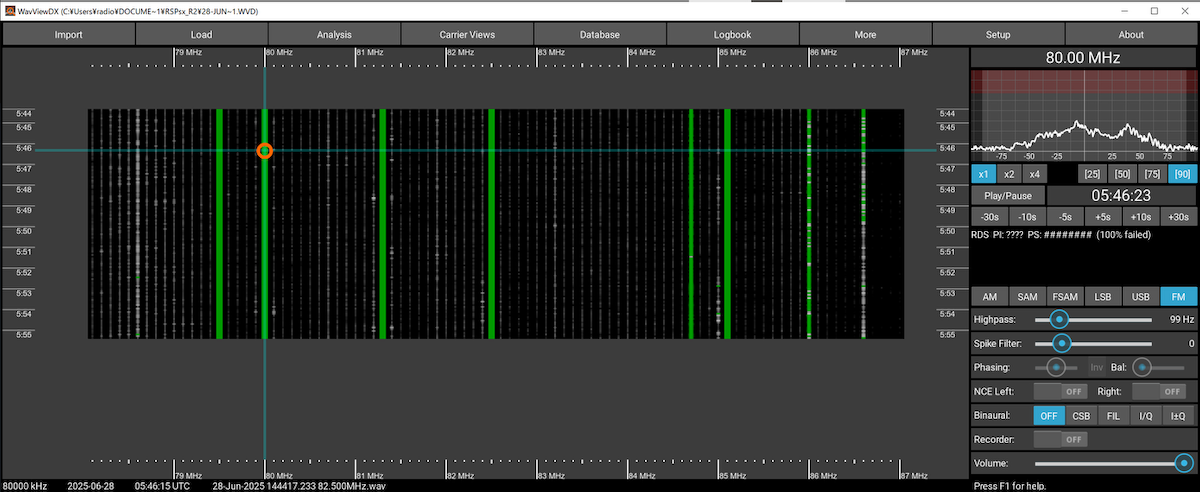
WavViewDX is primarily geared toward medium wave DX, but it seems like it can be used for FM DX as well. The image in Figure 4 shows reception from 79-87MHz using an RSPdx-R2 and an indoor YouTwin antenna. It supports stereo and has good audio quality. With an outdoor antenna, it could also be used for FM DX, such as with sporadic E and other short-lived propagation enhancements.

Figure 4


These English translations were prepared for IRCA’s DX Monitor, and are used with the kind permission of  IRCA as well as of the authors and the editor of the Totsuka DXers Circle publication, PROPAGATION.