
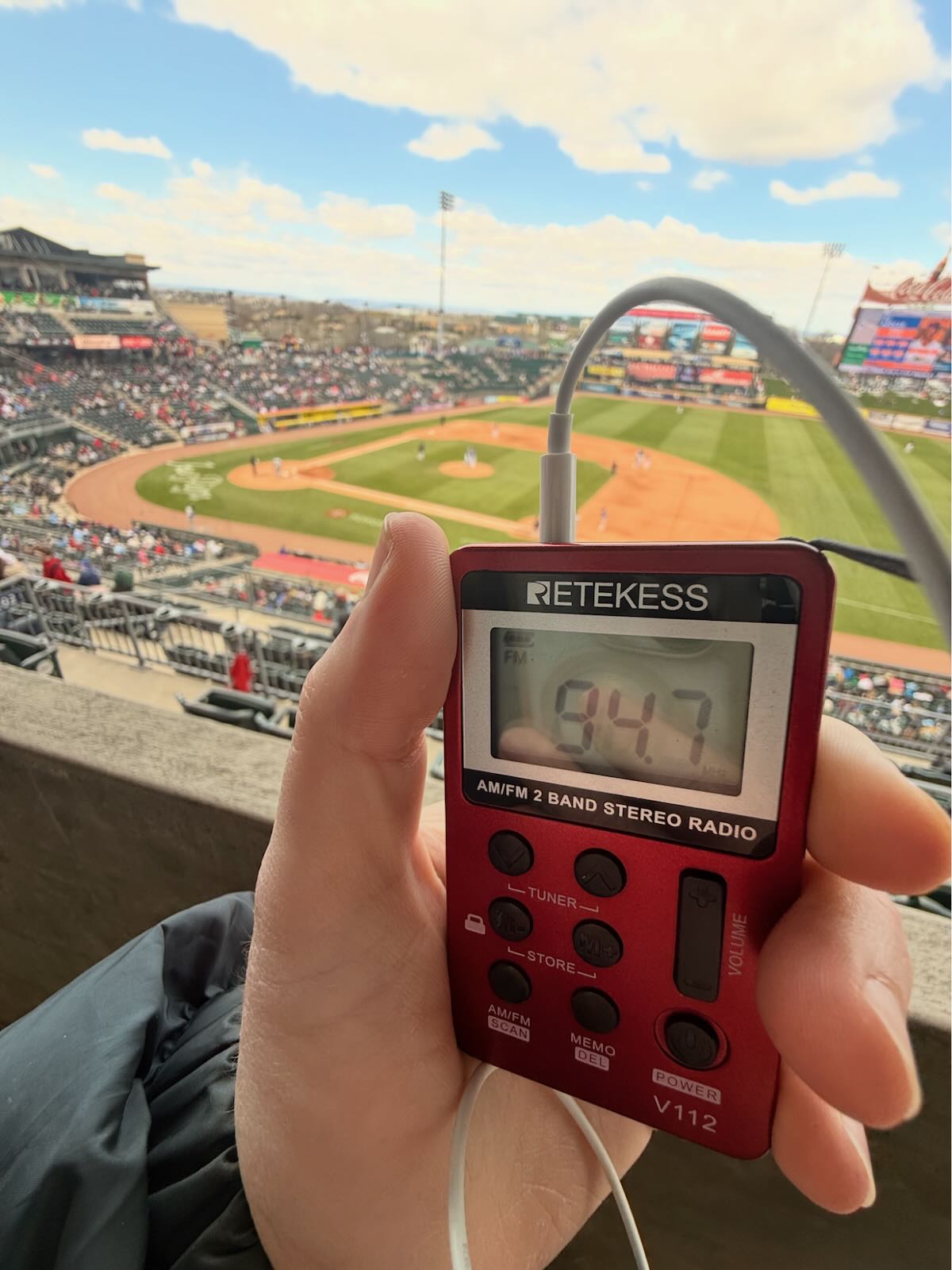
The Retekess V112 takes in the scenery at a Lehigh Valley IronPigs game in Allentown, PA
by Aaron Kuhn
In my previous post for SWLing Post, I suggested the characteristics of an ideal ballpark radio and considerations for radio selection. While researching that post, I came across the Retekess V112 which ticked a lot of the boxes I recommended – compact, cheap, unobtrusive.
The Retekess V112 has indeed turned out to be a compact, affordable, and unobtrusive companion for enhancing the game-day experience at the ballpark. Priced at a consistent $15.49 on Amazon [SWLing Post affiliate link] for over a year now, this little red (or Gold) radio has exceeded my expectations.
Unboxing and Accessories (and what to replace):
While the physical packaging is a distant memory to me, the V112 comes with earbuds, a neck lanyard, and a Micro-USB charging cord.
- Earbuds: While included, the provided earbuds are notably uncomfortable and were quickly relegated to the recycling bin. My ears are not your ears of course, and they might be salvageable with interchangeable eartips if you have some lying around, but it’s highly recommended to bring your own comfortable earbuds or headphones. This is especially important as the headphone wires double as the antenna, and reception can vary significantly between different pairs of headphones based on the cable. My older Apple EarPods offered good comfort and reception, while Sony MDRE9LP’s performed poorly. Experimentation of pairing the radio with low-cost IEMs would be an interesting project.
- Neck Lanyard: Surprisingly, the neck lanyard is the hidden gem of this package. It allows the radio to hang around your neck, keeping your hands free for hot dogs and foul balls.
- Micro-USB Charging Cord: While USB-C would be a welcome modern update, the included Micro-USB cable is understandable given the radio’s price point and older engineering. It’s hard to complain about the cable-port standard chosen when they give you the cable you need, and you probably have multiple other Micro-USB cables kicking around in storage boxes and drawers already.
Portability and Power:
- Size and Weight: The Retekess V112 truly shines in its portability. Weighing 45 grams (0.1 lbs) and measuring 3.3 x 1.8 x 0.5 inches, it’s so small and lightweight that it’s easy to forget you’re carrying it, and easy to lose it in your pocket (like I have done multiple times!) This weight is even more impressive given the battery is built-in. I like to leave my earbuds plugged into it and wrap them around the radio body for transport, producing a tidy, tiny package of everything I need.
- Battery: Battery life is another strong suit – I have yet to accidentally run it down, even forgetting to charge between games. I typically throw the radio on a battery bank on the way to the game, or shortly before the game, and have never run down the 500mah battery. I can’t find a stated battery life, and due to my experience really can’t estimate a runtime besides “long enough for extra innings.”
Features and Functionality:
- Antenna: While relying on the headphone cable for an antenna does impact reception, it eliminates the bulk and vulnerability of a traditional antenna whip. This helps to make the radio instantly pocketable and prevents accidental seat-neighbor-pokes or damage. There’s nothing fancy such as selectable bandwidths to really help you out here, so you’re either going to have usable reception or you won’t.
- Power/Mute Button: The power button cleverly doubles as a soft-mute, perfect for cutting out commercials between innings. A quick button tap when the last batter is out mid-inning mutes until you see the next batter up, and returns the previously set volume quickly.
- Keypad Lock: The keypad lock function is invaluable for setting the desired volume and then tossing the radio in your pocket or letting it hang from the lanyard without accidental button pressings changing stations or volume.
- Presets / Direct Frequency Entry: The lack of a number keypad for direct frequency entry is a minor inconvenience and my only real complaint, but in reality it’s lack of preparation. The radio does offer presets, making it easy to save your preferred stations before heading to the game – as long you remember to do so.
Future Wishlist:
If any radio manufacturers are out there listening (get in touch, Retekess or Tecsun!) I still think there’s a few features that would make an even better ballpark radio as discussed in my article from last year:
- Bluetooth Headphone Support: There are a number of small radios on Amazon that advertise themselves as having “Bluetooth”, but when you dig deeper the feature just turns the radio body into an external speaker to your phone/tablet/laptop. The exception to the rule is the Prunus J-618 which claims actual bluetooth headphone support. Bonus points to manufacturers – allow two sets of paired headphones to be driven simultaneously. Finding comfortable Bluetooth earbuds is way easier these days at retail than finding a pair of wired earbuds, and you probably already own a pair to your liking.
- Replaceable Parts: Implementing Bluetooth headphone support is going to require the move to an external antenna, and with that I’d love to see an antenna that can be easily replaced if it snaps off / is broken. I’m pro-repairability on electronics, so it would be great to see parts kits available at a small cost up-front with the radio to increase the likelihood the device lasts for years. Think antennas, plastic trim/doors, clips, lanyards, etc.
- Selectable Bandwidth: I’d pay a little more for a radio that has a selectable bandwidth feature on both FM and AM. Legible commentary for a ballgame doesn’t require a very wide bandwidth, and this would go a long way towards turning an unstable/fringe signal into something more enjoyable. I’ve made use of bandwidth selection on Tecsun radios at the ballpark in the past and this is a sorely missed feature.
- USB-C Charging: It’s 2025 – the world has moved to USB-C. Any device worth its salt these days should include a USB-C charging port, with actual proper USB-C PD support – none of that hacked up USB-A to USB-C junk.
- Multiple Mounting Options: The lanyard on the Retekess V112 is great, what would be even more fun is some kind of clip that could attach to a stadium cupholder, or be attached to a seat in some fashion. Being able to strap a radio somewhere with bluetooth headphone support would be the ultimate convenience.
Conclusion:
For under $17 delivered to your door, the Retekess V112 is a great investment for live baseball enthusiasts. This radio has consistently enhanced my enjoyment of baseball games with its portable size, performance, and ease-of-use.
At $25, the Prunus J-618 looks like it might be a contender to the Retekess V112 throne and is one I’ll likely be checking out in the future. The Tecsun PL-368 is an attractive proposition for a ballpark radio, but in my mind provides more radio than you need, at a price-point ($75-$100) where I’d be afraid of breaking it or misplacing it in a ballpark environment.
For what it is, I’m not sure there’s much else that can compete at this price with the Retekess V112 for a low-cost, turn-key solution to live baseball play-by-play.
Just found the website of the small earpiece radio supplier:
https://www.livesportsradio.com/products
Audio delay has been generating some niche businesses
Dissenting opinion: I bought this radio about 5 years ago but returned it after 2 days. Reception was awful, both AM and FM. Maybe poor quality control?
Interesting analysis and write-up on this radio. Now here’s one that does the opposite for TV, it adds in delay: https://www.sportsyncradio.com/sr-404/
This is great! I know a lot of people who definitely prefer the radio play-by-play over the TV broadcasts.
Pick up a pair of C. Crane earphones, and you’ll be in Radio Heaven. They are an outstanding earphones at a good price.
Wasn’t aware they sold headphones individually, definitely a great option for people if they don’t own a wired pair.
https://ccrane.com/earbuds/
I use the Retekess V112 at my Church. Everything put out over the PA system is also fed to an Assisted Listening Device Transmitter that transmits an FM signal on 72.1 MhZ. (The V112 has one FM band that covers 64 thru 108 Mhz. It also has another that tunes 87 to 108 for a quicker standard broadcast band scan.)
If I go to an outdoor event, I do a band scan and can sometimes pick up a program for the event.
If charged over night, I get about 12 hours of operation when used with an efficient mono earpiece (set at volume level 4 or 5)
What is the difference between Retekess V112 (this review) and Hapito Personal Small Transistor radios?
https://www.amazon.com/Pocket-Portable-Digital-Walkman-Reception/dp/B099WHVP7M?th=1
Looks like the Hapito has a plastic front that is not painted. My V112 has a gold painted plastic front. After several months of use, the gold paint is scratched down to the plastic & looks a little ratty.
Looks very, very similar. As TheZ stated, body paint/coating is a bit different but I would guess under the hood it’s the same radio. As it is with many low-cost electronics, I very much doubt “Retekess” is the original manufacturer of the V112 so there’s likely a reference-design you can just buy/commission.
I enjoyed your review; this radio would be a worthy replacement for my Sony SRF-M37V, which always goes to the ballgames with me. As others have mentioned with your previous post, broadcast delay can make this a moot point. I recently attended an (formerly Oakland) Athletics game, and the total latency/delay in the broadcast audio made it unlistenable in person. The delay was generally about 20 seconds, often long enough that the announcer was a full pitch behind the action. Maybe the minor league team in the same stadium will have a shorter delay (a different station after all) but I haven’t tried that yet. This used to be a fun way to combine the radio hobby with the baseball experience, but it won’t work for me.
Broadcast delay can be a real bummer and ruin the whole idea. I’m a big Phillies fan and unfortunately they were 10+ seconds of delay on the analog FM rendering it pretty much unlistenable. I’ve had much better luck at all the minor league ballparks I’ve been to, none of which have been any more than a 1-2 second delay , most are pretty near to live.
If a standard FM Broadcast station also has HD Channels, it takes 8 seconds of latency for the digital audio to be transmitted. The big FM guys have it set so that if you listen to HD1 in the car, and when it drops out, it defaults to analog FM. They purposely delay the analog FM so that you have a seamless auto transition between HD1 & the analog channel. Since most FM’s have HD channels, just about all are 8 seconds behind the action. I think that you can get live action on AM if they don’t have to worry about the broadcast hosts cussing. If worried, they add delay for that.
Unfortunately, over the air TV is digital & also has latency on a live broadcast.
Ah – that absolutely makes sense! (And I think someone pointed out in last post I did as well!) WIP 94.1 does broadcast in HD on FM, and unfortunately they discontinued their AM feed many years back. This only reinforces the idea of having AM Radio support being critically important for this use case if given the choice between an FM w/ HD delay + an AM feed.
I was wondering about this because I recently read about a UK cricket ground that sells headset FM radios which tune to put of band FM signal s put out by the stadium (in the 60s MHz) and which are closer to live than the broadcast equivalent would be – presumably they take the feed from the commentary box before it goes out to the broadcast stations. They tend also to be switchable into broadcast FM receivers so they’re not rendered useless when leaving the range of the LPFM signal.
I was at the 2025 US Open Golf Tournament at Oakmont Country Club. They had earpiece FM Radios that relayed the live radio broadcast of the event (PGA Tour Radio). The maker of the radio had a web site imprinted (that I forgot the address to), but stated that it was in the business of supplying these earpiece radios at live sports events to get keep the live action in sync with the received audio. I did an estimate for transmitter power needed to cover the Oakmont CC with the earpiece radios, base on 100Mhz and a1 inch receive antenna. It came out to be around 60 to 80 watts. Checking further, this company supplies and gets the transmitter for the event licensed as part of the package that they supply.
Just found the website of the small earpiece radio supplier: https://www.livesportsradio.com/products
Outside of the Americas almost all phones except iphones® have the chip enabled for FM radio reception in stereo. In the more populated areas some areas have no AM broadcasts. In Europe most radios in retailers are DAB+/FM with no AM.
https://www.lg.com/au/about-lg/press-and-media/lg-stylus-dab-the-worlds-first-smartphone-to-support-digital-radio-comes-to-australia/ this was in 2016. This was a DAB+ receiver and phone. Perhaps it needs reintroduction in Europe with major networks in Norway and Switzerland DAB+ only and all new cars after 2020 must receive terrestrial digital radio, there is wide spread areas with DAB+ broadcasts.
However, like streaming, DAB+ has a delay which can make watching live sport with delayed commentary confusing This also occurs in India with DRM and live cricket for the same reason.
This is an excellent point that deserves being made – If you own an Android phone in the US that has FM Radio support, it’s absolutely worth trying that out at the ballpark instead of buying a separate radio.
Wow, Aaron, what a great write-up: succinct, to the point, and useful!
Your comments about the earbuds reminded me of a germanium diode radio I had as a kid (shortly after the Civil War) that had a hard plastic “earbud.” Ow! One size definitely did not fit all.
It strikes me from your comments that the Retekess V112 might make a great “boredom” radio, tucked in a pocket for when you get stuck in a line at the Post Office, etc.
Cheers, Jock