
Many thanks to SWLing Post contributor Mark Hirst, who writes:
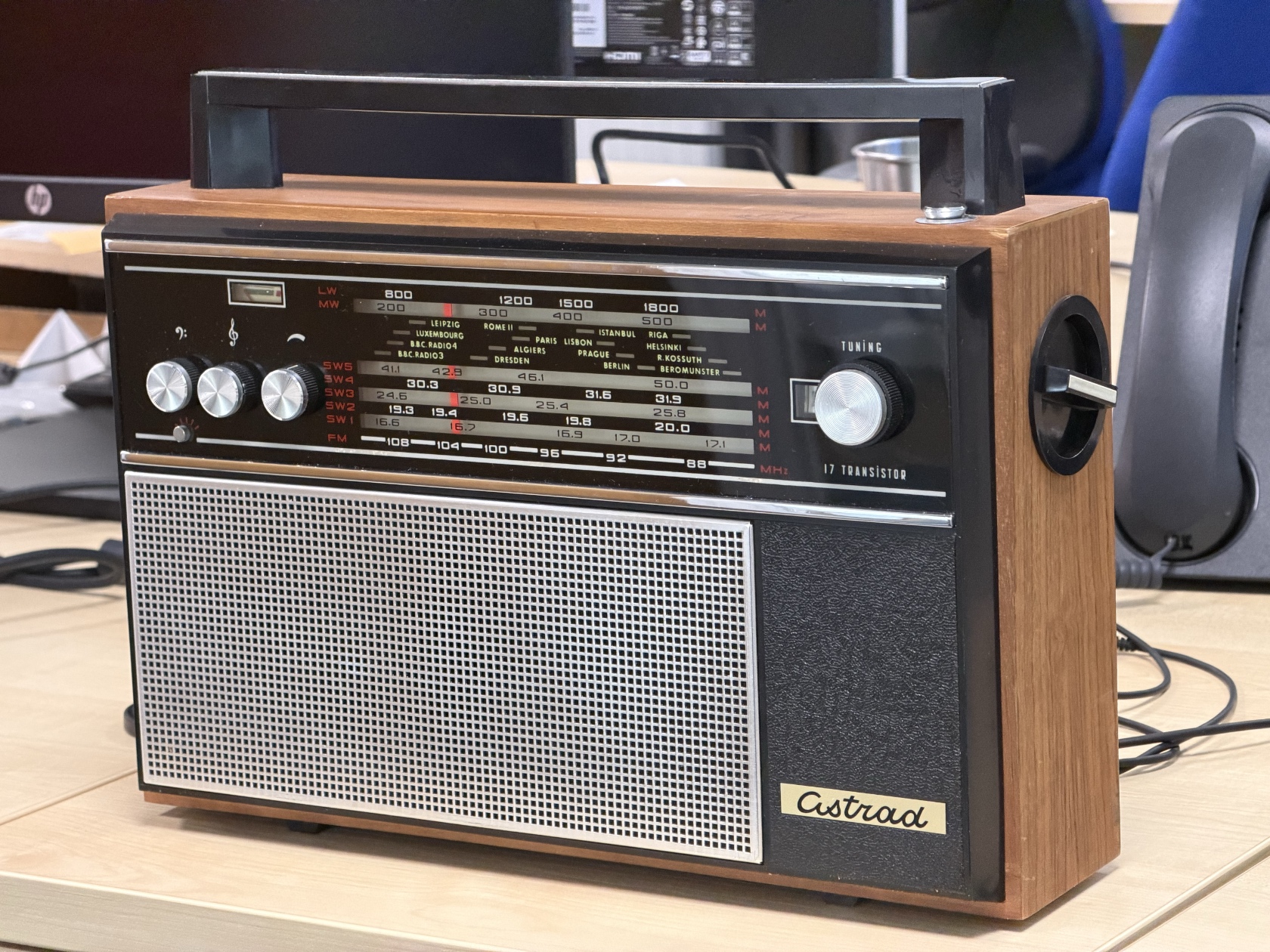
This gem arrived in the charity shop where I volunteer yesterday, a radio made in the USSR (Minsk) in around 1975.
It was in fantastic external condition, although after checking it out discovered that the band changing control on the right hand side had been disconnected.
I suspect something went wrong with the very mechanical way it switched frequencies (shown in the video below), which rotated individual circuit boards into play.
Somebody seems to have opened it up, set it permanently on VHF, and then disconnected the control to prevent any further changes.
It was evidently sold in the UK as it has BBC radio stations on the dial and I even found a UK service manual for it.
I was tempted for a while, but I’m learning these days that this sort of thing just ends up as clutter.
Hard to believe that only five years after this electro-mechanical radio was made, Sony would release the ICF-2001 !
Mark
Manual:
https://archive.org/download/Trader_ASTRAD_B205/b205_text.pdf
Radio Museum:
https://www.radiomuseum.org/r/minsk_radi_astrad_f8_tr17_b205f8tr17.html#
YouTube – Astrad “Mikado” F8-TR17-B205:
https://www.youtube.com/watch?v=osDxKNdun98
Yesterday, I spotted this in the charity shop window and went straight in to buy it. I was told that the band selector didn’t work. When I got it home, I noticed the screw holes were still sealed with wax, meaning it had never been opened. After carefully removing the wax, I discovered the band selector’s grub screw had come loose. I tightened it up, and the selector worked perfectly. The radio is now fully functional!
I own the Selena B 212 which on my opinion is a great mw radio and sounding great !
It takes a bit force to change the bands..?
Yes it does, and it was the cause of the dreaded cracked bandchange knob. I saw all manner of repairs including big globs of Areldire resin! There was a supplier down in London ( ‘Technical & Optical’ I think) who carried stocks of them.
What a fun find!
Not sure I’d have had your restraint, kudos to you for that!
What a fun read and fun to follow the links too…
I followed the link to Radiomuseum.org and was mightily amused to see among their collection of photos – which includes some nice shots of the innards – a photo of a cover of the UK consumer journal Which for September 1973. Which reviewed products to give – or so it claimed – an impartial review so consumers could make up their minds on facts not hype, the Which Sept ’73 cover with a picture of the Astrad reads
“The small add for this £20 radio said compare it’s performance with £80 radios
[Picture]
We did – it wasn’t as good”
That said the Astrad filled a market niche as Simon noted above in his delightful comment…
73
Julian
Very common in the mid-70’s and the turret band selector was a major cause of intermittent reception. I had quite a lot of them (and the similar earlier Selena models) on my bench back then.
AKA Vega ?????? ?-205 (“Selena B-205”), ??? ????? (“VEF Ocean”) 205, etc., etc., and multiple variations within. Made by Minsk Radio Works, imported into the UK (and eventually some other Commonwealth countries) by Technical and Optical Equipment (TOE), who started off importing cheap Soviet cameras, microscopes, lenses, etc. They were then taken over by Mashpriborintorg, a Soviet “Foreign Economic Association” – part of the Soviet Trade Minsitry – for the purpose of supporting the economy by receiving hard currency from the West.
FM on these is a bit average, though the technical details are interesting (depending on the exact model / build date, it’s not *quite* the usual ratio detector or Foster-Seeley type), but MW & SW are usually pretty good for the era. Biggiest issue is usually problems with that bloody great clunky turret bandswitch – they’re actually pretty reliable, but the contact do tarnish and the fingers do wear and sometimes fold over &/or break, and they’re fiddly to repair/replace.
Schematics are actually pretty easy to find for all these and related models, though the service manuals are usually in Russian ;).
One other interesting factoid about them: they often use brass inductor cores in the FM front end rather than ferrite (presumably Soviet ferrites of that era weren’t up to the task at VHF). Upshot is when aligning the FM front end you wind the core *out* to increase inductance and *in* to decrease inductance – the opposite of most other receivers!
That was a great find Mark. In the USA, there’s a charity called GoodWill that has a website where second-hand goods are auctioned off, including radios. It’s a fun place to virtually window shop. I’ve gotten some great items like a used microscope, radio, and other vintage items. Enjoy your radio. Thanks to Thomas too, for posting.
What a beautiful radio, Mark! Thank you for sharing this with us and, I must admit, I admire your restraint! It would have been incredibly tempting to take that gem home!
Best,
Thomas
For those countries with a reasonably open trade with the USSR in the 1970s, such as the UK and Europe these radios were quite widely available. They provided much needed hard currency and so to attract a market were reasonably priced. They were usually marketed under the Vega brand here
They were an effective SW radio, better than the single bandspread you could find on major brand offerings, but in cost well below the specialised radios that were the alternatives. Some of the mainline brands had good SW radios at the time, but again these were quite expensove. So for a schoolboy teenager like me, a Vega was as good as I could afford. As others have noted VHF/FM tended to drift and also be rather deaf. I reverted to my older Phillips portable for that. But when it came to tuning SW it was a joy. More bands, wider and easier tuning space and quite sensitive. Drifting a little on the higher bands, so I had to tune to one side if I was recording something, to avoid drifting completely off. The big, issue was the slow breakdown of the bandswitch. This came through a mixture of dust/grime and mechanical breakdown. Mainly curable by contact lubricant every few months and switching backwards and forwards carefully until it worked. Fortunately by the time this was completely annoying I was at uni, had a few holiday jobs and enough money to move on. So in September 1980 Sony launched the 2001 in the UK – the first mass market digital keypad radio. I got one of the first batch and my Vega was demoted to a spare. Another step in my shortwave journey.