

Noted by Bob Colegrove
In the Northern Hemisphere the nights continue to get longer as we approach the winter solstice; we gain an hour of early evening darkness on Sunday, November 2nd; the summer atmospheric disturbances are nearly gone; propagation is better. It’s time to set aside the activities of summer and once more dive underneath the headsets.
DXing is not the same thing as listening. For listening you position yourself in a nice recliner with the radio on a table beside you. You set the radio to ATS and scan the available fare. You select one of the more interesting results and, together with your favorite beverage, listen to the programming. DXing, on the other hand, requires well planned work and lots of patience. Critics might say it also requires some imagination; however, I have always tried to be honest with myself and ask if what I am hearing is truly QSLable.
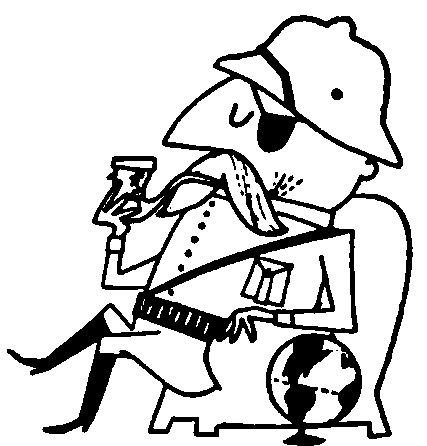
Sir Oswald Davenport, intrepid DXer and Chairman,
National Association of Armchair Adventurers
Don’t get me wrong, I listen a lot, but I also DX. Living on the East Coast of NA, I often direct my antenna toward Asia and the Pacific hoping to hear Japan and New Zealand. However, more often than not, these have proven to be illusive. DXing is like fishing. Often, you pull up an old boot or find the bait is gone. Further, the sound quality of a true DX signal will have no appeal to an audiophile. It is intentionally weak and subject to fading.
So, you get your wins when you can. Last February I scanned the 49-meter band stopping at 6130 kHz to identify some faint pop/rock music. There were two possibilities, a Chinese station and Radio Europe. If you have never heard of Radio Europe, it is in Alphen aan den Rijn, The Netherlands, and has a rather imposing name for a modest 1 kW station. It is targeted to Western Europe, and is listed in HFCC, B25. The station is identified periodically in English by a dramatic baritone male announcer. The recording was made at 0211 UTC on February 6, 2025. The announcement begins 9 seconds into the clip; Radio Europe is mentioned at 23 seconds.
The curious thing is Radio Europe is not necessarily well received at the U. of Twente SDR site just 100 miles away. Science notwithstanding, there is simply no accounting for propagation.
Well, Radio Europe is back this season as strong as I have heard it, and if you’re a NA East Coaster, you might give it a try from 2300 UTC on. I see it was reported in Florida in 2023. Using exalted carrier single sideband (ECSS) (SSB in simpler terms) seems to produce the best results. Despite low power and long distance, it’s occasional stations like Radio Europe that keep this DXer fishin’. For a clear sample, it streams here http://p.liveonlineradio.net/?p=radio-europe.
Good DXing ’25-’26.

Dexter D. Xer
Bob,
Thanks for the timely reminder . . . and I love “Sir Oswald Davenport, intrepid DXer and Chairman,
National Association of Armchair Adventurers”! Who wouldn’t want a membership certificate on their wall?
Possibly I fall into the category of “content DXer.” Very early in my SWLing career, decades ago, I was visited by an expert DXer. He fusses with my rig for a bit, tuning to a specific frequency to reveal a scratchy signal in a language I did not understand. “That’s Peru,” he says. I was underwhelmed.
Yet, earlier this year in the pre-dawn hours, I was delighted to detect a tiny AM (MW) station from Pennsylvania with a local nature program. So, for me, it’s not just how far away and how difficult to hear, but also what I hear.
One target that I would love to hear is RNZ’s Cyclone watch on shortwave: https://swling.com/blog/2025/11/rnz-pacific-launches-2025-26-cyclone-watch-service-on-shortwave/
On the ham bands, the New England Weather Net from 1030-1130 UTC on 3906 LSB is worth a listen. I heard them last week.
Yes, it really is like fishing . . . you never know what you might catch.
Cheers, Jock
Hi Jock,
Thank you for your comments. I note your postings are always positive and upbeat.
In retrospect, I worry my thoughts on DXing, as I described, may have been overstated. There are many varied facets in the jewel of radio listening. You have suggested a few of these.
Many years ago, my mother would pack up a picnic and the family would go fishin’. We used long, simple bamboo poles (no casting rods) which had to be strapped to the outside door handles of the car for transport. Geist Reservoir was completely isolated on the Indiana prairie. There we would hike to a “spot” and set up the poles, which were propped up on wooden forks, butt end anchored on the beach with a rock, line out in the water, and mostly left unattended. Occasionally, a bobber would go down and someone would run to pull it up. Otherwise, it was picnicking. The day’s catch might be very modest, having to do with little effort expended, but when it was over, we had been fishin’. Most often, I now do that with a radio.
Thank you, Bob–another thoughtful reflection and a timely reminder that DXing season is afoot! I really enjoyed your comparison to fishing–that sense of anticipation is exactly what keeps so many of us “casting our lines” into the ether each season.