
Many thanks to SWLing Post contributor Dan Robinson, who shares the following review:
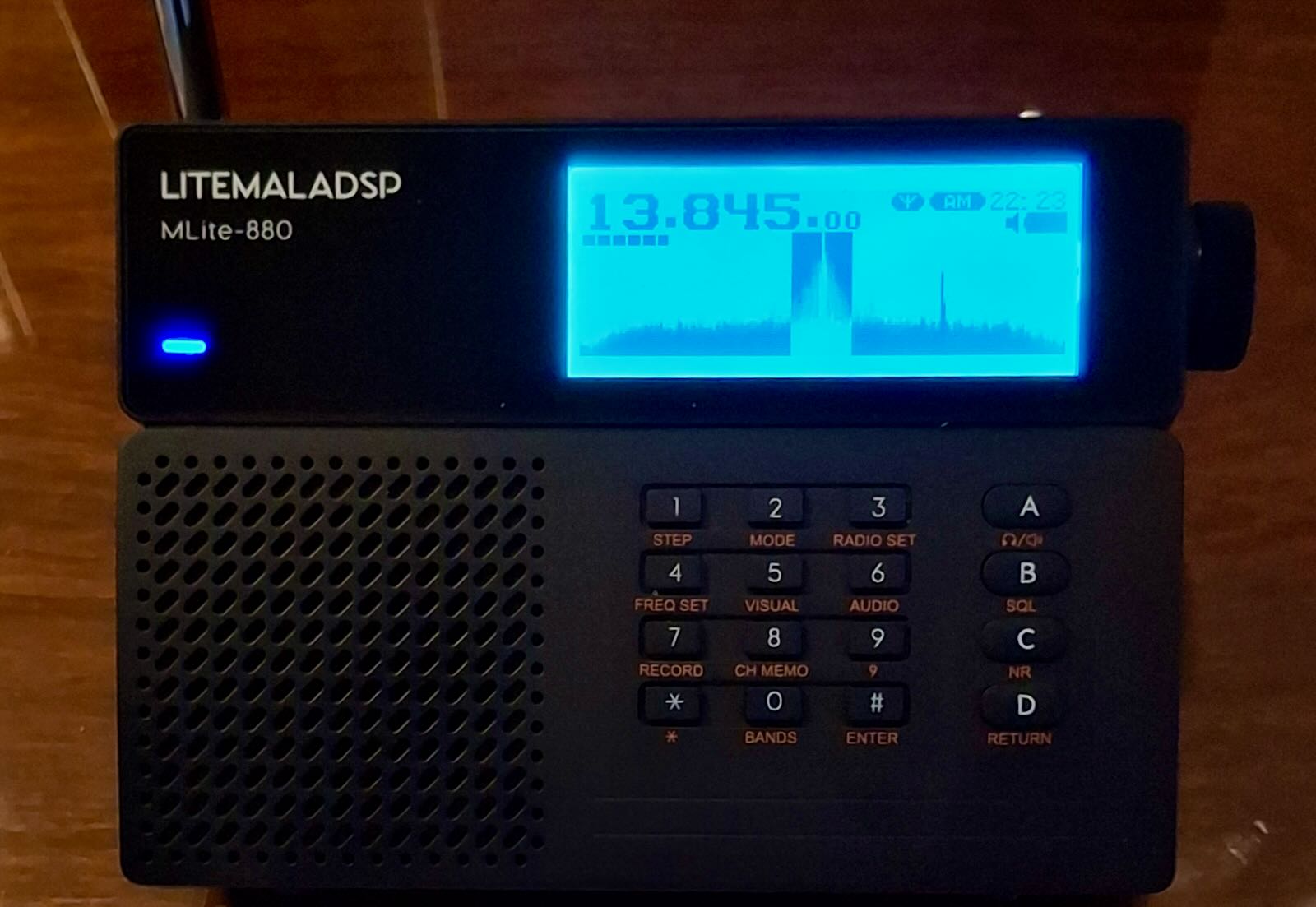 MLite-880 Spectrum Display Portable: Advanced SDR Performance in Traditional Portable Clothes
by Dan Robinson
For years, radio listening hobbyists (as many of us who are still around in 2026) have had numerous choices when it comes to portable receivers. Those of us who got our start as DX’ers/SWLs in the 1960’s (some earlier) or 1970’s have seen a lot of hardware come around the corner.
Some years ago, the Malahit/DSP receivers, firmware, and hardware designed and made in Russia appeared. There was the Belka, amazingly small but a superb receiver that many of us still use. Although shortwave broadcasting has generally been on the decline, we were lucky that companies such as Tecsun, Sangean (reported to have now stopped all production of SW portables), and other China/Taiwan-based companies continued to make impressive portables.
ICOM, Yaesu and Kenwood began putting spectrum scopes in displays a long time ago. ICOM’s IC-R9000 (produced 1989 to 1998) was the first to bring that feature. The more recent Icom 7300, 8600, and 9500 demonstrated far more advanced spectrum displays, as did Kenwood. Ten Tec in its original form put rudimentary spectrum display capability in its RX-350/Jupiter receiver/transceiver.
Today, we’re seeing a number of HT units with some kind of spectrum display. The Radtel 950Pro is one example of this. ICOM’s IC-R30, discontinued but a superb wide band unit, also has a spectrum option though quite limited. Various China-based companies started putting spectrum displays into the ATS series of receivers, and scope displays became standard on transceivers by Xiegu and others.
Malahiteam in Russia licensed firmware out to a range of China-based manufacturers. The China-made “ATS” portables available from AliExpress and Banggood have been through numerous versions, including the ATS25 Pro + AIR desktop, the ATS25 Ultra, ATS25 XF (see https://www.youtube.com/watch?v=LJC-pAu4nUk), and these are increasingly emphasizing the spectrum option on the display. There have been some very interesting front panel designs such as the DP-666 based on the TF6686 chip, and the AMNVOLT ESP138, the first with dual 4732/6686 architecture (see: https://www.youtube.com/watch?v=m1njJskDSUI&pp=ygUMZXNwMTM4IHJHzGlv)
What we had not seen until recently was anyone putting a spectrum display into a “traditional” portable cabinet (some years ago, I had suggested to County Comm/Maratac which has carried a re-badged Tecsun PL-368 that they consider doing so. At one point I received from them a photo of a prototype which looked like a PL-368 with a spectrum display at the top. But to my knowledge nothing was done to advance that to market).
WHAT IS THE MLite-880?
 There have been a number of reviews/demonstrations on YouTube of the MLite-880, including by Tech Minds (see: https://www.youtube.com/watch?v=cmO8TIr_VFo). One of the most extensive is a nearly hour-long review by a Russian YouTuber RADIOCHIEF.RU (see: https://www.youtube.com/watch?v=ut6cY2jZv7Q&t=1065s) and another excellent overview by Radio Bunker here: https://www.youtube.com/watch?v=wgcRoha-mfM).
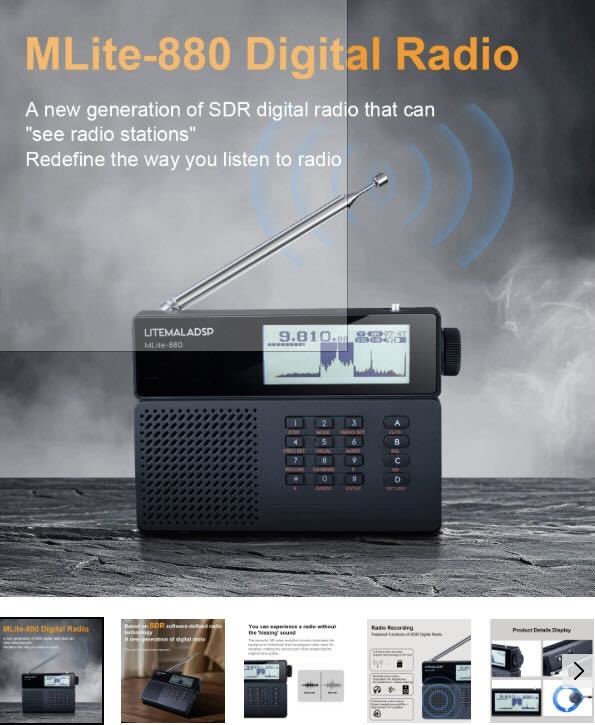
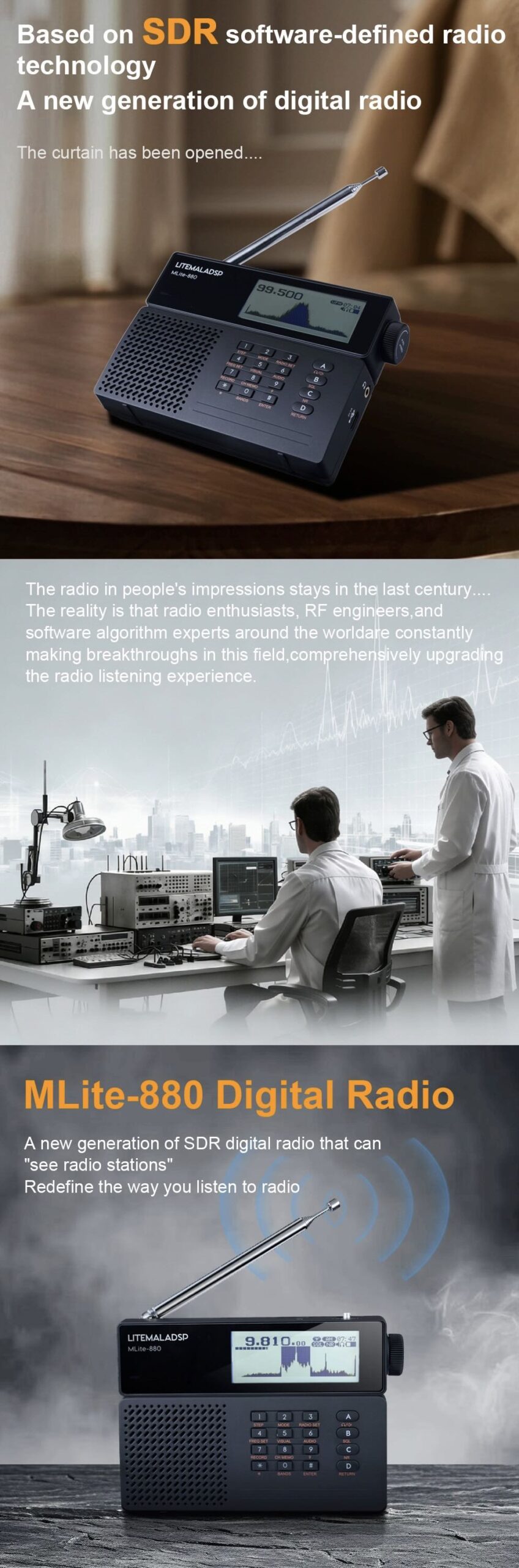
The major feature can be seen at power on. Instead of just a digital/numerical display of frequency we see the frequency AND below, a 40 kHz slice of spectrum. As the advertising description on the Elecevolve.com website states:
“A new generation of SDR digital radio that can “see” radio stations” . . . and “the radio in people’s impressions stays in the last century.”
The message that Malahiteam wants to convey is clear: this is a major step forward from portable design of the past.
The radio is very light, with a back-stand and a fairly robust whip antenna which stands at an angle when the receiver is being used with the back-stand (unfortunately, the antenna base does not allow it to go vertical).
 Around the cabinet, there are a minimum of controls: on top, we have a simple power-on/off switch and a microSD slot (more about that later). USB-C and headphone jack are on the right, and an external antenna jack on the left. The frequency display module of the radio looks like just that — it’s on top above the multi-function keypad and ABCD keys. As for mode displays, there are battery and Bluetooth lights below and next to the LITEMALADSP letters. On the back, we find the 21700 battery compartment, and on the back-stand, we find information about the receiver, but no “Made in…” information whatsoever.
From the videos, and certainly from the name of the radio (LITEMALADSP) we have the impression that the MLite-880 is a cost-reduction version of the Russian DSP/2/3 receivers. Neither 4732 nor TEF 6686 chips are used. While one video review states that an MSI-SDR-M1 chip is inside, Georgiy at Malahiteam states that this is not so.
There was obviously a deliberate choice of the 21700 battery rather than 18650 used in Tecsun, Choyong, and other portables. First adopters say that so far, this battery keeps the receiver going for hours, something I can confirm. Anyone unfamiliar with professional type batteries like this should invest in a good standalone charger; if you already own a Tecsun PLxxx or D808 portable you will be familiar with 18650 and similar cells. [UPDATE]: Larger size 21700 battery does not fit — the battery provided with the radio is a EVE INR21700/50E
The inclusion of a backstand is very welcome, since Russian DSPs and China-made SDR portables often lack one. The whip antenna is not thin and flimsy like those found on some China-made small portables. There’s a mini to SMA adapter included in the box.
One reviewer notes that high-speed microSD cards are needed because files are recorded in WAV format. Georgiy at Malahiteam states that 16 and 32 GB cards have worked, BUT one user reports a 256GB card worked. Recording capability is a feature seen on other portables like the Raddy RF919. A good sized speaker is on the left. The tuning knob has a dual push-pull function for volume and frequency change.
And the radio has Bluetooth capability, which worked fine when I first tried it with a Bluetooth speaker.
In menus under “About” we see “Designed in Russia/Made in China.” I recommend that readers view the various videos available online. While I was in the process of writing, I was surprised when the MLite-880 I had ordered from Banggood showed up on my doorstep. So, I’m able to provide initial impressions, and when a second unit arrives here, I’ll do some unit-to-unit comparisons. [NOTE: Testing done using only the onboard whip antenna]
VIDEO: UNBOXING AND DEMO
Click here to view on YouTube.
“LITE” BUT NOT LIGHT ON FEATURES
 If this is supposed to be a “Lite” version of the Malahit DSP receivers, whether the original Russian-made units or those from China, that would not be apparent to someone using this receiver for the first time. Numerous options are brought over from the Malahiteam DSP. We have synchronous reception (but see below) and the ability to correct calibration variations. Recalibration and BFO fine adjust is something we see on Tecsun portables, and China-made SDRs, and the AFEDRI SDR.
I won’t list everything, but we also see Hi-Z/50 Ohm, BiasT, Attenuation, and options for adjusting display brightness, spectrum average, spectrum fill, and RDS view. That is quite a lot of flexibility and reminds me of what we find on receivers costing thousands of dollars. Under Audio settings, we see Filter Type, Filter Low Freq, Filter High Freq, and variable Noise Reduction. One reviewer asserted that NR “works significantly better than on the Russian-made DSP-3, which costs near $500,” and based on my first tests, I agree. NR runs from 0 to 15 and, once set, can be quickly activated by pressing the C button on the right labeled NR. Overall filtering ranges: 0 to 8 Hz, 0 to 12 Hz, 0 to 15 Hz for the three designated filter positions.
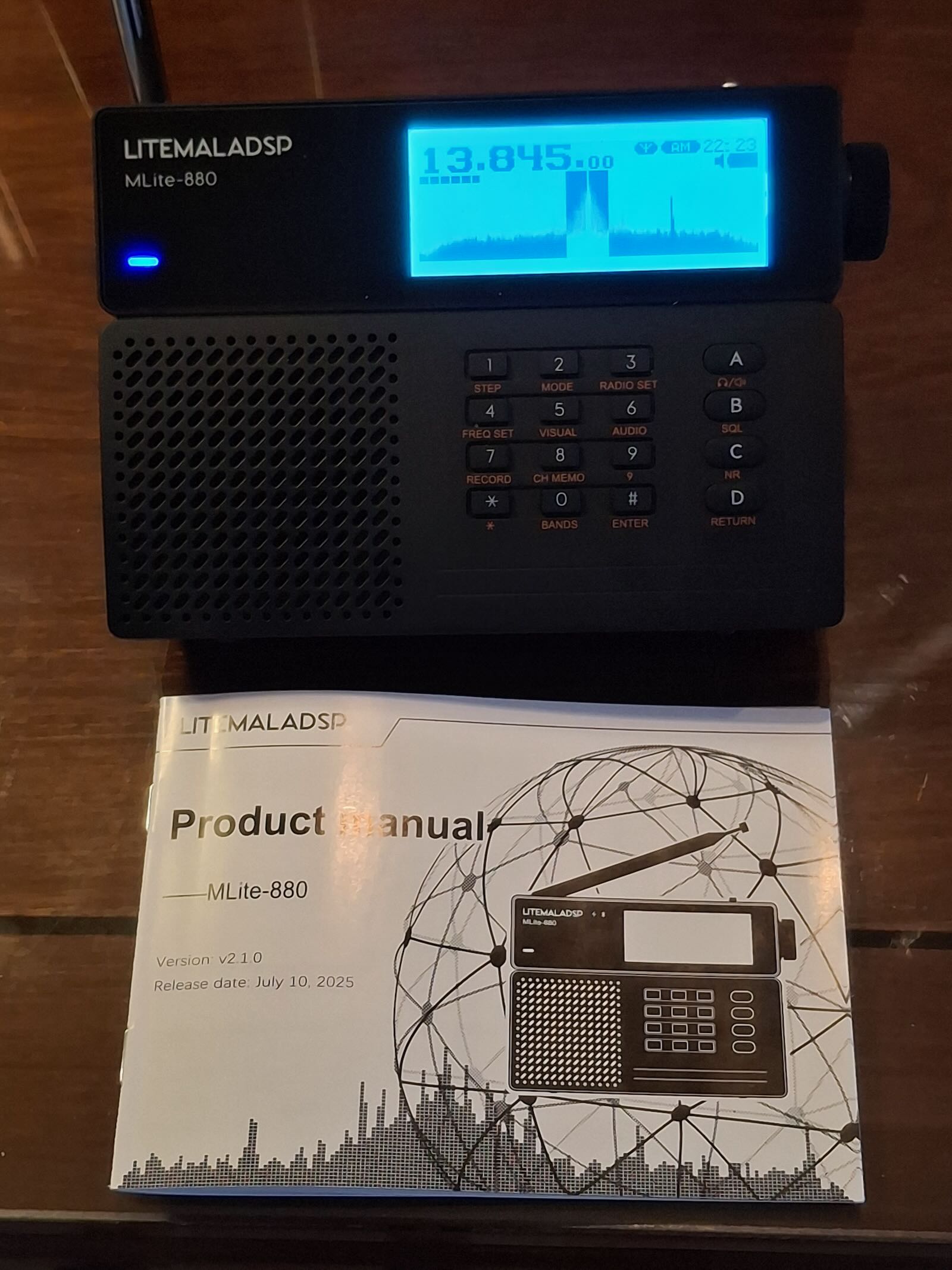
AGC settings include AGC limit, AGC gain, and manual control, all settable in dB. On a third page of options, we find NB Mode, NB Threshold, Equalizer Type, Key Beep Level, and SQUELCH Threshold. Recording is accomplished with a direct access button (NOTE: I had some problems getting record working with a 1GB microSD but switched to a FAT32 8 GB and it worked). A quite nice printed manual shows the modes: USB, LSB, CW, DSB, AM, SAM, NFM, WFM. Steps are listed as: 100 Hz, 500 Hz, 1 kHz, 2.5 kHz, 5 kHz, 6.2 kHz, 8.3 kHz, 9 kHz, and 10 kHz.
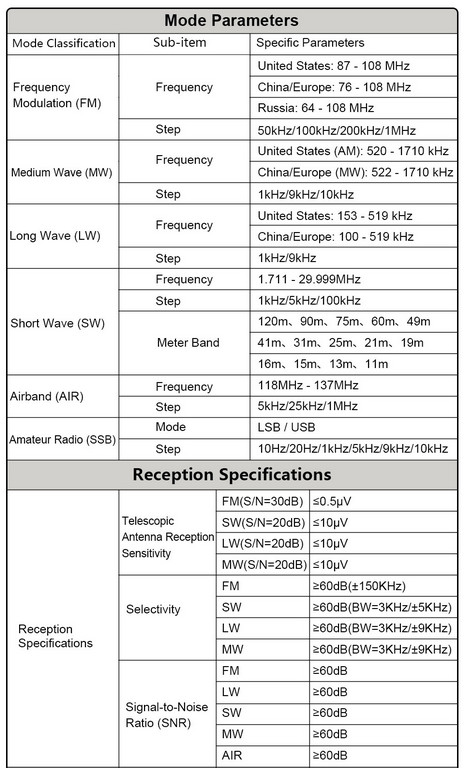 The MLite-880 contains band ranges selected by pressing the appropriate key and then A/B to scroll through those ranges. Coverage is from 100 kHz to 519 kHz, from 520 kHz to 1710 kHz, and up to 29,999khz. But one can directly enter any frequency in this entire range, regardless of the ranges. Under AMATEUR BANDS, we find 135.70 kHz to 137.80 kHz (2200m), 472 kHz to 479 kHz (630m), 1800 kHz to 2000 kHz, 3500 kHz to 3800 kHz, 5351.5 kHz to 5366.5 kHz, 7000 kHz to 7200 kHz, and on up to 29.700 kHz, with 70 mHz to 70.5, and 144 mHz to 148 mHz. Finally, FM/VHF bands include 65.9 mHz to 74 mHz (OIRT), 76 mHz to 108 mHz, and AIR band 118 to 137 mHz.
The spectrum display on the MLite-880 is 40 kHz. For most people, especially those coming from a portable with just a digital numerical readout, I don’t think this is going to be a problem. The 880 obviously has a smaller spectrum display than the full Russian DSP or Chinese-originated portables. Under VISUAL settings, we have choices of: BRIGHTNESS LEVEL, BRIGHTNESS OFF TIME, SPECTRUM AVERAGE, SPECTRUM FILL.
I have not opened my MLite-880, but RADIOCHIEF.RU on YouTube shows the cabinet back removed (around the 29-minute mark). We see extensive shielding with metal covers over key sections. Very impressive, and it finds me wishing that other manufacturers would have done this. How much better the short-lived “Elite Satellit” by Eton might have been with better internal shielding.
What remains to be seen is the extent to which the MLite-880 monochrome display throws off interference, a well-known issue with the original Russia-made Malahit units and China-made portables. See my interview with Georgiy of Malahiteam, who notes that not all noise is gone. “We weren’t able to completely eliminate the noise,” he says, adding that “it still occurs in places, mostly on the long and medium wavelengths. However, significant attention was paid to the screening, and turning off the display completely solves the issue.” The screen shutoff he mentions is accomplished as of now by pressing the “9” key.
We learn from the few available YouTube reviews that the main microcontroller in the MLite-880 is the STM32H743, which one reviewer says is “about the same as the older version in the Malahit DSP-3”. And he adds: “It’s a full-fledged SDR like the DSP-3 that is, unlike all sorts of superhet Tecsuns and DEGENs on chips with all sorts of soft mutes, the Malachite works just as well but significantly better. . .”
Unfortunately, so far we see that firmware updating is accomplished using the STMCube program used by the Russia and China units and the excellent AFEDRI. I find STMCube to be clunky and often frustrating, though it seems straightforward when explained in the ML-880 manual.
RADIOCHIEF.RU on YouTube provides a demonstration of the MLite-880, comparing it with an ICOM IC-R20 and a DSP-3. He notes that while there are flaws in the 880 they appear to be fixable via firmware upgrades. In the downloads section of the elecevolve website we see version 1.2 dated 6 February 2026. The unit delivered here has 1.1 The printed manual shows “v2.1.0 Release date July 10, 2025”. I’m not aware of videos or other online presence of the ML 880 before January 2026.
WHAT’S THE BIG DEAL?
SWLing Post readers, whether SWLs or amateur operators, may be asking what the big deal is with the MLite-880. That’s understandable, but let me explain the significance. Much as the Choyong LC-90 became the first receiver to provide HF and Internet radio in a traditional radio cabinet (though without any spectrum display), the 880 shows that placing such a display in a traditional portable cabinet has been quite possible for some time — it just took someone to go ahead and do it.
For one comparison, think of what something like the SONY ICF-SW55 with its quite large front display, could have been had DSP technology been available decades ago! The ML 880 should prompt other manufacturers to head in this direction (yes, we’re talking about you Tecsun). One could easily envision a spectrum display in any one of a range of other portables, such as the D-808 or Raddy RF919.
PERFORMANCE
 I have included a video showing the MLite-880 tuned to various AM, FM, SW and AIR frequencies. Malahiteam confirms there is no ferrite for AM, so we’re dependent on the whip antenna. RDS on FM is superb, with digital information picked up immediately upon tuning in a station. On AIR band, I would rate the 880 as acceptable (I’m spoiled by my AOR-3000A). Thankfully, SSB and SAM are usable on AM/MW. And in FM we have multiple bandwidth options.
The big headline for me is how superb NR (noise reduction) is on the Mlite-880. Though changing the values (0 to 15) requires diving into a menu setting, being able to just press the letter key that controls NR is really nice. Signals jump right out of the mud, and combining NR with SAM improves things even more. Other users and I have already sent a request for an upgrade that would enable selectable sideband SAM, so we’ll see if that change can be made.
For me, another headline is how well-calibrated the Mlite-880 is out of the box. I have yet to use the fine adjustment feature found in the menu. And stability is superb. This is how SSB should be implemented and should be a lesson to other China-based manufacturers (for example, my Radtel 880 and 950Pro HTs both exhibit CW/SSB error out of the box, which in my view speaks volumes about QC).
FIRMWARE UPGRADES
It would have been far preferable to have live OTA upgrade ability on the 880, as we do on the Choyong LC-90. In response to an inquiry, “elecevolve.com” states: “Regarding the OTA firmware real-time upgrade feature you mentioned, it is currently not supported. This upgrade involves not only firmware but also hardware improvements. We will take your suggestion into consideration and explore adding OTA firmware real-time upgrade functionality in future updates.” See the comment by Georgiy of Malahiteam on the updating issue.
OTHER RECOMMENDATIONS
ENCODER: The encoder on the Mlite-880 is “clicky” and noisy. Given the amount of use the radio’s only knob gets (push/pull for volume, constant frequency tuning) a higher quality encoder is an absolute must. Consideration should be given to providing a separate volume control — this would reduce strain on the encoder which now has to be pressed in and out many times during a listening session.
COVERAGE ISSUES: As suggested by other first adopters there does not seem to be any reason that the MLite-880 could not be extended above 138 mHz to enable reception of local public service comms, and one user suggests coverage should extend to 999 MHz (similar to the RF919).
BACK-STAND VULNERABILITY: Thankfully, the back-stand on the 880 is wide and feels sturdy. However, I can see situations where the radio may be pressed down while using the stand, causing the back-stand to break. I don’t see a way to replace the back-stand, but am seeking clarification from Malahiteam and the distributor on this issue.
DISPLAY NOISE?
As I was finishing this review, I noticed a discussion of some display noise and the sensitivity of the Mlite-880 display to finger contact. These issues plagued the Malahit and Chinese copies for years, so we’ll have to watch this. If the internal shielding in the MLite-880 is what it is, it’s hard to see how much more could be done in this regard. Again, see the comment on this by Georgiy from Malahiteam.
SUMMARY
For me, the sudden appearance on the radio market of the MLite-880 is a thunderbolt for the radio hobby. Sure, a spectrum display is not a big deal when we’ve been used to having the feature for decades. But this is important — I have never seen anyone move ahead to put this in a traditional radio cabinet. We have to credit the guys at Malahiteam for their work on this (see my interview with Georgiy below), which was obviously ongoing for a long period. That the Mlite-880 suddenly appears to have such a high level of construction and overall implementation by the Malahiteam partner is impressive.
The MLite-880 gets us thinking again about what could be next. Might we see the designer of the Belka slightly enlarge that radio to include a spectrum display? Will Tecsun finally get off the couch and realize how dated the displays are on their PLxxx portables? For now, we have yet another exciting surprise entry to the portable radio scene, and one that takes a brave leap to another design level. It’s one that makes me yearn for the days when the shortwave bands were full of stations — having something like the MLite-880 back then, and being able to view the spectrum when bands were crowded, would have been quite the ride!
So, will you actually hear anything on the Mlite-880 that you won’t on your trusty PL-990 or D-808? Probably not. But this is one cool receiver that brings the VISUAL aspect of tuning in whatever is left on the SW bands, as well as AM, FM, and AIR band to a portable radio that won’t prompt people to remark in public “what the hell is that?” questions that often come while using a DSP or similar radios that look like Star Trek communicators.
As I was completing this review, I successfully connected with Georgiy of Malahiteam on Telegram, and you can read his comments here:
The MLite-880: Comments by Georgiy of Malahiteam
Dan Robinson (DR): So, the MLite-880 is a revolutionary development in SDR portables. Previous Malahit DSP units were one thing, but putting this into a “traditional” portable cabinet changes the game. When did you guys realize that going to a traditional portable cabinet, rather than the metal cabinet designs, was a necessary forward step?
Georgiy: This step was clear almost from the start. But the sheer complexity of working with plastic held us back; there was no understanding of how to design the case, no understanding of the technology, nothing.
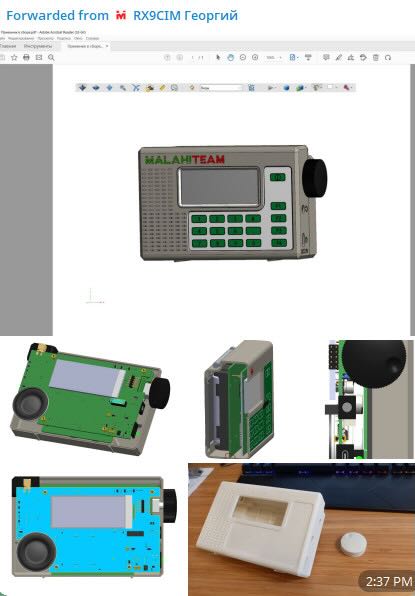 Work on MLite began in late 2022. Initially, the design was envisioned to be somewhat simpler, but the general concept was defined from the start. There were first concept models. Then it became clear that we wouldn’t be able to finish the work ourselves. Again, because of the plastic frame [issue]. If had known how to work with plastic, or found someone who did, we could have done it ourselves.
In early 2023, we had our first engineering prototype. It was a fully functioning radio receiver, mounted on test boards. I approached my Chinese partner and suggested they take on the Lite project. [They] developed a new enclosure design and refined the printed circuit board design. The first receiver, ready for use but still in a test enclosure, was expected to be delivered around late 2024 or early 2025. Throughout 2025, software improvements were made, and the Chinese partner was preparing for production. I wouldn’t say the Malahiteam team spent a lot of time on it overall, but it did take several months of work… spread out over several years.
DR: The big headline here, in my view, is that the remaining major radio makers could perhaps have moved to do something as you have done, replacing the numerical display with one with spectrum scope a long time ago?
Georgiy: In fact, technical work takes a lot of time, and the results are shown only when there’s something to show. Projects are announced only when there are results, and this can happen after years of actual development.
DR: One reviewer on YouTube stated that he thinks the 880 comes close to or equals the Malahiteam DSP-3. What would you say about this?
Georgiy: There is no difference in the quality of the DSP algorithms – the DSP 3 algorithms were taken as a basis. In terms of RF performance in the HF band, the MLite has a slightly higher dynamic range, surprisingly enough. The difference is small, just a few dB.
We weren’t able to completely eliminate noise; it still occurs in places, mostly on LW and MW. However, significant attention was paid to the screening, and turning off the display [using the 9 key] completely solves the issue.
DR: It seems you obviously gave thought to the need to have a robust whip antenna (unlike some of the other China small portables) and one that could be well-positioned when the 880 is on the desk. But there is still no full rotation at the bottom, and with the back stand, the antenna still can’t go full vertical. Might this be changed in future designs?
Georgiy: I think we’re discussing this issue. How feasible it is to change the body shape. I need to discuss this with my Chinese partner. This hasn’t been thought through yet. We’ll see based on experience and feedback.
DR: We see there is a prototype being discussed on the Malahit channel of something called the R1, a new SDR. Can you tell us anything about that?
Georgiy: Regarding the R1, it’s a new word in the world of radio. It’s a box with built-in batteries that connects via Wi-Fi and lets you listen to broadcasts through a web interface.
DR: A response from your Chinese partner stated that OTA live FW updates are not possible now, and this would require a hardware change. I find the STMCube method to be cumbersome, and I know others who are not PC comfortable, who agree. The Choyong LC90 is an example of decent OTA updating, but they have struggled with the issue of interference onto HF from the internal WIFI card, so I understand this is not a simple matter.
Georgiy: In fact, OTA mode can cause problems both in terms of server maintenance and accessibility from different countries. And the 880 doesn’t address this. But the R1 has this feature built in. . . OTA updates only, without user intervention. The device receives HF, VHF, and UHF frequencies. Its dynamic range is higher than that of the RSP. It also has three built-in antenna connections: 50 Ohm, HiZ, and balanced input. You can literally hang the R1 on a loop antenna and listen to the radio remotely via Wi-Fi.
DR: So if you could summarize Malahiteam planning on the 880, was there a main goal of producing a “cheaper” version of DSP3? As one of the YouTube reviewers noted, use of the MSI-SDR-M1 chip seems to place the 880 equal to DSP-3.
Georgiy: MLite-880 doesn’t use msi001. It uses a very original solution, the specifics of which I won’t reveal yet. But it’s really interesting.
The product name Mlite880 indicates that it uses the TEF6688 chip, because the TEF6688 chip is labeled F8802.
From my reading though, the TEF6688 cannot provide SSB reception, which the MLite 880 does exceptionally well.
As the TEF6688 has baseband I2S output, it doesn’t need to support SSB itself. If the baseband signal is delivered to a separate processor, it can decode SSB or whatever other signal type it is programmed to decode.
Actually, I have wondered why something like this hasn’t been done earier.
I received my MLite-880 last week.
A few observations:
1) As received, the receiver had firmware version 1.2.
2) Tried formatting a 32 GB memory card as exFAT but the receiver didn’t like it. So reformatted as FAT32.
3) After setting the date in the receiver, it stated in the display the entered date. However, for recorded audio files, the date was wrong! It was off by one month. Instead of February, it had March. I fixed that by entering the month in the receiver as January. Recorded files then had a month of February.
4) It seems there is no way to transfer files from the receiver to a computer except by moving the memory card between the receiver and the computer. It would be nice if the receiver could be connected to a computer so it sees the files so that they could be downloaded over USB.
5) The radio couldn’t see my MacBook Pro to broadcast audio to it when Bluetooth was set up. No problem connecting to an Anker Bluetooth speaker, however.
6) As received, it appears that the frequency calibration of my radio is good to about 10 Hz. I used the Fldigi spectrum scope while tuned to CHU. I tuned the radio to 7849.00 kHz in USB mode and narrowed the bandwidth. The offset in the spectrum scope from 1000 Hz was about -10 Hz or so.
7) One of the reasons I acquired the MLite-880 to add to my stable of receivers was a promise of scheduled audio recordings. When I asked on the Banggood website if that was possible with the receiver, I was told it was. Oh well. So, it would be nice if the receiver had an alarm function so that the receiver would tune to the desired frequency/mode and then start recording audio for a set period of time.
I’ll add more comments when I find something new for me.
Those who think the frequency calibration may be broken in firmware 1.2 have likely not turned the knob far enough. The MLite 880’s adjustment is in very tiny 0.1 PPM (parts per million). This is an impressive level of adjustment accuracy for a portable receiver!
I upgraded my set to firmware 1.2, and wanted to replicate a 1 kHz offset tuning on WWV at 15 MHz. When you put a radio in SSB and tune up or down by 1 kHz, you definitely hear the audio quality change.
A 1 kHz change from 15 MHz equals 66.67 PPM. Since the frequency calibration in the radio adjusts in 0.1 increments, this means you need to turn the knob (a lot!) to read “667 x 0.1ppm”. I did this on mine and the tonal change in the voice announcements was clearly audible. I then returned the setting to “0 x 0.1ppm” and the audio sounded fine.
Note that parts per million calculations is frequency dependent, so I recommend using upper HF signals for testing, such as WWV 15 MHz, or you’ll be tuning the radio’s knob for a lonnnng time!
A more scientific way to check the frequency calibration of the MLite 880 would be with a software tool called Spectran. I’ve used Spectran in the past to check the exact carrier frequency of medium wave stations. (A big thanks to Victoria, BC Canada DXer Nick Hall-Patch for alerting me to this useful program.)
It may be, but I only need to adjust to 60 x 0.1ppm in the firmware of 1.0 and 1.1, but even if it is adjusted to 600 in 1.2, of course, the developer has admitted that it is a BUG, and he will fix this problem in the next firmware.
Very interesting! Thanks for sharing this. So, it’s definitely a bug. I never actually tried this feature in ver. 1.1 (my radio came with 1.1 loaded). The bug must have caused adjustment to become almost non-existent or very slow .
Has anyone found their MLite 880 to be noticeably “off” in frequency out of the box?
There are also several other users who feedback that the frequency correction in 1.2 does not work (or as you said, you need to adjust a lot of offsets). This is indeed a bug, and the developer expects to fix this problem within a week.
My 880 couldn’t connect to any devices via Bluetooth at first, no matter what I did. Today, I couldn’t resist taking the device apart and pressing and holding the PAIR button on the Bluetooth chip. Then the Bluetooth worked normally again.
According to the developer, the Bluetooth module can switch between TX and RX modes. My Bluetooth module was probably set to RX mode at the factory, so it couldn’t connect to any Bluetooth devices. Long-pressing the PAIR key switches it to TX mode. Hopefully, this will help those whose Bluetooth isn’t working.
I have been trying to get Bluetooth to work. it will connect but no sound, saw you mentioned it might be in RX mode so i pushed the button inside many different ways… no luck. is the led supposed to change color or something to indicate what mode it is in? The developer should do something to prevent a TX/RX error.
Any help is appreciated.
Mike N3IDS
If you can connect but there is no sound, please press the “A” key. When the headphone chart appears on the screen, the sound will be transmitted to Bluetooth.
I was wrong. I found the technical documentation for the Bluetooth chip, and this chip can indeed switch between RX/TX modes, but it requires soldering to switch modes. So, my 880 is not experiencing an issue with being in RX mode. Instead, the problem is that this chip cannot “forget” the Bluetooth devices it has already connected to, which prevents it from connecting to new Bluetooth devices. Therefore, the current issue is that my 880 can only connect to one device. If I want to connect to another device, I have to disassemble it and manually press the PAIR button on the chip. I’m not sure if other users are experiencing the same situation
I found that I need to wait 30 seconds or more for the 2nd device to connect successfully. My first Bluetooth device (earbuds) connected in 2-3 seconds.
At least you can connect to a second device, but I can only connect to the first device. If I want to connect to another device, I have to disassemble the device and press and hold the PAIR button on the Bluetooth chip.
FYI, there is a Facebook group “MLite-880 Users Group” devoted to this radio.
If you are looking for a small protective case for the MLite 880, you might try this one:
https://www.amazon.com/dp/B01BNSX6I0…
It’s a tight fit, and you need to remove the semi-rigid divider panel and the two elastic straps (optionally). Use a very sharp knife such as a #11 Exacto blade. The top half of the case has a mesh “bin” where you could potentionally squeeze in some wired earbuds or a reel-type wire antenna.
The radio touches the case interior on all sides, and it’s a slight squeeze. However, since this case is a hard shell EVA design, I think it is more protective than soft pouches (as sold with the Sangean ATS-909X2).
I’ll have to rescind my recommendation of this particular case. I’ve decided it’s just a bit too tight on all sides, and I’m concerned that over time the edges of the radio might start to wear. Also, I discovered the encoder knob is pushed in while in the case, and that doesn’t seem to be the best to have it continually in the depressed state (i.e. like when you switch between volume and tuning).
I’ll need to switch to a slightly larger case. This one looks promising: https://www.amazon.com/dp/B0FF9YBLPZ/
anyone have squelch issues? works on shortwave but does not silence on fm
Squelch and Noise Reduction are not working for FM, as there’s probability that FM in this radio is TEF6686 – a separate chip.
Hi Dan, that KS for sharing your findings, great review! If you have the chance, could you please amend your review or prepare a new small article on the FM performance? I wonder how it compares to the community current benchmark, the Qodosen DX 286.
The firmware I received for the 880 shows as 1.0, and I don’t know how to upgrade it yet. I just upgraded my DSP2 to 2.5, but the upgrade methods for the 880 and DSP2 are obviously different, and I’m afraid to try it.
I don’t think the process is different — assume you used STMCube program to upgrade the DSP-2? Anyway,
based on conversations on the Malahiteam Telegram channel it does not appear that any major firmware update
has occurred yet even though 1.2 is shown at: https://www.elecevolve.com/download/ I would wait until you
are absolutely clear on the update process.
I found it! Just press and hold 1 while powering on to enter DFU mode.
Do let us know if you successfully install 1.2 and what differences there are if they are immediately apparent.
My factory firmware version is 1.0. I successfully flashed into version 1.2, but the frequency correction function didn’t work, so I returned to 1.1. All functions are normal. Now it’s the Chinese New Year, and I haven’t received a reply from the manufacturer.
The upgrade is easy:
1. Download Firmware from https://www.elecevolve.com/download/
2. Download and install STM32CubeProgrammer from https://www.st.com/en/development-tools/stm32cubeprog.html
3. While pressing “1” on Mlite-880 switch it on – it will show you’re booted in the DFU mode
4. In STM32CubeProgrammer right hand side select USB, refresh DFU, Connect to Mlite-880
5. While connected, in STM32CubeProgrammer left hand side select “erasing and programming icon” – it’s the second from the top left. Select your file, should be .bin. Select 3 checkboxes: “Verify Programming”, “Run after programming”, “Full chip erase” and Press “Start Programming”. It will erase the memory, upload FW and restart the ML-880.
Thanks… been a while since I used STM for upgrading. . . spoiled by the Choyong LC90 OTA
Anyone who has gone to 1.2 please let everyone know what changes occurred. One person says it may have caused an issue with the calibration adjustment item
I have 1.2. Frequency calibration works fine, “About” menu now shows developers’ callsigns, no other changes detected. From the chat with RX9CIM: No release notes, consider 1.2 as a base, no new features, bugfixes only.
Do we know what the bug fixes were?
P.S. Mine arrives later this week.
Hey Richard, unfortunately not.
My radio has arrived 19 th February with firmware 1.2, calibration not works
I wonder how “picky” the Bluetooth pairing is, since from the videos I watched, it seems to “automatically” pair with anything in range, and there’s no way to select what Bluetooth device is visible or being connected. Maybe there’s a list of manufacturers that are BT compatible with the radio.
Good question
My Bluetooth connection to the Xiaomi Sound Party speaker and AirPods 4 earphones wouldn’t connect. I tried many times but finally gave up.
Hi there, ML-880 automatically connects to a device in pairing mode.
1. Enable the bluetooth in Radio menu.
2. Set your headphones into pairing mode.
3. Wait several seconds while ML-880 connects to you headphones. Blue Bluetooth sign should appear to the left of the screen.
4. Select the Audio output, press “A” button to set the desired mode from: Speaker, Speaker + Headphones, Headphones only.
I tried with Airpods 3, works fine:
To put AirPods into pairing mode, open the charging case lid with the AirPods inside, then press and hold the button on the back for about 5 seconds until the status light flashes white. For AirPods 4 or AirPods Pro 3, double-tap the front of the case if no button is present, or for AirPods Max, hold the noise control button.
This doesn’t work for my 880; my Bluetooth is probably broken. I plan to contact them once the factory resumes operations.
Art, those instructions were very helpful, particularly #4 about making sure to enable headphones with the “A” key. I’d not noticed that my MLite 880 was on speaker only, and couldn’t figure out why my earbuds were not connecting. Bingo! They work great now with the radio.
Dear Guy, I’m glad this helped you. One observation i noticed with Bluetooth is when it’s enabled in Radio but not connected to a device it repetitively blinks red inside the radio, one can see that via USB-C socket. Don’t know how this may help. ..
Tested ML880 with 256GB SD Card Fat32 works fine
Wow that is quite a large microSD size thanks. It is important to format the card before use as I have found.
Art, I tested with a 256GB card, formatted exFAT (FAT32 has an upper limit of 4GB, perhaps exFAT is what you meant).
When I tried the 256GB/exFAT card in my MLite 880, it would not record. In fact, the radio spontaneously rebooted after few moments! I freshly formatted the card in my PC first.
However, a 32GB/exFAT card works great. a 2-minute recording netted a file 18.6MB in size. from my calculations a 32GB card should provide roughly 52.6 *hours* of WAV file recordings (the radio writes WAV files, not MP3).
Dear Guy! Happy that you tested another boundary of this radio. In my scenario i meant exactly FAT32 formatted SD card of 256GB. I also started with testing my default formatting extFAT and i changed it after it didn’t work, because i just didn’t want to buy a new card for that radio. FAT32 supports this media size with max file size of 4GB, this should be ok. My SSB recordings are ~1minute = 1MB, having a 66,6 hours limit for a session is ok to me.
Together with that i think “larger media size support with exFAT” should be a great feature request to a developer in 2026. At the moment I don’t know what is the best way to put this into the developer’s backlog..
Thanks for clarifying, Art. Of course, it’s 4GB upper *file* size, not the capacity of the card! That makes 100% sense now.
I will use my separate SDcard Formatter program and make sure my 256GB card is formatted FAT32, not exFAT, and then give it a try in my 880.
Guy, what’s your SD-Card vendor? I have SanDisk Ultra microSDXC UHS-1 256GB 120MB/s here
Art, most of my cards are Samsung, but this 256GB one is SP brand, U3 speed. However, I formatted it as “Large FAT32” in the Rufus utility and it works great in the MLite 880! Thanks for the tips. Free space is showing as 238GB on the 880’s screen.
We have come a long way with signal displays for radios. In the late ‘60s I was employed by Communications Electronics Incorporated (CEI) purveyors of military-grade receivers. “Signal monitors” were incorporated into various models and also sold as accessories. Their chassis were about the size of a cigar box. Their displays were CRTs having screens of about 4” wide by 1.5” high. There was a single lateral trace along the bottom of the screen. A detected signal would produce a vertical displacement in the trace in proportion to its strength. In that sense they also served as signal strength indicators. The bandwidth was perhaps 100 kHz to 200 kHz end to end at SW or VHF frequencies. The center displacement would be the tuned frequency. It was great fun to twirl the tuning knob and watch the signals go by.
No external antenna port 🙁 Tuning knob has a click or segmented (I hate that) despite that like the idea of portables getting a spectrum display, maybe waterfalls will be included soon
“No external antenna port ”
???
Yes there is.
Brilliant review thanks
Thanks and this update: the 880 comes with a 1NR21700. Slightly longer and larger 21700 does not fit.
Very helpful, thanks. I guess the INR21700 is the flat top battery version of the 21700.
To be exact — the battery included with the radio is: EVE INR21700/50E
Correction to what I mentioned earlier– this radio does NOT use a flat top 21700 battery. I see at 1:15 in Tech Minds video that a button top version is installed from the factory. this is an important distinction for a proper fit. Evidently the “EVE INR21700/50E” is just the exact model number of the button top 21700 used, but any comparable 21700 will work. Note that “21700” means dimensions of 21mm diameter X 71mm length.
edit: 21mm X 70mm
Can confirm THESE fit:
https://www.amazon.com/dp/B0D3LVM5H5
Excellent review, Dan! I enjoyed the questions and comments directed to Georgiy, too.
My MLite 880 arrives next week, and I’m interested to see how it’ll perform on trans-Pacific medium wave as well as HF.
From my experience HF works perfect in amateur and broadcast bands. MW and LW are not for DX here, lower sensitivity observed.