Category Archives: Art

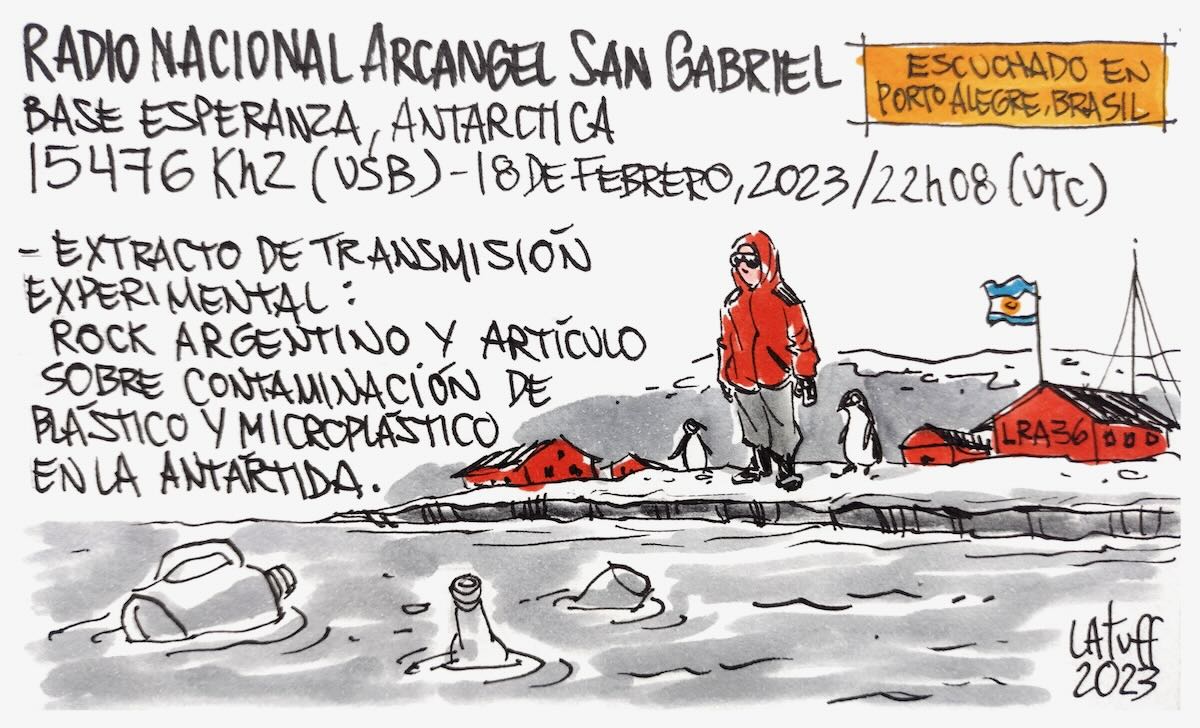
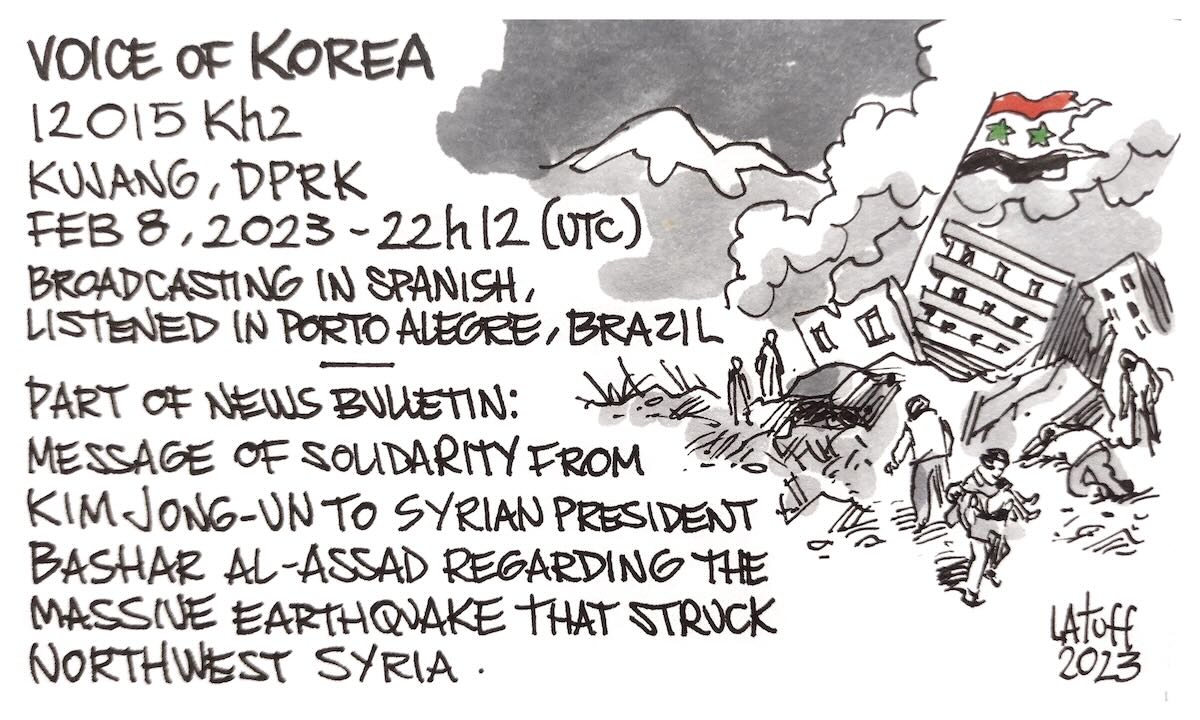
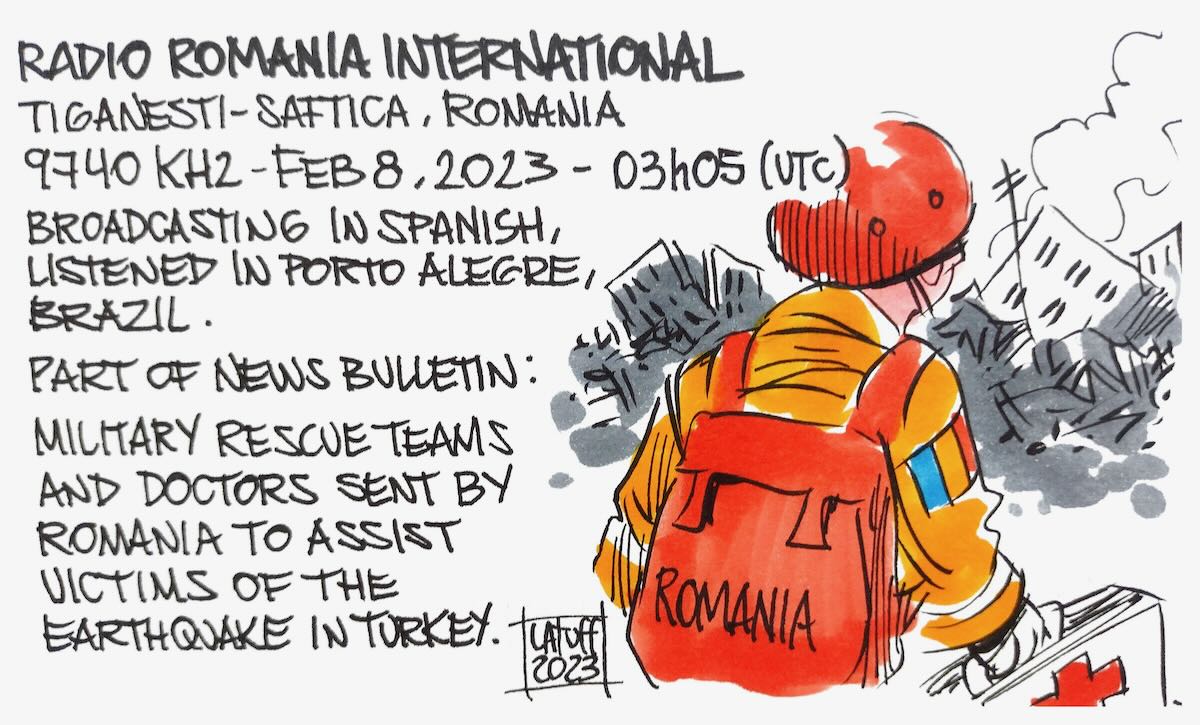
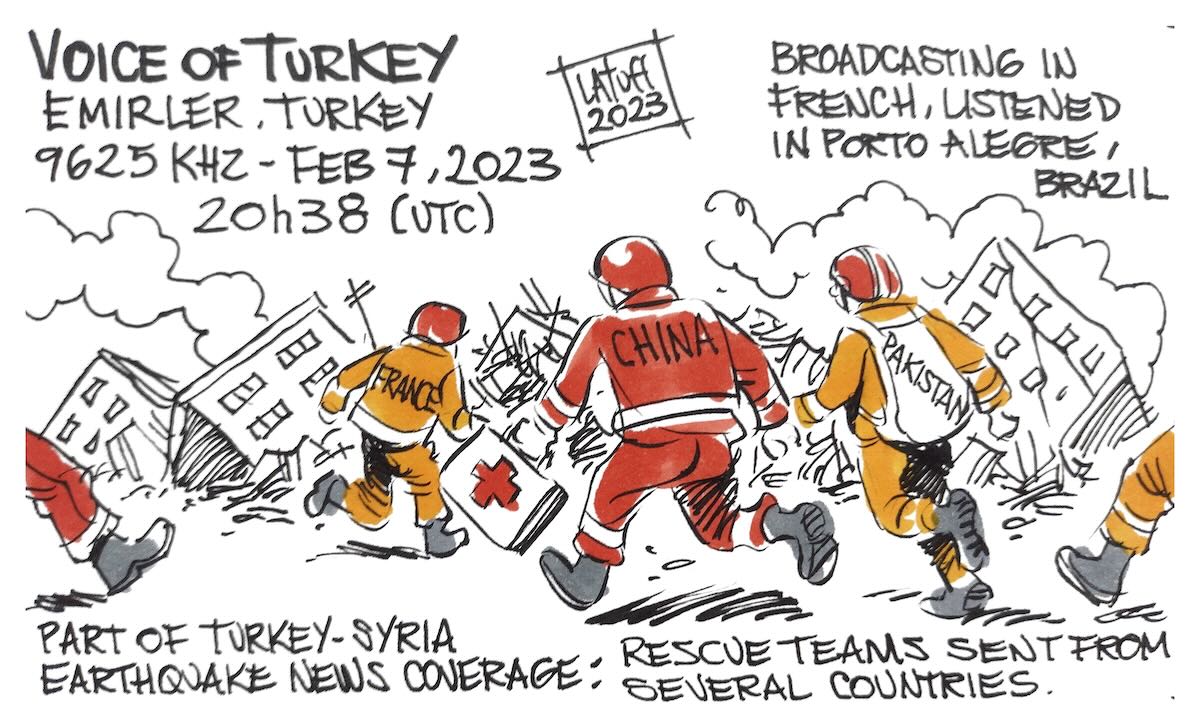
Carlos Latuff’s shortwave radio logs are a work of art

For those who don’t know, our friend and SWLing Post contributor, Carlos Latuff, is not only a devoted radio enthusiast, but also a prominent political cartoonist in Brazil and throughout the world.

Recently, Carlos has been posting his shortwave logs on his Twitter feed and they’re pretty amazing.

Carlos’ shortwave logs not only include comments and notes from each broadcast, but also his own artwork.

Here’s Carlos’ recording of Vatican Radio which accompanies the log at the top of this post:

Click here to check out Carlos’ Twitter feed where he posts his political cartoons and, yes, even the occasional shortwave listening log!

If you’ve been a reader of the SWLing Post for long, you’ll notice that we’re not a space for political discussions; there are much better options out there on the Internet. Here, we stick to the world of radio, but we can’t help but highlight this intersection and Carlos’ creative logs.

In fact, Carlos, I might nudge you for that Vatican Radio recording and your artwork to post on the Shortwave Radio Audio Archive!

RCA Radio Tours Map circa 1934

My friend, Maristella Feustle, recently shared this classic RCA “Radio Tours” map of North America. RCA printed this in 1934–during the Great Depression–when most people could not afford to travel. Their map encouraged families to use their radios to travel the world over the air and experience local culture & music.

As Maristella pointed out, the detail on this map is pretty darn amazing.

Click here to download a high resolution image of this RCA map.

Help Ed identify this mystery radio in “The Last Man on Earth”

Many thanks to SWLing Post contributor, Ed, who writes:

Recently I’ve been watching some pandemic-themed movies and found “The Last Man on Earth”, a pretty good 1964 post-apocalyptic science fiction horror film (which was remade in 1971 and 2007 with different titles.) In this film, the main character (well played by Vincent
Price) uses an HF transceiver in a fruitless effort to find other survivors of a global plague. It was shot in Italy, and the transceiver doesn’t look like any American radio I’ve ever seen. Perhaps some of your SWLing Post readers can identify it?

BTW: SWLing Post readers might also be interested in knowing this film can be downloaded for free from The Internet Archive.  https://archive.org/details/lastmanonearth-1964

What do you say, SWLing Post Community? Is this radio a fabricated stage prop, or a real model?  Please comment!

In the meantime, I’ll add this post to our ever growing archive of radios in film!

Spectres of Shortwave: Amanda Dawn Christie’s film about RCI Sackville now streaming

IMPORTANT UPDATE – Amanda Dawn Christie notes:

“Unfortunately [this video] was never supposed to be public – it was an accident on my part. The film will be viewable soon though, for seven days. May 26 to June 1. It is being hosted by a gallery in Montreal. That upload was only a test for them, and should never have been public. I was in a hurry, trying to get it uploaded before I packed my hard drives before I moved and I guess I didn’t check all the settings. Sorry about that. I appreciate the enthusiasm though.”

SWLing Post friend and filmmaker, Amanda Dawn Christie, has just uploaded a version of her film Spectres of Shortwave to Vimeo where it can be viewed free of charge:

Click here to watch on Vimeo.

The story of a 1970s CB Radio QSL card print house

Many thanks to SWLing Post contributor, Ulis (K3LU), who shares the following story of a popular CB Radio QSL Card design and print house:

73s and 88s :: The Ballad of Runnin Bare and Lil White Dove

We set a custom screensaver on Our AppleTV. Told it to pull images from Flickr tagged with “British Columbia.” After my wife and kids and I spent a few weeks in Vancouver and in various places on Vancouver Island, it had become one of our favorite places. We missed it.

And so, at night, after a show or movie ended and the AppleTV sat idle for a few minutes, a slideshow would automatically begin. The Parliamentary Buildings in Victoria, the Inner Harbor, the wild, rocky, tidepool-rich shores of Tofino, the murals of Chemainus.

Then, every once in a while, an illustration of some sort. I couldn’t tell what. A one-panel comic? Some kind of advertisement or flyer? It would be gone from the screen before I could really get a good look. Weeks would go by and I wouldn’t see it until, once again, there it was. It looked old, like something from the 60s or 70s. And it had numbers on it, like a code or a message: 73s and 88s.

It was the numbers that got me. Like the park rangers in The Shining calling for Wendy Torrance on the radio: “This is KDK-1 calling KDK-12. KDK-1 calling KDK-12. Are you receiving me?” They seemed to be saying something. But what? I had to find out. So, I took to Google, and began my search.[…]

Click here to continue reading the full article.

FYI: Although the CB Radio landscape is quite different than it was in the 70s, most modern shortwave radio receivers can tune to CB channels. Here’s a quick tutorial from our archives.

Radio Waves: Radio Marti DRM, Push for Shepparton Museum, APRS on the History Channel, and Radio’s “Major Cultural Opportunity”

Radio Waves:  Stories Making Waves in the World of Radio

Because I keep my ear to the waves, as well as receive many tips from others who do the same, I find myself privy to radio-related stories that might interest SWLing Post readers.  To that end: Welcome to the SWLing Post’s Radio Waves, a collection of links to interesting stories making waves in the world of radio. Enjoy!

Many thanks to SWLing Post contributors Alan Hughes, Michael Bird, Zack Schindler, and Dennis Dura for the following tips:


Radio Marti Begins Shortwave DRM Transmissions (Radio World)

Radio Marti began Digital Radio Mondiale (DRM) shortwave transmissions on Feb. 4. Part of the U.S. Agency for Global Media (USAGM), Radio Marti broadcasts news and other programs to Cuba. The DRM shortwave transmissions are from USAGM’s Greenville, North Carolina, site.

USAGM has transmitted in DRM before. There were some transmissions from Briech, Morocco, in the early 2000s. Greenville tested DRM in 2009 in partnership with what was then known as HCJB Global Technology. So why are they back now after an absence of over a decade?

“We want to experiment a bit with different modes and services available on DRM. We also want to help push the development of low-cost receivers and the best way to do that is to put some transmissions on the air, explains Gerhard Straub, director of USAGM’s Broadcast Technologies Division.[]

Push for museum at Shepparton’s Radio Australia site (Shepparton News)

Amateur radio enthusiasts are pushing for the former site of Radio Australia in Shepparton North to be upgraded and retained as a national museum of radio broadcast history.

Members of the Shepparton and District Amateur Radio Club and The Vintage Radio Club of North East Victoria are due to present a 25-page proposal to an anonymous consortium of buyers said to be interested in acquiring a 258ha block of land along Verney Rd.

The block includes two buildings and several large broadcast towers on the former site of Radio Australia. The site is currently owned by BAI Communications.

The Shepparton club’s assistant secretary, Geoff Angus, said the proposal would be presented to Greater Shepparton City Council for forwarding to the consortium.[]

APRS usage seen on the History Channel “Secret of Skinwalker Ranch”

Zack Schindler writes:

I have been watching a show about paranormal activity on the History Channel called The Secret of Skinwalker Ranch. In the episode this week they hired a professor to do a balloon launch with some RF sensors. In this episode they also showed the APRS.FI webpage and I was able to read his callsign from an APRS tracker, KM4MRH.

The professor used an APRS tracking device. On the right side of the page link below you can click on Other SSID’s to see other balloon launches he has done. Normally when there is a balloon launch you can see the data from it going up and down. This page shows the Skinwalker balloon launch data transposed over a map. https://aprs.fi/#!call=a%2FKM4MRH-3&timerange=3600&tail=3600

Sadly they are using these for measuring RF fields rather than these.

In a Crisis, Radio Should Be Bigger Than Ever — So Why Isn’t It? (Rolling Stone)

Terrestrial music stations have a major cultural opportunity right now, but employees say a muddied strategy is standing in the way

Radio personality Kevin Ryder was “baffled” by KROQ’s “cold, heartless attitude” when he and his morning-show team were fired at the end of March. The station has long been an alternative/rock staple in Los Angeles, the second-largest market in the country, and Ryder had been on the air for more than 30 years.

“The new people in charge now weren’t here for the building of the world-famous KROQ,” Ryder, one-half of the popular Kevin & Bean Show, said on air when the station let him go, live one final time. “I don’t think it means anything to them. It’s a numbers business, and there’s no family aspect to it anymore. It’s only numbers, but this place was built without numbers. It was musicians, artists, and the special relationship between music, the station, and our fans.”

AM/FM radio provides localized, round-the-clock information and entertainment via friendly neighborhood voices — so in theory, it’s the perfect platform in a global crisis that forces hundreds of millions of people to stay home. But Ryder is one of many in the radio community — including on-air hosts, music directors, program directors — who have been shocked by sudden job losses in recent weeks as COVID-19 has spread across the U.S., and news out of the industry has been one bad thing after another. Why is terrestrial radio missing the opportunity here — and how should it be fighting to get back on top?[]


Do you enjoy the SWLing Post?

Please consider supporting us via Patreon or our Coffee Fund!

Your support makes articles like this one possible. Thank you!