Category Archives: Radio History

The Netherlands celebrates 100 years of radio

Many thanks to SWLing Post contributor, Gérard Koopal, who writes:

Dear Thomas, on November 6 it is exactly 100 years ago that Hans Idzerda transmitted the first radio broadcast in the Hague, the Netherlands.

To commemorate this event, the VRZA has a special broadcast using the original Zeedijk studio from radio Veronica and historical NOS/NRU studios. The broadcast is from 10.00 till 21.00 hours CET and there is an internet stream available.

Also rebroadcasting through some lpam stations. For more information see this website (in Dutch):

www.hollandspalet.nl

Greetings, Gérard Koopal

Thank you for sharing this, Gérard!

“When the world got its news from shortwave radio”

Many thanks to SWLing Post contributor, Dennis Dura, who shares the following article from SwissInfo.ch. Make sure you visit SwissInfo.ch to listen to their embedded recordings:

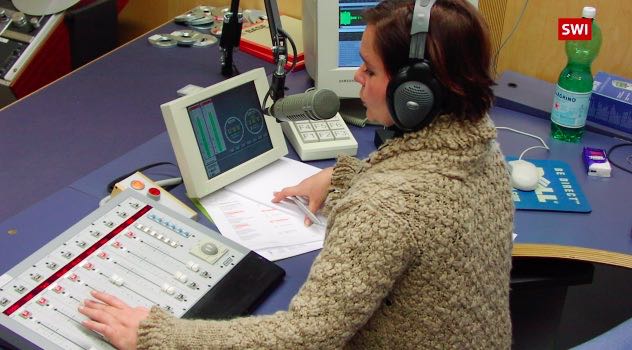
What did SWI swissinfo.ch sound like for the first seven decades of its existence? The short answer: a radio station. 

From the mid-1930s to 2004, Switzerland’s international service was Swiss Radio International (SRI). The first few decades of SRI’s existence were the heyday of shortwave – it was often the only way of getting news directly from other countries.

A brief history of SRI, the predecessor of swissinfo.ch, helps explain why you hear what you do in the video above.

What began as the Swiss Short Wave Service in 1935, would grow from broadcasting programmes in German, French, Italian and English to include other European languages and Arabic, and eventually change its name to Swiss Radio International.

The international service was considered a voice of neutrality during times of war, first during World War II, followed by the decades of the Cold War and up to and including the first war in the Gulf in the early 1990s.

This decade would mark the beginning of the end for Switzerland’s shortwave broadcasts. Shortwave transmitters gave way to relaying programmes via satellite, and this, in turn, would give way to the internet when the service went online in 1999 as SRI’s website.

In 2004, the plug was pulled for good on SRI as part of budget cuts, but not swissinfo.ch. Now producing exclusively online, the international service extended its linguistic reach by adding Russian, Japanese and Chinese, and publishing more video and audio reports.

Journalists working in swissinfo.ch’s current ten languages collaborate closely to set the editorial agenda, providing the necessary context in their stories so they are understood wherever they are read, seen, or heard in the world.

Project ‘The Sounds of…’

This article is part of the project “The Sounds of…” produced with our partner media organisations Polskie RadioRadio Canada InternationalRadio Romania International and Radio Prague International. Further videos have been produced by journalists at these outlets, to give an insight into their work in these countries.

Eifeler Radiotage to broadcast from Cold War bunker

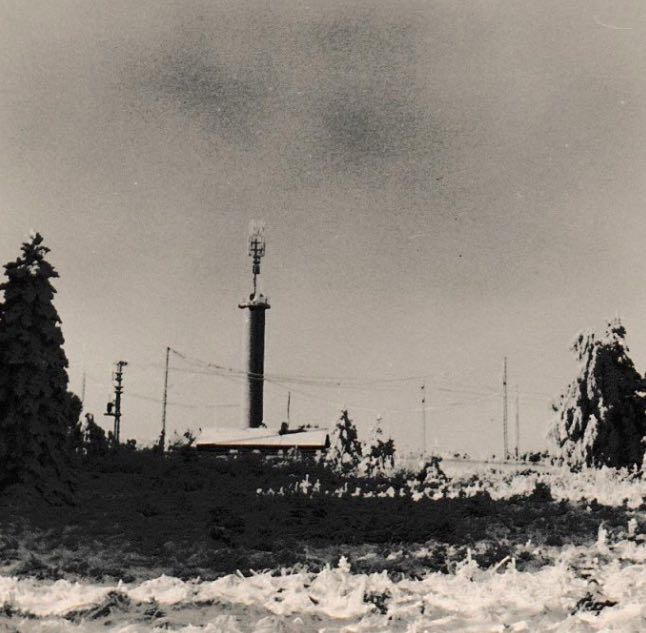
Photo source: Eifeler Radiotage

Many thanks to SWLing Post contributor, Gérard Koopal, who writes:

This might be interesting for your followers in Europe and especially for those living in or nearby Germany.

On the 9th and 10th of November, the Eifeler Radiotage are to start transmitting in German from a Cold War bunker in Germany. There is also a possibility to visit the location (Kall Krekel). Below is a link to their homepage where you can also find a few videos from the Cold War radio room which is still functional and in use.

https://www.eifeler-radiotage.de/

Thanks for the tip, Gérard!

A radio museum…in a subway

Many thanks to SWLing Post contributor, Paul Evans, who shares a link from Atlas Obscura featuring the Museo de la Radio in the Parque de los Venados station in Mexico City:

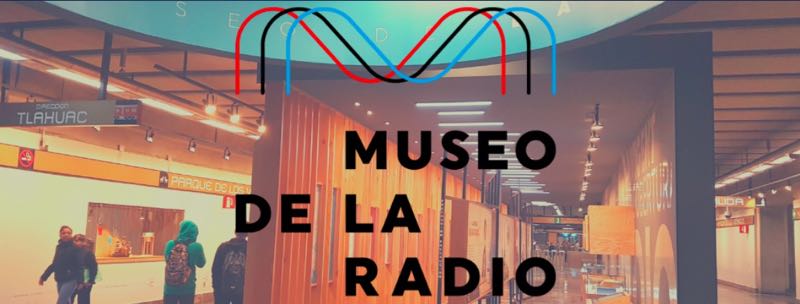
Upon entering the Parque de los Venados station of the Mexico City subway system, you may be surprised to find that you’ve also entered a museum. Here, the subterranean corridors double as the Museo de la Radio (Radio Museum), a small institution dedicated to the communication system’s history.

The museum’s exhibits display different radio-related devices such as lightbulbs, consoles, and microphones. The most prominent is the famous four-key xylophone with which the XEW—dubbed “the voice of Latin America”—announced its broadcasts during the golden age of the ’30s.

Other showcases contain collections of old radios, and still more highlight radio stars’ records. The display cards narrate some important events such as the first transmission, the birth of the digital radio, tidbits of curious data, and explain how the sound waves work.

The most interesting part of the museum is the radio booth, which actually broadcasts live shows. It was installed and opened in 2018, complete with the most advanced technology. One space is the speech booth, and another is the editing booth.[…]

Continue reading and view all photos at Atlas Obscura.

GCHQ “hidden past” in the press

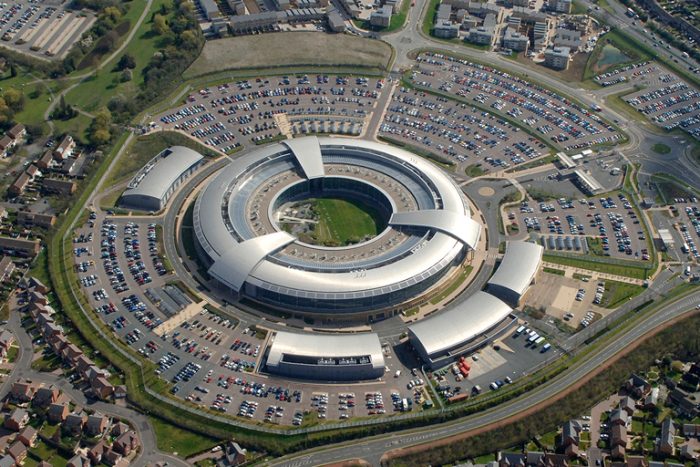
Benhall Aerial View (Source: GCHQ.gov.uk)

Many thanks to SWLing Post contributor, Kris Partridge, who writes:

You recently posted about the on going GCHQ exhibition at the Science Museum here in London.

I now offer you two more GCHQ items. Both radio related.

First one from BBC Radio:

How Scarborough saved the world

The Secret History of GCHQ

Stories from the intelligence agency’s hidden past – and how it’s been listening in for the last 100 years. With BBC security correspondent Gordon Corera.

Click here to listen online (when available).

This will be transmitted tonight at 20h00 London (BST, UTC +1) that’s at 15h00 East Coast time! This will be available after TX on BBC Sounds, the replacement for BBC iPlayer radio.

The second, also radio related, is/has US interest:

GCHQ’s secret hilltop site in Scarborough revealed as having pivotal role in Cuban missile crisis

he pivotal role in the Cuban missile crisis played by a secret outpost of GCHQ in Scarborough has been revealed.

The task of the tiny bunker on the North Yorkshire coast, described by staff as dank and often smelly, had been to monitor the Soviet Baltic fleet and merchant shipping in the northern hemisphere.

In 1962 this somewhat unglamorous job for Britain’s cyber spy agency was thrust into the centre of world affairs as tensions between the West and the Soviet Union threatened to escalate into nuclear war.

On October 16, 1962, US President John F Kennedy had been told the Soviet Union was secretly shipping nuclear missiles to Cuba, just 90 miles off America’s south eastern coast.

US forces established a naval blockade, preventing the arrival of any ships, but some Soviet vessels were already on their way to the island. Any confrontation between the two naval forces risked escalation into nuclear war.

The operators in the Scarborough bunker were able to intercept the Soviet ships reporting back their position and establish where they were heading.

“Traditionally just another task at the bottom of Scarborough’s priority list, suddenly escalated to the very top priority for British intelligence,” Tony Comer, GCHQ’s historian told the BBC.[…]

Click here to continue reading the full story at The Telegraph.

and [from the BBC]:

Scarborough’s role in the Cuban missile crisis revealed

A secret base in Scarborough played a key role in resolving the Cold War’s Cuban missile crisis, it can now be revealed.

Up on a hilltop, not far from a caravan park in England’s North Yorkshire coast sits what is believed to be the longest continually running listening station in the world.

The GCHQ base at Scarborough was established just before World War One because its position was ideal to intercept German naval radio signals in the North Sea.

During World War Two, it helped locate German U-boats in the Atlantic. By the Cold War it shifted to monitoring Soviet communications.[…]

Click here to read the full story at the BBC.

I hope, for you in time to hear it “live”, and the online version for your blog readers.

I managed to do just that, Kris! Thank you so much for sharing these links and stories. I especially look forward to the Radio 4 piece later today.

Listen to RFE Hungary’s 1956 Revolution Broadcast

Many thanks to SWLing Post executive producer, Scott Gamble, who shares the following article from Hungary Today:

From October 19th until November 12th, Radio Free Europe‘s (RFE) Hungarian broadcast recorded around and during the 1956 Revolution can be listened to online, exactly how it was aired 63 years ago minute by minute, HVG reported.

The Hungarian broadcast of RFE’s 1956 program that was aired on shortwave, through foreign transmitters, was recorded at the repeater stations, and has been preserved thanks to the German government’s examination of the radio’s role in the revolution, launched after the events.

After the inquiry, however, the footage, consisting of 60 tapes, was concealed in a basement for decades, until it was rediscovered in the 90s, transferred to cassettes, and digitized.

In the framework of the First University Radio in Pest’s (Els? Pesti Egyetemi Rádió- EPER) voice memorial project dubbed “SZER56” (derived from the radio’s Hungarian name: Szabad Európa Rádió), people can hear (once again) these recordings. The recordings were restored, digitized, and published by the National Széchényi Library (OSZK), which EPER then restored to the original broadcast session.

The footage includes four days that preceded the outbreak of the Revolution, making it the only available recording that preserved the 50s’ “every day” shows. Moreover, this would be the first time the public can hear this outstanding piece of media history. In addition to political broadcasts, the recordings include radio plays, musical compositions, and even quizzes.

The “broadcast” will be available from Saturday on eper.elte.hu or here and here.

Click here to read the full article at Hungary Today.

Thank you for the tip, Scott!

Readers: If you know of any way we could obtain these recordings, I would love to add them to the Shortwave Radio Audio Archive.

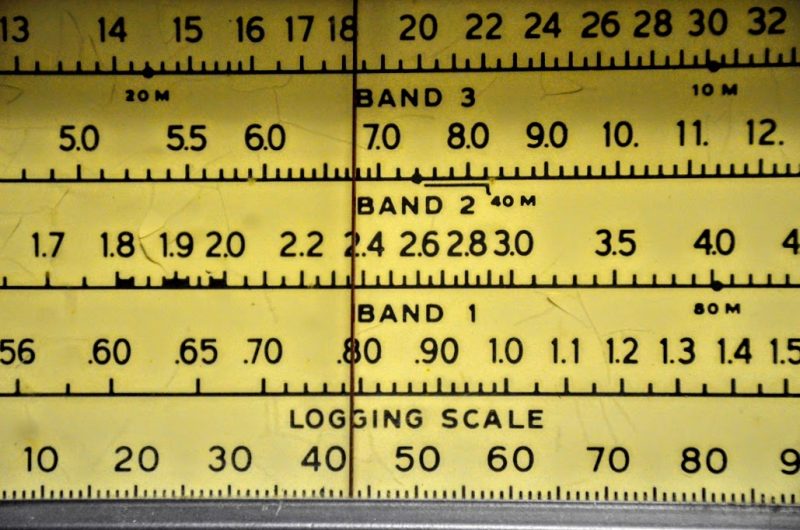
Radio Malaysia QSL and memories

In response to our post regarding Radio Sarawak, SWLing Post contributor, M Breyel, shares the following:

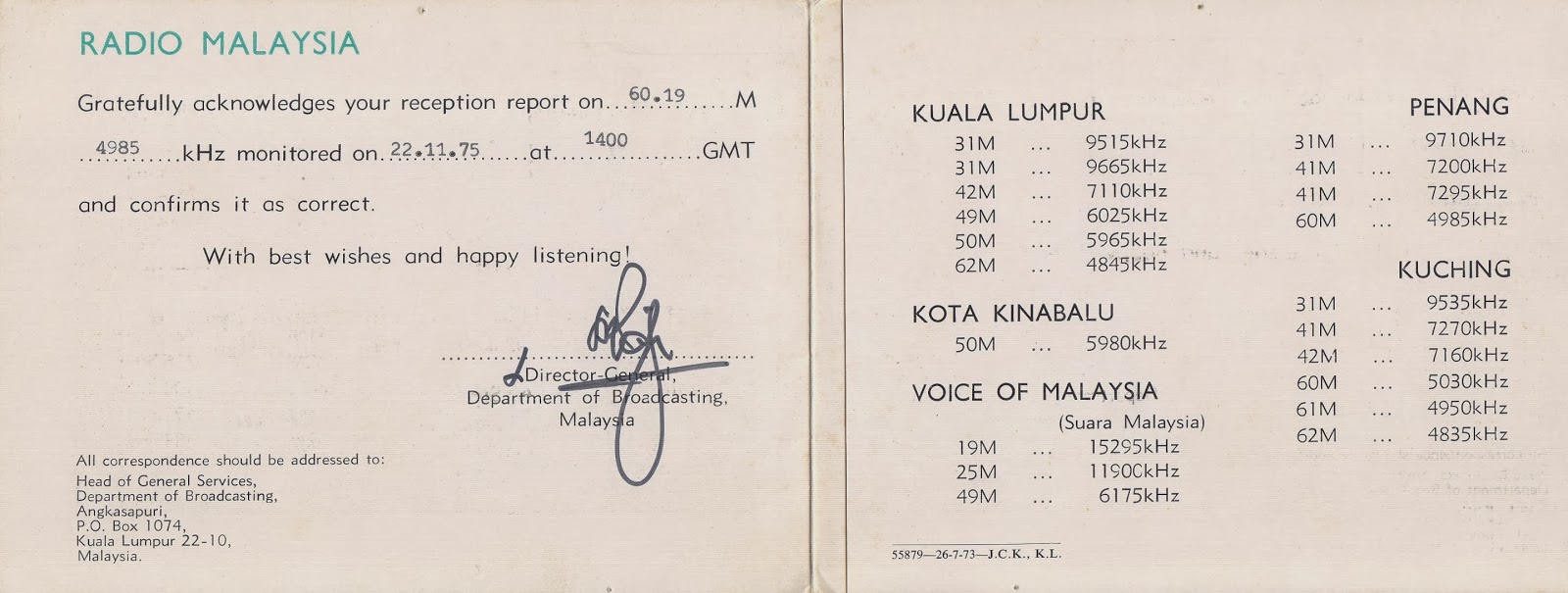
These were the shortwave frequencies RTM used in 1975. This is my QSL card for an RTM transmission originating from Penang, as received on Denver, Colorado. [Click images to enlarge.]

Most MW stations in Malaysia ceased operation after 2000. That said, a 750 kW MW station in Sabah remained operational as late as 2008, if I remember correctly. My guess is FM became more prominent thereafter.

Certainly here in peninsular Malaysia (Kuala Lumpur), particularly in 1987, we had six government FM stations. Sign-off was usually at midnight or 1 am, depending on the station. An annual license (tax) was issued for each radio owned.

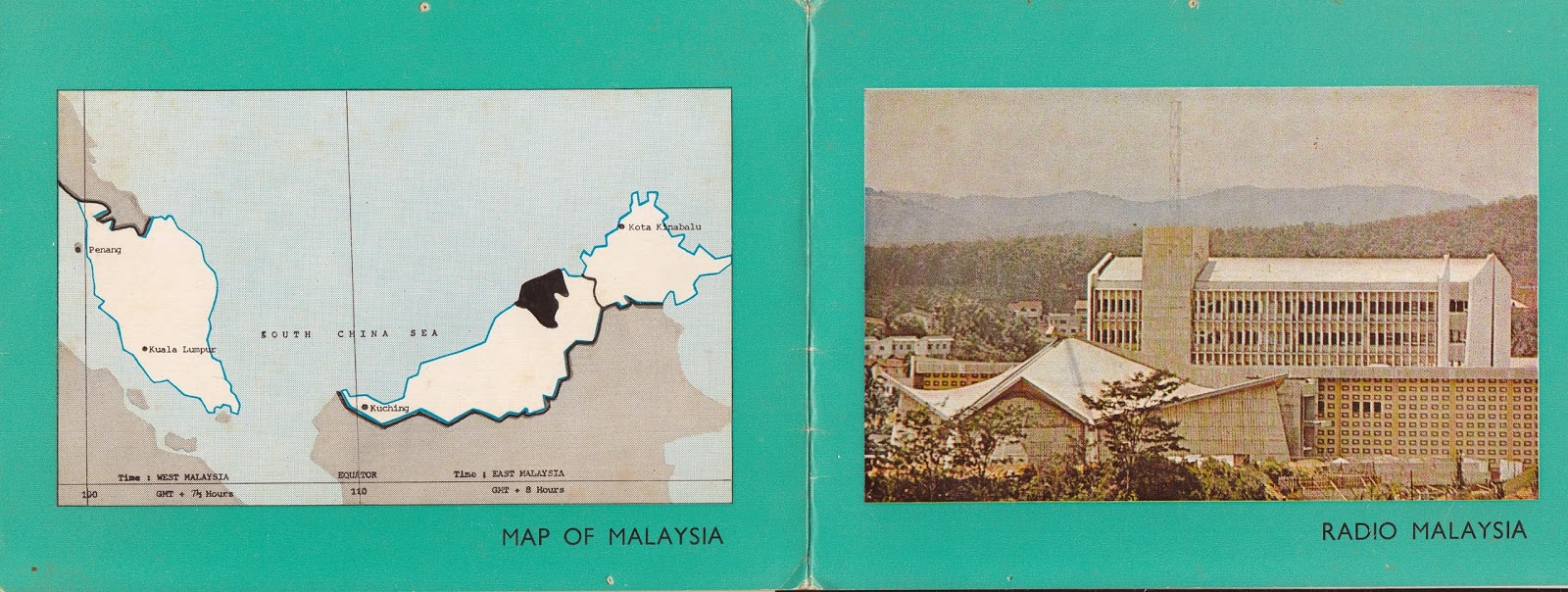
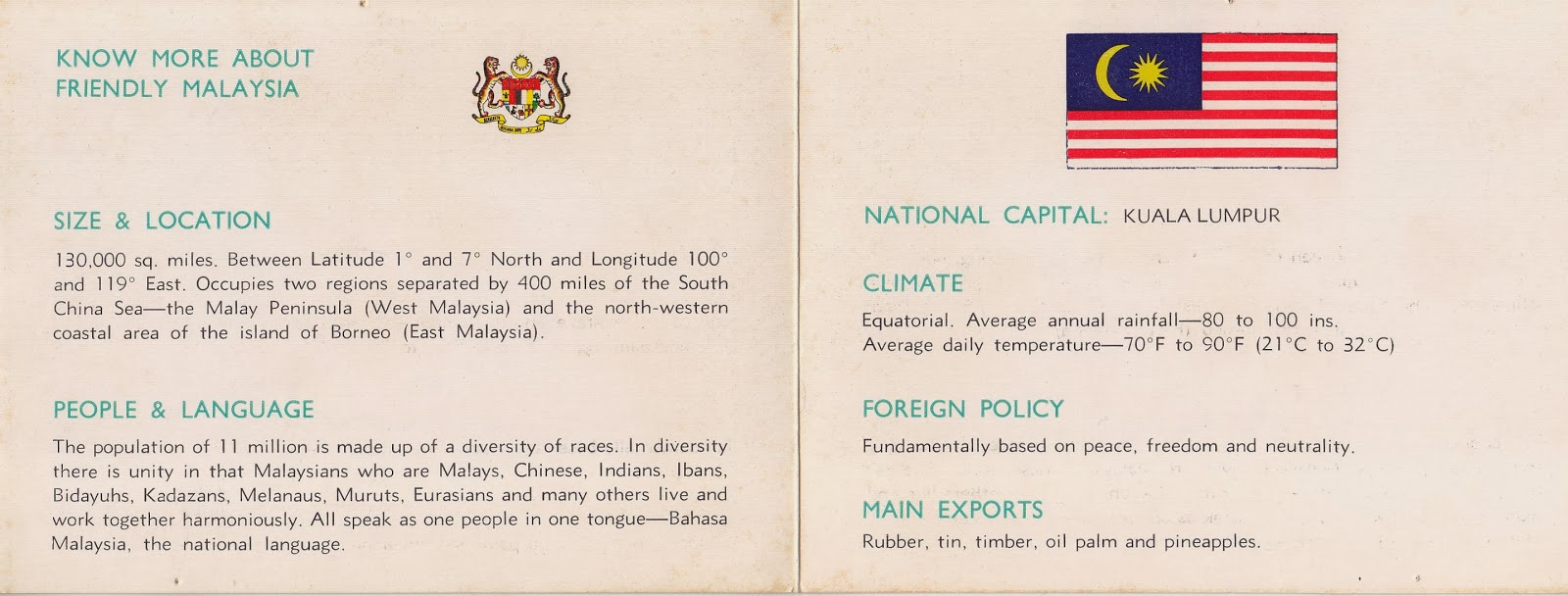
Note, the QSL card [above] appears to have first been printed in 1973, judging by the smaller date printed at the bottom of the card. It was one of the few folded cards I received in my DXing years from 1967 to 1980. It features three sections, folded twice and printed on both sides. The Angkasapuri studio in Kuala Lumpur, map and flag of Malaysia, caption about the country, transmitter sites and frequencies and verification data is depicted on it.

This particular card was issued for a reception report I posted on 22 November 1975, nearly 40 years ago. Unbeknownst to me then I had picked up Radio Malaysia via Penang, according to the frequency legend (4.985 kHz) stated on the card. I assumed it was Kuala Lumpur and, more importantly, I was excited to have logged a new country to my growing list of international broadcasters.

At the time I lived in Northglenn, Colorado — a suburb north of Denver. As I recall Radio Malaysia was usually received in the early morning hours between 5 and 8 am. Reception was always weak, yet music and speech was audible despite atmospheric noise.

The receiver I used was a Zenith Trans-Oceanic H-500, a 5 valve/tube radio originally manufactured in the early 1950s. The antenna was an inverted L, elevated at over 30 feet, spanning approximately 75 feet in length.

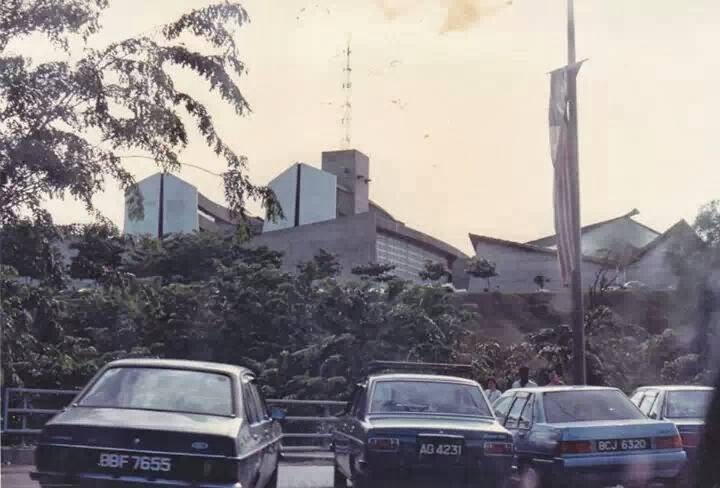
This is a photo of Angkasapuri, the RTM Headquarters in Kuala Lumpur, as it appeared in 1987. The HQ as changed very little since then:

Interestingly, the Australian Armed Forces had a radio station based in Penang in the late 70s-early 80s.

For more on vintage QSLs from Malaysia, please refer to my blogsite.

Or see this video.

Wow–thank you for sharing your DXing experience with us! It sounds like the Zenith Trans-Oceanic H-500 served you quite well back then! What a classic set.

Post readers: Please check out M Breyer’s blog for more interesting DX and radio history.


Do you enjoy the SWLing Post?

Please consider supporting us via Patreon or our Coffee Fund!

Your support makes articles like this one possible. Thank you!