Tag Archives: FM

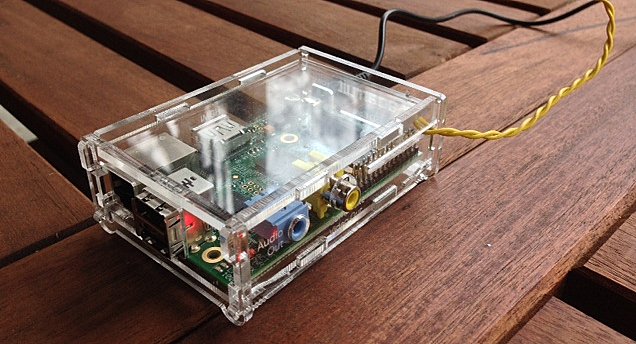
My Raspberry Pirate is now radio-active

RaspberryPirateRadio

Two weeks ago, Make Magazine published a simple hack that turns your Raspberry Pi
into a low-powered and portable FM transmitter/radio station.

For those of you not familiar, the Raspberry Pi is a single-board computer developed in the UK by the Raspberry Pi Foundation. The RasPi is a cleverly-designed, useful device–especially if you like tinkering with mobile computing. Best yet, the Raspberry Pi is very inexpensive; the basic computer costs a mere $40 US, though there are starter kits that include common accessories for $70-80.

One of the first things I did upon returning home, following nearly two weeks of US east-coast travel (which included the Winter SWL Fest), was to build my own Rasberry Pirate Radio. I had hoped to make the radio before my trip, but thought I wouldn’t have enough time. Had I known what I know now–that the Raspberry Pirate Radio is a super simple and easy hack–I would have made it anyhow and taken it along for the ride.

My antenna wire connected to pin 4. (Click to enlarge)

My antenna wire connected to pin 4. (Click to enlarge)

To be fair, what makes this project so simple is the fact that Make Magazine so beautifully documents the procedure on their website.  It also helped that I have a little familiarity with creating disk images–still, I’m certain that if I were a total newbie, I could have done all of this within 30 minutes…Which is just what I did.  And I’ll bet you can, too.

There are really only three steps required to make your own Raspberry Pirate Radio:

  1. Make a simple FM antenna and attach it to pin 4 on the Pi’s board. In my case, I had a small dual conductor connector attached to about eight inches of twisted pair wire. I simply connected one side of this connector to pin 4. Since my FM antenna is not cut to a resonant length, I know I’m compromising the FM transmitter’s range a bit…Still, it’s what I had on hand, and it works!
  2. Download Make Labs‘ disk image and flash it to your SD Card.
  3. Add music to the “Pirate Radio” partition of the SD card and edit the config file to your preferences. If you have the option to do this step on Mac OSX or Linux, the process is much easier than on Windows. But Windows users, fear not: Make Magazine describes, in detail, how to add files.

After I finished these steps, I simply plugged in my Raspberry Pi and tuned one of my radios to 89.9 MHz (the frequency I chose and saved to the config file). The Pi booted and started the Raspberry Pirate Radio script automatically.  Brilliant!
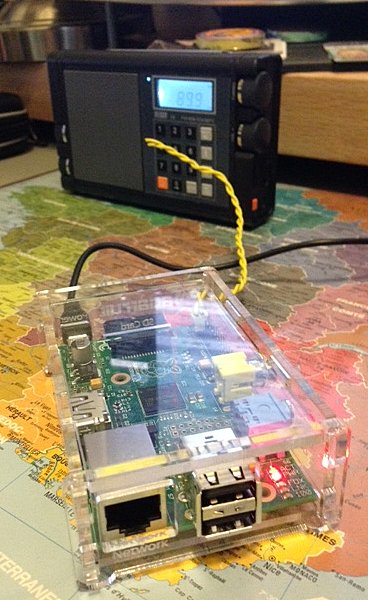
RaspberryPirate-FMRadio

It’s alive!

Being a shortwave radio nut, of course I loaded my Raspberry Pirate Radio with a few gigabytes of my off-air recordings that are a heavy on music (all of which you, too, can pull from our Shortwave Radio Audio Archive). It’s kind of fun tuning my bedside Tivoli Audio Model One to 89.9 MHz and hearing the Voice of Greece, with all of its shortwave audio characteristics. If I close my eyes, I can pretend the Model One has a shortwave band. Love it!  Just the thing to drift off to…

I’ve kept the Raspberry Pirate Radio running nearly 24/7 here at home. I’ve also had excellent luck running the radio mobile by using my Eton Rechargeable Battery Pack as the power source (Universal Radio also sells a higher capacity version, if you like). I’ve yet to test how long the power block will run the Raspberry Pi, but I imagine it will last for a couple of hours, at least.
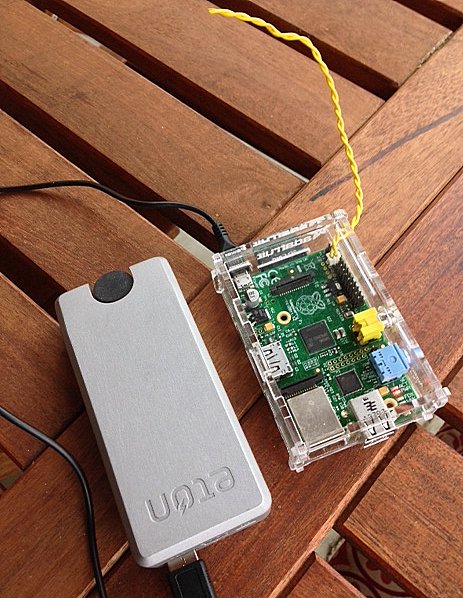
RaspberryPirate-EtonBlock

If you want to take your Raspberry Pirate Radio in the car, it’s a simple matter to power it with a 5VDC USB power plug. You probably already have what you need, especially if you charge your mobile phone in the car.

If you’ve never experimented with the Raspberry Pi, this is a perfect first project for you. Just think about it: for under $50, you can make a simple-yet-effective FM radio station which shuffles your favorite music or recordings from any source–from obscure radio pirates to far more distant stations. Besides, once you have a Raspberry Pi, you’ll find there are thousands of other radio projects to occupy your rainy weekends.  Enjoy!

Many thanks to Make Magazine for posting this simple project!

Update: Several people have written concerned that the Raspberry Pirate Radio has no output filtering of its RF signal.  This is true. Though I have not tested it, I would have to assume that it could radiate on harmonic frequencies and potentially interfere with other radios. Though the broadcast footprint is very small, if you live in a high-density neighborhood, you will need to keep this in mind. I live in a very rural area and my nearest neighbor couldn’t possibly hear my Raspberry Pirate Radio.

I’m very curious if there’s a simple mod to filter the output RF. If you can think of one, please comment!
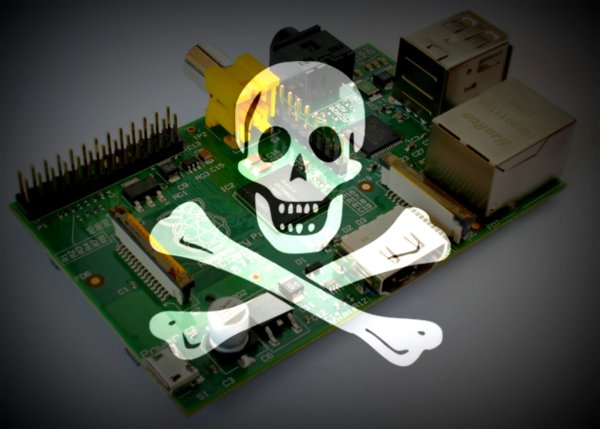
Make a Raspberry Pirate Radio

Sorry, I just couldn't resist the urge to make a pirate graphic.

Sorry, I just couldn’t resist the urge to make a Raspberry Pi-rate graphic.

Many thanks to SWLing Post reader, Paul, for this article on Make Magazine that teaches you how to turn your Raspberry Pi into an FM transmitter. Make Magazine states that this FM transmitter “has enough range to cover your home, DIY drive-in movie, a high school ball game, or even a bike parade (depending on the stragglers).”

What a simple hack:

(If the embedded video above doesn’t appear, simply click here to watch at Makezine.com.)

Raspberry Pi’s are very inexpensive (less than $40 US on Amazon) and a fun tool to have around the shack anyway. I plan to try this project as early as this weekend. I have many hours of shortwave radio recordings that I would love to pipe through the house via FM. I only wish the Raspberry Pi could broadcast in AM. Perhaps one day…

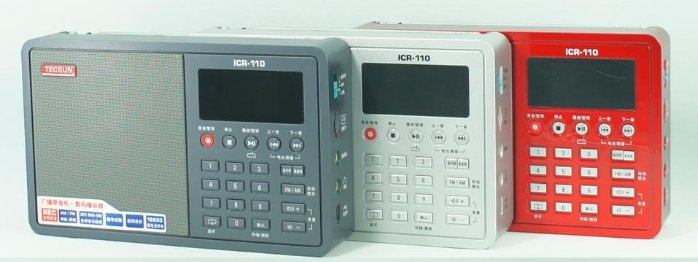
The Tecsun ICR-110 packs AM/FM and digital recording/playback

Photo: BigBargainsOnline from eBay

In a comment, SWLing Post reader Owl mentions:

“Tecsun has just released ICR-110 which is as BIG as the PL-880 and seems to have the same speaker too.”

The ICR-110 can be found on eBay–click here to search. At $46.00 US shipped, I’m very tempted to purchase it. Though it lacks shortwave, it appears that it can record AM (MW) and FM broadcast stations in either MP3 or WAV formats. While I’ve yet to find a radio that can make a digital recording with acceptable fidelity (the CC Witness Plus being a notable exception) I would like to think the engineers at Tecsun have nailed it.

I have a friend who has recently purchased the ICR-110, and am looking forward to his review! (hint, hint)

Review of the RadioShack AM/FM portable digital radio, Model 12-587

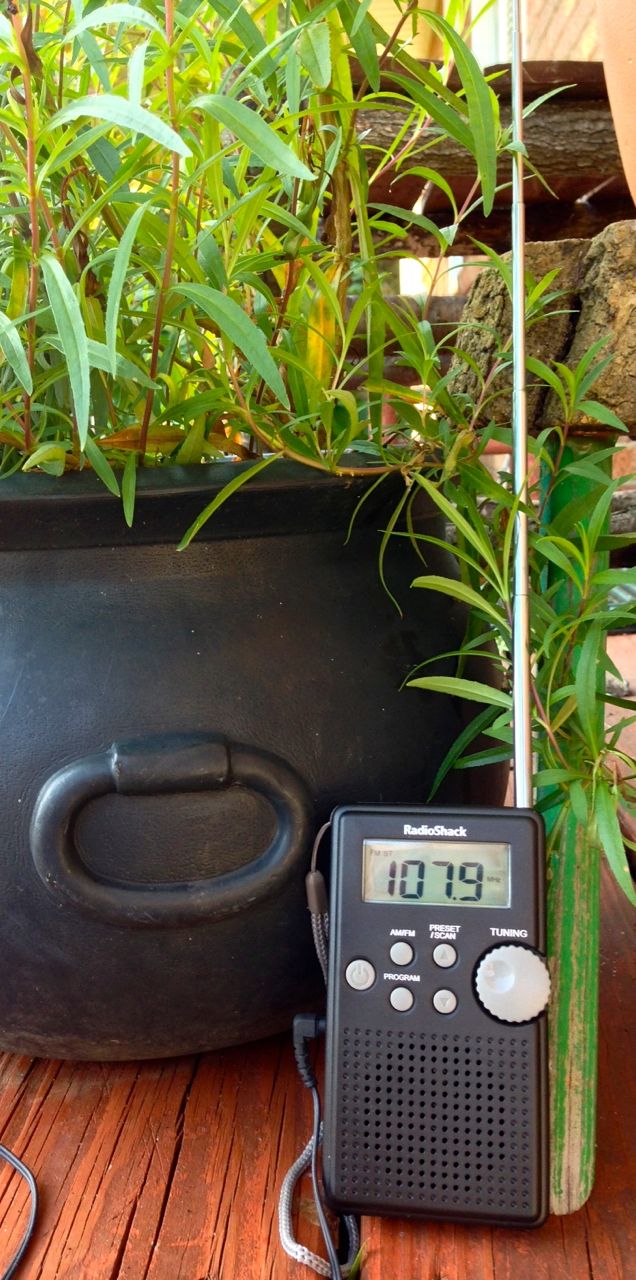
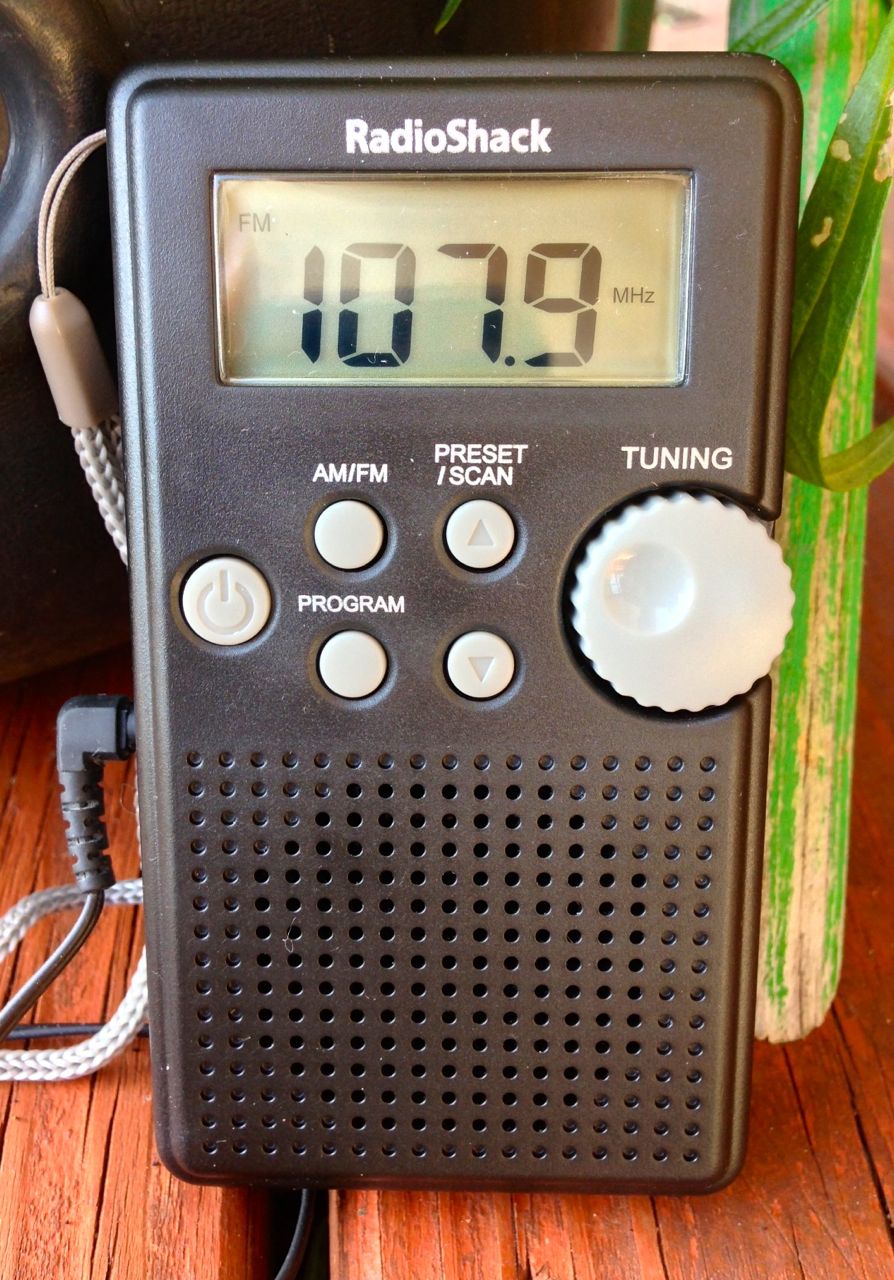
The RadioShack Model 12-587 AM/FM Radio

The RadioShack Model 12-587 AM/FM Radio

Three days a week, my father––now in his seventies––takes a three mile walk through his home town, revisiting the neighborhoods of his youth. He began the walks upon retirement, and in my opinion, the routine has helped keep him in great shape. When he first started walking I learned he was carrying around a heavy AM/FM radio with him.  I bought him a bargain one-off Coby AM/FM portable that is not only lightweight but sports a handy neck strap. Dad’s loved it. Indeed––much to my surprise––it’s lasted about ten years, and is still playing, although starting to show signs of wear…

So I decided it was time to test drive a suitable replacement. After searching, I found the RadioShack Model 12-587 AM/FM radio. At a clearance price of $14.99 (US), there will be no loss of sleep if Dad misplaces it or drops it on the pavement.

Still, I couldn’t resist giving it the once-over, and thought I might share the mini review that resulted. As I always say for radios in this price range, my expectations were low.

Here’s a summary of this little AM/FM radio’s pros and cons:

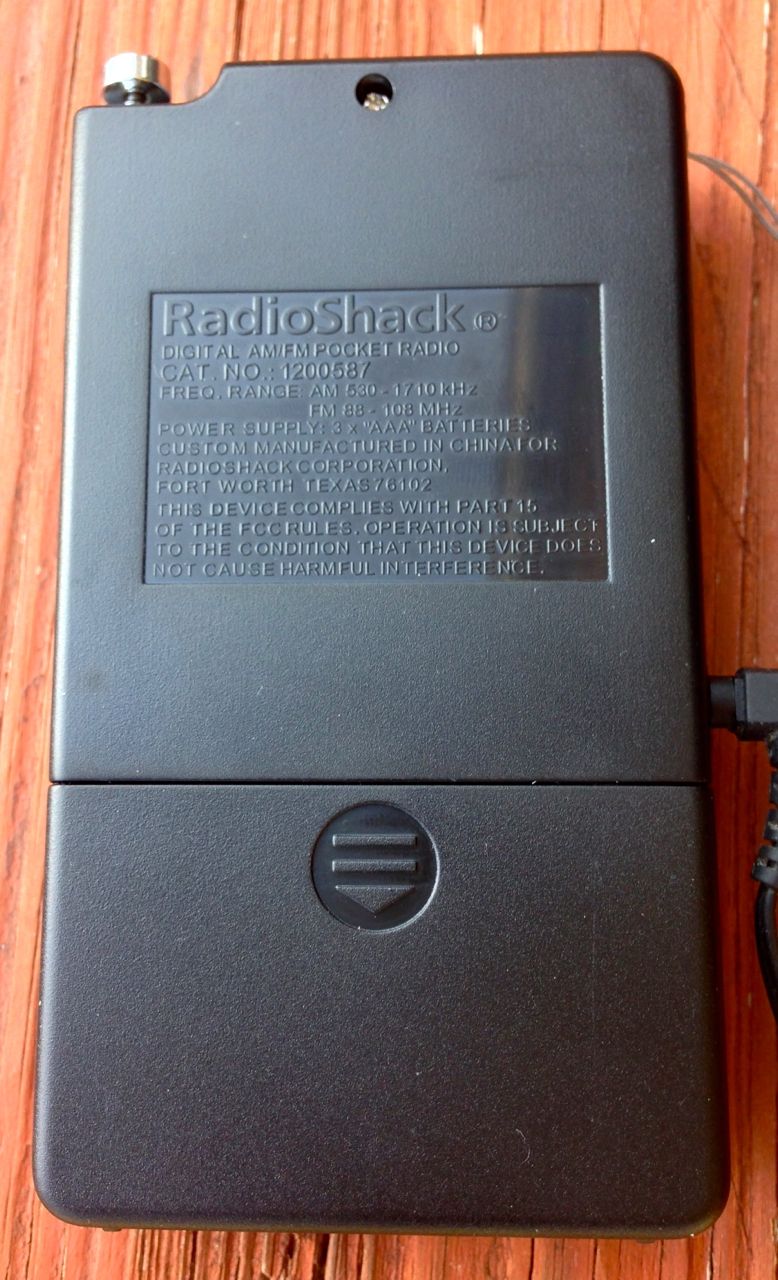
Back of model RadioShack 12-587

Back of model RadioShack 12-587

Pros:

  • Very good FM selectivity and sensitivity
  • Excellent FM stereo lock
  • Scan function both useful and quick
  • 10 AM and 10 FM memories (see con)
  • Large, amber back-lit LCD display
  • Simple control lock switch on right side
  • AM (medium wave) sensitivity adequate
  • AM nulling above average
  • Plastic “blister” packaging very easy to open!

Cons:

  • Tinny sounding audio via built-in speaker
  • Headphone audio lacks high/low; mid-range only
  • Memory allocations supposedly volatile (when batteries are replaced)
  • AM frequency steps fixed at 10 kHz (cannot adapt to 9 kHz steps used in rest of the world)
  • AM (medium wave) sensitivity mediocre at best
  • Complete mute while tuning; not capable of band-scanning
  • Dimple on tuning knob not useful
  • Very sensitive to noise (QRM) on the AM band, resulting in static popping/crackling in audio

Obviously, this is not a radio for the radio hobbyist or world traveler, as it lacks any real medium wave sensitivity and cannot tune in 9 kHz steps. FM tuning is also locked on odd frequencies, thus will not work throughout parts of the world with even spacing. And though the radio is touted as having “extended bass,” the audio is tinny, even via headphones.

RadioShack-Model12-587-AMFMRadio-2BUT.  This is a perfect example of a situation in which, though cons outweigh pros, the RS Model 12-587 is a great match for its intended purpose: my father’s morning walks. Why? It’s a simple-to-operate radio with a large, back-lit display (Dad won’t need to put on his glasses to read it). It receives local AM and FM stations very well. The mid-range audio––while lacking ample fidelity for music––are perfect for the talk shows he listens to while walking. The radio is durable, lightweight, easy to tune, and has a lock feature. It is also remarkably easy to program memories: simply press the program button until preset flashes in the LCD display, use the scan up/down buttons to choose a memory number then press program again.  It’s also very affordable, so no problem to replace as necessary.

In conclusion, the RS Model 12-587 is not a performance radio––and I wouldn’t generally recommend it––but it suits my father’s needs very well.  Like to walk or run? Maybe it’s just what you’re looking for, too.

Newsweek: Can radio turn the tide in Syria?

Syria_(orthographic_projection)Thanks to The Professor for sharing this brilliant article by Mike Giglio in The Daily Beast:

“Twenty minutes—this was the small window of time that Majid (not his real name) usually gave himself to broadcast his radio dispatches and then flee. The Syrian was making a name for himself as a bold, young journalist in Damascus, venturing into contested neighborhoods in the capital’s war-torn suburbs to deliver his reports. The broadcasts were low tech and old-fashioned, produced for an upstart radio station called Al-Watan FM, or “The Homeland FM,” and went out on the local airwaves, crackling into a sphere otherwise tightly controlled by the regime. Any Damascus resident scanning the dial could tune in.

It was dangerous work. Pushing into the capital’s FM frequencies meant transmitting an easy-to-track signal from within the city. Government soldiers or regime thugs often came looking for Majid when he went on the air, so he tried to be quick—setting up, going live, then packing up and disappearing within the span of 20 minutes.”[…]

Continue reading the full article in Newsweek’s The Daily Beast online.

Mystery radio identified

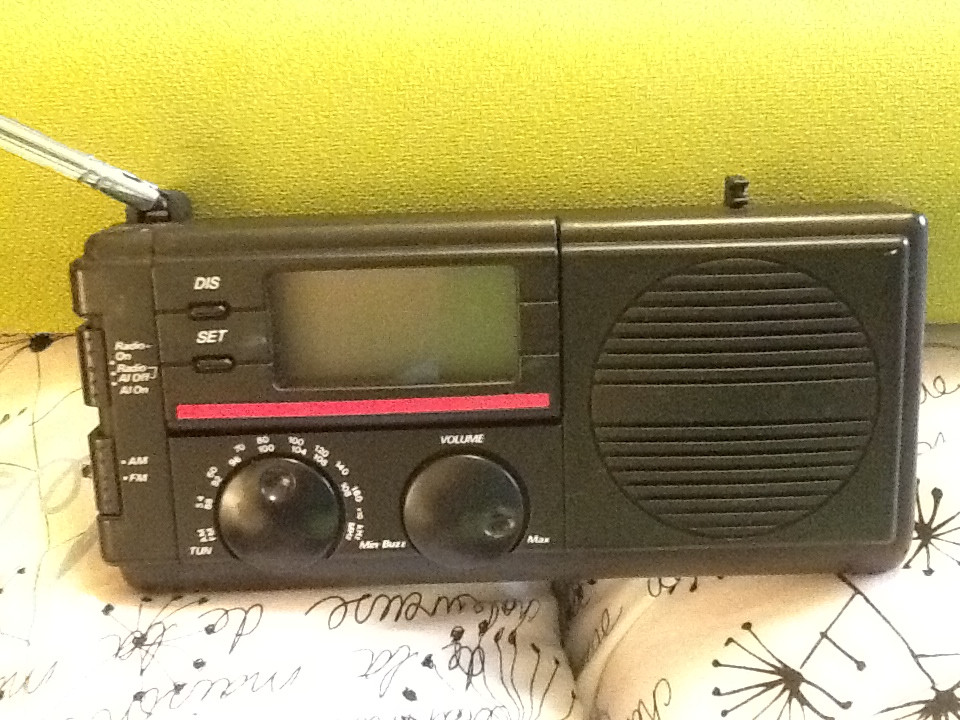
Click to enlarge.

Click to enlarge.

Wow, that was quick! Many thanks to Ulli who solved the case of the mystery radio we posted yesterday.

Ulli comments with details:

The radio was a giveaway about 1995.
I opened it :
1 IC Sony CXA1191S 314J22V , 5 Transistors , 3 -band filter , 5.5 cm speakers , 8ohm , 0.5 W.
Today’s AA batteries are a bit too long, the 3 AA not quite fit into the battery tray .
The display with the time can be tilted .
On the back is a sticker :
AM / FM CLOCK RADIO LCD , DC POWER SUPPLY , RADIO DC 4.5 V, 1.5 V DC CLOCK ,
ART No. 05796-07 , CENTRON LABORATORIES LTD .
and on housing :
U.K.REG.NO.2013420 .

Thanks, Ulli!