Category Archives: Nostalgia

The Sony ICF-8000: Bob’s nostalgic journey

Many thanks to SWLing Post contributor, Bob Butterfield, who shares the following guest post:


The SONY ICF-8000

By Bob Butterfield
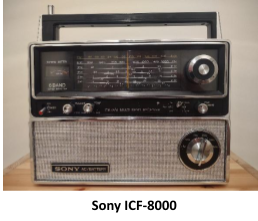
As many radio enthusiasts have experienced there are some pieces of equipment that come and go for a variety of reasons.  Many times, there are regrets about radios or accessories that are here one day and then gone another.  Years ago, I was gifted a Sony ICF-8000 “Super Sensitive” FM/MW/SW portable radio.  My ICF-8000 was one of those that “went.”  To tell you the truth, I am not actually sure where it went off to!  In those days I used my “Super Sensitive” radio on vacation trips, on the back deck, and for local MW/FM and casual SW listening.  When a new position with the Government necessitated relocation, I left this radio behind at my parents’ house where it was regularly used by my mother in the kitchen.  That is when things get fuzzy.  Suffice it to say that I am not sure what happened to it.
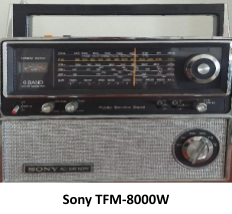
As far as I can determine, the Sony ICF-8000 is a close relative of the earlier Sony TFM-8000W, another “Super Sensitive” model.  What sets them apart is that the Sony TFM-8000W has the Public Service Band (PSB) and the Sony ICF-8000 does not.  The ICF-8000 has its SW bands spread out into 4 bands: 1.6 to 3.5, 3.5-7, 7-14, and 14-26.1 MHz.  In contrast the TFM-8000W has a slightly shorter SW frequency range split into three bands: 1.6-4, 4-10, and 10-22 MHz.  Both radios have continuous coverage with no gaps from MW to SW as well as FM.  These radios are almost identical in appearance.  Other than the PSB and three SW bands on the TFM-8000W, the only other visual differences from the ICF-8000 are how the bands are arranged, identification of the Public Service Band on the face plate, and the addition of an on/off squelch toggle switch for the PSB.  Internally the TFM-8000W has a couple more semi-conductors.  In line with these two radios is the older Sony TFM-1600W “Super Sensitive” which came out circa 1971, has its own distinctive but similar appearance, and is set up like the ICF-8000 with FM/MW/SW.
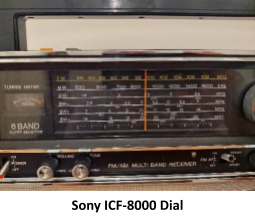
A while ago the “I used to have that radio nostalgia bug” hit me, and I have been searching since for a decent ICF-8000 to purchase.  Sony TFM-8000Ws in decent shape are up for sale on eBay on occasion, but I was looking for the ICF-8000.   Finally, I spotted one recently (which was listed as a TFM-8000W!) at a price and condition I was comfortable with.  After negotiation with the seller, I purchased it.   There is some useful information on the Web about the Sony TFM-8000W.  Jay Allen has a good piece on this unit worth checking out.  The Sony ICF-8000 appears to be much harder to find, information on the Web is skimpier, and I am not sure how long they were produced.  It is quite possible that its production run was limited.  Manufacturing likely started in 1976 when it probably replaced the Sony TFM-8000W.  One reference I located on the Web listed the ICF-8000 being made as early as 1974 but provided no source.   I also found evidence of at least two versions of ICF-8000s being produced; one with a switch located in the battery compartment allowing multiple different voltages including that for Japan, and one operating on 120 volts only.  The corresponding model number identification panels on the rear are annotated accordingly with voltages available.  Both versions have “FM/AM Multiband Receiver” lettering on the face plate.   Sony, like Panasonic, often tweaked models for domestic and foreign markets, adding or modifying features to fit those markets accordingly.  If anyone has more information on these models, year(s) manufactured, availability of free manual copies, etc., drop them in the comments section.

The Sony ICF-8000 I purchased was in very good shape having just some minor imperfections showing on the faceplate paint. No cleaning was necessary, nevertheless I gave it one.  All switches were quiet and functioned as they should.  A nice feature of the ICF-8000 is its exceptionally smooth tuning mechanism which utilizes a flywheel.  In addition, on my radio, the tuning scale is practically spot-on on all the bands.  Not usually the case in an analog set of this type forty-five plus years old.  When added to the fact that the SW frequencies are spread out in four bands instead of three, tuning is easy.  The presence of a fine-tuning knob is a nice touch and can be useful.  Also available is a tone control knob, signal/battery strength meter, a lighted dial, AC/DC capability, external antenna connection, world time calculator wheel (at the rear on the battery compartment cover), and a dual FM AFC and AM Broad/Sharp bandwith control.
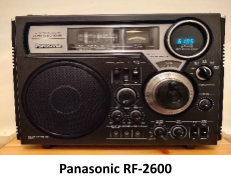
Nostalgia aside, the Sony ICF-8000 has provided reliable performance on all bands so far.  MW sensitivity is adequate while SW reception is above average using the built-in telescoping antenna which measures 44 inches (111.75 cm) in length.  I did a limited shortwave reception comparison in the 49-meter band between the ICF-8000 and the Panasonic RF-2600 with its 37 inch (94 cm) built-in telescoping antenna and found the Sony performing equally with the Panasonic; at times even better perhaps due to its longer antenna.  When connected to an external 75-foot (22.86 meters) longwire I found the ICF-8000 shortwave reception to be particularly good.  I did not experience any overloading, nor did I encounter multiple images.  The sound was, as others have attributed to the TFM-8000W, “mellow”.  If this is not to your liking on the shortwave bands the tone adjustment is useful.   Noise levels were well tolerated.  I suspect that the Sony TFM-8000W would perform similarly.

Is the Sony ICF-8000 a fantastic DX machine?  No, it is not.  Is it “super sensitive”?  Maybe not “super,” but definitely above average, and surely sensitive enough for general listening.  Is it an attractive, affordable classic, easy to use, and sturdy radio with decent performance that can hold up through the years?   I think so.  Does it bring back fond memories?  Absolutely!
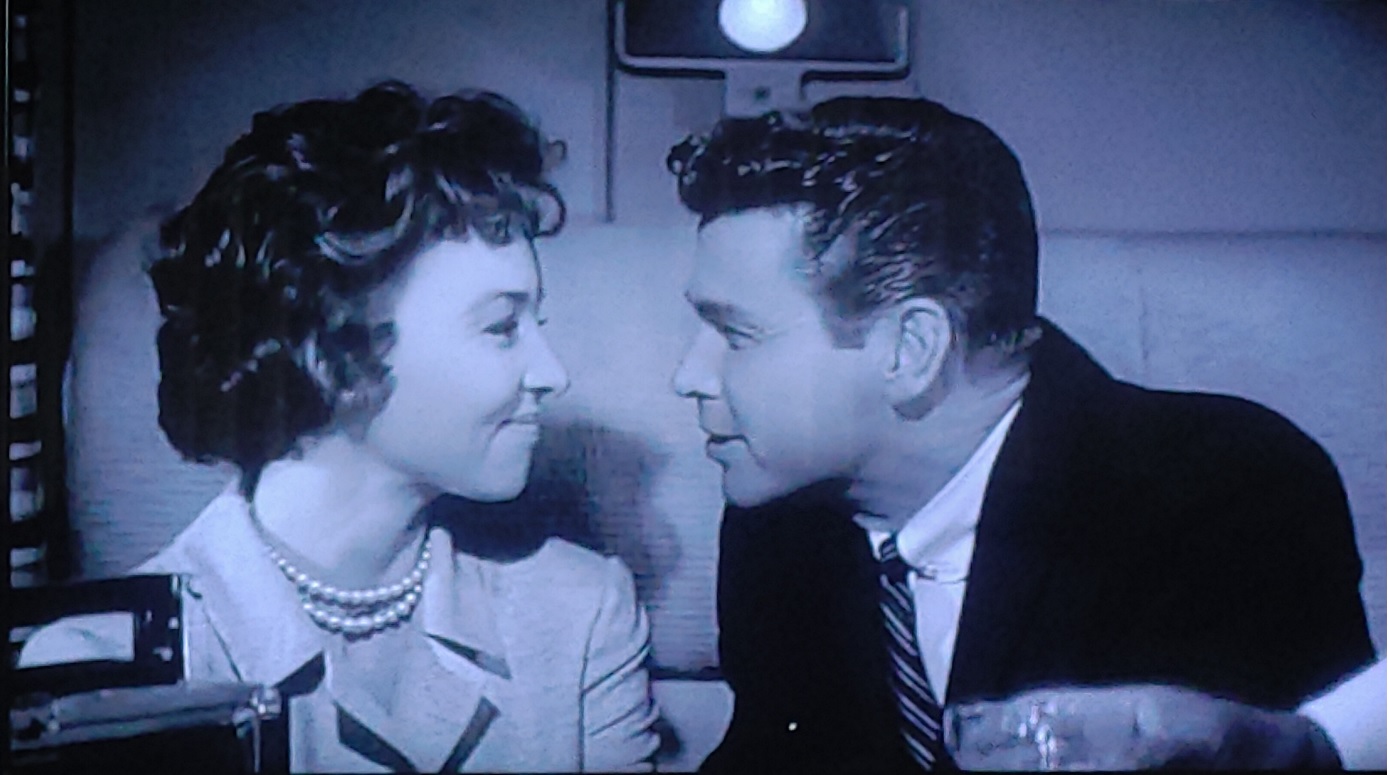
Perry spots a Zenith Transoceanic in “The Alligator People”

Many thanks to SWLing Post contributor, Perry Lusk (KG7YC), who writes:

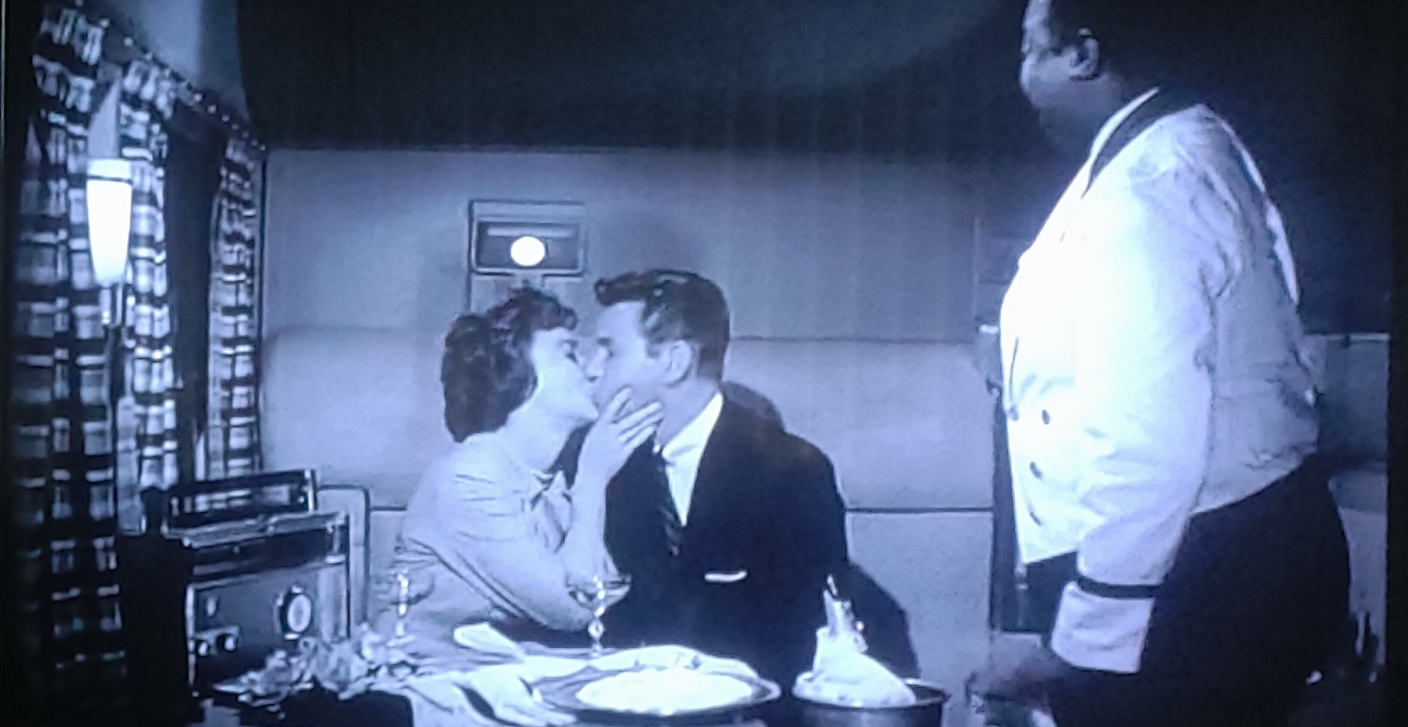
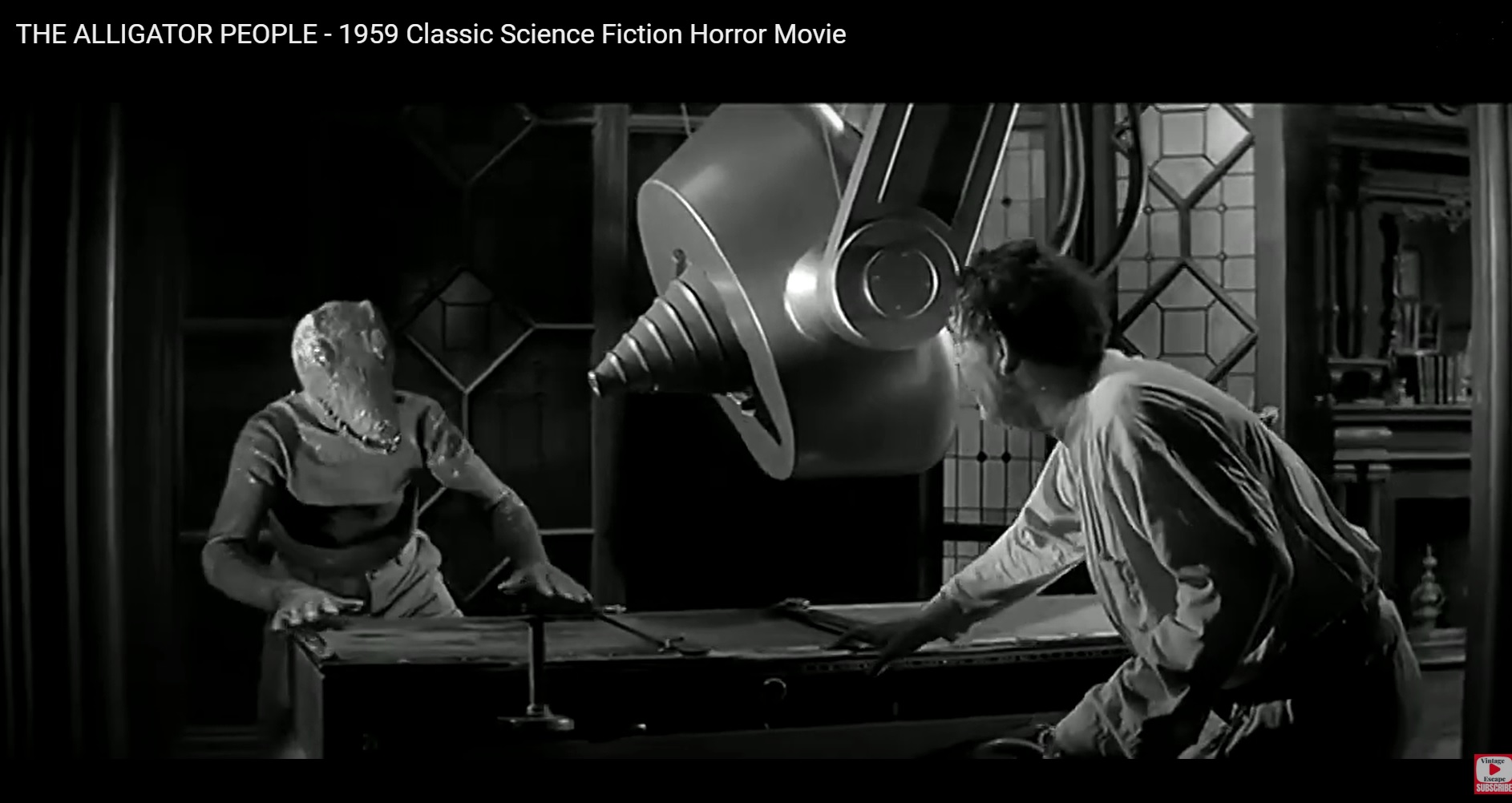
I spotted this on an old “B” rated film:

Might be more fun to identify the movie than the Zenith Transoceanic we all know.

The answer is The Alligator People (1959). The man is diagnosed with a fatal medical problem and try’s getting an experimental procedure that involves alligator DNA and later turns into a, you guessed it, an alligator!

Wow! That sounds like a wild ride for the protagonist!

So we may all recognize a Transoceanic when we see one, but does anyone know the exact model? Feel free to comment!

Dan spots an ICOM in the trailer for the new film “I.S.S.”

Many thanks to SWLing Post contributor, Dan Robinson, who writes:

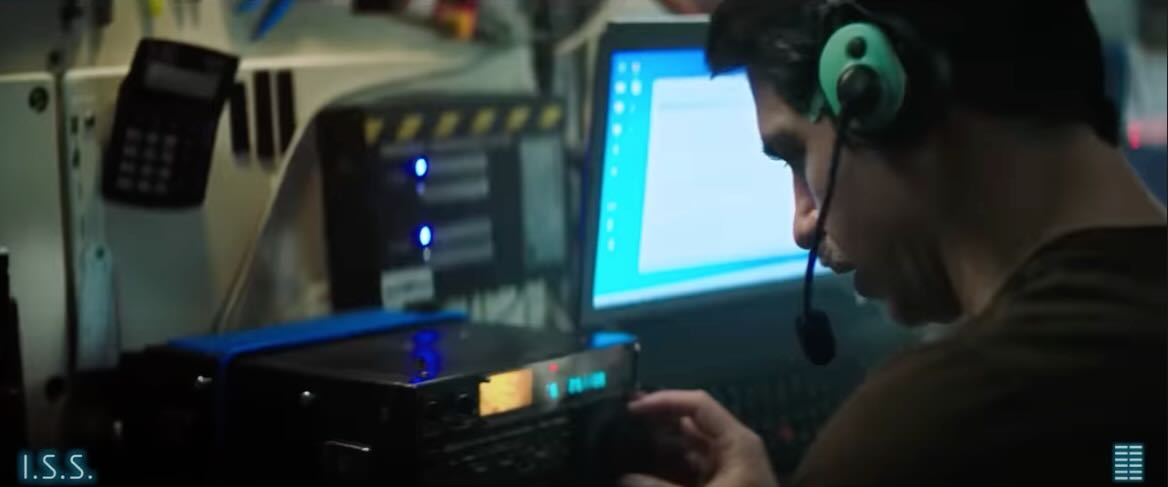
An ICOM transceiver features in the new movie I.S.S. A film from the space disaster genre about U.S. and Russian astronauts and cosmonauts on the space station when nuclear war breaks out down on Earth. See if you can ID the radio, which flashes by quite quickly in the trailer for the movie:

Click here to view on YouTube.

Did you catch it? If you want to confirm, check out this screen shot from the trailer… Continue reading →

Radio Reminiscences . . . A Reader Participation Post

By Jock Elliott, KB2GOM

The other night, at 10 pm Eastern Time (0300 UTC), I was listening to Zoomer Radio from Toronto, Canada, on 740 kHz (medium wave) when a program called “Theatre of the Mind” came on. This wonderful program airs Monday through Friday and presents “Old Time Radio” programs from back in the day when radio dramas were a regular part of on-the-air fare.

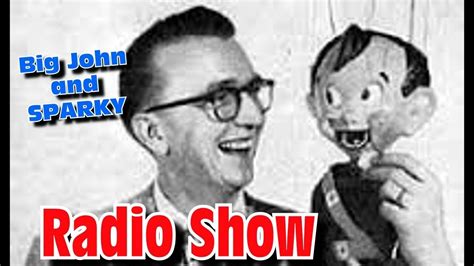
As I listened, I got sucked through a hole in the space-time continuum. Instantly, I was no longer an official oldster with eight decades in his sights .  .  . now I was a grade-school kid on Saturday morning in the early 1950s looking forward to Big John and Sparky and Space Patrol coming up on the radio. Programs like that were a regular staple of my childhood.

It’s weird, but I can’t recall the content of any specific episode, but I can easily remember the joy I felt as the familiar strains of “The Teddy Bear’s Picnic” (Big John and Sparky’s theme) were broadcast.

Theatre of the Mind is a great moniker for radio dramas, because your mind is forced to fill in the details of the drama. The dialog, narrative description, and a few sound effects provide the clues, and, in the magic of your imagination, you provide the rest of the scenery and the setting, and it is great fun.

The power of the mind’s eye was brought home powerfully to me, in a funny way. Space Patrol was not just a radio program; it was also a television program. My family did not have a TV until I was in fourth grade. As a result, I never saw Space Patrol on TV until I saw it at a friend’s house. (Remember this was in the infancy of TV.) When I did, my overwhelming impression was: this is lame. The program that was wonderful in my mind on radio was considerably less so on live TV.

Later in grade school, I was given a germanium diode radio for Christmas. It became my tool for secretly monitoring “The Hawthorne Den” (jazz after midnight) under the covers. It was Big Time, Big Deal adventure for a boy my age . . . does it get better than that?!! It actually did, when my Dad brought home a Zenith Transoceanic.

So dear reader, check out Zoomer Radio on 740 if you can and enjoy Theatre of the Mind.

And now it’s your turn: what are your favorite radio reminiscences (modern or ancient like mine)? Please post them below.

Jarno spots vintage radios in “The Undeclared War”

Many thanks to SWLing Post contributor, Jarno (PA3DMI), who writes:

Hi Thomas,

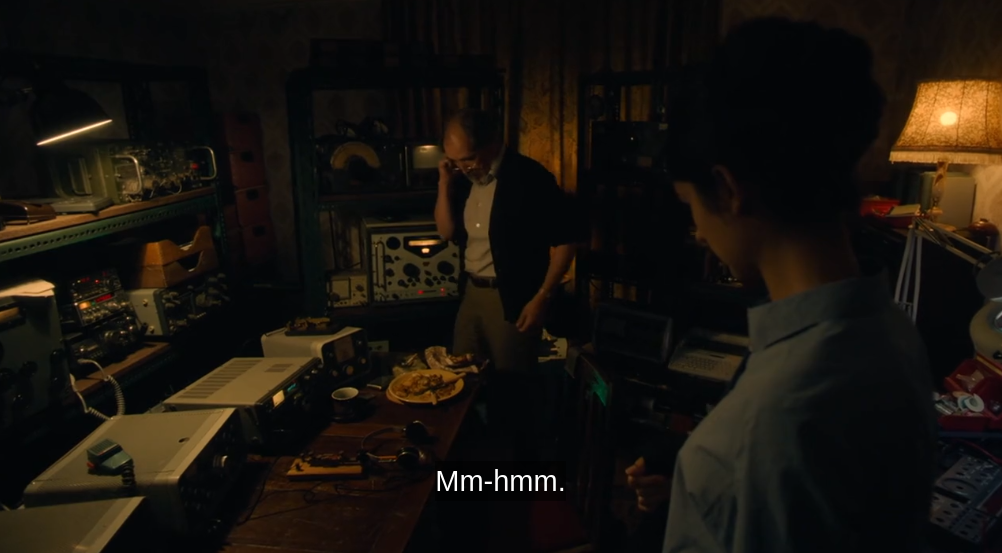
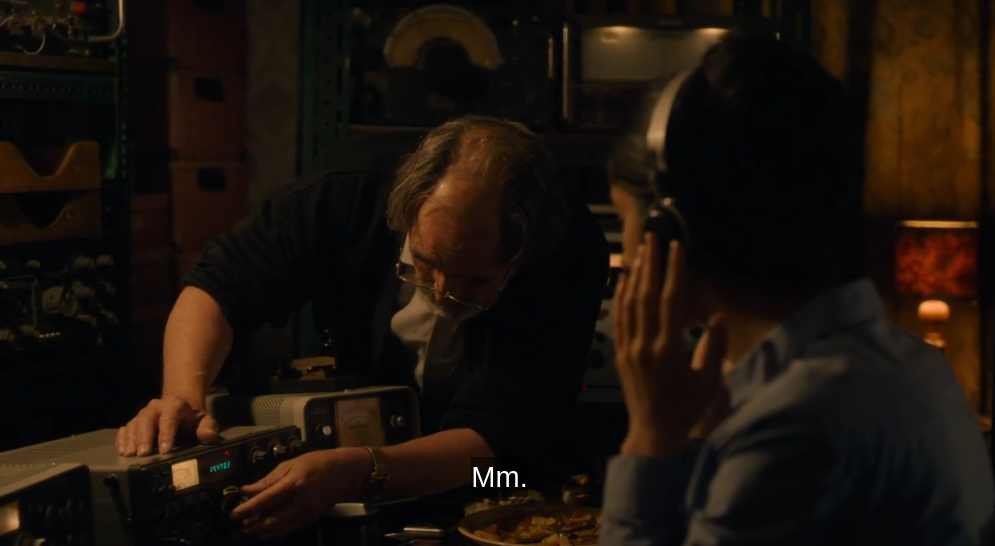
I found some radio’s in the UK spy series ‘The Undeclared War.’

It’s GCHQ the spy department in the UK. In episode 4 one of the leading characters makes a visit and look so many Yaesu, Eddystone, Heathkit and many more radio’s.

Bye from Amsterdam,

Jarno – PA3DMI

Many thanks for sharing this, Jarno! This looks like a fascinating series as well. Thank you for the tip!

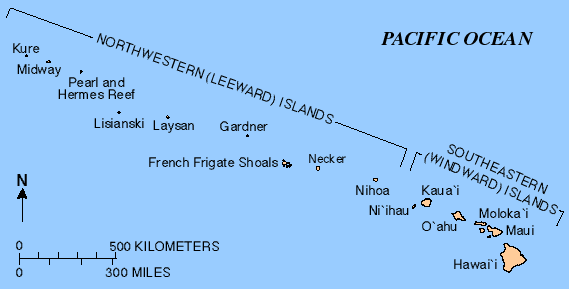
Midway Island Radio Terminal 1971: Digging up the past and a mystery signal…

Many thanks to SWLing Post and Shortwave Radio Audio Archive contributor, Dan Greenall, who shares the following post:


Midway Island Radio Terminal 1971 – digging up the past

It was a brief “military style” transmission on approximately 14.85 MHz shortwave, logged sometime during 1971. And I still had a recording of it!

Recording:

I wondered if there was any chance of confirming what exactly I had heard way back then, so I recently decided to try a little bit of detective work. My first contact was with Nick England, K4NYW, who runs a “hobby” website about U.S. Navy communications in the 1950’s and 1960’s. He was good enough to put me in contact with a Midway navy vet, Charles E. “Chuck” Kinzer, who writes:

“…it could be a “long count” test for one of the transmitters at the Naval Communication Unit transmitter site where I worked.

When I was there (1966-1968) they installed two log periodic fixed antennas, one pointing generally east (Washington DC) and the other generally west (toward Vietnam).

Each was connected to an AN/FRT-39 10 KW transmitter. And for the most part, always connected to the same two transmitters. (We had an antenna patch panel and could mix and match most any transmitter to most any antenna.) It is my understanding that they were used by the Security Group on Eastern Island (one of the two Midway Islands which are Sand and Eastern). They were set up for single sideband voice. (Most of the other AN/FRT-39s were set up for multiplexed TTY tones on both sidebands with suppressed carrier. 16 channels on each sideband.)

From time to time, they would tell us they wanted to do a “long count” and we would set the power level of one of the transmitters. As they did the count, we would set the power level of the peaks of the voice close to the maximum transmitter power. You could see the various meters flail up and down to near maximum along with the voice. This would be mainly the “PA Plate Current”, “PA Plate RF”, and PA Output” meters on the 10 KW final.

We couldn’t hear the voice, just see the meter activity. It would help if the person knew the frequency. If it was NOT an amateur radio frequency, it might have been one of those long count tests on one of those Navy transmitters. ….”over 50 years ago” sounds reasonable for that exercise. I assume the usage of that particular transmitter/antenna setup lasted to the end of the Vietnam war, at least.

Incidentally, when this was first set up, we had instructions to put X transmitter on Y antenna and so forth when they started testing the two new antennas. They would ask to do a “long count” test where we would set the power levels. Then shortly after they would start shouting into the microphone raising the power level too high and the transmitter would trip off. We asked them exactly what they were trying to do and, for secrecy I guess, they would not tell us. After a while, they figured out they were using the two antennas backwards. For example, they were trying to transmit east off the back side of the west facing antenna. These were VERY good antennas and very little power was wasted in the envelope going backwards.

I don’t know if this helps. Rather amazing that there is a recording existing like this. You never know what is going to pop out of the woodwork.”

Chuck later added that he might ask someone else for a little help. In the 1970’s, I used to own a guide to utility stations by Joerg Klingenfuss, that had lots of great frequency information, but sadly, I decided to part with it a number of years ago.

Please listen to the audio file of the transmission above from 1971, maybe some readers might weigh in with their thoughts on this? Please feel free to comment.