Update: Bonito RadioJet IF-Receiver 1102S

The Bonito RadioJet - Click to Enlarge

An inside scoop just for SWLing Post readers:  We’ve just received some interesting updates about the new Bonito RadioJet IF-Receiver 1102S from German company Bonito. Our contact Dennis, a representative of Bonito, informs us that FCC should be approving the RadioJet within a week, and units will be shipping to retailers about the same time. Naturally, I’m quite eager to review this receiver, as it promises a low noise floor (-137 dBm-!?!) and a sleek, sizable user interface. Pricing seems to be in line with the Perseus and Excalibur for North American buyers.

RadioJet Back

Dennis at Bonito tells us:

[S]ince December we’ve been delivering RadioJets to end customers…

Preordering was amazing in our opinion (370 RadioJets!) and the customers who contacted us are extremely happy with it.

We also have some tests from German magazines and the SDR gurus are delighted with the signal quality.

The real concern with any SDR–especially with a new one–is whether or not the manufacturer will support and upgrade the user interface over time.  After all, an SDR is only as good as your ability to control and use it.  In consideration of this, Dennis volunteers the following:

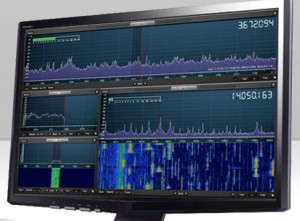
We have, meanwhile, improved and extended the whole software [package] and put a lot of new features in it. One is a huge frequency list, including transmitting times, and shown [in the display is] a world map [indicating] day and night and moon phases. (See screenshots)

Screenshot 1 - Click To Enlarge

Screenshot 2 - Click to Enlarge

I must say, I love the superimposed broadcaster ID as seen in Screenshot 1 (above). This is a very cool addition, which makes for convenient at-a-glance broadcasting identification. Coincidentally, this should also help users find unscheduled broadcasts such as pirate radio stations, numbers stations, utilities, etc. The map target icons also make it quite easy to identify broadcast sites on the world map (see Screenshot 2).  Again, Dennis:

Top view of RadioJet board (Click to enlarge)

I’ve included an image of the [receiver] board. You see no active parts between the antenna and ADC [analog to digital converter].

Dennis claims that it is this absence of any active components between the antenna and ADC that keep the RadioJet noise floor so remarkably low.

Bonito rep Dennis also voluntarily asked me to post the following to SWLing Post readers:

It would be great if you would send me a small list of things that MUST be in the software. Every comment is welcome.

So if you have a comment or a particular request regarding this software, please leave it in this post or simply contact us–we’ll make sure Bonito receives this informative feedback from you.

Of course, these are early days, but it looks like Bonito has the right focus to create a very competitive and innovative SDR product. This will require more than good engineering, however; it requires excellent support and a user-friendly experience.  Time will tell–and so will our forthcoming review!  We will be reviewing the Bonito RadioJet IF-Receiver 1102S in the near future, comparing it with the Microtelecom Perseus, so check back and follow this tag.

In the meantime, you can check out further screenshots below:

Screenshot 3 - Click to enlarge

Screenshot 4 - Click To Enlarge

Screenshot 5 - Click To Enlarge

Screenshot 6 - Click To Enlarge

Screenshot 7 - Click To Enlarge

Screenshot 8 - Click To Enlarge

Screenshot 9 - Click To Enlarge

Screenshot 10 - Click To Enlarge

Check Universal Radio’s website for Bonito Radiojet IF-Receiver 1102S availability and pricing in the USA.

Global Pirate Radio Weekend March 31-April 1

Harri Kujala, organizer of the Global Pirate Weekend, has changed the dates from the March 24-25 to the weekend of March 31-April 1, 2012. More details will follow on Harri’s blog and schedules announced as they become available.

Global Pirate Weekend, by the way, is an event that gives pirates from all over the world a chance to test their broadcasts on the HF spectrum (not limited to, but mostly between 15-22 MHz).

This will be a great opportunity for radio listeners to log pirate radio stations from across the globe. Good music and variety are a given!

Thanks to UK Dxer for the tip. Again, check Harri’s blog for updates!

Voice of Nigeria broadcasts DRM from their new facility

(Source: VON via Kim Elliott)

VON’s ultra modern transmission station launched 
Lawan Hamidu, Abuja

President Goodluck Jonathan has commissioned Voice of Nigeria’s (VON) ultramodern super transmitting station and its revolving antenna, located at Lugbe, Airport Road, Abuja.

President Goodluck Jonathan, represented by the Vice President, Namadi Sambo at the event, stated that the project was in line with Federal Government’s commitment to meet the 2015 global deadline for the digitization of the broadcast industry and international best practices.

Sambo said “We are today empowering the Voice of Nigeria to robustly project our international profile and make Nigeria heard positively and more widely around the world,” adding that “the transmitting station we are commissioning today is therefore aimed at making VON better able to meet its vital obligation of telling our story from our own perspective.”

The President noted that VON established in 1961, as an external arm of the then Nigeria Broadcasting Corporation, was in recognition of the critical role the country was playing in freeing other African countries from the shackles of colonialism.

“Nigeria understood in her early history that it needed an external voice to reach the world as the leader of Africa and to provide a platform for rallying African voices,” he stated.

President Jonathan, charged the management and staff of VON to as a matter of priority develop programmes that would make the Radio station the choice of listeners in and outside the shores of Nigeria.

He added that “You have the duty of helping to inculcate in all Nigerians abiding peace and pride in Nigeria and the knowledge that we all have a stake in ensuring that our strive towards sustained economic growth and development is not compromised by breaches of peace and security in any part of the country.”

Similarly, Dr. Jonathan assured that Government was committed to meeting its obligations to VON and other broadcast organisations.

“In keeping with my avid policy of expanding the political space and driving the ideals of democratic process, this administration is not interested in turning VON, or any government broadcast organisation into an uncritical mouthpiece for our policies,” he emphasised.

In his remarks, the Minister of Information, Mr Labaran Maku, called on President Jonathan to ensure the immediate completion of the second phase of the VON project.

He also appealed for additional funds for the nation’s information sector for the smooth execution of government transformation agenda.

The Minister said “Mr President what we now need is the second phase of this project, that second phase would mean the construction of two more transmitters and we don’t have those two transmitters we are going to have a heavy burden on the existing transmitters and this will not be good for this technology. So, we plead with Mr President that after this commissioning we will want Mr President to approve the immediate execution of the second phase of this project. The Information sector is need of infusion of funds to make us give Nigerians and Africans all over the world the best programmes.”

In his welcome address, the Director-General of VON, Abubakar Jijiwa, expressed optimism that the second phase of the project, when completed, would enable VON to embark on 24-hour broadcasting.

Alhaji Jijiwa solicited for Presidential intervention for the VON expansion projects which included the construction of two additional transmitters and antenna systems in line with global best practices and standards, construction of VON Abuja Broadcasting House as well as rehabilitation and upgrading of the ageing Ikorodu Transmitting Station.

Mal. Jijjiwa stated that “The second phase of this project needs be commenced urgently. It will comprise of two additional super power transmitters and one fixed and one rotatable antenna. When this is done and completed, VON would have the capacity for 24-hour broadcast and we can move this from our existing 18-hour broadcast and this would be the hall marks of simultaneous broadcasting which every external broadcaster hopes to achieve.”

The event included, the commissioning of three Super-Power Transmitters, three fixed and one rotatable antenna, the first in Africa and sixth in the World.

Voice of Nigeria, Nigeria’s external broadcast station is mandated to project Nigeria and Africa’s views to the world.

Located in Lugbe, a suburb of Abuja in the Federal Capital Territory, the transmitter has a rotating antenna, with the capacity of a hundred and fifty kilowatts and is powered by one thousand two hundred high tension generators.

New Digital Studio

On Monday, the Voice of Nigeria commissioned an ultra-modern digital studio in Abuja, as part of efforts to enhance its broadcast.

The new studio, commissioned by the Minister of Information, Mr Labaran Maku, is named after Mrs Stella Bassey, a seasoned broadcaster and former Deputy Director, Programmes of the Voice of Nigeria.

Commending Voice of Nigeria for its quality broadcasting, Mr Maku urged the radio station not to relent in its efforts to maintain world class broadcast standards.

The Director General of Voice of Nigeria, Mallam Abubakar Jijiwa said the station had a culture of rewarding hard work.

Mallam Jijiwa said the studio was named after Stella Bassey because of her immense contributions to the corporation and the country in the area of broadcasting.


Listening to Coronal Mass Ejections, close to the source

(photo: Spaceweather.com)

Shortwave radio listeners know that coronal mass ejections (CMEs) often disturbing our SWLing. More than once I’ve been in the middle of listening to a broadcast, or even chatting with a fellow radio amateur on the HF spectrum and the effects from a CME would, in essence, wipe us out.

CMEs, in fact, have been getting a lot of publicity as of late. Now’s your chance to hear whatone sounds like–a little closer to the source:

[The following video] is a sonification of the recent solar storm activity turns data from two spacecraft into sound. It uses measurements from the NASA SOHO spacecraft and the University of Michigan’s Fast Imaging Plasma Spectrometer (FIPS) on NASA’s MESSENGER spacecraft at Mercury. The creator is Robert Alexander, a design science doctoral student at the University of Michigan and NASA fellow.

VOA launching interactive humanitarian shortwave programs for Burundi

At a forum of the Winter SWLfest this year, I made a presentation titled, “Shortwave For Good.” In it, one of the ideas I put forth to increase interaction between international broadcasters and their listenership in Africa is through the use of mobile phone SMS technology. I was very pleased today to see that VOA, at least in Burundi, is moving in this direction.

(Source BBG via Media Network)

Two new interactive VOA radio shows in Burundi are giving a voice to young entrepreneurs and providing up-to-date information about the HIV/AIDS pandemic in the central African country. The half-hour Kirundi language programmes are produced in Burundi and broadcast from the VOA studios in Washington.

Tujahe, which airs on Sundays, is hosted by Olivier Nkengurutse and Diane Ndonse. VOA Central Africa Service Chief Robert Daguillard says, “We see Tujahe as an opportunity for young Burundians to discuss not just business and entrepreneurship, but also what makes it so difficult to create jobs in Burundi, a country with fertile land, good schools and good roads.”

The other new show, called Kira, focuses on the HIV/AIDS crisis, which Burundi’s government has identified as one of the most serious health issues facing the country.  The show, which airs on Saturdays, also features reports from the field, audience trivia questions and music by Burundian artists.

VOA Director David Ensor says, “We hope these programmes serve the needs of our audience in Burundi by providing an interactive space for discussion and debate.  Voice of America is uniquely suited to the creation of programmes like these, which utilize local talent and provide up-to-date information about subjects of critical importance.”

The programmes are partly funded by grants from USAID and the State Department. They are broadcast on shortwave, FM, and on the Internet. VOA’s Central African Service, which broadcasts to the Great Lakes region in the Kirundi and Kinyarwanda languages, was created in 1996 and has covered Rwanda’s post-genocide recovery, the conflict in Democratic Republic of Congo and Burundi’s civil war.

Remembering radio enthusiast Jay Smilkstein

I’ve only attended the Winter SWLFest for  four years thus far, yet the friends I’ve made there have become like family. It shouldn’t be a surprise, really; we’re all passionate about radio and things related to radio and broadcasting. It’s an event where we can be who we are–no need to explain to these compatriots why you like tuning in shortwave stations, while the internet seems (at least to everyone else) to be so much easier.

Jay had a strong interest in AM DXing, tube gear, amplifiers and, I learned this year, IF filter design.

Jay Smilkstein, 1961-2012.

Our friend Jay was, I believe, at the higher-functioning end of the autism spectrum.  While Jay had some social hang-ups and behaviors that made some uncomfortable, fortunately, at the SWLFest, there were a number of folks who went out of their way to take Jay under a wing, assist him with personal interactions, and generally welcome him back  each year.

I’m pretty sure that he considered the SWLFest, and many he’d interacted with over the airwaves, his radio family, too.

Jay passed away suddenly from a heart attack two days ago, on Monday, March 12th, 2012.

As my friend, David, phrased it:  Long may you ride the radio waves you loved so much.


Radio St. Helena to go off the air

Though this news effects a relatively small number of people on the remote island of St. Helena, it is sad to those of us who enjoyed the annual challenge of catching  the weak signal of Radio St. Helena on shortwave. In truth, for technical reasons, they have missed recent annual broadcasts. Still, it was a fun event. Would be nice if an annual shortwave transmission or amateur radio special event could be scheduled to take its place.

(Source: RNW Media Network)

One of the remotest islands on earth, St Helena in the South Atlantic, will experience big changes in its media this year. Radio St Helena, which operates on 1548 kHz mediumwave and for some years broadcast a special once-a-year programme on shortwave via a transmitter of Cable and Wireless, will be closing down. Its parent company, St Helena News Media Services, is being dissolved, and the final edition of its newspaper the St Helena Herald was published on 9 March 2012.

In its place, a new government-funded company called the St Helena Broadcasting Corporation (SHBC) has been set up, and will operate three FM radio stations on the island, one of which will be a relay of the BBC World Service. The intention is that SHBC will become self-sustainable within three years. It officially became operational in February, and will also publish a weekly newspaper to replace the Herald. The first edition will be published later this month, but the radio stations are not expected to go on air until the summer. Until then, Radio St Helena will continue operating.

The other current station on the island, Saint FM that started operating in 2005, was invited to become part of the new organisation, but station manager Mike Olsson subsequently pulled out of discussions. Saint FM provides a 24-hour community service on FM, and is also broadcast on Ascension Island, the Falkland Islands and Tristan da Cunha. Its internet stream enables Saints around the world to keep in touch with their families on the island. Former Radio St Helena station manager Tony Leo can be heard on Saint FM every Wednesday at 1500-1700 UTC. Saint FM also publishes a weekly newspaper, the St Helena Independent.

The resident population of St Helena, who are entitled to hold UK passports but have no automatic right of residence in the UK, is currently just over 4,000, but this is being boosted by the arrival of personnel from the company building the island’s first airport, which is due to open in 2015. It’s expected that the number of tourists per year will rise from the current level of under 1,000 to 30-50,000.