Tag Archives: Canada

CBC News: RCI looking for Sackville transmitter site buyers

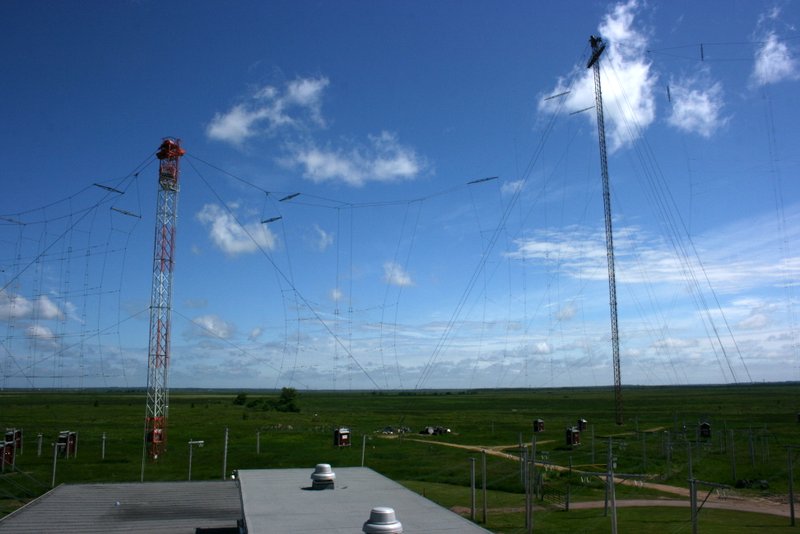
The vast, open Sackville site will most likely become a wind farm.

Just posted by CBC News:  a breaking news item which focuses on the closure of the Sackville RCI transmitter site and reveals the fact that site owners are now looking for buyers.

During my recent visit to the Sackville site, I spoke with their Transmission Operations Technologist, Marcel Cantin; we both agreed that the most likely future of the transmitter site is to become a wind farm, much like one visible from the site in neighboring Nova Scotia. Evidently, the province has been talking with farmers whose property borders the Sackville site in hopes to procure more land for wind farm development. The Sackville site’s 280+ acres would represent a great portion of the land they wish to procure. The only obstacle I see to this not becoming a reality would be local opposition–and they may have good cause. The two main arguments against wind farms are the noise they produce (not really a problem where RCI is/was located) and the fact that they can harm migrating bird populations. The site is very close to the Sackville Waterfowl Park, a local bird sanctuary which is home or host to innumerable varieties of water birds, and which I also had the good fortune to visit when in Sackville. Opposition in this regard may be substantiated.

(Source: CBC News)

After decades of service, the transmission towers outside of Sackville, N.B are no longer broadcasting Radio Canada International to the world.

The international broadcasting service ended its shortwave transmission Sunday night.

“I find myself, on behalf of all of us, saying goodbye to 67 years of radio,” said host Marc Montgomery, breaking down on air.

[…]”There’s no denying the importance of the internet. There’s also no denying that it can be and is regularly blocked by authoritarian regimes. Shortwave broadcasts on the other hand, almost always get through to people hungry for information,” said Montgomery.

Martin Marcotte, director of CBC Transmission, said he’s now looking to sell the New Brunswick towers and land.

He said he’s focussing (sic) on selling the site to other shortwave broadcasters or wind farm companies.

“It will be fairly costly to dismantle and as a last resort we would dismantle the facility, return it to bare land as it was when we first acquired that site,” said Marcotte.

As for broadcasters, the only one of which I am aware who has both the funds and ambitions to purchase such a transmissions site, is China Radio International.

Of course, I would hope that a broad-sighted private purchaser or even non-profit could keep the site running much as it has been, recognizing its vital relevance to Canadian international relations and to the developing world generally–especially in light of the recent addition to the site of a remote operation system.

Too bad, the Canadian government couldn’t recognize this in time.

WWII shortwave messages found on cardboard discs

Photographer: Nigel Mykura. (Creative Commons)

(Source: The Globe and Mail)

The voices of Canadian servicemen fade in and out, at times clear and booming, at others distant and muffled. But for their families, these scratchy, static-laden messages were the sound of hope.

The men were prisoners captured during the Second World War by the Japanese army, which broadcast their messages home over Radio Tokyo. Short-wave radio enthusiasts on the west coast of the United States listened in, making a hobby of recording the messages onto cardboard discs and sending them to the soldiers’ families.

Complete with audio from the original discs, this is an article you should view in full at The Globe and Mail.


Is radio a Canadian invention?

Today is Thanksgiving in Canada–and perhaps we should all thank this fine country for its contribution to radio as we know it today.
In this short audio documentary, Radio Canada International focuses on the innovative work of Canadian Reginald Aubrey Fessenden. As this piece points out, though Marconi receives recognition as the father of radio, Fessenden played a stronger role in making it possible to hear the human voice over the air.

Click hear to listen to LITTLE KNOWN CANADIAN FACTS: Radio, a Canadian invention at Radio Canada International.

For a full biography of Reginald Aubrey Fessenden, check out the Hammond Museum of Radio‘s website.

Thanks to RCI’s The Link for the tip & Happy Thanksgiving, Canada!

Canada’s shortwave time station, CHU, is moving

Press release from the National Research Council (NRC) of Canada:

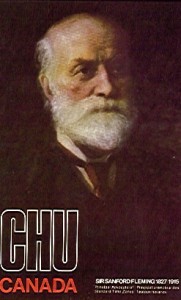
CHU's QSL card used in the 1980s depicting Sir Sanford Fleming, father of uniform times zones.

1980s QSL card from radio station CHU depicting Sir Sanford Fleming, father of uniform time zones.

Time to change your shortwave radio dial

After seventy years of broadcasting Canada’s official time, NRC’s shortwave station CHU will move the transmission frequency for the 7335 KHz transmitter to 7850 KHz. The change goes into effect on 01 January 2009 at 00:00 UTC.

CHU is a part of NRC’s system for disseminating official time throughout Canada, broadcasting 24 hours a day from a location approximately 15 km south-west of downtown Ottawa. Listeners hear tones to mark the seconds, voice to announce the time in French and English, and digital data to set computers.

The atomic clocks at CHU are part of the ensemble of clocks in the time and frequency research laboratories in Ottawa, at the National Research Council Canada. The NRC clocks are used in conjunction with clocks in the time laboratories of other countries to construct the internationally accepted scale of time, UTC (Coordinated Universal Time), which is now the reference for official time used by all countries. UTC is the modern implementation of Greenwich Mean Time.

“Coincidentally, this frequency change comes at a time when NRC is investing resources to refurbish the aging transmitters at CHU in order to provide clear, dependable shortwave services as part of NRC’s mandate to disseminate time to all Canadians.” said Raymond Pelletier, Technical Officer at the NRC-Institute for National Measurement Standards, who oversees the CHU facility. “The shortwave time service is especially beneficial for those in remote locations where there is limited access to internet and telephone communication. CHU also provides a back up against failure of other services.”

In April 2007, the International Telecommunications Union re-allocated the 7300-7350 KHz band from a fixed service to a broadcasting service. Since then, interference on the 7335 KHz frequency has come from many information broadcasters around the world.

CHU listeners in Canada and around the world who have for so long considered the 7335 KHz frequency exclusively for time signals, are very vocal about this interference. We have heard from amateur radio operators, watchmakers, astronomers, and navigators who use the tones and voice signals. As well, comments were received from those who use the carrier as a calibration source at a distance for their equipment.

To give notice to users, CHU will broadcast an announcement in both English and French. More information
about CHU can be found at:
http://inms-ienm.nrc-cnrc.gc.ca/time_services/shortwave_broadcasts_e.html
Comments about the CHU change can be sent by e-mail to [email protected].