Tag Archives: DX Central

DX Central SEDAP: A Sporadic Es Data Analysis Dashboard

Many thanks to SWLing Post contributor, Loyd Van Horn, who shares the following announcement:

FOR IMMEDIATE RELEASE

DX Central Unveils SEDAP: The World’s Most Advanced Sporadic Es Data Analysis Dashboard for the FM DX Community

MANDEVILLE, La. — April 29, 2026 — DX Central is proud to announce the official launch of version 2.0 of our popular Sporadic Es Data Analysis Project (SEDAP), a revolutionary, interactive intelligence dashboard designed to decode the mysteries of VHF propagation. Officially unlocking on Friday, May 1, 2026, at 7:45 PM CDT (0045 UTC May 2) at fmdxdata.com, SEDAP transforms nearly a decade of siloed radio loggings into a massive, cinematic data science suite, completely free of charge for the hobbyist and academic community.

Historically, analyzing Sporadic E (Es) propagation on the FM band has been an isolated effort, with individual DXers tracking their own localized season-over-season metrics and comparing notes with other DXers. SEDAP shatters that limitation by aggregating more than 95,000 North American FM broadcast logs and presenting them with brand new interactive visualizations to give DXers a whole new understanding of this elusive and magical propagation method.

“For years, our understanding of Sporadic E has been largely limited to individual observations,” said Loyd Van Horn, founder of DX Central and creator of SEDAP. “By bringing all of this data together, we aren’t just looking at spreadsheets anymore. SEDAP allows us to physically watch ionospheric clouds spawn, compress, and track across the continent in real-time. We can finally see what a typical season looks like on a macroscopic level.”

Built on a Google Cloud BigQuery architecture, SEDAP boasts a sleek user interface featuring dynamic visualizations, including:

  • The Es-Cloud Tracker: The newest and perhaps most exciting addition to the SEDAP dashboard. The Es-Cloud Tracker is a cinematic, multi-day playback engine that maps the approximate geographic formation location of FM DX Sporadic Es ionization clouds over North America. Openings can be “played” on a timelapse, allowing DXers to watch a simulation of the Es clouds as they develop, morph and transit throughout the day or a range of days.
  • Path Line Analysis: In-depth analysis on the most common and productive paths to and from a DXer or station location. Visually “see” the paths that evolved over the span of a day or date range.
  • Frequency & MUF Forensics: An interactive “SDR Tuner” interface to interrogate large scale band yields, signal paths, and daily Maximum Usable Frequency (MUF) ceilings.
  • Station & RDS Intelligence: Deep-dive forensics into the WTFDA station database, featuring PI-Code adoption maps, format/slogan correlation matrices, and gamified “Unheard Target” lists for US States and Counties.
  • DXer Network Intelligence: Long-term seasonal performance audits and multiple normalized metrics to filter out observer bias as much as possible
  • “We have certainly seen a huge growth in the number of DXers both reporting receptions and the amount of receptions they are reporting thanks to improved technology and resources from SDRs to propagation monitoring through Rabbitears and the FM DX Webservers,” says Van Horn. “So while we are not here to say one season was better than another, we can give DXers insights into Sporadic Es season that can help them strategize antenna placement and bearing, timing of monitoring, potential paths based on different periods within the season and a whole lot more. This is about improving our understanding of what happens when the ionosphere sends those FM signals back down to Earth.”

SEDAP makes no claim of ownership over the raw data presented, acting strictly as an analytical engine. The platform owes its immense capabilities to the unprecedented collaboration and public data provided by FMList.org, and the Worldwide TV-FM DX Association (WTFDA).

To protect the integrity of the database and respect the bandwidth of its data partners, SEDAP is strictly governed by a non-commercial usage policy. Automated scraping and commercial monetization are prohibited, but users are highly encouraged to explore, share, and cite the dashboard’s findings.

The Sporadic Es Data Analysis Project will be accessible to the public beginning May 1, 2026. To access the dashboard, view the real-time launch countdown, or read the full data usage policy, visit fmdxdata.com.

About DX Central: Based in Mandeville, Louisiana, DX Central is a premier hub for the radio monitoring community, dedicated to advancing the hobby of DXing through live streams, online receivers, regular DX challenges and contests, educational content, and data-driven propagation analysis.

Media Contact:

Loyd Van Horn | Founder, DX Central

Email: [email protected]

Web: dxcentralonline.com

Youtube: youtube.com/@DXCentral

Twitter/X: twitter.com/DXCentral

Loyd Van Horn
W4LVH – Mandeville, LA
Member: IRCA/NRC Courtesy Program Committee (CPC)
Founder: DX Central – Because we’re all about radio
Web: dxcentralonline.com
Twitter: @DXCentral
YouTube: youtube.com/c/DXCentral

DX Central: 2026 Summer of DX Challenge

Many thanks to SWLing Post contributor, Loyd Van Horn, who shares the following announcement:

Summer of DX 2026

FOR IMMEDIATE RELEASE

DX Central Announces the 2026 Summer of DX Challenge: The Biggest, Most Advanced Logging Event Yet

MANDEVILLE, LA — DX Central is thrilled to announce the return of the hobby’s most exciting seasonal event: The 2026 Summer of DX Challenge! Running from May 2 through August 31, 2026 at summerofdx.com, this year’s challenge pushes the boundaries of radio monitoring with brand-new bands, entirely new challenges, and a revolutionary, custom-built data terminal that makes logging easier than ever before.

For the first time in the event’s history, NOAA Weather Radio (NWR) joins Medium Wave (AM) and FM Broadcast Band II (FM) as an official challenge category, opening up an entirely new layer of tropospheric and meteor scatter chasing for scanner enthusiasts.

To handle the massive influx of summer logging, DX Central has completely eliminated registration requirements and launched a brand-new, custom-coded interactive dashboard.

New Features for 2026 Include:

  • Frictionless Logging & Bulk Import: Say goodbye to typing out callsigns and cities! The new terminal features a click-to-log Database Search utilizing WTFDA and Mesa Mike databases. Prefer to upload your logs rather than enter manually? The new Bulk Import tool allows you to upload CSVs directly from FMList, MWList, and WLogger, automatically mapping your data and updating your score in real-time.

  • The Multiplier Scoring Engine: Borrowing from traditional Ham Radio contests, DXers now earn massive score multipliers for every unique US State, Canadian Province, and International Country they log per band.

  • The John Cereghin Century Club: The legendary Grid Square challenge expands! DXers who log 100 unique US Maidenhead Grids on MW, FM, (20 on NWR) will earn our prestigious Century Club certificate, with endorsements for every 50 additional grids (10 for NWR).

  • County Hunters & Rovers: Chase US Counties across all three bands, and take your gear on the road! The new “Rover” category allows mobile DXers to activate rare grids and counties for special recognition.

  • Bi-Weekly Bounty Hunts: Tune in to our DX-themed Internet radio station, DX Radio (thisisprobablydxradio.com), for encrypted ‘targeted intercepts’ hidden through secret broadcast codewords revealed at the top of each hour. Enter the codeword into the DX Central terminal to unlock clandestine, time-sensitive DXing missions!

The 2026 Summer of DX active logging window opens on Saturday, May 2, 2026 at 0100 UTC and closes on Monday, August 31, 2026 at 2359 UTC. All receptions must be solely from this time period to qualify. To ensure everyone has plenty of time to review their SDR recordings, the DX Central terminal will remain open to accept logs and bulk uploads until September 30, 2026.

Whether you are a seasoned FM Sporadic E chaser, a dedicated MW night-owl, or firing up a weather radio for the first time, the 2026 Summer of DX has a challenge for you.

Get your receivers ready, prepare your antennas, and prepare to log! For more information, to view the live leaderboards, and to access the logging terminal, visit summerofdx.com

Loyd Van Horn
W4LVH – Mandeville, LA
Member: IRCA/NRC Courtesy Program Committee (CPC)
Founder: DX Central – Because we’re all about radio
Web: dxcentralonline.com
Twitter: @DXCentral
YouTube: youtube.com/c/DXCentral

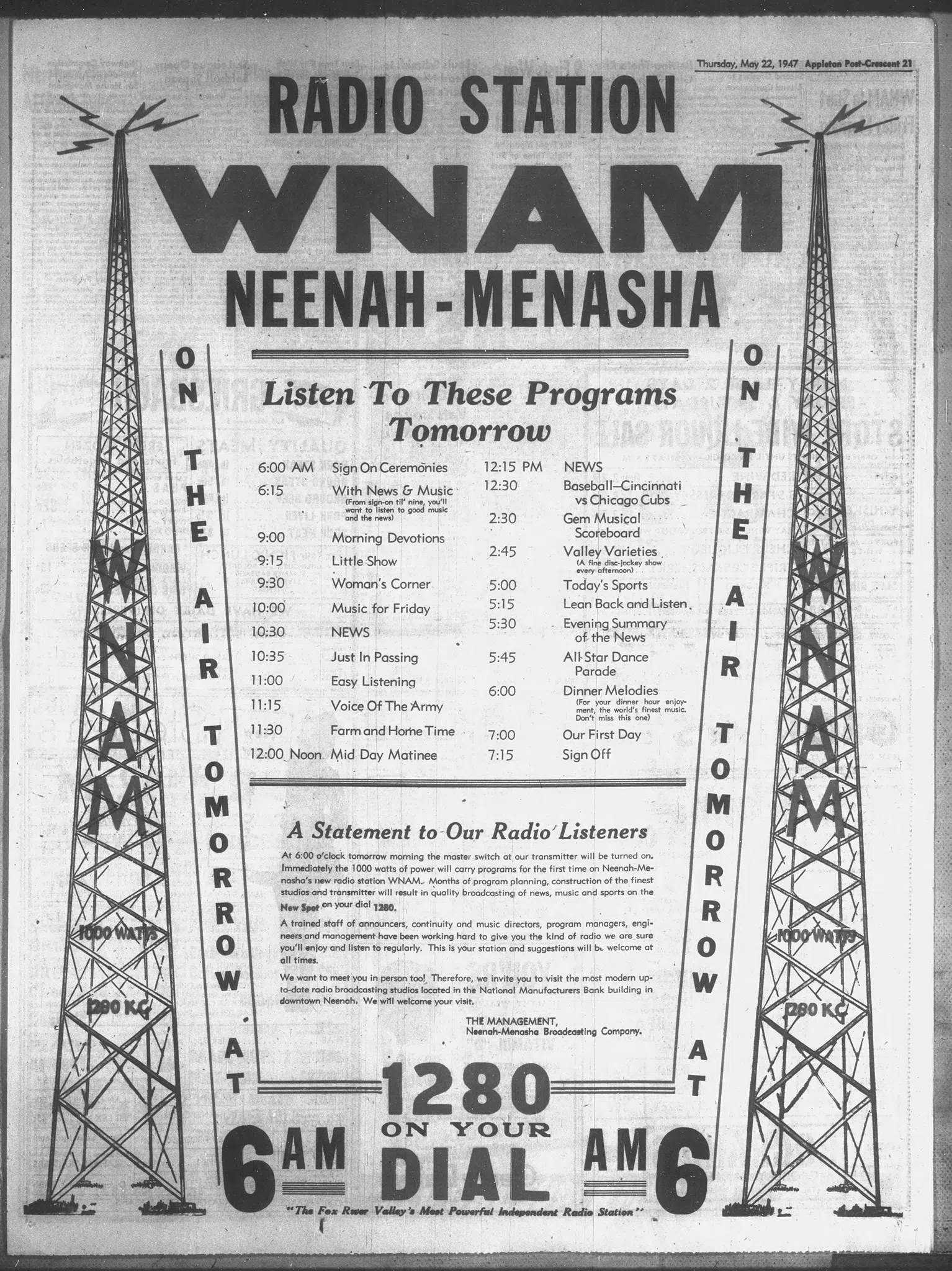
WNAM Final Broadcast and DX Test Announcement: December 30-31, 2025

The following announcement was shared by Loyd Van Horn of DX Central:

FOR IMMEDIATE RELEASE

1280 – WNAM DX Test Announcement

Dec 27, 2025

The Courtesy Program Committee (CPC) of the National Radio Club (NRC) and the International Radio Club of America (IRCA) announces a special DX Test for distant listeners for radio station WNAM on 1280 kHz in Neenah-Menasha,WI. The test is scheduled for Tuesday, December 30th and Wednesday, December 31st starting at Midnight local Central Standard Time through 5:05 AM Central Standard Time (This equates to 0600 to 1105 UTC on 30 December and 31 December).

This test is scheduled to run for 2 minutes after ABC News at the top-of-the-hour each hour from Midnight to 5am local Central time. ABC News runs from :00-:03 after the hour. The DX Test will run from :03-:05 after the hour, each hour of the window.

These test transmissions are being broadcast in conjunction with the final days of broadcast of WNAM. WNAM is scheduled to cease broadcast operations at 11:59 PM Central Time on December 31st.

These test transmissions are a way to honor the history of WNAM in its service to the community as well as provide an opportunity for DXers to hear WNAM one last time – or possibly the first time!

The test will consist of an assortment of classic station jingles, sweep tones, voice IDs, morse code and other sounds.

WNAM will be operating at their daytime power/pattern for the duration of the test events.

In addition, listeners/DXers are invited to tune in WNAM’s special 3-hour farewell broadcast on Wednesday, December 31, starting at 9:00 PM Central Standard Time. This will include a “recreation” of the station’s glory years as “Blue 128” complete with airchecks from previous on-air staff.

RECEPTION REPORTS & QSL REQUESTS

All reception reports will be verified through the station directly with a special QSL that was developed for the occasion. Reception reports along with MP3 recordings or .MP4 video recordings of your reception should be emailed to:

[email protected]. Please be sure to use the subject line: “WNAM 1280 DX TEST RECEPTION REPORT.”

The following are recommendations are in effect in order to expedite processing and receive a QSL verifying your report:

    • Reports via email only – this is required. An MP3 file attachment of your reception (best reception) or an MP4 video clip are preferred. While written descriptions will be considered along with the recording, they may not suffice alone for verification.
    • Reports must be submitted within 30 days of the test.
    • The report must include your name, location, and return email address, clearly grouped together at the top of the verification request.
    • Please also include a description of your receiver, antenna, and any interference noted.
    • If you use a remote SDR to receive the test, you must clearly indicate that in your verification request. We will only accept one such report per DX’er. You cannot log the test on multiple remote SDRs and request multiple verifications.

The IRCA/NRC CPC would like to thank the owners and staff of WNAM}, Steve Edwards and CPC member Loyd Van Horn for helping to arrange the test.

Good luck to all DXers!

About the CPC

The Courtesy Program Committee (CPC) is a cross-functional group comprised of members of both the National Radio Club (NRC) and International Radio Club of America (IRCA) for the purpose of coordinating and arranging DX Tests with AM radio stations. These DX tests both allow radio stations to conduct valuable equipment tests on their transmitter and audio chain as well as enable DX hobbyists to receive the testing station from greater distances than would normally be possible. The CPC membership consists of: Chairman Les Rayburn, Paul Walker, George Santulli, Joe Miller and Loyd Van Horn.

For radio stations interested in coordinating a DX test with the CPC, please visit the following Web site for more information:

https://amdxtest.blogspot.com/

For more information on the types of content heard during a DX test, the video “An introduction to DX Tests” is available at DX Central:

https://www.youtube.com/watch?v=NQX_zmEC4fY

Inaugural DX Central MW Daytime Challenge starts today!

Many thanks to SWLing Post contributor Loyd Van Horn at DX Central who shares the following announcement:


The Inaugural DX Central MW Daytime Challenge

What a great season of DX Central Live! and the MW Frequency Challenge it has already been and we are just getting started! This season, you helped us cross 1,000 subscribers on our YouTube channel, have brought in a record number of MW Frequency Challenge submissions thus far, and have helped to generate a lot of energy around this DX season! We couldn’t do it without your support, so thank you!

First, a little housekeeping. We will be taking some time off to spend the holidays with family and of course – some DX! As such, there will be no DX Central Live! on Friday, December 23 or 30th. We will return on Friday, January 6, 2023.

Also during this time, we will be taking a brief pause on our weekly MW Frequency Challenge as well. I will be announcing the results from week 12 (576-600) when we return on Jan 6, as well as the next frequency range at that time.

Don’t worry, we have a challenge for our little break that should provide all of the fun and difficulty to push DXers to scratch new ones in their logbooks: The Inaugural DX Central MW Daytime Challenge.

The premise: Log as many stations as you can during daytime conditions. That’s it!

Nothing but daytime DX (period from 2 hours after local sunrise to 2 hours prior to local sunset) starting at 0200 UTC Saturday, December 17 and ending at 0200 UTC Monday, January 2, 2023. This challenge is open to all DXers around the world!

A few rules:
– Loggings must be during your local daytime period (2 hours after local sunrise to 2 hours prior to local sunset)
– Loggings must be from between 0200 UTC Saturday, December 17th and 0200 UTC Monday, January 6.
– Any stations are allowed for this challenge: local stations, TIS/HAR, part 15 transmitters not to mention anything distant you might be able to pull in!
– Stations do not need to be “new to you”, relogs are allowed
– Stations need to be on any mediumwave frequency between 530-1710 kHz.
– Loggings should be from a location within 50 miles of your home location. This includes use of online SDRs, portable operations, etc.
– If you are traveling for the holidays and will be away from home but have access to either your station remotely or another online SDR from your home location, those submissions will be allowed.
– Only submissions made using the Google Form sheet (link below) will be considered for the challenge. Social media posts, emails, etc will not count.

Categories for this challenge will include US and international versions of:
– Most stations logged
– Most US States/Canadian Prov logged
– Most countries logged
– Furthest reception
– Most frequencies with at least one logged station

Google Form for entries: https://forms.gle/TVgCPrHMpfDAzbzb6

I hope this challenge will be a fun one for all!

To all of our fellow DXers, supporters, family, friends….Merry Christmas, Happy Holidays and may your logbooks be filled with DX and your hearts filled with joy and love!

73,

Loyd Van Horn
W4LVH – Mandeville, LA

DX Central’s MW Frequency Challenge: Week 11 Results and Week 12 Announcement

Many thanks to SWLing Post contributor Loyd Van Horn at DX Central who shares the following announcement:


Another great week of DX and another productive one for us at DX Central and for many DXers, according to the logs!  We spent the week diving back into another graveyard frequency (1490) and the results speak for themselves!

As a reminder, our live streams on Sunday nights have been so much fun getting to interact and hear about what you heard in the previous week.  If you haven’t been able to make it to a livestream yet, you are missing out!  Join us Sundays at 1945 CST / 0145 UTC (Monday morning, UTC) on our YouTube channel:  youtube.com/c/dxcentral

A total of 22 DXers from three countries (Mexico, Canada and the US) and 18 US States brought in 127 logs for Week 11 of our MW Frequency Challenge.    76 unique stations in 34 U.S. states and three countries made it to this week’s log. Continue reading

DX Central’s MW Frequency Challenge: Week 9 Results and Week 10 Announcement

Many thanks to SWLing Post contributor Loyd Van Horn at DX Central who shares the following announcement:


Another great week in the MW Frequency Challenge, and you all continue to pour the logs in!  Our live streams on Saturday nights have been so much fun getting to interact and hear about what you heard in the previous week.  If you haven’t been able to make it to a livestream yet, you are missing out!  Join us Saturdays at 1945 CST / 0145 UTC (Sunday morning, UTC) on our YouTube channel:  youtube.com/c/dxcentral

A total of 29 DXers from three countries (Mexico, Canada and the US) and 17 US States brought in 82 logs for Week 9  of our MW Frequency Challenge.    25 unique stations in 18 states and six countries made it to this week’s log.  The number of logged stations was down, because there are fewer stations on 550 than previous weeks.  But look at that jump in countries…an opportunity here for DXers to get some great international DX!

Most Logged Stations: From runner-up last week to the top spot this week, South Carolina’s Rob Keeney hauled in an impressive 9 stations this week.  Right on his heels, was Mark Connelly (MA) and Stephanie Battaglino (CA) with 7 each.

Most Logged States: Rob Keeney once again took the top spot for heard states this week with 7 logged US states:  FL, GA, MO, NC, NY, OH, TX

Most Logged Countries:  Mark Connelly (MA) brought in the most countries (including US) with 4 total countries:  Colombia, Cuba, US, Venezuela.

Furthest Logging: Brent Taylor of Canada’s Prince Edward Island and his log of YVKE-Radio Mundial in Venezuela was our longest reception of the week at 2,477 miles!  This was only 5 miles more than the #2 spot, Mark Connelly’s 2,472 mile reception of HJHF-Radio Nacional de Colombia in Colombia.  Even tighter, Mark’s log was only ONE MILE more than our third place finish from Marc DeLorenzo for his log of HJHF at 2,471 miles!  Talk about a close one!  Rounding out our top 10 was Jim Renfrew (NY) – 2,358 miles for YVKE, Mark Connelly (MA) – 2,163 for YVKE, Rob Keeney (SC) – 2,034 for HJHF, Brent Taylor (PEI) – 1,962 for WPAB, Mark Connelly (MA) 1,531 for Radio Rebelde, and Stephanie Battaglino (CA) – 1,094 for KTSA.

Loyd/DX Central Numbers:

  • 5 stations logged
  • 3 states logged (GA, MO, TX)
  • 3 countries logged (USA, Cuba, Colombia)
  • 1,926 miles for furthest catch (HJHF in Colombia)

Most Logged Station: WGY in Buffalo, NY brought in 10 logs this week for the top spot. Missouri’s KTRS and Cincinnati’s WKRC at 7 logs each were just behind them.

Most Logged State/Province:  As you might imagine, WGR’s logs brought NY to the top spot here with 10 receptions.  NC (9) and TX, MO (8 each) were just behind.

Most Logged Country (outside of US):  Colombia and Mexico each brought in 4 loggings this week.  Cuba and Venezuela (3 each) were just behind.  In all, 15 stations outside of the US were logged this week.

Busiest Time of Day: Overnight hours (67% of logs) continued to be the busiest period for DX.  Surprisingly, sunrise was in the second spot with 14.6% of all logs.  Sunset (11%) and Daytime (7.3%) rounded out the rest of the day.

Most Used Receiver:  While portable use is still going strong, SDRs once again were the king of DX this week with 56 of 82 logs (69%).  Portables brought in 20 logs (24%) of all loggings.  Among SDRs, we actually had a new brand at the top of the hill as Airspy SDRs brought in a total of 22 loggings (40% of all SDR logs).  SDRPlay’s 18 logs (32% of SDR logs) and Perseus’s 13 receptions (23% of SDR logs) were also very popular this week.  For portables, Tecsun’s came out of nowhere this week to take the top spot with 9 loggings (45% of portable logs).  C. Crane radios (4 loggings, 20% of portable logs) took the #2 spot.

Most Used Antenna: Magnetic Loops were once again the most popular option for DXers this week, with 32 logs (40% of all logs).  The Wellbrook loop’s 21 loggings (65% of all mag loop logs) were the most popular used mag loop, with both the W6LVP and YouLoop (9 logs each, at 28%) also bringing in DX.  Termed loops proved to continue to be a popular option as well, with 17 loggings (21% of all loggings).  This week, other loops (such as the AN-200 or Tecun loops) also brought in 17 loggings this week as a popular option.

See the full export of data at our Google Sheet:  https://docs.google.com/spreadsheets/d/1OGMctuhKyj3lIxqd6tv9oxw2WhZ3F7Q7qM7TGnOxPak/edit?usp=sharing

With week 9 now under wraps, we look ahead to week 10 and for this week, we have a rather unique challenge.  Rather than focus on a single frequency, we are going to explore the ENTIRE expanded band!  1610-1710 kHz – any licensed station (including broadcast and TIS) count as a valid log.  No pirates, no NDBs, etc.  So the NJ TIS station on 1710?  Counts.  1630 Radio Elohim in El Salvador?  Counts.  The “TVS” NDB on 1650?  Does not count.

With 11 frequencies to contend with – even with much fewer stations per frequency – this should be our largest week yet!

Our Google Form for Week 10 can be found here:  https://forms.gle/41FNE9F81bhCr4ts6

RULES:

Logs for Week 10 will only be accepted for stations received between 0300 UTC Sunday, January 23, 2022 and 0300 UTC Sunday, January 30th (will be announcing the closing during our live stream of DX Central Live!).  Logs must be for licensed stations received between 1610 and 1710 kHz.  This includes all standard broadcast stations in the US and internationally, as well as any TIS stations received.  Logs must be from your own equipment using WebSDRs is allowed for reference, but will not be counted towards the challenge (unless it is YOUR WebSDR).  If you do log from a WebSDR, be sure to mark your location as from the location of the WebSDR itself, not your home location.  All loggings must be submitted using our Google Form at https://forms.gle/41FNE9F81bhCr4ts6  Submissions by any other form including social media, email, etc. will not be accepted.

An eCertificate will be sent to the DXer with the most logged stations during the challenge time period.  Additional eCertificates may be presented at the discretion of DX Central.

Have fun, 73 and best of DX!

Loyd – W4LVH

DX Central’s MW Frequency Challenge: Week 8 Results and Week 9 Announcement


Many thanks to SWLing Post contributor Loyd Van Horn at DX Central who shares the following announcement:

Another great week of loggings in our MW Frequency Challenge is in the rear view mirror, with week 8/1460 kHz closing out last night during our DX Central Live! livestream.

We now turn our attention to a new frequency for week 9: 550 kHz.

This will be a challenging frequency, as there are not as many stations here. There are opportunities though for both domestic and international DX, and US stations have a decent amount of space between them and a good smattering of 5kw stations to make this week one that should be a lot of fun!

We are already getting in some good logs from those that were on the livestream last night, be sure to get your logs in as well using the Google Form linked in the blog post, below.

https://www.dxcentralonline.com/post/mw-frequency-challenge-week-8-results-and-week-9-announcement

Good luck to all!
Loyd Van Horn