Category Archives: Contests

Staying the Course: W9IMS Stages its Second Special Event of the Month, Celebrating the Indy 500

By Brian D. Smith, W9IND

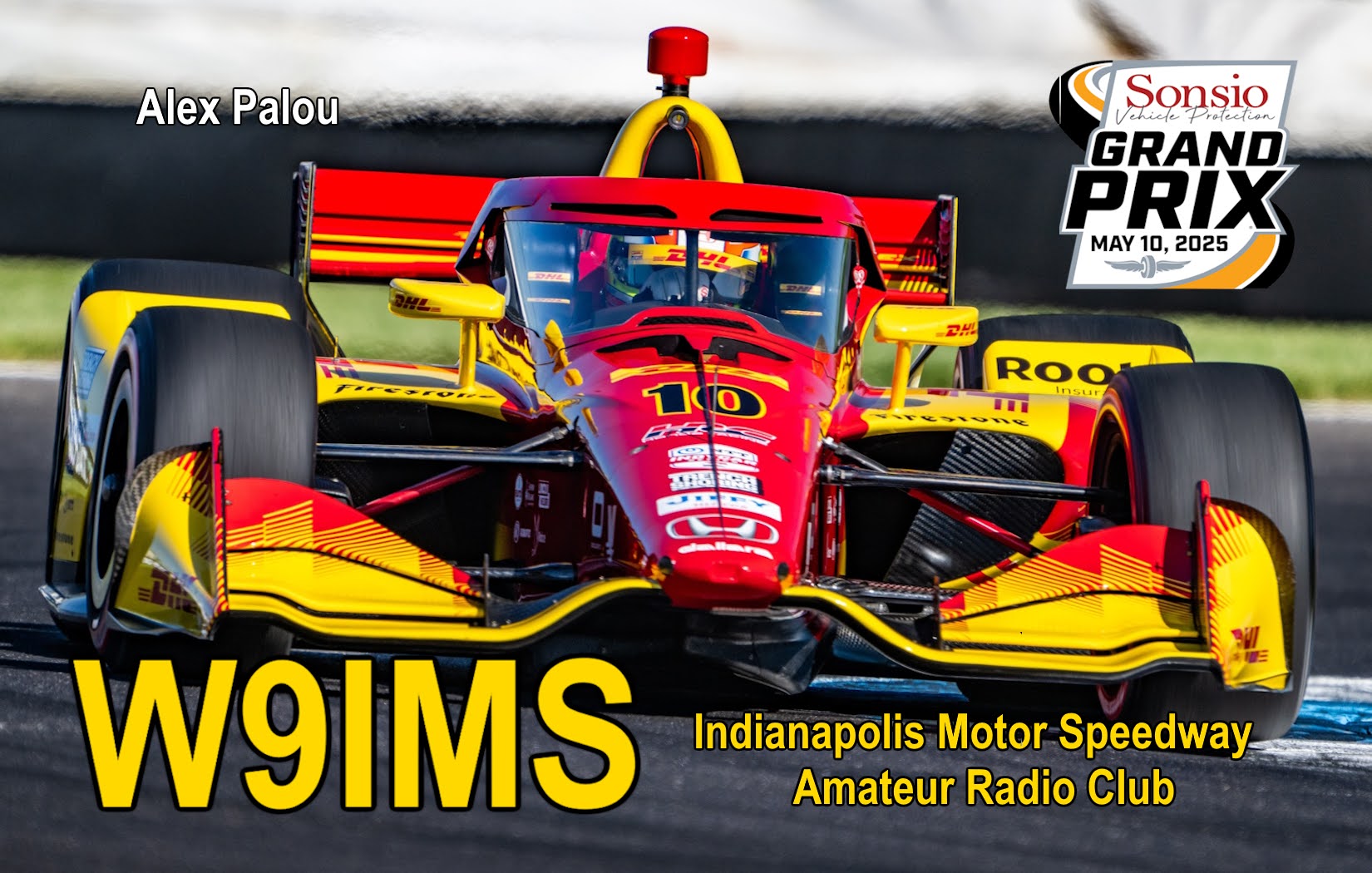
It’s back to the track for amateur radio station W9IMS. Less than 2 weeks after concluding their first special event of the year, members of the Indianapolis Motor Speedway Amateur Radio Club will take to the airwaves from now through Sunday, May 24, to commemorate the legendary Indianapolis 500. 

If you already worked or tuned in W9IMS during the initial event, the IndyCar Grand Prix, this is your chance to snare the second of three contacts required for the 2026 Checkered Flag Award. To earn this certificate, radio amateurs must contact all three W9IMS events in the same year (SWLs may substitute reception reports). The third special event, honoring the NASCAR Brickyard 400, will fire up from July 20-26.

Even if you missed the Grand Prix, you’re still eligible for a colorful and collectible QSL card marking the 110th running of the Indy 500. The current operation is slated to conclude at 11:59 p.m. Sunday, May 25 (Indy time) or 0359 UTC Monday, May 26.

Tips on finding W9IMS:

  1. Check DX Summit (www.dxsummit.fi) for spots listing the current frequency or frequencies of W9IMS. You can customize your search by typing “W9IMS” in the box at upper right. 
  2. Go to the W9IMS page on QRZ.com (short cut: www.w9ims.com) and look for the heading, “2026 Operating Schedule.” The Indianapolis 500 link opens into a weeklong schedule of individual operators and their reserved time slots. Although the special event can be activated at any time throughout Race Week, your odds of snaring the station improve dramatically during hours with a listed op.
  3. Look for the Indy 500 station on 20 and 40 meters – on or near 14.245 and 7.245 MHz – and there’s a bonus band if you plan to attend the race or be in the Indianapolis area on Race Day. Each year on the morning of the 500, W9IMS operates simplex FM on 146.52 MHz, working hams situated in the grandstands and the infield of the track, as well as those en route or residing in the local area.
  4. Remember that the published schedule can be shortened by adverse circumstances, such as local thunderstorms, solar flares, and a lack of calling stations. Don’t wait till the final hour to hunt W9IMS!
  5. However, radio amateurs who still haven’t worked W9IMS by Sunday may benefit from the policy changes that usually kick in at the end of Race Week. W9IMS ops tend to start calling for “only stations that have not worked this event” and may switch to contest-style operations, exchanging only signal reports to put more contacts in the log.
  6. Keep in mind that both hams and SWLs are eligible for QSL cards and the certificate. So if you’re unable to work W9IMS by Sunday night, you can create a reception report by copying down details of other contacts – such as date, frequency, UTC, and the callsigns of a few stations you heard W9IMS working. SWL reports count as credits too, but the certificate will likely feature your name instead of your call. 
  7. If you succeed in bagging W9IMS, congratulations! The station website (www.w9ims.com) contains everything you’ll need to know about obtaining your QSL cards and certificate. 

Hams: If you can hear W9IMS but can’t complete a QSO in the waning minutes of the special event, don’t give up. You can still create an SWL report by jotting down the details of other W9IMS contacts – including frequency, UTC, a signal report and the callsigns of several stations that you heard W9IMS contact. A valid report satisfies the requirements for a Grand Prix QSL card and the first of three credits for a certificate. SWL certificates feature operators’ names instead of callsigns but are otherwise indistinguishable from awards issued to amateur radio operators.

Remember to stay on your toes once the Grand Prix operation is over – the Indy 500 special event begins only nine days later!

Seven Days in May: Earn an Indianapolis Motor Speedway QSL and the first step toward the 2026 Checkered Flag Award

By Brian D. Smith, W9IND

The long wait is over for W9IMS paper chasers! As racing teams spend the coming week tuning up their speed machines, radio enthusiasts can tune in for their first chance at earning Indianapolis Motor Speedway QSL cards and the 2026 certificate.

The first of three special events commemorating major auto races at the legendary 2-and-a-half-mile oval begins Sunday, May 3, and continues till 11:59 p.m. Indy time on Saturday, May 9 (0359 UTC Sunday, May 10) – Race Day for the 13th running of the IndyCar Grand Prix.

To qualify for the certificate, known as Checkered Flag Award, hams and shortwave listeners must work/tune in all three of this year’s special events, which also include the Indianapolis 500 from May 18-24 and the NASCAR Brickyard 400 from July 20-26. But even if you fall short in attempting to bag the trio, you can still claim a colorful, collectible QSL card for each of the events you connect with.

Prime time for W9IMS is 6 to 10 p.m. Eastern Time (2200-0200 UTC) on weekdays, sometimes extending to midnight (0400 GMT Sunday) and beyond, and the bands of choice are 40 and 20 meters – generally on or around 7.245 and 14.245 MHz. But QRM and other issues can prompt changes in frequencies. The best bet is to check for W9IMS spots on DX Summit (www.dxsummit.fi) and eHam (www.eHam.net).

Also, while W9IMS can take to the airwaves at any time between now and the final Saturday signoff, you’ll have a better chance of finding active stations by going to the W9IMS QRZ page (www.w9ims.org) and clicking the Grand Prix link under “2026 Operating Schedule” – which displays the time slots that operators have signed up for. The same page contains additional information about W9IMS QSL cards and the certificate.

For radio amateurs who still haven’t worked W9IMS by Saturday afternoon, note that toward the end of the event, operators often start limiting calls to stations that haven’t yet worked the current special event. Another tip is to drop in for happy hour, the last hour of the last day – in this case, 11 p.m. Saturday (0300 UTC Sunday). That’s when W9IMS ops traditionally switch to contest-style QSOs, exchanging only signal reports so they can log as many stations as possible. But remember, too, that W9IMS special events can end prematurely if they encounter sparse QSOs or unfavorable solar or weather conditions.

And a final tip for hams: If you can hear W9IMS but can’t complete a QSO in the waning minutes of the special event, don’t give up. You can still create an SWL report by jotting down the details of other W9IMS contacts – including frequency, UTC, a signal report and the callsigns of several stations that you heard W9IMS contact. A valid report satisfies the requirements for a Grand Prix QSL card and the first of three credits for a certificate. SWL certificates feature operators’ names instead of callsigns but are otherwise indistinguishable from awards issued to amateur radio operators.

Remember to stay on your toes once the Grand Prix operation is over – the Indy 500 special event begins only nine days later!

DX Central: 2026 Summer of DX Challenge

Many thanks to SWLing Post contributor, Loyd Van Horn, who shares the following announcement:

Summer of DX 2026

FOR IMMEDIATE RELEASE

DX Central Announces the 2026 Summer of DX Challenge: The Biggest, Most Advanced Logging Event Yet

MANDEVILLE, LA — DX Central is thrilled to announce the return of the hobby’s most exciting seasonal event: The 2026 Summer of DX Challenge! Running from May 2 through August 31, 2026 at summerofdx.com, this year’s challenge pushes the boundaries of radio monitoring with brand-new bands, entirely new challenges, and a revolutionary, custom-built data terminal that makes logging easier than ever before.

For the first time in the event’s history, NOAA Weather Radio (NWR) joins Medium Wave (AM) and FM Broadcast Band II (FM) as an official challenge category, opening up an entirely new layer of tropospheric and meteor scatter chasing for scanner enthusiasts.

To handle the massive influx of summer logging, DX Central has completely eliminated registration requirements and launched a brand-new, custom-coded interactive dashboard.

New Features for 2026 Include:

  • Frictionless Logging & Bulk Import: Say goodbye to typing out callsigns and cities! The new terminal features a click-to-log Database Search utilizing WTFDA and Mesa Mike databases. Prefer to upload your logs rather than enter manually? The new Bulk Import tool allows you to upload CSVs directly from FMList, MWList, and WLogger, automatically mapping your data and updating your score in real-time.

  • The Multiplier Scoring Engine: Borrowing from traditional Ham Radio contests, DXers now earn massive score multipliers for every unique US State, Canadian Province, and International Country they log per band.

  • The John Cereghin Century Club: The legendary Grid Square challenge expands! DXers who log 100 unique US Maidenhead Grids on MW, FM, (20 on NWR) will earn our prestigious Century Club certificate, with endorsements for every 50 additional grids (10 for NWR).

  • County Hunters & Rovers: Chase US Counties across all three bands, and take your gear on the road! The new “Rover” category allows mobile DXers to activate rare grids and counties for special recognition.

  • Bi-Weekly Bounty Hunts: Tune in to our DX-themed Internet radio station, DX Radio (thisisprobablydxradio.com), for encrypted ‘targeted intercepts’ hidden through secret broadcast codewords revealed at the top of each hour. Enter the codeword into the DX Central terminal to unlock clandestine, time-sensitive DXing missions!

The 2026 Summer of DX active logging window opens on Saturday, May 2, 2026 at 0100 UTC and closes on Monday, August 31, 2026 at 2359 UTC. All receptions must be solely from this time period to qualify. To ensure everyone has plenty of time to review their SDR recordings, the DX Central terminal will remain open to accept logs and bulk uploads until September 30, 2026.

Whether you are a seasoned FM Sporadic E chaser, a dedicated MW night-owl, or firing up a weather radio for the first time, the 2026 Summer of DX has a challenge for you.

Get your receivers ready, prepare your antennas, and prepare to log! For more information, to view the live leaderboards, and to access the logging terminal, visit summerofdx.com

Loyd Van Horn
W4LVH – Mandeville, LA
Member: IRCA/NRC Courtesy Program Committee (CPC)
Founder: DX Central – Because we’re all about radio
Web: dxcentralonline.com
Twitter: @DXCentral
YouTube: youtube.com/c/DXCentral

Radio Awards Program: 750th Anniversary Patronage of Saint George

Many thanks to SWLing Post contributor Paul Jamet for sharing information about a new radio special event open to amateur radio operators and shortwave radio listeners.

Good morning Thomas!

This is information that should catch your attention:

750th Anniversary Patronage of Saint George: https://ao750sj.ure.es/ 
Rules:  https://ao750sj.ure.es/bases

With best

Paul JAMET

Thank you for the tip, Paul!

Top 10 DX of the Year Contest: Starting December 1, 2025!

Many thanks to SWLing Post contributor, Istvan Biliczky, who shares the following announcement:

The countdown has begun!

The largest SWL contest of the year is coming soon. Get your radios and antennas ready, make a contest plan, and find the lowest power and most distant stations!

You can find the contest rules and detailed description here:

https://www.topdx-radioclub.com/top10dx.html

SWL Contest 2025 Wrap-Up & New SSB SWL Contest

Many thanks to SWLing Post contributor Frank, who shares the results of the SWL Contest 2025, which challenged shortwave and medium-wave listeners from around the world to log as many stations and transmitters as possible. A total of 34 participants from 17 countries participated, demonstrating the incredible reach and diversity of the SWL community.

Frank is now organizing an new challenge—the SSB SWL Contest 2025, running from March 1st to October 31st, 2025. This contest focuses on listening to amateur radio stations in SSB mode across the 10m to 40m bands, with the goal of logging the most DXCC entities over eight months. Both SWLs and licensed amateur radio operators are welcome to participate!

Check out the full results of the SWL Contest 2025 here.

For the new SSB SWL Contest 2025 Rules, visit: https://chinaradiosswl.blogspot.com/2025/02/ssb-swl-contest-2025-rules.html

Radio Waves: New SSB SWL Contest, DRM Functionality Recommendations, and Word DAB Summit 2024

Radio Waves:  Stories Making Waves in the World of Radio

Welcome to the SWLing Post’s Radio Waves, a collection of links to interesting stories making waves in the world of radio. Enjoy!

Many thanks to SWLing Post contributors David Iurescia, Alan, and Frank (SWL F14368) for the following tips:


SSB DXCC SWL Contest

Many thanks to Frank (SWL F14368), who shares the following announcement:

Hi Thomas

I have organized another SWL contest for 2025! The goal will be to listen a maximum number of DXCC entities in eight months but only in SSB mode (USB or LSB).

Check out the details here.

Best 73 de Frank SWL F14368

Digital Radio Mondiale Releases the DRM Consumer Radio Receiver Functionality Recommendation (DRM Consortium)

The DRM Consortium (www.drm.org) releases today its DRM Consumer Radio Receiver Functionality Recommendation (rxspec.drm.org). The document describes and defines the core functional parameters of consumer radio receivers capable of receiving DRM radio broadcasts. As DRM is being increasingly rolled out, adopted and demonstrated globally such a document is necessary to offer a guide to receiver manufacturers, but also broadcasters and regulators, so that consumers get a common and consistent DRM digital radio experience.

[…]The DRM Receiver Functionality Recommendation applies to all types of consumer-targeting DRM radio receivers, with detailed application-specific requirements for automotive receivers, personal mobile devices (such as mobile, feature, and smart phones or tablets incorporating built-in radio receiver functionality for terrestrial broadcast radio), and general-purpose receivers (all types of stand-alone receivers, including home and desktop radios).

The Consumer Receiver Recommendation builds upon the more technical DRM MRR – Minimum Receiver Requirements Specification (mrr.drm.org), which must be implemented and followed by any DRM receiver.

The new Consumer Receiver Recommendation covers DRM digital radio in all broadcasting bands: in the LW, MW, SW and VHF bands (Band I, II and III) and analogue AM and analogue FM radio. [Continue reading…]

WorldDAB Summit: Ensuring Radio Stays Prominent in the Car (Radio World)

Summary: At the WorldDAB Summit 2024 in Zagreb, industry leaders emphasized the importance of keeping radio front and center in the evolving connected car landscape. Gregor Pötzsch of Volkswagen Group’s CARIAD stressed the need for easy findability and engaging multimedia content, while Tomas Granryd of the EBU Connected Car Playbook highlighted the challenges posed by hidden FM/DAB buttons, voice activation inconsistencies, and increasing competition from global digital platforms. With 70% of in-car audio still coming from radio, broadcasters have the leverage to shape dashboard integration, ensuring seamless hybrid reception and intuitive voice control. Read the full article at Radio World.


Do you enjoy the SWLing Post?

Please consider supporting us via Patreon or our Coffee Fund!

Your support makes articles like this one possible. Thank you!