Tag Archives: USSR

Astrad “Mikado” F8-TR17-B205: Mark discovers this USSR radio at his local charity shop

Many thanks to SWLing Post contributor Mark Hirst, who writes:
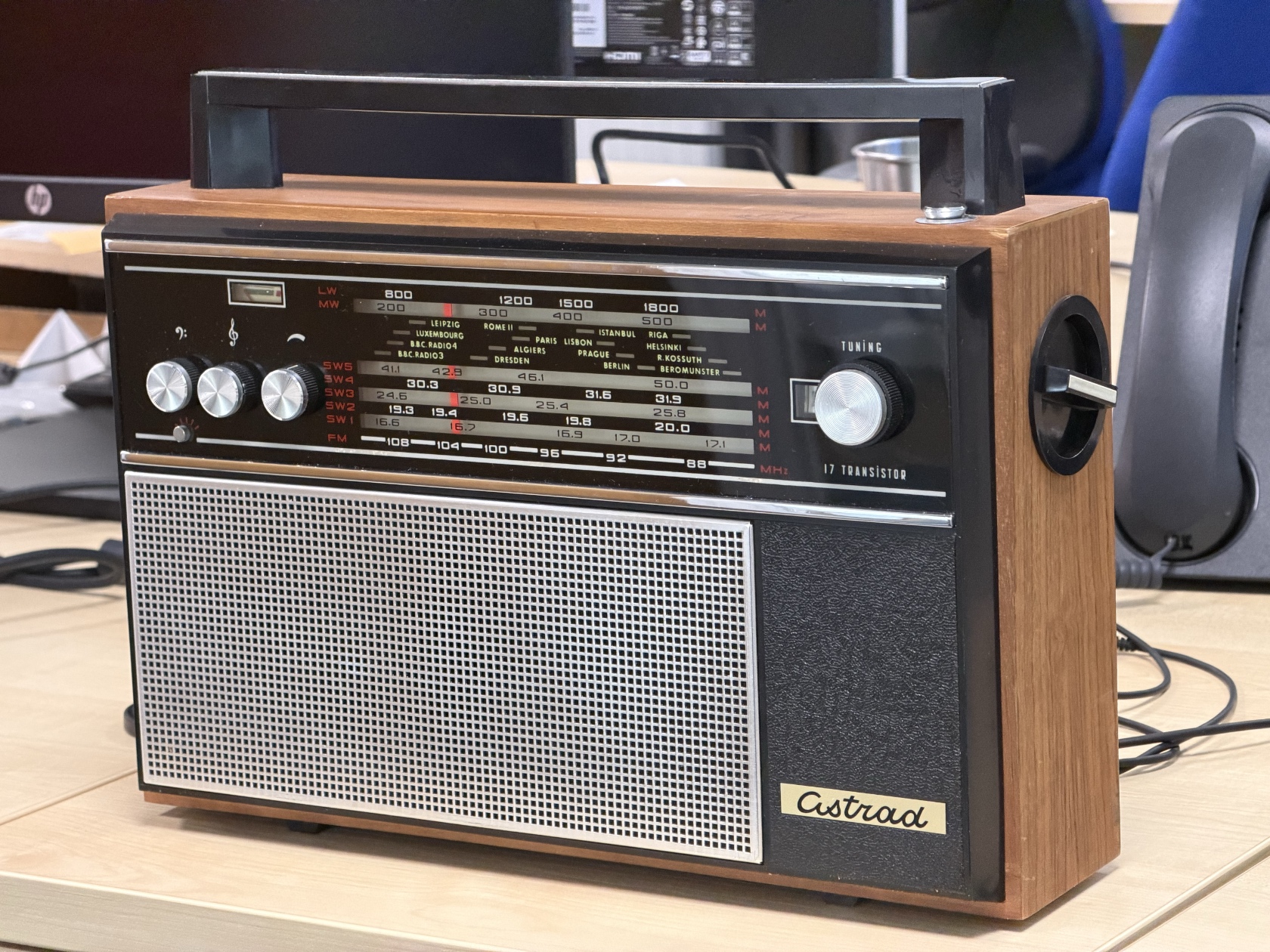
This gem arrived in the charity shop where I volunteer yesterday, a radio made in the USSR (Minsk) in around 1975.

It was in fantastic external condition, although after checking it out discovered that the band changing control on the right hand side had been disconnected.

I suspect something went wrong with the very mechanical way it switched frequencies (shown in the video below), which rotated individual circuit boards into play.

Somebody seems to have opened it up, set it permanently on VHF, and then disconnected the control to prevent any further changes.

It was evidently sold in the UK as it has BBC radio stations on the dial and I even found a UK service manual for it.

I was tempted for a while, but I’m learning these days that this sort of thing just ends up as clutter.

Hard to believe that only five years after this electro-mechanical radio was made, Sony would release the ICF-2001 !

Mark

Manual:
https://archive.org/download/Trader_ASTRAD_B205/b205_text.pdf

Radio Museum:
https://www.radiomuseum.org/r/minsk_radi_astrad_f8_tr17_b205f8tr17.html#

YouTube – Astrad “Mikado” F8-TR17-B205:
https://www.youtube.com/watch?v=osDxKNdun98
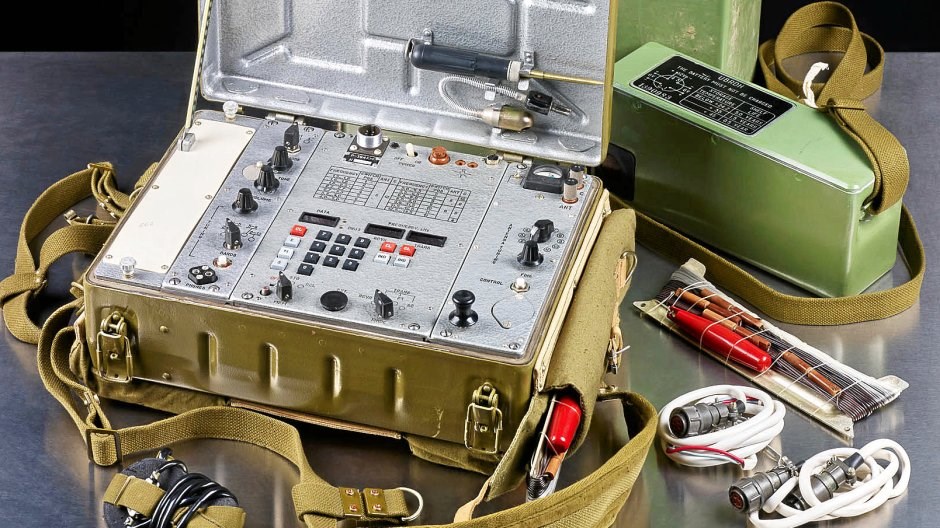
“German Archaeologists came across a Russian spy radio”

Photo: Jürgen Vogel / LandesMuseum Bonn via the Southgate ARC

(Source: Southgate ARC via Jake Brodsky, AB3A)

Not an everyday find: Archaeologists from the Rhineland Regional Council were amazed when they came across a Russian spy radio instead of Roman traces in the Hambach open-cast mine during excavations. Hidden in a large metal box.

“When the box was opened, it hissed,” Dr. Erich Claßen, head of the LVR Office for the Preservation of Archaeological Monuments in the Rhineland, told journalists. In the container: a Soviet radio type R-394KM, code name Strizh, a digital HF spy radio.

It was developed in the early 1980s in the Soviet Union (USSR) and used by the countries of the Warsaw Pact in the final phase of the Cold War. It was the last model before the fall of the Iron Curtain in 1989 and the collapse of the Soviet Union in 1992.

The device has a digital news system and a digital frequency display. It was used by agents abroad as well as by special units and was available with Russian or English text on the front. The spy version is known by the Russian code name “Strizh” (English: Swift).

In the LVR-Landesmuseum in Bonn there is currently not only the mysterious radio to see. Under the title “Gods, Graves and Agents”, spectacular finds from the year 2019 are on display until 29 March:

https://bodendenk
malpflege.lvr.de//de/aktuelles/veranstaltungen/AusstellungAiR2019.html

73

Tom DF5JL

Click here to read the full article at the Southgate ARC.

Shortwave Radio: One of 5 popular espionage techniques from former USSR

(Source: Top Secret Writers)

Shortwave radios have been a tool of the espionage trade for many years. Radios can transmit information encoded to be picked up by the receiver and then decoded.

This technique was used throughout World War I, World War II, and the Cold War. Like Steganography, radiograms are still being used today.

[…]The techniques were used by the Soviets during the Cold War many years ago, but it seems that they have remained long-lasting fixtures in Russian Espionage.

We actually reported on this back when news broke about the russian agents who used numbers stations for espionage purposes. Yep, shortwave radio is your friend if you don’t want people tracing where you are and what you’re listening to.

Mind you, when you live in a country that suppresses free speach, you also reach for a shortwave radio.

Read the full article that details four other popular espionage techniques from the former Soviet Union.