
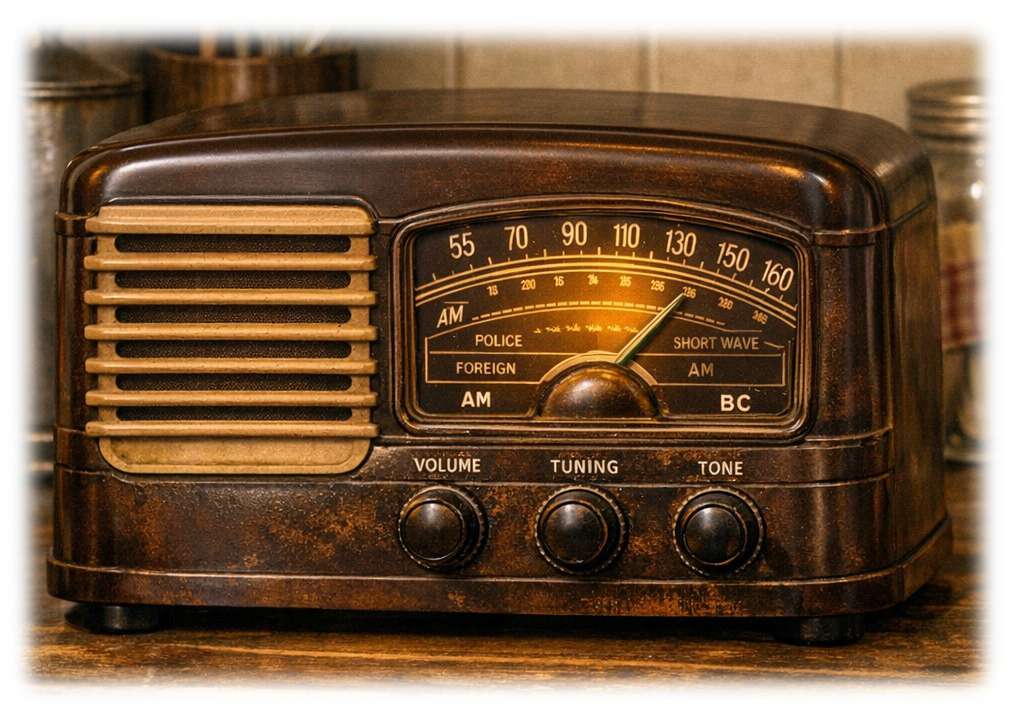
Copilot Radio, Model Unknown
The dial certainly has some problems, but the rich, Bakelite, art deco cabinet is superb.
By Bob Colegrove
One of the great attractions of the radio hobby is that it has so many different areas on which to specialize. As examples, one can focus on a particular band, collect or restore radios, DX or just listen. With so much to choose from, one can impulsively skip from one area to another. I have tuned the shortwave bands for many years, but I also like the AM medium wave band. If there is a purpose to this post, it is simply to bring some occasional attention to AM listening and DXing. There is nothing new in what follows.
What’s in a Name?
To start with, this subject is somewhat confusing by calling it what we do. There are at least three common terms for the electromagnetic spectrum between 530 kHz and 1700 kHz: 1) AM, 2) broadcast band, and 3) medium wave. This poses an identity dilemma; that is, none of these names are exclusive. AM defines a form of modulation, amplitude modulation, which is used in other portions of the spectrum. The same may be said of broadcast band. There are several international broadcast bands within the shortwave spectrum. That leaves us with medium wave. But that term lacks precision. What exactly are the boundaries of medium wave? Shortwave bands have relatively precise names related to their wavelength, 80 meters, 31 meters, etc. Should we call medium wave the 176-thru-943-meter band, instead? Let’s just stick with any of the old familiar terms.
In the Beginning
I’m sure many readers share the experience related here. Even before shortwave there was medium wave. Our initial encounter may have been with the monolithic, multi-band console radio in the parlor. However, the house was likely home to one or more less pretentious table radios, which were limited to the medium wave broadcast band. It all began with curiosity about what lurked in the relative space between the few local stations that played so clearly along the dial. We likely found less listenable stations poking through in the inter-station space. These were stations like our own in neighboring communities. Then, at night, a strange thing happened. Like stars in the sky, more stations appeared, some hundreds of miles away. At the same time, some of the stations we heard during the day disappeared, maybe even a local station or two.
Well, one thing led to another, and soon we were keeping track of stations that we heard. We took note of where they were located and their position on the dial using a new term called kilocycles. The fastidious among us kept daily logs with dates, times, and reception conditions. So, our DXing career began.
I came along a full generation after the advent of AM radio broadcasting. In my early years, it was still the mainstay of public information and entertainment. Television stations were beginning to pop up across the country one by one, and FM radio’s popularity was still a decade away. Like any imposing distraction, there was curiosity in what was being heard and, in the case of radio, where it was coming from.
Our house was home to perhaps three or four AM radios. At the age of seven, I was gifted of a 4-tube Sears Silvertone – mine to keep in my own room. But the radio that really got me going came along several years later and belonged to my father. This was a General Electric Model P755A, five-transistor portable. Shaped somewhat like a lunchbox, including the handle, it was the quintessential portable radio that the world had been waiting for. It ran for many hours off a single, but pricey 9-volt carbon-zinc battery. There was purposely no provision to run it from AC power. Also, it used an internal ferrite core antenna. There was no jack or terminal for an external antenna. Besides the tuning knob and volume control, it had a jack for a single earplug. It was truly portable in all respects. For all its simplicity, it did its job very well, and I borrowed it whenever the occasion presented itself.
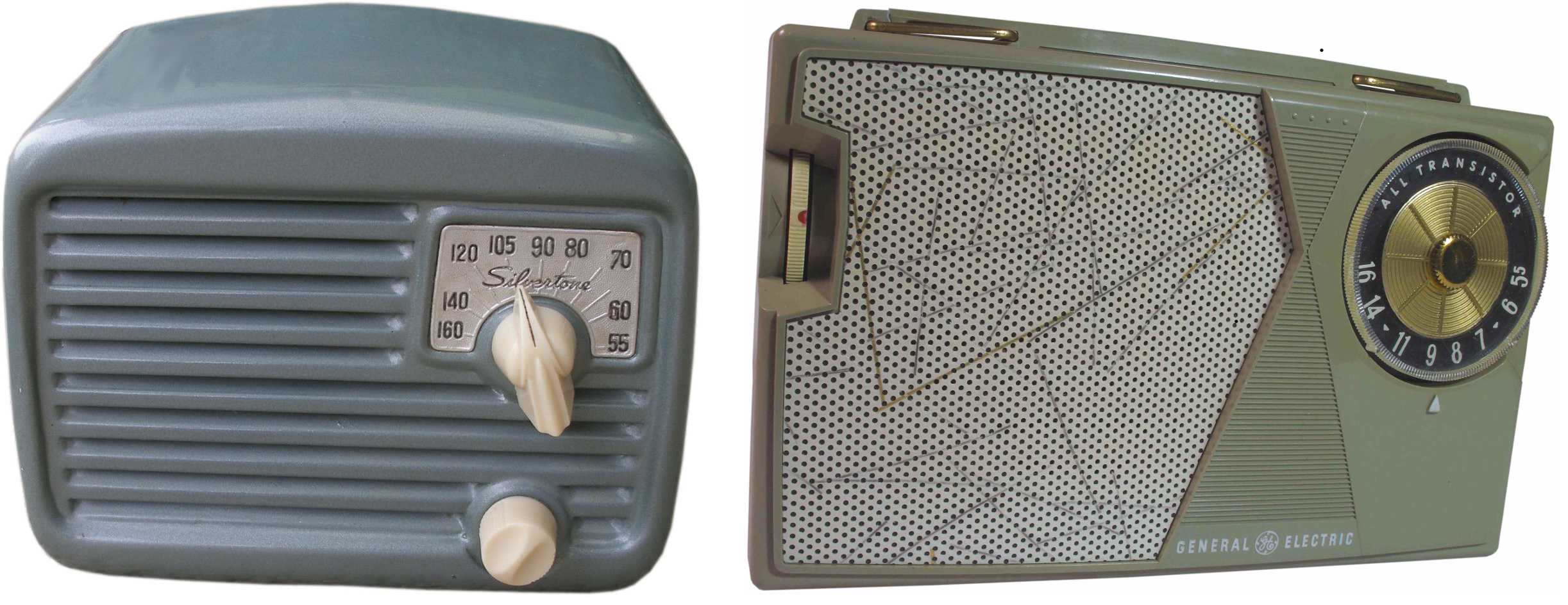
Left: Silvertone Model 132.818-1, Sears, Roebuck & Co (1949, $11.95)
Right: General Electric Model P755A Transistor Portable (1957, $19.95)
As an only child, I was the sole recipient of any goodies that came along, and it wasn’t too long before I had my own comparable Westinghouse portable. But the GE was really the one that got things started.
A Plethora of Stations
I have recently wondered whether shortwave use has contracted about as far as it can go. This is not the case with AM, at least not yet. The graph below shows the total number of AM radio stations in the US throughout history, 100 years. The total has remained relatively stable since 1960, albeit with a slight downward trend from the peak around 1990. Stations occasionally come and go. Some rebrand with a different format or fresh call letters. Note that the steepest rate of decline, 217 stations, occurred over the past five years, amounting to 4.7%. Whether this rate of attrition will continue is a matter of speculation.
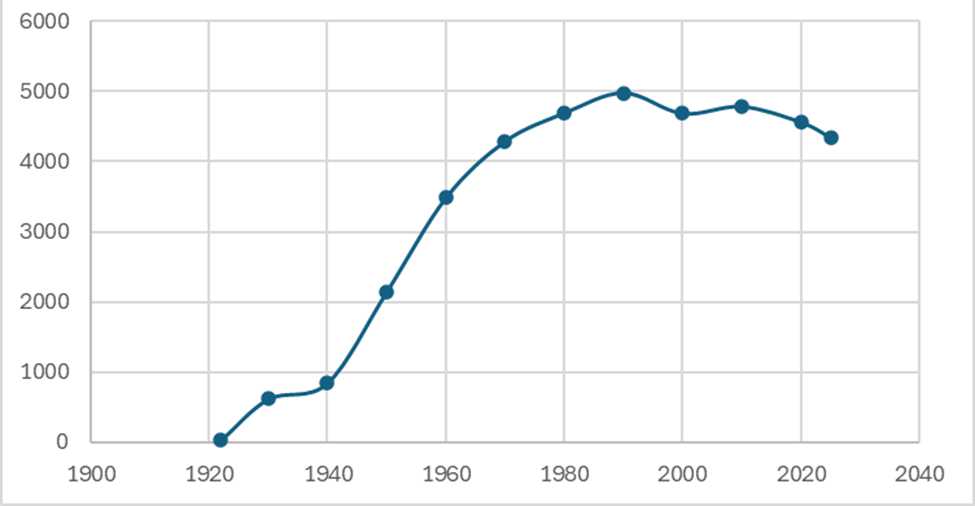
Graph compiled from https://en.wikipedia.org/wiki/Radio_in_the_United_States
Medium wave DXing is a lot different than shortwave. The density of stations will vary depending on what part of the world you live in. Here on the East Coast of North America, the AM band is saturated with signals. That is, with a suitable antenna, one can at least detect a station on each of the 118 available channels – certainly at night and possibly even during the day. On the other hand, some years ago, I had an opportunity to visit Honolulu, Hawaii. With little time to listen, I only heard a few of the islands’ stations but imagined what possibilities nighttime Dxing held.
Despite the density of stations on the East Coast, there will still be limits on the number of stations logged. My experience is that initially the log grows quickly, then tapers off steadily as you go along. Your time is eventually spent locked in on a local or regional frequency, waiting for something you’ve heard to fade out and something you haven’t heard to fade in. In a previous posting, I worked the lower end of the band rigorously for some time, coming up with a fair number of catches.
Ten-kHz channel separation is the convention in Region 2, the Americas. There have been some occasional anomalies. Several years ago, there was a handful of so-called “split-channel” nonconformists, who placed their carriers midway between channels and presented an opportunity to log some hard-to-hear countries. It was also possible to pull in a few very high-power European and North African stations. This took advantage of the 9 kHz vs. 10 kHz channel spacings between Region 1 (east) and Region 2 (west).
Seasonal changes are also important. Winter is the best. Propagation is generally better and more consistent. Atmospheric noise is minimal. Local stations limited to daylight operation have shorter hours. The gray hours around sunup and sundown can produce unusual DX conditions.
Programming
Programming has changed since the 1950s. As the go-to medium for public information and entertainment, content was original and competitive. Mornings were often filled with local DJs playing occasional songs and generally keeping listeners apprised of news and weather. Traffic helicopters were still in the future. The genre of soap operas was born and consisted of 15-minute, serialized dramas one after the other during the middle of the day. Faithful audiences followed these melodramas for many years. DJs took over the airwaves again in mid-afternoon and continued through dinner time. Prime time lasted throughout the evening hours with regular drama, comedy and variety shows which were networked throughout the country.
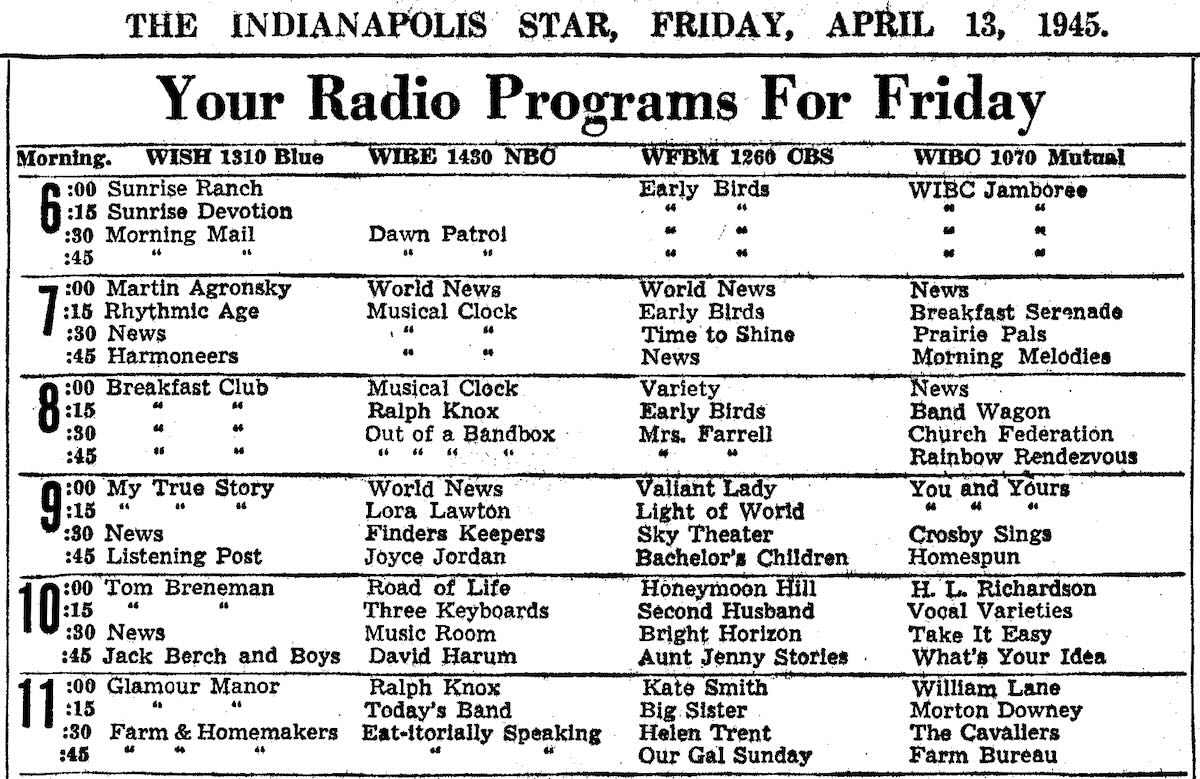
Newspapers published daily tabular program schedules for all the local stations. My dear mother would carefully trim these out of the paper and clip them together for a complete week’s program listing. You can see below some of WFBM’s soap operas started as early as 9:00 am. Don McNiell’s Breakfast Club (WISH, 8:00 am) “coming to you from high atop the Hotel Allerton in downtown Chicago” was a great syndicated live variety show.
 The advent of television and FM did not mean the end of AM radio. Instead, it went on to a second golden age due largely to rock’n roll and other popular music. The likes of Wolfman Jack and Cousin Brucie garnered the loyalty of a younger generation through the ‘60s, ‘70s, and ‘80s. Today, much of the content is “canned” for economy. You can classify the fare into news, talk, sports, religion, and ethnic categories with very little music or other variations throughout the day. AM radio has learned to adapt and survive.
Antennas
All the credible rules one has ever learned about antennas still apply when listening to medium wave. However, one type in particular stands out as being especially useful. Loop antennas. Simply put, loop antennas are effective for their directional properties. There are 118 channels in the Americas used by perhaps 10 to 12 thousand stations. The channels must be shared. All of this is regulated to some extent, but there remains a good amount of overlap and interference. That is where the null response characteristic of a properly designed loop antenna comes into play. By pointing the loop normal to the direction of the interfering station, it is quite possible to hear a station of lower power or further away.
I have had great success over the years using loop antennas I fabricated myself. This is not in everyone’s interest or capability. Some folks will favor active (amplified) loop antennas, of which there are several. However, very adequate passive loop antennas are available at reasonable cost, require no power, and may be inductively coupled to a portable radio, so they require no direct wiring. These include the Tecsun AN-100, AN-200, and the Terk Advantage AM Indoor Antenna. The AN-100 and AN-200 may be branded under other names. Bringing a coil-capacitor circuit into resonance and hearing the radio come alive is curiously addictive.
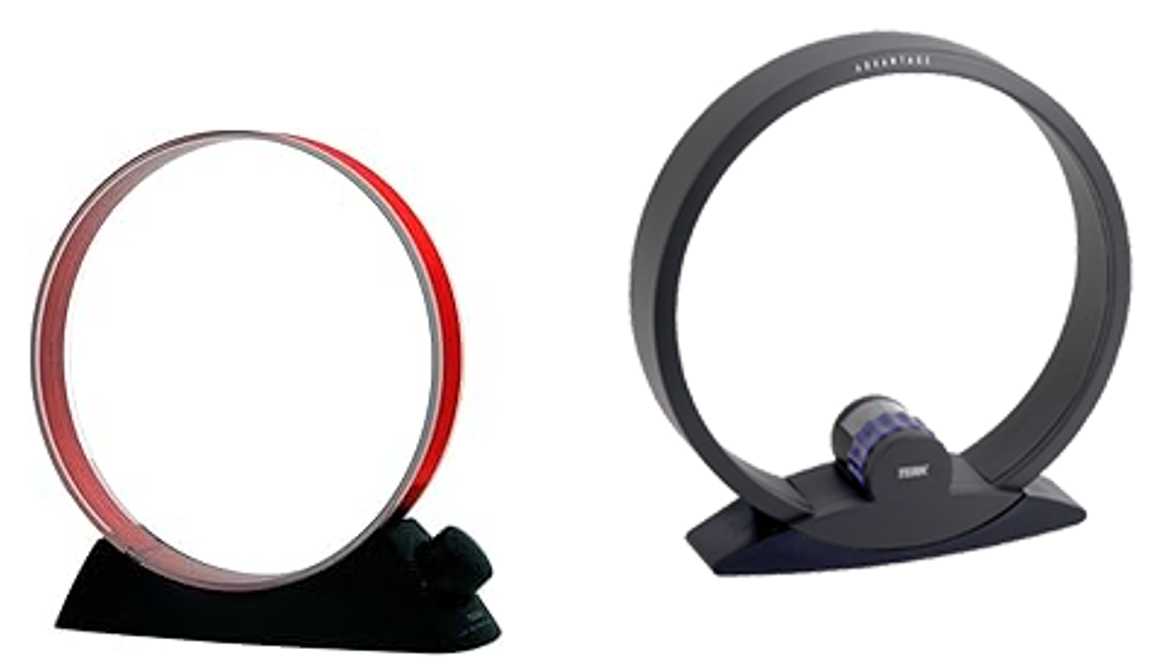
Tecsun AN-100 (left) and Terk Advantage (right)
Station Listings
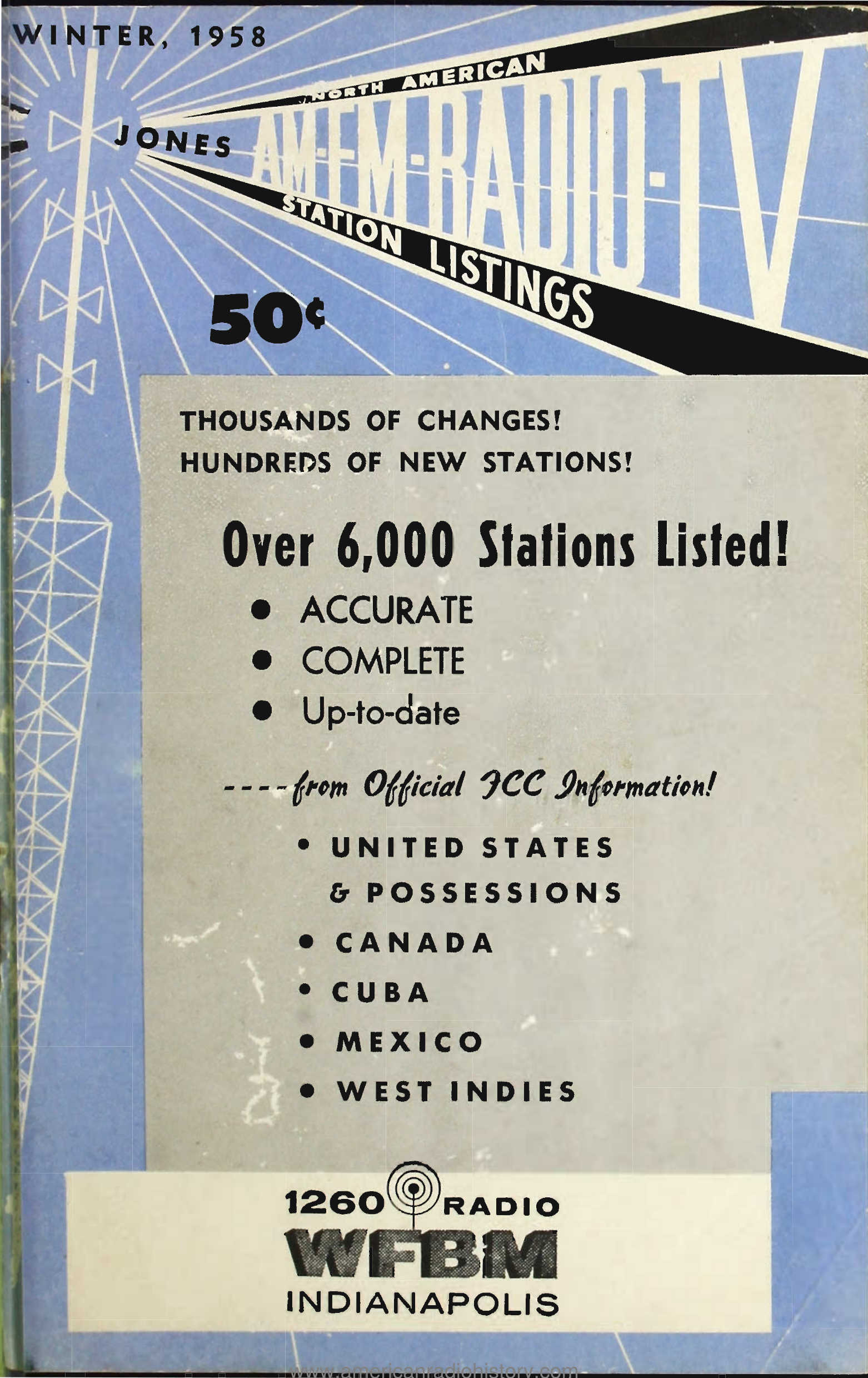
Just as with shortwave, it is very useful to have some resources to help identify stations. The year was 1958 BC (before computers). There were no online portals for station information. Printed information, what there was of it, was generally spotty and dated. There was one man, however, whose passion for radio and TV of the time led him to manually and painstakingly develop a database of radio and TV stations, their locations, and their frequency or channel. His name was Vane A. Jones. He was a real estate broker by trade, and his office was coincidentally right down the street from where I lived in Indianapolis. Although I never met him, his dedication to producing his station guide is a marvel of work that has amazed me over many years. His North American AM-FM Radio TV Station Listings was self-published in 1958, and picked up by Howard Sams Publishers in 1963, where it continued to be revised periodically through 1981. See https://www.worldradiohistory.com/Archive-All-Logs-Lists-Directories/Jones_Master_Page.htm. This is the book I started with and still have as a keepsake.
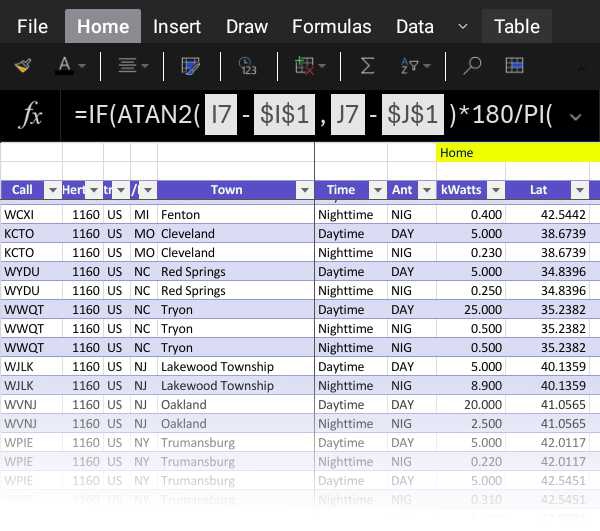
Moving forward 68 years I now get my data from the Federal Communications Commission (FCC) by periodically downloading their AM database for all Region 2, the Americas (https://www.fcc.gov/media/radio/am-query). I import this into Excel, filter out the data I am not interested in and load it on a Kindle tablet for easy access while listening. In addition, the spreadsheet has been taught to calculate the distance between home and the station.
Internet
Before the internet we did not have very many resources for identifying stations. Today, most stations have a website and a link to stream their station. By comparing what you hear on the stream link with what you think you hear on the radio, you can often make a positive identification. There are a couple of caveats to this. The broadcast may be networked over several stations, in which case the radio may be receiving the same broadcast, but from a different station than that being streamed. The other issue is that the streamed broadcast may be delayed by several seconds, requiring you to stand by for some common interruption such as a local commercial.
Besides the station’s own streaming, you can try to pair up what you are hearing on the radio with dedicated streaming services such as TuneIn and Radio Garden.
There is a myriad of other techniques you can apply using the Internet. I have found that stations which simulcast AM and FM channels tend to announce the FM frequency more often than that of their AM channel. As a result, you can deplete your radio batteries waiting for some telltale clue as to the station’s identity. By activating your favored search engine and pairing the announced FM frequency with that of the tuned AM frequency, you can often find a link to the unidentified station. For example, an announcement for 92.9 MHz FM with the radio tuned to 670 kHz would produce a search for “92.9 MHz 670 kHz” and would lead you to links for WLUI in Lewistown, PA. The reasoning is there are not many stations sharing the same pair of AM and FM frequencies.
National Radio Club
If the avid AM DXer were restricted to just one resource, I would venture to say it would be membership in the renowned National Radio Club (https://nationalradioclub.org/). It is the oldest and largest medium wave DX club, having been around since 1933. DX News consists of 20 bulletins per year, bi-weekly in winter, monthly in summer, and contains over 750 pages a year of DX and radio information. The seminal publication, The AM Radio Log, is the definitive source for AM station information. A 47th edition is scheduled for publication in the Summer of 2026. To bait your interest, the 2017 edition is available for downloading at https://www.worldradiohistory.com/Archive-All-Logs-Lists-Directories/Archive-Radio-Logbooks/NRC_Logs/NRC-Radio-Log-2017-38.pdf. Another noteworthy NRC publication is the Antenna Pattern Book. This contains transmission patterns for both day and night operation of US, Canadian, and selected foreign stations.
I know I am missing other valuable resources for medium wave DXing. Perhaps you can help me out with comments.
Digital AM
Well, we’re back where we started – with words. Digital AM is a contradiction in terms. The foregoing discussion relates to the “broadcast band” in its traditional sense. This is changing. Today’s AM band has become a laboratory for technological experimentation. In-Band On-Channel (IBOC) radio, sometimes called “HD Radio,” is digital technology. It allows AM and FM stations to transmit higher quality digital signals simultaneously with their analog signal. In the case of AM, the listed analog frequency is augmented by digital content on unused adjacent channels. For example, WCAO, 600 kHz in Baltimore, MD uses 590 kHz and 610 kHz for its digital HD content. The two neighboring channels are not used by other local stations.
WSHE (formerly WWFD) in Frederick, MD, operates on 820 kHz. In 2018, it became the first AM station to abandon analog transmission for an all-digital, MA3 mode. Despite both stations being local to me, I have no idea who listens to the digital content, let alone, what kind of device they are using. Currently “Digital AM” is a facet of broadcasting that has not been widely promoted.
Digitization of the medium waves is only one part of what has come to be called “AM radio revitalization.” This movement promoted by the FCC took shape several years ago. Much of it is regulatory. Key elements include the relaxation of community coverage standards, and the use of FM translator (repeater) stations. Elimination of the complex AM “ratchet rule,” is also involved. This rule has been criticized for discouraging AM station improvements resulting in a net loss of interference-free nighttime AM service.
Revitalization may take us down a long, bumpy, and expensive road. Along the way medium wave radio must maintain social relevance and listeners must be induced to return to the band as a significant source of information or entertainment. One thing is certain, the portion of the electromagnetic spectrum between 530 kHz and 1700 kHz is not going away. It is more durable than the ground we walk on. It will continue in one form or another. Meanwhile, we can continue to enjoy it just the way it is.
AM. Medium wave. Broadcast band. Whatever you call it, it’s a fascinating part of radio.
Good DXing.
I really enjoy reading these “look-back” articles. It brings a lot reminiscing to the fun I had back then.
I have been a DX’er for 64 years and a Ham for 47. I got my start with a 6-Transistor radio (I think it was a Global) back in 1962. On a Winter late afternoon, from Houston Texas it started to pick up stations from Des Moines (WHO), Chicago, Cincinnati and St. Louis. During the Cuban Missile Crisis I was introduced to Shortwave Radio by a caretaker who watched me after school. I was pretty much a Latch-Key kid, as both of my parents worked all day. I would have competitions between the radios my parents had. I did some nice daytime DX’ing and spent a lot of late night listening with those Transistor radios. During that time, I used White’s Radio Log from Radio-TV Experimenter as a guide.
In 1964 my parents moved and I met my first Shortwave Listener. He had a Popular Electronics magazine monitoring call, WPE5DNB. Needless to say, I would head in that direction. By 1965, I had my first Communications Receiver a Hallicrafters S-120. The emphasis became Shortwave, but my interest in Medium Wave was still there.
Throughout the years, girls, rock-‘n-roll, trouble, being a bit of a rebel and eventually growing up interfered with the hobby, but it never did remove it. I became a Ham in 1979 and have really enjoyed being one. Always running very modest stations off and on over the years, I have accomplished things that I never thought I would.
I have always enjoyed Medium Wave DX’ing and later FMBC DX’ing in my cars. I did a lot of traveling in the 1970s into the late 80s. My Medium Wave DX’ing picked back up in the mid-1990’s when I read an article in Monitoring Times for a Medium Wave passive loop. I built it and it rekindled my interests in Medium Wave DX’ing.
I have built 3 One-Foot Box Loops and 3 and 4-Foot Loops. I also have a Radio Shack MW Loop (Tecsun AN-100 look a like), a Select-A-Tenna and was gifted a Ferrite Sleeved Loop (FSL) and a portable with a Supercharged Loopstick. I have a plethora of portables from a Realistic DX-440 through a XHData D-808. I really enjoy DX’ing with my cheap RTL-SDRs. My issue is that I still Ham too much. I keep saying, “One of these days”. I also love to FM Broadcast Band DX.
I prefer to DX by the “seat of my pants”. I have always DX’ed that way. I use the Web to verify and to report. I will match streaming on occasions if an ID is lacking, or it’s in a foreign language I am having issues interpreting.
I also download the FCC Databases. Back in the mid-2010’s I worked with Bob Colyard of DXWorld.com developing an Excel Spreadsheet with the FCC FM Database. After he passed, once a year I still download the FM and AM Databases and convert them into Excel. I place them on my Google Drive if anyone wants them, but very few do. It is the way I DX, just like using White’s Radio Log.
I enjoyed the article. Enjoy this hobby in the way you wish and be proud of what you accomplish.
In the words of Ricky Nelson, “You can’t please everyone, so you got to please yourself”.
73 Art K7DWI/5
Bob,
What a wonderful piece! Well-written, informative and entertaining.
Well done. Put a Gold Star on your chart.
. . . What Thomas said . . .
Cheers, Jock
“It is more durable than the ground we walk on.” Yes indeed! I have seen it more than once: When the chips are down, AM is the news and information source that gets through.
Bob, thanks for the brief yet complete walk through the AM band. It’s a nice Easter Sunday morning read.
White’s Radio Log was my go-to resource in the 1970’s. They could be found at the back of each issue of Communications World. These old magazines can all be found online today. Thanks for another great article.
And actually, “Radio-TV Experimenter” before “Communications World”.
I used White’s Radio Log from the early 60’s from that magazine.
I also bought what I believed was the last White’s Radio Log which was in a small booklet.
Unfortunately, I have misplaced or lost the booklet in one of my retirement moves.
73 Art K7DWI
Born in the mid ’50’s, I grew up on AM radio. I’m in my 70’s now and still do DXing occasionally. There are oldies stations out there as well as radio theater broadcasts as well. There is far more varied programming than many people realize. I read that up to 25% of American households don’t own an AM/FM battery operated radio. If there’s a power outage, my primary source of information is the AM band. Most people just say
“I’ll just check my phone”. Recipe for disaster. I urge people all the time to “Be Prepared” as I was taught in Boy Scouts.
Great article. I really enjoyed it.
I always thought it interesting to note that the only remotely “metric” standard the US embraced was the 10khz AM band separation, whilst the supposedly metric world settled on 9khz.
Great article. I too enjoy AM DX. Really enjoyed the article. I too had an old tube radio, I think it was Zenith, that my dad had helped me fix. Great memories and lots of fun .Lately my favorite thing is to use low-cost AM portable radios and see how many stations I can pick up in the evening. I usually don’t care much for the programming today, but listening to catch that distant city is fun. During baseball season, I really enjoy trying to pick up a number of different ballgames-although sadly many have gone to FM including here in Pittsburgh.
Exactly what I needed to read this fine Sunday (Easter!) morning. Thank you, as always, for sharing, Bob. You are a treasure! -Thomas