Author Archives: Thomas

A Message About Politics on the SWLing Post

Dear Readers,

Over the 17 years I’ve been running the SWLing Post, I’ve done my best to make this space a safe haven from divisive politics. This site has always aimed to bring people together through a shared love of shortwave listening, international broadcasting, and radio communications — no matter where they live or how they vote.

That said, the very nature of international broadcasting means that political topics will occasionally surface. When governments decide to decommission transmitters, reduce funding for public broadcasters, or overhaul agencies involved in international communication, the decisions are often political in nature — frequently tied to elected officials or broader geopolitical shifts. As such, they become newsworthy for our community, and I believe we have a responsibility to acknowledge and explore them.

In the past, we’ve covered major changes in international broadcasting — from the shutdown of Canada’s RCI Sackville site, to Australia’s complete withdrawal from shortwave, to Greece’s repeated (and eventually permanent) closure of their shortwave services. We’ve also reported on the disappearance and sometimes return of broadcasts in various regions around the world. In nearly every case, I’ve been heartened by the civil and insightful conversations these stories sparked here on the SWLing Post.

This year, however, we’ve seen a notable increase in news items that carry a heavier political weight. For instance, the recent “Bloody Saturday” shakeup in U.S. international broadcasting under the DOGE initiative caught many off guard — even critics of the agencies in question were surprised by the suddenness and execution of the changes. Since many of our readers live in the U.S. or closely follow American policy, the stakes feel especially high right now.

As a result, we’ve had to moderate more comments than usual, and in some cases, we’ve chosen to disable comments entirely on certain posts. This is never a decision we take lightly — but we do so when we feel that an external news item already has its own space for public discussion and when the likelihood of unproductive venting here outweighs constructive dialogue.

We’re not going to shy away from reporting on these important developments. In fact, to ignore them would be to make a political decision in itself.

Instead, our goal is to present information as clearly and objectively as we can, linking to sources that provide both context and multiple perspectives. While it may be impossible to find purely objective news sources, we do our best to choose reporting that is fair and fact-based.

With that in mind, I kindly ask that when you comment on these types of posts, you do so with respect for others — even (and especially) when you disagree.

Share your viewpoint, provide evidence where you can, and aim to add to the conversation.

Refrain from name-calling, personal attacks, or using the comment space as a venue to vent political frustrations. We have five trusted moderators who review comments daily, and they may choose to remove inappropriate remarks or close comments altogether if things get off track.

Thank you for helping us keep the SWLing Post a welcoming space for everyone — a place where thoughtful discussion, curiosity, and mutual respect still prevail. Let’s continue promoting practical actions and shared solutions that strengthen the global community of international radio listeners and broadcasters alike.

With appreciation,
Thomas
SWLing Post Editor

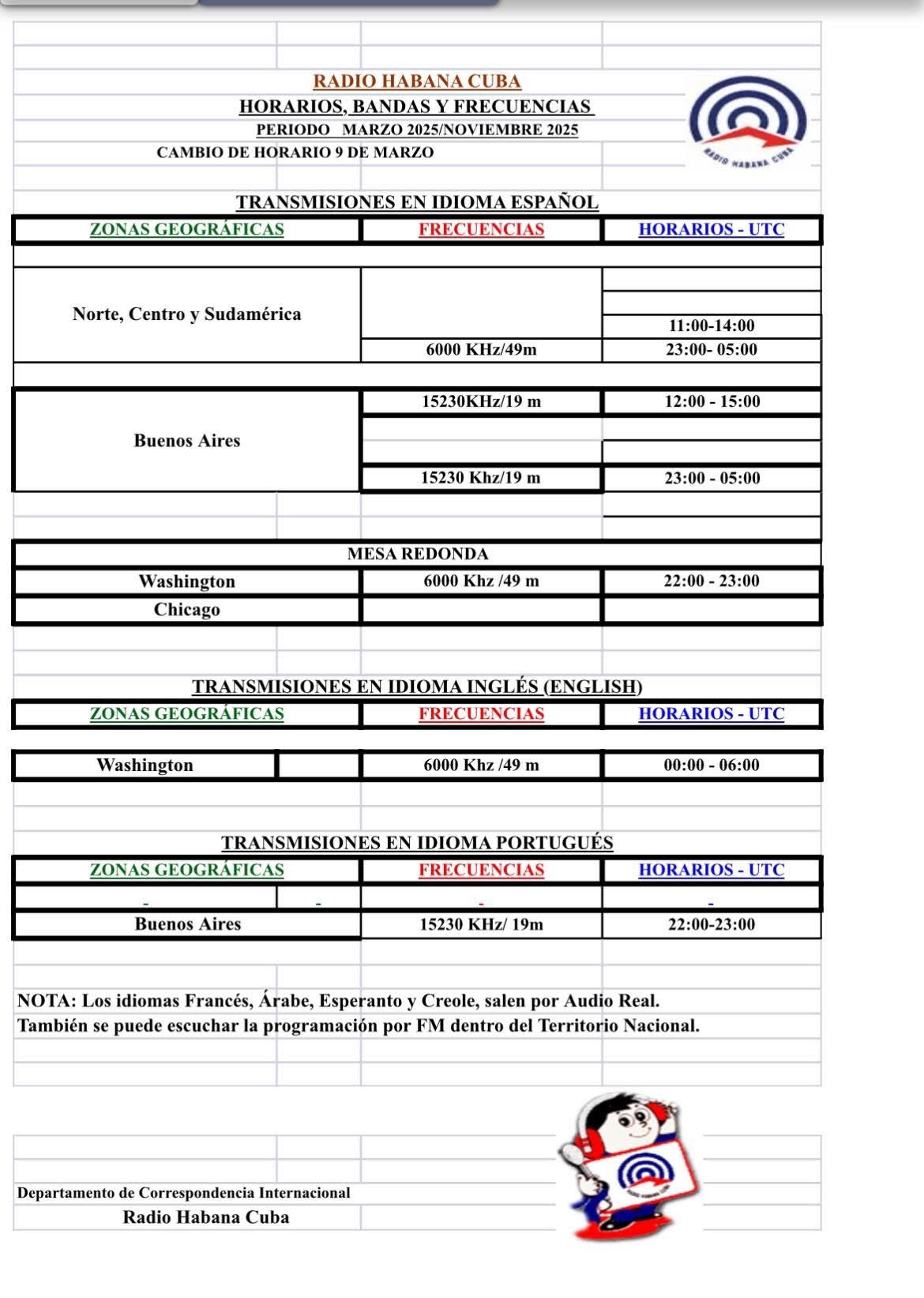
Radio Havana Cuba’s A-25 Schedule

Havana, Cuba (Photo: Wikimedia Commons)

Many thanks to SWLing Post contributor Paul Walker, who writes:

This is the A25 Schedule for Radio Havana Cuba. Only English, Spanish, and Portuguese remain on shortwave (SW) broadcasts. You’ll notice that only two frequencies, 6000 kHz and 15230 kHz, are still in use. Unfortunately, the antenna systems and transmitters are probably beyond repair, and it seems China won’t be providing any more funding. Regardless, the broadcasts still sound awful—fuzzy, distorted, and incredibly under-modulated.

French, Arabic, Esperanto, and Creole will only be available via streaming. Honestly, if it were up to me, I would consider reversing course a bit by dropping service to North America and focusing on Latin America and Africa. This could involve prioritizing Spanish, Portuguese, and French, while offering English and Creole only online.

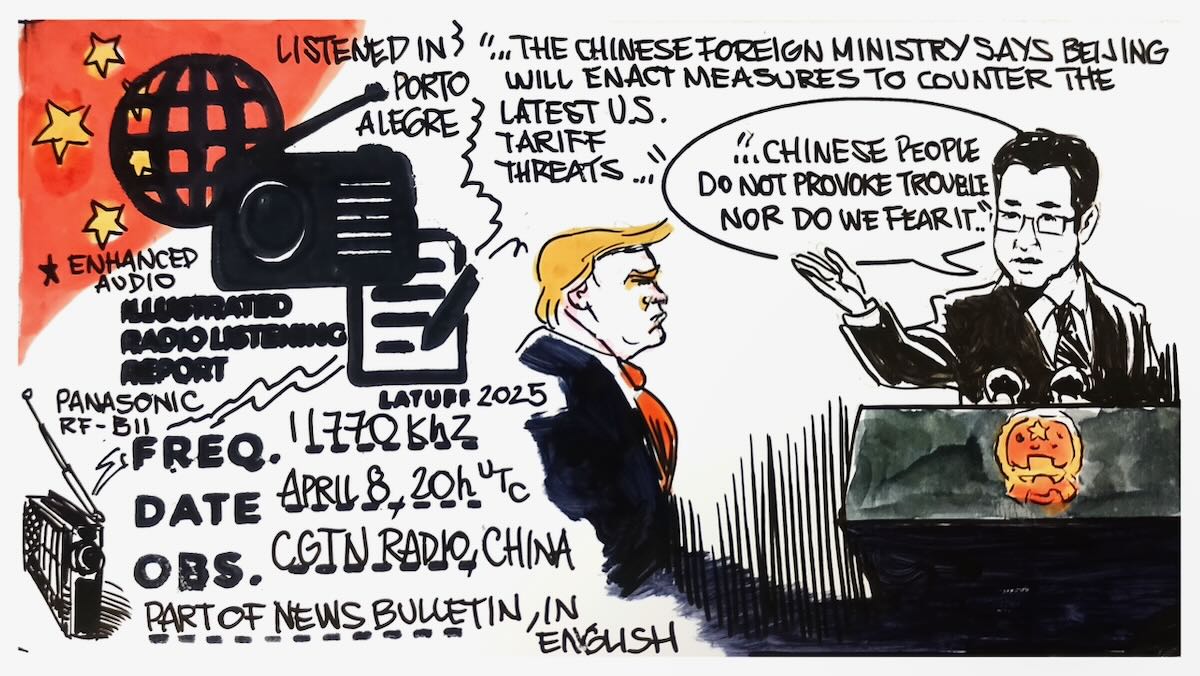
Carlos’ Illustrated Radio Listening Report and Recording of CGTN (April 8, 2025)

Many thanks to SWLing Post contributor and noted political cartoonist, Carlos Latuff, who shares illustrated radio listening report of a recent CGTN broadcast.


Carlos notes:

Chinese people do not provoke trouble, nor do we fear it.” CGTN Radio, China, 11770 kHz.

Part of CGTN Radio’s news bulletin (in English) about the Chinese government response to Trump’s tariffs. Listened in Porto Alegre, Brazil, on a Panasonic RF-B11 receiver.

Click here to view on YouTube.

Radio World: Three Mysterious New Shortwave Stations Approved in the U.S.

From Radio World: In a rare move, the FCC has approved two new construction permits and granted a full license for international shortwave broadcasting—prompting questions about their true purpose. All three applicants—DPA Mac, Parable Broadcasting, and Turms Tech—claim intentions to use the DRM standard, yet past filings and meeting summaries suggest possible ties to high-frequency financial data transmissions, a purpose not authorized under current broadcast rules. Who are these new players, and what exactly do they plan to transmit?

Nick Langan unpacks the story in Radio World. Click here to read the full article.

DRM: Should the U.S. Take the Leap?

Photo by Brock Wegner on Unsplash

Many thanks to SWLing Post contributor, Alan, for his recent article in Radio World titled “The Modernization of Broadcast Radio. In it, Alan argues that the proposed “AM Radio for Every Vehicle Act” in the U.S. should go beyond preserving legacy systems and instead embrace Digital Radio Mondiale (DRM) as the future of terrestrial broadcasting. Drawing comparisons with digital transitions in countries like Norway, Switzerland, India, and China, Alan highlights the potential to reduce transmission costs, increase coverage reliability, and enhance emergency communications — all while offering a path to modernize U.S. broadcasting infrastructure.

Click here to read at Radio World.

Alan Roe’s A-25 Season Guide to Music on Shortwave (version 1.0)

Many thanks to SWLing Post contributor, Alan Roe, who shares his A-25 (version 1.0) season guide to music on shortwave. Alan provides this amazing resource as a free PDF download:

Click here to download Music on Shortwave A-25 v1.0 (PDF)

Alan notes that copies of his “at-a-glance” single-page PDF programme grids of all BBC WS, CGTN Radio, R Romania Int, VO Turkiye and R Taiwan Int English programmes on shortwave all updated for A-25 and are available in his DropBox account: http://tinyurl.com/shortwaveprograms

As always, thank you for sharing your excellent guide, Alan!

This dedicated page will always have the latest version of Alan’s guide available for download.