Shortwave listening and everything radio including reviews, broadcasting, ham radio, field operation, DXing, maker kits, travel, emergency gear, events, and more
Many thanks to SWLing Post contributor, Ed Efchak (WX2R), who shares the following announcement:
The Solar Eclipse Is One Month Away!
Learn How You Can Participate in Two HamSCI Roundtable Events
The last total solar eclipse across North America for twenty years will occur on Monday, April 8th. Hams across North America are asked to participate in learning more about how the ionosphere functions by getting on the air to help scientists in a series of ionospheric experiments.
Connect with HamSCI members and curious hams on Wednesday, March 27 at 8PM (Eastern) / 5PM (Pacific)*, or that same day at 10PM (Eastern) / 7PM (Pacific)* for a Zoom presentation on HamSCI’s Festivals of Eclipse Ionospheric Science (FoEIS). The presenters will take your questions during the 30-minute presentations.
The program will start by covering HamSCI’s basis and purpose, quickly moving into why we are conducting experiments, how hams and SWLS can participate, and what we hope to learn from the event. Along the way, we will discuss why the science behind the events is important to users of the high frequency radio spectrum – including amateur radio operators!
Learn about the HamSCI’s eclipse-focused operating events:
There is no need to pre-register, create an account or log into any site. Simply follow this link at the date and times above to be taken to a Zoom meeting room, hosted by HamSCI: HamSCI FoEIS Roundtable Zoom Link
Join us on March 27th!! Get on the air April 8th!!
HamSCI serves as a means for fostering collaboration between professional researchers and amateur radio operators. It assists in developing and maintaining standards and agreements between all people and organizations involved. Its goals are to advance scientific research and understanding through amateur radio activities and encourage the development of new technologies to support this research.
For more information about HamSCI, to join our mailing list, or participate in our work, please visit us at www.hamsci.org.
The man who defined the sound of live rock ‘n’ roll music and brought audio engineering principals into mainstream amateur radio use, Dr. Bob Heil, K9EID, has passed away at the age of 83. He was an ARRL Life Member and in the ARRL Maxim Society. A Facebook post from Heil Ham Radio paid tribute to their founder: “Bob fought a valiant, yearlong battle with cancer, and passed peacefully surrounded by his family.”
Heil founded Heil Sound in 1966, through which he created the template for modern concert sound systems for musicians like the Grateful Dead, The Who, Joe Walsh, and Peter Frampton. The talk box used on iconic live record Frampton Comes Alive! was of Heil’s design. His audio engineering products have been featured in the Rock & Roll Hall of Fame, and he was honored in 2007 with the Parnelli Audio Innovator Award for his impact on the live sound industry. “My life has been about achieving great sound, whether on the concert stage or in the amateur radio world,” Bob Heil recounted in 2022. “I’ve watched Heil Sound go from a regional sound company to a world-class microphone manufacturer. This company has been my passion,” he said.
Parallel to his commercial and artistic success in live music, was his passion for amateur radio. He was active in ham radio from a young age and merged his expertise in audio engineering with his love for radio. Heil Ham Radio was founded to produce microphones, headsets, and other gear for radio amateurs with an emphasis on high-quality audio.
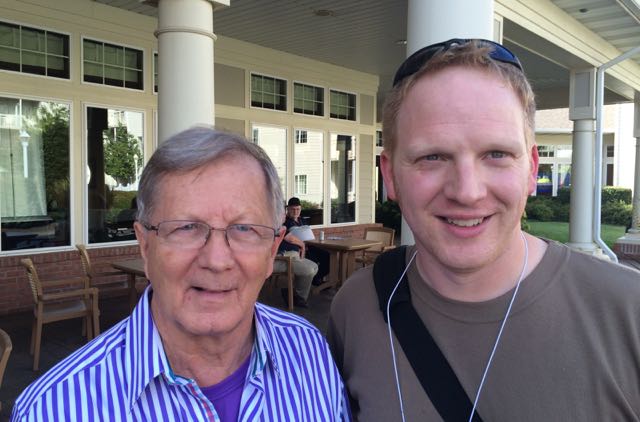
Heil was known as a mentor who enjoyed helping others find success in ham radio. Recently, his grandson Charlie Hartley, KF0OOP, became a licensed ham to surprise Heil for his birthday. The pair attended the ARRL Midwest Convention/Winterfest in St. Louis, Missouri, on January 27, 2024.
Heil was a generous donor to amateur radio organizations, including ARRL. Recently, he donated a host of new audio gear to the Hiram Percy Maxim Memorial Station, W1AW.
His generosity and kind nature will be missed by many, including ARRL Director of Development Kevin Beal, K8EAL. “Bob was a titan in many areas. He was generous with his time, offered keen insights, and had the heart of a philanthropist in the ARRL Maxim Society,” Beal said. “He was a gentleman to his core, making friends easily and everywhere he went, from rock stars to captains of industry. I consider it a real privilege to have become a friend to him, too, all because of amateur radio.”
Heil was known for his passion for AM operations. He served for many years as an on-camera host of the Ham Nation podcast. Tributes to Heil have been flooding social media, including from his co-hosts.
ARRL President Rick Roderick, K5UR, said Heil’s passing is a significant loss. “Bob Heil’s technical achievements that brought high-quality audio to amateur radio pale in comparison to his generosity and willingness to help his fellow ham. He’s long been known as someone eager to help mentor and teach. His legacy on our hobby will be long-lasting. Our thoughts are with his loved ones.”
Many thanks to Ton & Klaas-Jan who share the following announcement:
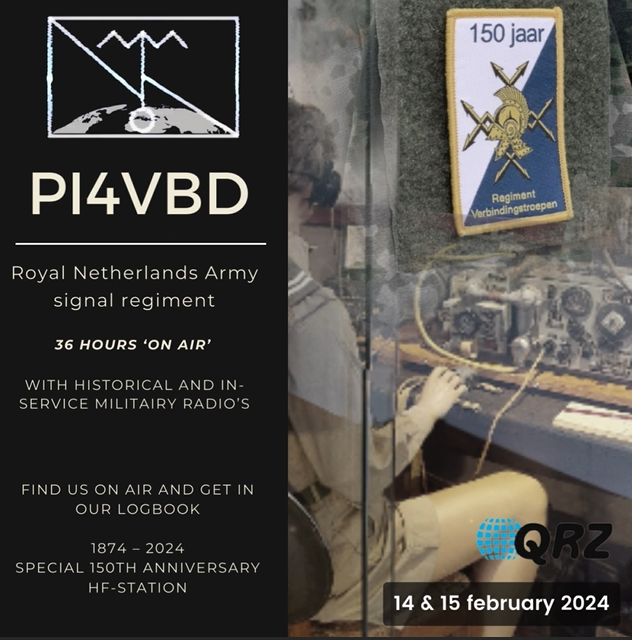
On 14 & 15 February we (the royal netherlands army signal regiment) will celebrate our 150th anniversary.
We will be on air for 36 hours with a all kind of historical and in-service radio’s on all bands in SSB and CW with cadets, servicemen, amateurs, veterans etc.
Would you share our special station among the amateur-radio world?
Thanks in advance!
73
Ton & Klaas-Jan
PI4VBD
Royal Netherlands Army signal regiment radio club
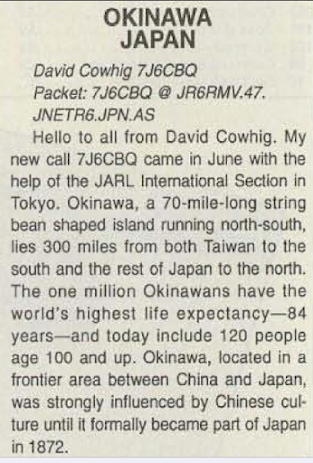
The article about Sergeant Malik Pugh USMC on Okinawa brought back memories from the 1990s. David Cowhig was 73 Magazine’s Hambassador on Okinawa — I had the same “position” in the Dominican Republic. David and I were both in the Foreign Service; we joked that 73 had afforded us our only chances to be ambassadors of any kind. David’s Okinawa QSL and the opening from his initial report to 73 magazine appear above. You can see more here:
Finally (and this is really cool): David Cowhig has been putting his language skills to good use, translating Chinese written material. He sent me his translation of the opening chapters of a Chinese science fiction novel about ham radio. Readers of the SolderSmoke Daily News will like this:
It will provide listeners in Gaza with the latest information and developments as well as safety advice on where to access shelter, food and water supplies
BBC News Arabic has today (1 November) announced an Emergency Radio Service for Gaza in response to the conflict in the region.
The emergency service – Gaza Daily – will broadcast vital news daily to the people of Gaza during this time of urgent need.
It will provide listeners in Gaza with the latest information and developments as well as safety advice on where to access shelter, food and water supplies.
Produced in Cairo and London and broadcast on medium wave, the service will initially run one programme a day at 1500 GMT from Friday 3 November. A second daily update will be broadcast at 0500 GMT from Friday 10 November.
The BBC World Service has a history of responding to emergency situations globally. Most recently, in May 2023 during the conflict in Sudan BBC News Arabic began an emergency radio service. In February 2022, the BBC News Ukraine service began extended TV bulletins following the invasion of the country. The BBC also previously launched a service for Gaza in 2014 following a summer of conflict.
Liliane Landor, Director, BBC World Service, says: “BBC News Arabic are extremely well-placed to offer this vital service for the people of Gaza at a time of greatest need. Their expertise and specialist knowledge of the region alongside the BBC’s reputation as the most trusted news provider, means we can reach civilians in Gaza with the information they need.”
RM3
Notes to editors: The Gaza service will be broadcast on MW 639kHz for morning and evening episodes.
Commission will vote in November on plan to remove outdated technical restrictions
FCC Chairwoman Jessica Rosenworcel says the FCC plans to “incentivize innovation and experimentation in the amateur radio bands” by getting rid of outdated restrictions and providing licensees with the flexibility to use modern digital emissions.
The commission at its November meeting is expected to take action on a Report and Order that would eliminate the baud rate limitation and establish a bandwidth limitation in the amateur radio bands below 29.7 MHz.
The order being circulated for tentative consideration by the commission would remove the baud rate limitation — the rate at which the carrier waveform amplitude, frequency and/or phase is varied to transmit information — for data emissions in the amateur radio bands, the FCC says. The current baud rate limits were adopted in 1980.
The order would implement a 2.8 kilohertz bandwidth limitation in place of the baud rate in amateur radio bands. The 2.8 kHz limitation is consistent with the commission’s treatment of other wireless radio services, the FCC says.
The current rules limit the baud rate for high-frequency amateur radioteletype/data transmissions to 300 baud for frequencies below 28 MHz (except in the 60-meter band), and 1200 baud in the 10 meter (28-29.7 MHZ) band. [Continue reading…]
Amateur radio operators who study space physics and the upper atmosphere probed the ionosphere’s response to the 2023 annular solar eclipse using shortwave transmissions.
On 14 October, millions of people in North, Central, and South America peered through safety glasses and other viewing aids at the partially obscured Sun. Simultaneously, thousands of folks experienced the annular solar eclipse in a different way: through transmissions sent and received over amateur radios.
Before, during, and after the eclipse, ham radio operators pinged signals off the ionosphere and connected to people hundreds or thousands of kilometers away. The experiment, part of the Ham Radio Science Citizen Investigation (HamSCI), is gathering hundreds of thousands of those contacts to investigate how the ionosphere responds to the temporary loss of sunlight during an eclipse. [Continue reading…]
The U.S. Coast Guard also is concerned about petition from the Shortwave Modernization Coalition
Numerous commenters have told the FCC that a proposal to “modernize” the shortwave band is a threat to amateur radio operators in the United States and possibly the end of ham radio as we know it. And hams are just one source of opposition to the idea.
The FCC inquiry was prompted by a request from the Shortwave Modernization Coalition for a rulemaking to amend the Part 90 rules.
SMC believes there is underutilized spectrum in the high-frequency bands. The coalition wants to use 20 kW transmitters for the transmission of time-sensitive data from fixed stations. It wants the FCC to allow these fixed, long-distance, non-voice communications in multiple bands between 2 MHz and 25 MHz.
Ham opponents worry about interference. One also characterized the coalition as being “packed with special interest groups that harbor little interest in shortwave modernization beyond their own needs to getting faster financial market information.”
The commission’s Office of the Managing Director sought comments on its proposal this summer. The petition, RM-11953, drew more than 800 comments. [Continue reading…]
Many of us hold fond memories of listening to AM radio in the car. But these days, drivers are just as likely to listen to satellite radio, Spotify, audiobooks or podcasts. Good ole FM radio is still around too. That’s led many people to question if AM, America’s oldest broadcast medium, still has a future?
Not many people noticed when Tesla removed AM from new vehicles a few years ago. Ostensibly, they did so because the frequency interferes with electric vehicles. Never mind that older Teslas previously had functioning AM/FM radios. Or that the Federal Communications Commission has rules to limit electrical interference. Seemingly no one questioned Tesla’s decision.
In the past couple of years, other manufacturers including Ford, Audi, Volvo, BMW and Porche began removing AM receivers from new models or announced plans to do so. This elicited a more passionate response from AM listeners, particularly those in rural areas. For them, the frequency is more than just entertainment. They say it’s a lifeline for those in remote areas who otherwise wouldn’t have access to emergency information. It’s also one of the last places where they can get hyper-local news and entertainment. [Continue reading…]
It has been with great interest that I’ve read about carmakers dropping AM reception capability in new cars, particularly EVs, and about the introduction of the “AM for Every Vehicle” Act.
The reason most often cited by makers of electric vehicles is interference from on-board systems to AM band reception. The truth is we have ourselves to blame.
The assault on AM band purity predates the popularity of electric vehicles by decades. The onslaught of cheap switching power supplies in consumer electronics, RF noise-producing computers and personal devices, and the absolute lack of any care given to protecting the spectrum are incompatible with AM quality.
For far too long, consumers, manufacturers, the NAB and even the FCC did not fight to protect the band. It seemed nobody cared whether new fluorescent lights (remember those?) caused so much noise that they even affected reception in neighbors’ homes. Nobody took up the fight to keep the band clean and make noise-free AM reception even somewhat possible in high-density housing areas. Nobody seemed appalled at this complete disregard for the usefulness of the band in the future. [Continue reading…]
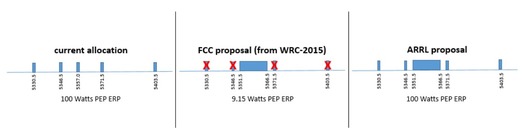
ARRL The National Association for Amateur Radio® is asking that all radio amateurs urge the Federal Communications Commission (FCC) to continue the existing use of the 60-meter band. A public comment period is open until October 30, 2023. ARRL encourages expressions of support to the FCC for the current 100 W ERP power limit (instead of reducing the power limit to 15 W EIRP) and continuing secondary access to the current channels.
When submitting your comments, be sure the correct proceeding’s docket number, 23-120, is included on the form.Your name and comments will be entered into the official public record of the proceedings and will be viewable by anyone who visits the docket web page.
While radio amateurs are encouraged to include any comments they would like in their submissions, they’re especially encouraged to draw upon their personal experiences using the 60-meter band for public service purposes and for its location between the amateur 80- and 40-meter bands, which is critical to ensuring signal propagation to certain geographic areas during variations in time and the solar cycle.
Some of the main points to comment on for this NPRM are:
Urging the FCC to keep the four existing channels allocated to amateur radio on a secondary basis.
Urging the FCC to keep the 100 W power limit for the four existing channels and the new 15 kHz subband.
ARRL Public Relations and Outreach Manager Sierra Harrop, W5DX, underscored the importance of commenting, urging members to speak up. “ARRL members make up the strongest voice in matters of amateur radio spectrum defense,” said Harrop. “Your membership and participation in the rulemaking process both ensure ARRL continues to make the difference when our band privileges are threatened. Please join us in effort to protect our 60-meter band privileges.”