 Many thanks to SWLing Post contributor, Mario Filippi (N2HUN), for the following guest post:
A Look Back: Memories of the Panasonic RF-2200 and its Sibling, the National Panasonic DR22
by Mario Filippi, N2HUN
All photos by author unless otherwise noted
One of the preeminent AM/FM/SW portables of all time is the venerable Panasonic model RF-2200 receiver that was sold in the USA starting in the mid-1970’s for around $165.00 US.
Weighing in at a hefty 7 pounds, 13 ounces and vital statistics of 12” x 7” x 4” it came equipped with a robust shoulder strap to schlep from the radio shack to alfresco listening sites and was basically a completely self-contained entertainment center for the radio enthusiast. My first RF-2200 was purchased in the late ‘70’s from Grand Central Radio Shop in New York City, now just a memory and long gone, but back then they sold a bevy of shortwave and ham radio equipment.
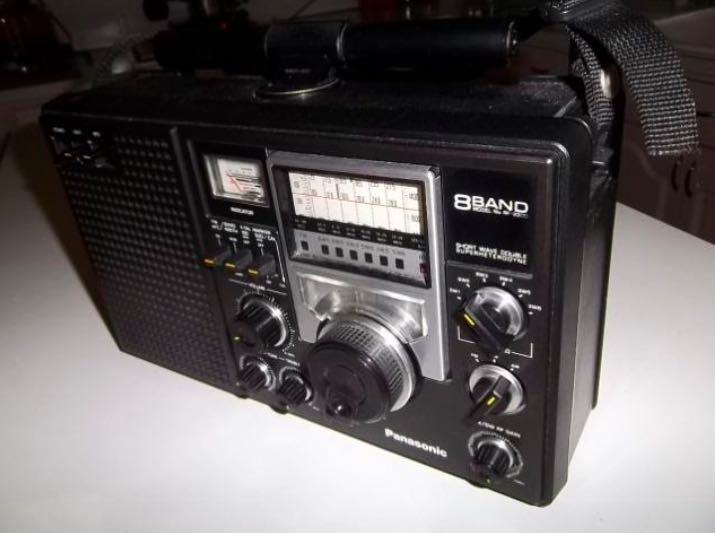
Photo 1. Author’s favorite portable of all time, Panasonic RF-2200
It was love at first sight when I saw the RF-2200 in the store’s gleaming glass display case way back when. The ‘2200 possessed all the bells and whistles to guarantee a good time for the SWL such as a rotatable ferrite AM broadcast band antenna, BFO (Beat Frequency Oscillator) for SSB reception, AM /FM/SW (3.9 – 28 MHz) bands, a D’Arsonval “S” meter that doubled as a battery status indicator, large four inch front mounted speaker, switchable coarse/fine tuning speed, base/treble/RF gain pots, 125/500 kHz crystal markers to calibrate the VFO, wide/narrow bandwidth switch, dial/S meter lights, earphone/recorder jacks and telescopic antenna for SW and FM. Plus it sported the renowned Panasonic trademark.
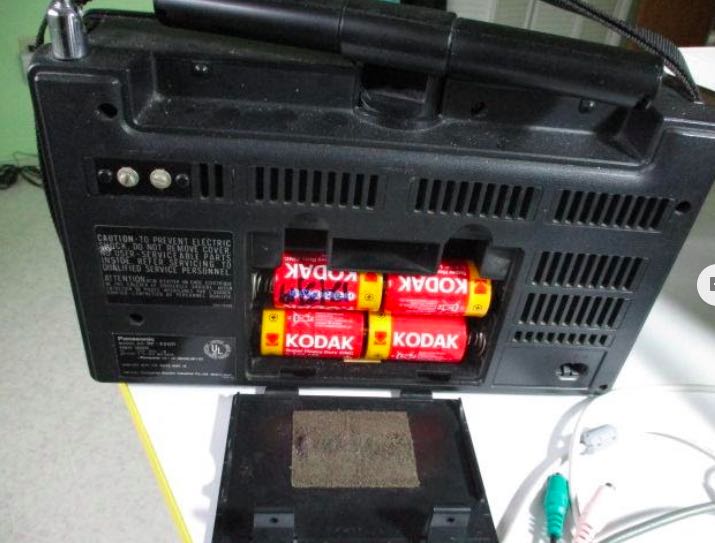
Photo 2. RF-2200’s rear: exposed battery compartment, screw connectors for external antenna, AC plug lower right. Rectangular earphone storage compartment is above batteries. Battery cover’s gray foam pad is dry rotted and needs replacement.
Part of the 2200’s ample avoirdupois can be attributed to the unit’s four “D” battery power plant, but Panasonic also supplied an AC cord to plug into the house mains and an earphone (located inside the battery case). It runs forever on those four stout dry cells, one of the many positive features of this vintage gem.
Back in those days portable radios generally were not judged and valued based their diminutive size and weight but on the array of features geared to the end-user. Front panels were festooned with an array of controls rivaling an aircraft’s cockpit. Knobs, analog dials, meters, large front-mounted speakers, switches and lots of black plastic were the order of the day. These all contributed to the beauty and practicality of portable shortwave radios back then.
One thing missing though was built-in memory channels; those existed in the operator’s brain and not yet delegated to memory chips.
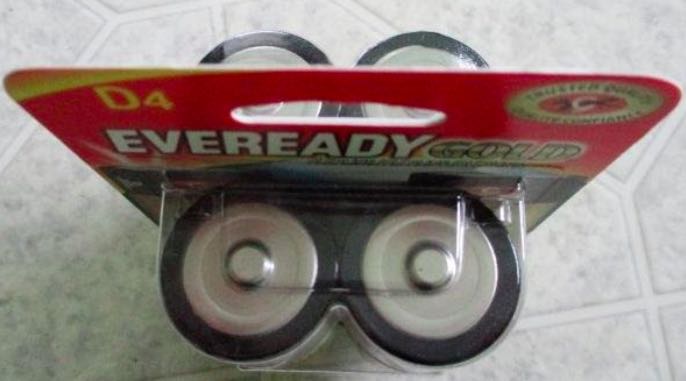
Photo 3. Pack of four “D” cells, at 1 lb 4oz, weighs more than some of today’s portables!
One of the features long gone and missing in modern receivers these days is the “recorder out” jack that looks identical to an eight-inch earphone jack and yes the ‘2200 has one. It was used to plug in a tape recorder to memorialize an op’s favorite radio show. Of course back then there were many more shortwave stations broadcasting. Gone also are those tiny incandescent bulbs, sometimes described as “grain of wheat” lamps that were used on S meters, dials, etc. The RF-2200 sports ample illumination for the S-meter and tuning dial which makes it a perfect bedside table radio for late night DX’ers and insomniacs.
Speaking of DX, the ‘2200’s rotatable AM ferrite antenna is one of the main virtues this radio possesses. As an avid AM DX’er and faithful disciple of AM radio in general, the ‘2200’s rotary directional antenna nulls out noise and routinely pulls in stations as far away as Nashville (WSM), Chicago (WBBM), St. Louis (KMOX), Atlanta (WSB), Boston (WBZ) and Toronto (CJBC) when the sun goes down. Look closely at the antenna mount’s base and you’ll even see compass-like degree markings that’ll help when retrieving a favorite local or DX AM station.
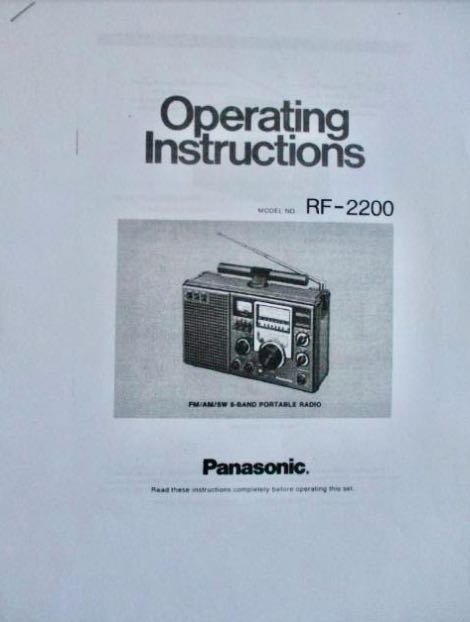
Photo 4. Operating manual copy is available on-line
Shortwave coverage is approximately from 3.9 – 28 MHz as per the service manual, but I’ve checked the actual coverage of my unit using a calibrated service monitor and found it to be 3.47 – 28.9 MHz which makes sense since I’ve tuned to W1AW’s code practice on 3.581 MHz with no problem and have also heard the Volmet station on 3.485 MHz. That’s good news for hams wanting to receive 80m CW. It gets a bit tricky though using the fine tuning option for CW hi hi.
AM broadcast band coverage is only from 525 – 1610 kHz as per the specifications; the AM band had not yet been extended to 1710 kHz at that time. The ITU approved the extension in 1988. With that in mind I wanted to determine what the actual band coverage of my unit was. Again, using an IFR service monitor it was found to be from 514 – 1720 kHz; that’s good news for those who listen to stations at the top of the band. It also explains why I can hear YWA, a non-directional radiobeacon (NDB) from Toronto, Canada just below the AM band on a frequency of 516 kHz. If you own a RF-2200 or DR22 tune to the bottom of the AM band and listen for it. You may also hear the warbling sound of NAVTEX stations on 518 kHz. Switch on the BFO and wait for dark, you might get lucky like I have.
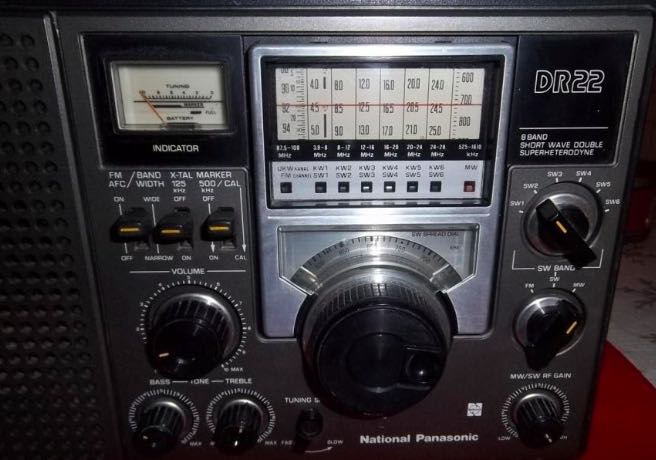
My apologies for not being an FM broadcast band listener so all I can state is the few times I’ve listened it sounded absolutely great. The specs state a FM broadcast band frequency range of approximately 87.5 – 108 MHz. Mine measured from 86.8 – 108.9 MHz but I’ve yet to realign my unit so these ranges may vary among the population. Note that I have undertaken the labor intensive task of aligning my National Panasonic DR-22 which is almost the exact same unit as the ‘2200. You can search this blog for my results that were kindly published by Thomas previously (click here to read).
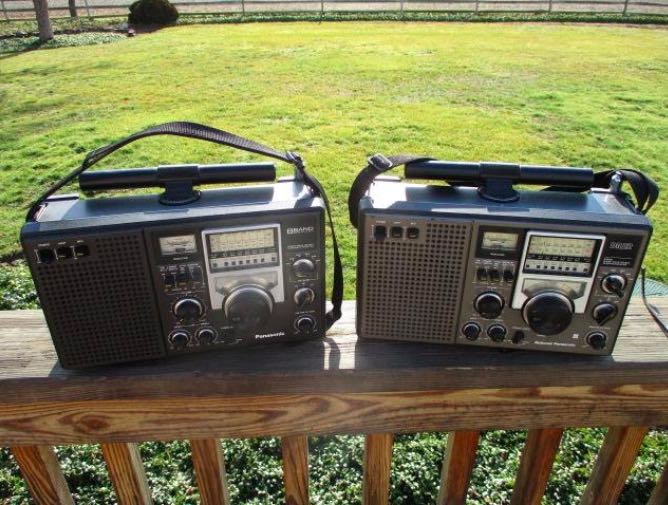
Photo 5. Side by side comparison. Panasonic RF-2200 on left, National Panasonic DR22 on right.
For those not aware, the RF-2200 was also marketed in Europe as the National Panasonic DR22 and in other parts of the world as the Cougar 2200. My DR22 was an eBay purchase, and that’s the best place to find either model.
DR22s are rather rare compared to the ‘2200 though. First off, one of the major differences with the DR22 is that it runs on either 110 or 220V, and that’s accomplished by a switch on the back of the unit.
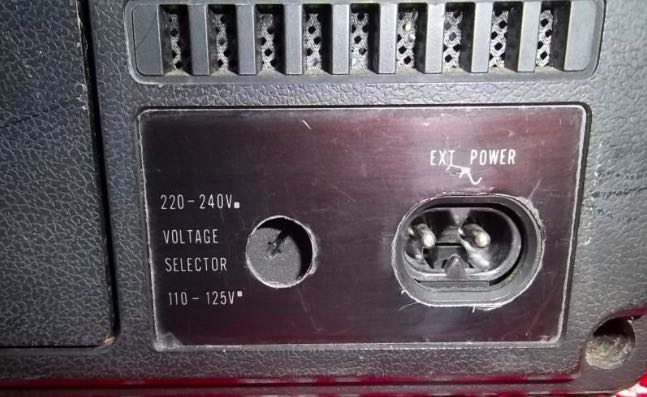
DR22 runs on 120 or 240V via switch on rear panel
The DR22’s front panel stenciling is slightly different too, as shortwave bands are labeled “KW 1 – KW 6” in addition to “SW1 – SW6”. Not sure what “KW” means though. Perhaps some reader can enlighten us.
Well, that’s about it, if you want a RF-2200, or DR22 then window shop on eBay. Lately they have been selling from $40.00 US (parts only) to $455.00 for pristine units. That’s a pretty wide price range and even I’m surprised at the high prices being gotten for clean units. All I can say is that the two I have now are staying right here in the shack with me.
Thanks for reading and 73’s.
eBay searches (note these eBay partner links support the SWLing Post):
Thank you so much for sharing this excellent post, Mario. Like you, I’m a massive fan of the Panasonic RF-2200; in fact, I own two of them! It is, in my opinion, the best AM/MW portable ever made.
Post Readers: Any other RF-2200 and DR22 owners out there? Can anyone explain why the DR22 labels shortwave bands as “KW1 – KW6”–? Please comment!
Do you enjoy the SWLing Post?
Please consider supporting us via Patreon or our Coffee Fund!
Your support makes articles like this one possible. Thank you!


Here are two more back to back episodes from my collection of recordings of Shortwave Listener’s Digest from Radio Canada International, this time from July 26 and August 02, 1982.