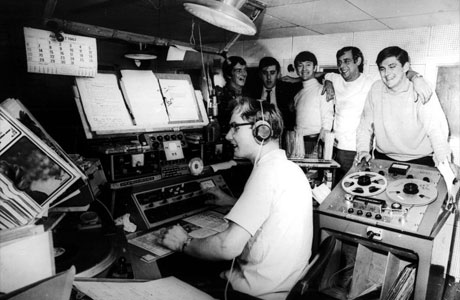
I’ve found that one side benefit of installing a 40 meter delta loop this past weekend is that I now have an antenna which is practically ideal for listening to pirate radio stations in and around the 6925 kHz “watering hole.” So, I’ve been spent a lot of evenings recently listening for pirates with the new antenna.

Shortwave Pirate MAC Shortwave featured DJ Ultraman
But Sunday night was a noisy night on the 40 meter band–I was hearing active static crashes probably associated with hurricane Irene. I did pick up a relatively strong signal from pirate station MAC Shortwave with DJ Ultraman at around 20:40 EST (00:40 UTC)–listen to the end of the broadcast here:
Note that I start the recording using the Alinco DX-R8T, but find the bandwidth too wide (hence the adjacent broadcaster you hear), so I switch to my Palstar R30C. One bonus in this recording: Commander Bunny’s parody of “I Shot the Monkey” originally recorded from WBNY studios.
At the top of the hour I heard Renegade Radio start a broadcast, but the signal was very weak here in the southeastern US. In fact, I couldn’t even ID the station. So, I turned to a trick I’ve used on tabletop and portable shortwave radios alike–namely, Exalted Carrier Reception (ECR) also known as Exalted Carrier Single Sideband (ECSS) reception.
What is ECR or ECSS?
Simply put, it’s when you tune in an AM broadcast using the SSB mode on your radio. In my case, I turned on the USB (upper side band) mode on my Palstar and zero-beat the frequency–meaning, I tuned out the hetrodyne whine until the audio sounded as natural as possible.
This is sort of a “poor man’s version” of synchronous detection (and, frankly, a little inferior to sync detection on most radios). Still, in this case, it made a huge difference in the intelligibility of the broadcast.
Why does it work? Well, as my ham buddy Mike recently explained it:”You are removing any selective fading problems by filtering away one of the sidebands and injecting a carrier of steady amplitude which eliminates the ‘tearing’ heard when a broadcast carrier is varying in amplitude.” Got that?

The Palstar R30 in USB mode tuned to Renegade Radio
At any rate, one of the reasons it works so well on my Palstar is because I can keep the bandwidth set rather wide while listening in SSB, thus helping a bit with the loss of fidelity that happens when moving off of the AM mode. If your radio automatically switches to a narrow filter in SSB mode, the audio fidelity may take a bigger hit, and degrade further.
Though I don’t have a comparison without using the ECR/ECSS method, I can tell you that the AM signal was barely audible. After tuning in using ECR, it became armchair listening.
Listen to almost one hour of Renegade Radio for yourself:
Those of you who have old radios with a very stable variable BFO (beat frequency oscillator) instead of a product detector might try using your BFO tuning to inject the BFO directly over the fading broadcast carrier to accomplish same kind of reception as ECR.
So, next time you have difficulty hearing a weak shortwave station, consider turning on the SSB mode and using the ECR/ECSS method. You may like what you hear! Ahoy, there…
 Last night, I tuned to the pirate radio watering hole of 6,925 kHz shortwave. I caught a bit of the Southern Relay Network as they played several hurricane and storm themed songs.