Category Archives: Radio History

Listen to RFE Hungary’s 1956 Revolution Broadcast

Many thanks to SWLing Post executive producer, Scott Gamble, who shares the following article from Hungary Today:

From October 19th until November 12th, Radio Free Europe‘s (RFE) Hungarian broadcast recorded around and during the 1956 Revolution can be listened to online, exactly how it was aired 63 years ago minute by minute, HVG reported.

The Hungarian broadcast of RFE’s 1956 program that was aired on shortwave, through foreign transmitters, was recorded at the repeater stations, and has been preserved thanks to the German government’s examination of the radio’s role in the revolution, launched after the events.

After the inquiry, however, the footage, consisting of 60 tapes, was concealed in a basement for decades, until it was rediscovered in the 90s, transferred to cassettes, and digitized.

In the framework of the First University Radio in Pest’s (Els? Pesti Egyetemi Rádió- EPER) voice memorial project dubbed “SZER56” (derived from the radio’s Hungarian name: Szabad Európa Rádió), people can hear (once again) these recordings. The recordings were restored, digitized, and published by the National Széchényi Library (OSZK), which EPER then restored to the original broadcast session.

The footage includes four days that preceded the outbreak of the Revolution, making it the only available recording that preserved the 50s’ “every day” shows. Moreover, this would be the first time the public can hear this outstanding piece of media history. In addition to political broadcasts, the recordings include radio plays, musical compositions, and even quizzes.

The “broadcast” will be available from Saturday on eper.elte.hu or here and here.

Click here to read the full article at Hungary Today.

Thank you for the tip, Scott!

Readers: If you know of any way we could obtain these recordings, I would love to add them to the Shortwave Radio Audio Archive.

Radio Malaysia QSL and memories

In response to our post regarding Radio Sarawak, SWLing Post contributor, M Breyel, shares the following:

These were the shortwave frequencies RTM used in 1975. This is my QSL card for an RTM transmission originating from Penang, as received on Denver, Colorado. [Click images to enlarge.]

Most MW stations in Malaysia ceased operation after 2000. That said, a 750 kW MW station in Sabah remained operational as late as 2008, if I remember correctly. My guess is FM became more prominent thereafter.

Certainly here in peninsular Malaysia (Kuala Lumpur), particularly in 1987, we had six government FM stations. Sign-off was usually at midnight or 1 am, depending on the station. An annual license (tax) was issued for each radio owned.

Note, the QSL card [above] appears to have first been printed in 1973, judging by the smaller date printed at the bottom of the card. It was one of the few folded cards I received in my DXing years from 1967 to 1980. It features three sections, folded twice and printed on both sides. The Angkasapuri studio in Kuala Lumpur, map and flag of Malaysia, caption about the country, transmitter sites and frequencies and verification data is depicted on it.

This particular card was issued for a reception report I posted on 22 November 1975, nearly 40 years ago. Unbeknownst to me then I had picked up Radio Malaysia via Penang, according to the frequency legend (4.985 kHz) stated on the card. I assumed it was Kuala Lumpur and, more importantly, I was excited to have logged a new country to my growing list of international broadcasters.

At the time I lived in Northglenn, Colorado — a suburb north of Denver. As I recall Radio Malaysia was usually received in the early morning hours between 5 and 8 am. Reception was always weak, yet music and speech was audible despite atmospheric noise.

The receiver I used was a Zenith Trans-Oceanic H-500, a 5 valve/tube radio originally manufactured in the early 1950s. The antenna was an inverted L, elevated at over 30 feet, spanning approximately 75 feet in length.

This is a photo of Angkasapuri, the RTM Headquarters in Kuala Lumpur, as it appeared in 1987. The HQ as changed very little since then:

Interestingly, the Australian Armed Forces had a radio station based in Penang in the late 70s-early 80s.

For more on vintage QSLs from Malaysia, please refer to my blogsite.

Or see this video.

Wow–thank you for sharing your DXing experience with us! It sounds like the Zenith Trans-Oceanic H-500 served you quite well back then! What a classic set.

Post readers: Please check out M Breyer’s blog for more interesting DX and radio history.


Do you enjoy the SWLing Post?

Please consider supporting us via Patreon or our Coffee Fund!

Your support makes articles like this one possible. Thank you!

1961 Film: “Tuning In Radio Sarawak”

Many thanks to SWLing Post contributor, Adid, who writes:

Hi Thomas, I just watched this very interesting DX film about RADIO SARAWAK.

It’s a behind the scenes look at radio in the tropics, with great vintage gear.

I don’t think it was FM as it’s was much expensive and coverage is limited. But on the other hand we don’t see the large MW antennas

What do you think?

Click here to view the film at the Imperial War Museum website.

Good question, Adid. The FM band wasn’t widely included on radios until the late 1950s and early 1960s. Since this film dates from 1961, I imagine some of those new transistor/valve radios could have included FM, although I imagine mediumwave was the choice band for regional broadcasts.

Hopefully, an SWLing Post reader can shed some more light on Radio Sarawak’s history! Please comment!

Knock John Sea Fort and life on Fort Roughs

Many thanks to SWLing Post contributor, Dave Porter, who writes:

This is a recent posting of a trip out to the Knock John Fort and also of a new book about life on a sister fort, Roughs Tower.

Report – – Knock John Sea Fort – May 2018 | Noteworthy Report

The fort is still dry inside. This was the home of R Essex and the RCA ET4336 + T aerial. When Bates closed Essex they moved to the Roughs.

Check Amazon for the book “Holding the Fort” by Bates son [affiliate link]. It’s a hardback book and is excellent. An early Christmas present!! Plenty of pics and Sealand as well plus their TX and studio.

Fascinating!  Thank you for sharing this, Dave!

RadioTapes.com: a treasure trove of airchecks from the Minneapolis/St. Paul markets

Cassettes

Photo by Ar Meftah

One of our contributors on the Shortwave Radio Audio Archive, Tom Gavaras, has been sharing some brilliant airchecks. I also discovered that Tom runs an amazing site simply chock-full of Minneapolis/St. Paul airchecks. Tom writes:

Hi Thomas,

[…]As an FYI … I own/run a website called RadioTapes (www.RadioTapes.com). It features more than 2,000 airchecks of Minneapolis/St. Paul radio stations dating back to 1924. You will also find some shortwave recordings that I previously posted (on the Special Postings page).

In addition to my collection, the website includes airchecks provided by more 100 contributors. RadioTapes also has a Facebook page with 1,400 followers.

Post readers: I strongly suggest you check out Tom’s amazing archive of airchecks.  If you ever lived in or DXed the Minneapolis/St. Paul market, you’ll certainly hear some familiar voices and IDs.

Thank you Tom!

Click here to check out RadioTapes.com.

Platja de Pals: Once a Cold War “front line” for Radio Liberty

(Source: CNN via Tracy Wood)

(CNN) — It’s March 23, 1959. The radio waves crackle and broadcast begins: “Govorit Radio Svoboda” (??????? ????? ??????? – “This is Radio Liberty speaking…”)
From the other side of the Iron Curtain, the radio broadcasts of US-funded Radio Liberty reached deep inside the Soviet Union. This was an opening line destined to enter Cold War folklore.

What most of those clandestinely tuning in could not possible imagine is the unlikely location those broadcasts were coming from.

This quiet beach resort of Platja de Pals, Spain, tucked between the Mediterranean Sea and the greenery of pine groves and rice paddies, makes for an unlikely Cold War front line, but this is exactly the role it played for nearly half a century.

At this spot, some 150 kilometers north of Barcelona, Catalonia’s rugged Costa Brava opens up into a large bay lined by a long sandy beach, the perfect location for what was to be one of the most powerful broadcasting stations in the world.

Strategic location

In the mid-1950s, and after nearly two decades of international isolation for Francisco Franco’s Spanish dictatorship, the increasing tensions of the Cold War provided the background for a rapprochement between Spain and the United States.

In this new Cold War context, Washington took an interest in Spain’s strategic location. General Franco, himself a staunch anti-communist, was happy to oblige. In a landmark deal, the United States was provided with a string of bases on Spanish soil, while Franco’s dictatorship would see its relations with the West restored.

The setup of Radio Liberty’s broadcast station in Pals was a side effect of this new geostrategic reality.

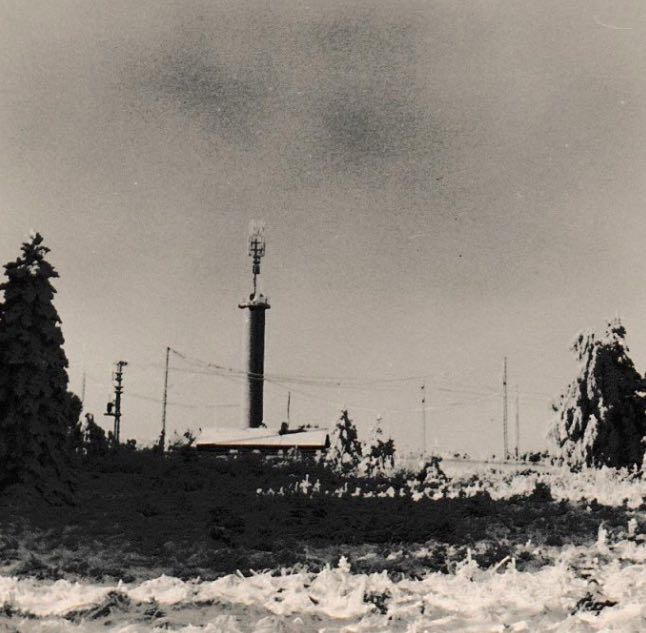
From 1959 to 2006, this beach was home to 13 massive antennas (the largest of them 168 meters high, or more than half the size of the Eiffel Tower). This spot was favored not only because of the availability of space — the antennas were laid out in a mile-long line parallel to the shore — but also because it provided direct, unimpeded access to the sea. A physical phenomenon called tropospheric propagation makes it possible for radio waves to travel further over water.[…]

Click here to continue reading at CNN.

KUNC piece features WWV

Chief Engineer Matt Deutch at WWV/WWVB. (Photo: Thomas)

(Source: Southgate ARC via Eric McFadden)

Broadcaster KUNC reports that a little-known radio station in Fort Collins might one day save the world

An array of radio towers sits behind security fences amid farms and pastures north of Fort Collins. This is home to WWV, the country’s oldest radio call letters. The station’s high-frequency broadcasts can be heard around the globe if you have the right kind of radio.

Now playing: pulsing sounds, every second, followed by an announcement of the exact time.

The station is run by the National Institute of Standards and Technology in Boulder, which is home to the atomic clock. WWV is capable of more than telling time. It could, if need be, save the world.

“Could be,” said Elizabeth Donley, chief of NIST’s Time and Frequency Division. “It’s an important part of our work.”

This year the station conducted communications exercises in coordination with the Department of Defense. Thirty-seven states, National Guard units, emergency management agencies and others participated in simple announcements. They were meant to see how many listeners are out there and how far away they can be reached. The answer: there are thousands of listeners as far away as Australia and New Zealand.

Mark Jensen, a civilian planner with U.S. Northern Command, the military’s homeland security operation in Colorado Springs, called WWV a “most essential asset to our nation.”

Should an emergency arise, volunteers would jump into action. They’re part of a program the military dubs MARS, which stands for Military Auxiliary Radio System. While jokes abound that the operators should not be confused for Martians, their work is serious. It’s doomsday stuff, like responding to the aftermath of a nuclear attack because the associated electromagnetic pulse could wipe out most communications.

Listen to program and read the full story at
https://www.kunc.org/post/how-little-known-radio-station-fort-collins-might-one-day-save-world