For your listening pleasure: two hours of music, and a little Greek commentary, from the Voice of Greece.
Recorded on February 24, 2013 at 00:00 UTC on 9.42 MHz.
Click here to download the MP3 of the recording, or listen below:
For your listening pleasure: two hours of music, and a little Greek commentary, from the Voice of Greece.
Recorded on February 24, 2013 at 00:00 UTC on 9.42 MHz.
Click here to download the MP3 of the recording, or listen below:
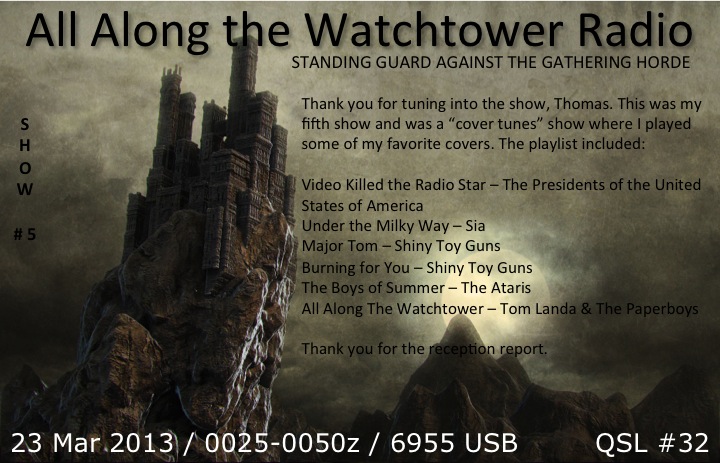
For your listening pleasure: 2 hours and 46 minutes of pirate radio station, Wolverine Radio–recorded Sunday, February 17, 2013 around 2:40 UTC.
Wolverine was broadcasting on 6.925 MHz in the upper side band. Typical of Wolverine, lots of music variety which spans the decades, and no commentary other than station ID throughout.
I decoded two of the SSTV images Wolverine transmitted; the Canadian flag (see right) and this one. You can easily decode these live, or via the recording below. Per Ragnar’s suggestion, I now use MMSTV to decode SSTV images.
Click here to download the full recording of Wolverine Radio, or simply listen via the embedded player below:
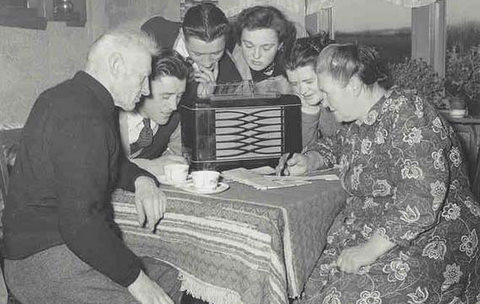
Earlier this week, I posted an article about wind-up (clockwork) radio inventor, Trevor Baylis.
I recently discovered a 1995 episode of RNW’s Media Network, which featured Baylis–and the clockwork radio–in the context of inventions that would carry us beyond the new millenium:
(Source: Media Network Vintage Vault)
Remember Trevor Baylis and the wind-up radio? I organised a conference for Radio Netherlands at the International Broadcasting Convention IBC between September 11-14th 1995. We decided to celebrate the fact that we were 5 years away from a new Millennium by looking at the technologies that would carry us forward. That included a look at different codings for DAB, a reality check on radio by Sri Lankan broadcaster Victor Goonetilleke and a special performance about the Clockwork Radio from Trevor Baylis, the British inventor who turned up in Amsterdam and charmed the audience with his frank, funny and brilliant introduction to the concept of wind-up radios. A few weeks after the conference we produced a special CD for those who took part. This is a copy for those who missed it. It’s double the length of a normal Media Network, just over an hour.
You can download this archive episode of Media Network on the Vintage Vault website.
By the way, Jonathan Mark’s Media Network Vintage Vault has many, many audio treasures from the radio past. Certainly worth bookmarking!

This week’s Jazz Notes starts with the Thelonious Monk song”Evidence” interpreted by the Blaine Whitaker Group (Photo source: Ohio University)
This morning at 13:30 UTC, I enjoyed listening to 11,945 kHz, home of Radio Australia and their Wednesday music show, Jazz Notes. I recently posted a recording of Jazz Notes and described my fondness for this particular show. Moreover, I find that the sonic texture of the shortwave ether enhances the nostalgic character of one my very favorite music genres.
As on most mornings, the signal out of Shepparton, Australia, on 11,945 kHz was very strong; the audio fidelity was, in consequence, very impressive for a transmission emanating from some 9,800 miles away.
Click here to download the full recording of Jazz Notes as an MP3, or simply listen via the embedded player below:
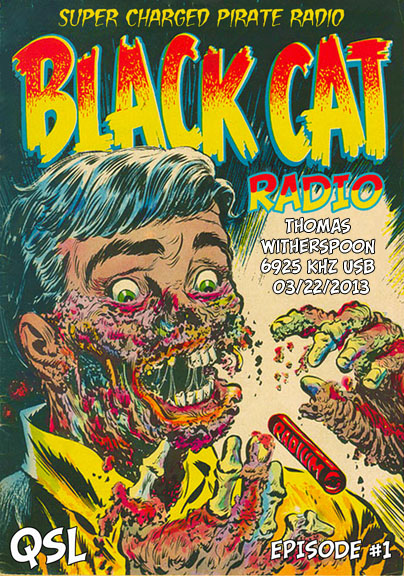
For your listening pleasure: 32 minutes of pirate radio station, WMPR.
I recorded this broadcast of WMPR on 6.925MHz AM on February 17th, 2013 at 10:00 UTC. You’ll note that this recording sounds a little “brighter” than a typical shortwave radio recording. This is due to the fact that I widened the AM filter to match the bandwidth of WMPR’s signal (about 17 kHz!).
Click here to download the MP3 of the recording of WMPR, or simply listen below:
The Degen DE32 is one of the latest DSP-based analog radios to hit the market. In the past, I have reviewed two others: the Degen DE321 and the Kchibo KK-9803. Tecsun had announced a version of their own–the Tecsun R-2010–which I had eagerly anticipated, but I now believe it’s been dropped from their future offerings. [Update: Not true–the Tecsun has been released as the R-2010D, see review].
I purchased my Degen DE32 from this China-based seller on eBay. To my knowledge, eBay
is the only place the DE32 can be purchased, at time of posting. As with the other radios mentioned above, my expectations were quite low for this little radio. After all, at $27 US (shipped), you can’t expect top-notch performance characteristics.
The DE32 comes with a carry strap, USB cable, a carry pouch, slim rechargeable battery, and operating instructions in Chinese. It does not come with a USB wall adapter (you’ll have to plug it into a USB port on your PC or other USB wall charger) and it does not come with a Micro SD card (for digital audio playback).
Audio
The DE32 has a small built-in speaker. The sound is a bit tinny, but is actually better than I expected from a speaker of this size. It makes for comfortable listening at close range–especially of spoken-word broadcasts. Happily, plugging in a good set of earphones helps audio fidelity tremendously. This is the only way I would listen to music on the DE32 for an extended period of time. On FM, in fact, audio via earphones is surprisingly good (again, for a $27 radio–check out the audio sample below).
Performance
The DE32 covers three radio bands: medium wave (AM), FM and shortwave (5.6-22 MHz). Performance between bands varies greatly. The best band, by far, is FM. Again, no surprise here, as the DE321 and KK-9803 performed quite well on FM.
Here’s a 20+ minute audio sample of a local classic rock radio station I recorded, 95.7FM The Ride:
From my home, I can pick up my benchmark distant NPR station quite easily if I hold the radio in my hand. If I place the radio in a window sill, its performance degrades somewhat and contains more static as the extra grounding (from holding the radio) made a positive difference. The audio, though, is still perfectly intelligible. Local FM stations come in quite clear and fidelity (through headphones) is excellent.
I found that strong local medium wave (AM) stations sound quite good on the DE32–better than its cousin, the DE321, by a small margin.
While traveling over the holidays in December, I recorded extended samples of local station (630AM WAIZ) with both the DE32 and the DE321. You can listen to audio samples below, but first it’s important to note that I recorded these (and the FM sample above) with my Zoom H2N digital audio recorder, with radios at a comparable volume and via an audio patch cord.
Note that these recordings represent what each radio sounds like via headphones, not their internal speakers.
This is WAIZ on the Degen DE32:
Compared with WAIZ on the Degen DE321:
You’ll note that the DE32 sounds a little fuller than the DE321, but reception is nearly identical on this local strong medium wave (AM) station. I also found that the DE32 was quite effective at nulling out local RFI (electrical noises) on medium wave. At the beginning of the recordings, above, you’ll hear the static increase and fade as I null out the noise by turning the body of the radio. The DE321 couldn’t null out the local noise quite as effectively as the DE32.
For medium wave DXing, though, you’re better off finding a different ultralight radio. The AGC simply can’t handle marginal signals. Indeed, the same AGC problems plague the shortwave bands as well. DXing would be very unpleasant as the AGC circuit simply can’t cope with weak signals or fading. All in all, as with medium wave, shortwave radio reception is fine for most strong signals.
Tecsun PL-380: What a difference an extra $23 makes
On shortwave, I decided to also compare the DE32 ($27) to the Tecsun PL-380 ($50). I tuned to a Radio Australia broadcast on 11,945 kHz. The comparison between these three portables is interesting:
Both the DE32 and DE321 struggled to receive the Radio Australia signal. In fact, if you really wanted to hear those broadcasts and had to listen on either radio for 30+ minutes it would be frustrating and fatiguing. Notice, however, the difference when listening to the same broadcast with the Tecsun PL-380:

The Tecsun PL-380 receives circles around the DE32 and DE321 on shortwave and medium wave (Click to enlarge)
There’s no comparison, really. In other words, you can hear it. The PL-380 has a lower noise floor, a fuller sound and no AGC problems as with the DE32 and DE321. Hence the reason I always take the PL-380 while travelling–and as a back-up if I plan to record a broadcast on-the-go.
On the shortwaves, as with medium wave, the DE32 is respectable when tuned to a strong signal. For comparison to the weaker signals above, here is a short recording of the DE32 tuned to Radio Havana Cuba:
Not too bad, really. Keep in mind, though, that in my part of North America, Radio Havana broadcasts are so strong that I can pick them up without even extending the whip antenna on most portables.
I haven’t tested the digital audio playback on the DE32 yet, although I expect the audio to be pleasant enough. Of course, it lacks a display to show any information about the audio you’re playing, but it would be great to load a few podcasts or audio books on.
In summary, I’ve tabulated the pros and cons below from the moment I took the DE32 out of the box, below. Note that these pros and cons take into account the $27 price level of this radio:
Pros:
Cons:

Conclusion? Though slim, lightweight and inexpensive, I wouldn’t find the DE32 DSP radio/digital audio player a useful radio in my collection.
If I were you, would I buy it?
If you’re looking for a very inexpensive MP3/Digital Audio player with AM/FM and shortwave, and your expectations are fairly low, the Degen DE32 is a reasonable $27 piece of kit. Especially if you only plan to use the FM band.
If the digital audio playback abilities are not important to you, I would go with the cheaper ($18 US) Degen DE321.
But if you really want performance on medium wave and shortwave, and you could care less about digital audio playback, spend the extra $23 ($50 total) and buy the Tecsun PL-380, instead. As you can hear above, it’s a much, much better receiver.

This episode of The Giant Jukebox features one of my favorites from Tom Petty and the Heartbreakers
The Mighty KBC broadcast again early this morning (from 00:00-02:00 UTC) on 9,450 kHz. Their signal was quite strong into North America and there was very little interference of any sort. As we’ve come to expect, the KBC’s Giant Jukebox of music has a lot of rock-n-roll variety, spanning the decades.
And as I’ve mentioned before, perhaps what I love most about The Mighty KBC is their format; it harkens back to the day when my local radio stations had professional DJ’s behind the mic, people who loved music and loved their job. Thanks to Eric and The Mighty KBC for blasting the Giant Jukebox across the planet! I look forward to their broadcast every weekend.
You can listen to the full recording below in the embedded player, or simply right click this link and save the MP3 file to your computer:
You’ll notice that Kim Elliott has another installation of digital text modes in this broadcast. At about 01:30 UTC, Olivia 8-2000 will be centered on 1500 Hertz, and PSKR125 centered on 2800 Hertz. At just before 02:00 UTC, images in MFSK32 will be at 1000 and 2000 Hertz, with another image in MFSK16 at 2600 Hertz.
Decode these digital modes using Fldigi from www.w1hkj.com.