Category Archives: Schedules and Frequencies

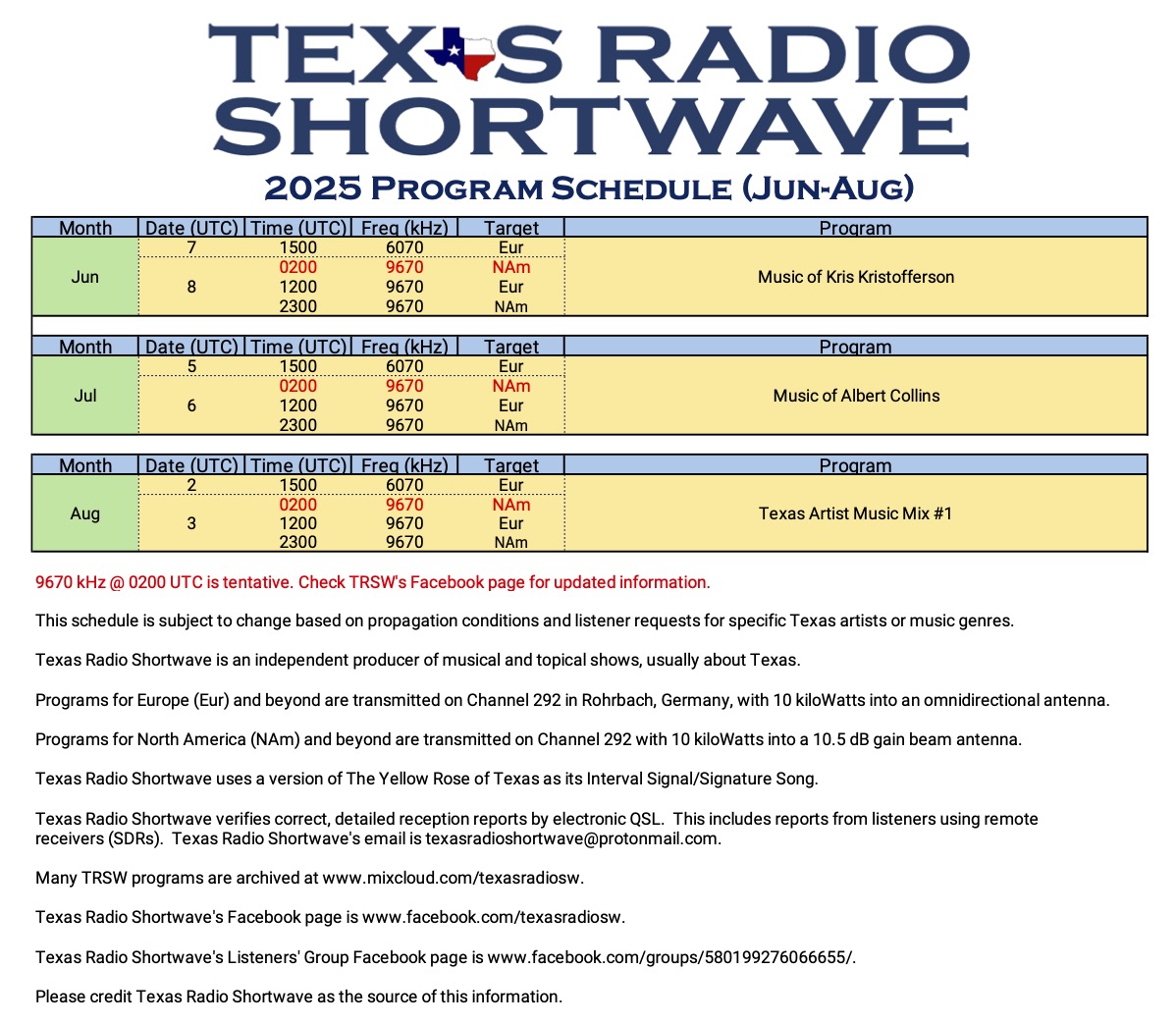
Texas Radio Shortwave: Test Broadcasts for Europe on May 18 and 21, 2025

Many thanks to SWLing Post contributor Terry (N5RTC), who writes:

Texas Radio Shortwave Tests for Europe on May 18 and 21

On Sunday, May 18, and Wednesday, May 21, we’ll test to Europe over Shortwave Radio (shortwaveradio.de).

We want reports comparing the reception of the two frequencies each day and between Sunday and Wednesday, since the broadcasts are at different times. If you have time, note how Channel 292 is received on 3955 and 6070 kHz.

We’ll have a nice QSL for correct reception reports, and maybe some other goodies if you send a really detailed report.

Our email is [email protected].

73.

Terry N5RTC
Dan Tunes into Tibet: “Hello Xizang” in English

Many thanks to SWLing Post contributor, Dan Greenall, who writes:

Many years ago, I used to enjoy listening to distant stations that broadcast a regular English language program to Eastern North America (where I live). They would generally have a newscast and commentary, which was often followed by a daily feature that would help a listener better understand what life was like in other parts of the world.

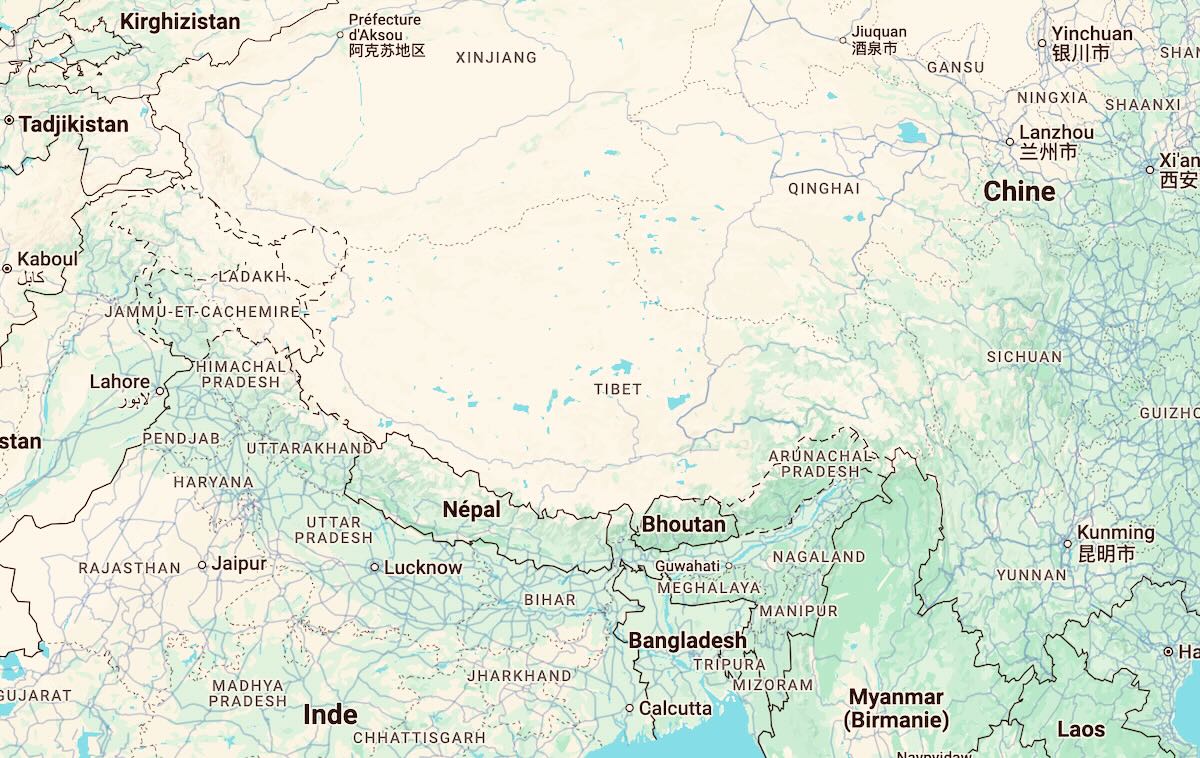
This type of programming is harder to find these days, but I was recently pleasantly surprised to find that the Tibet Autonomous Region of China (or Xizang in Chinese) has had a couple of daily broadcasts in English for some time. The programs are called “Hello Xizang”. According to their website, Hello Xizang “covers everything from social issues to traditional culture. It brings you news, stories and in-depth reports happening in Xizang. Check it out to gain an insight into modern Xizang and feel the pulse of contemporary Xizang.”

Hello Xizang is an hour long program in English between 0700 and 0800 UTC, and again from 1600 to 1700 UTC (most convenient time for me). A few frequencies to try are 4905, 4920, 6200 and 7255 kHz.

This schedule may not work too well for listeners in North America but quality reception can be had through the use of various SDR’s located closer to the transmitter site. I often use the Kiwi SDR of VE3HLS (Ken) who has retired in northern Thailand, from which I made the attached recording of their switch over from Tibetan to English programming:

Happy Listening!

Dan Greenall, Ontario, Canada

May 2025 Schedule Updates: From the Isle of Music & Uncle Bill’s Melting Pot

Many thanks to SWLing Post contributor, Bill Tilford, who shares the following update:

From the Isle of Music, May 2025

May’s program will feature music from two Cuban artists in Scandinavia, Yeisy Rojas in Norway and Eliel Lazo in Denmark.

Friday, May 9:

6070 kHz at 1700 UTC
3955 at 2100 UTC
Sunday, May 11:
9670 kHz at 1700 UTC using beam E (repeat of May 9 episode.)

Uncle Bill’s Melting Pot, May 2025

May’s program will feature music from the Kingdom of Bhutan and will air as follows:

Friday, May 16:

6070 kHz at 1700 UTC
3955 at 2100 UTC
Sunday, May 18
9670 kHz at 1700 UTC using beam E (repeat of May 16 episode).

**In addition to direct radio reception, we do honor reception reports using remote SDRs as long as the whole program is described and which SDR is specified.

Radio Six International: Updated Shortwave Broadcast Schedule

Many thanks to SWLing Post contributor Tony Currie with Radio Six International who shares the following update: 

Effective from Saturday 12th April 2025, and until further notice, Radio Six International will now broadcast as follows:

Every Saturday, 9,670kHz (10kW Rohrbach) 21:00 – 22:00 GMT in English.

Thanks for noting this change.

TONY CURRIE

Director of Programmes,
radio six international

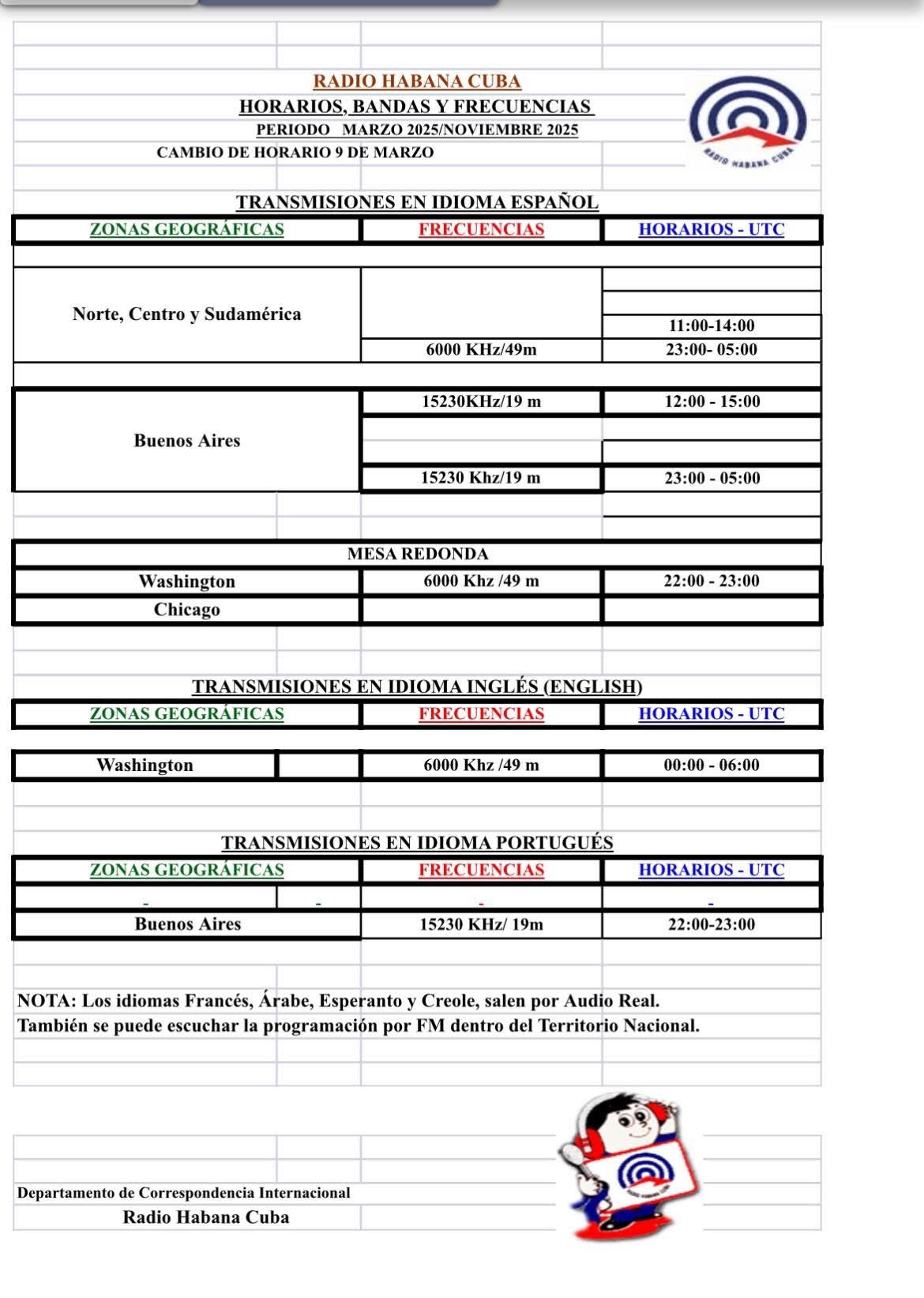
Radio Havana Cuba’s A-25 Schedule

Havana, Cuba (Photo: Wikimedia Commons)

Many thanks to SWLing Post contributor Paul Walker, who writes:

This is the A25 Schedule for Radio Havana Cuba. Only English, Spanish, and Portuguese remain on shortwave (SW) broadcasts. You’ll notice that only two frequencies, 6000 kHz and 15230 kHz, are still in use. Unfortunately, the antenna systems and transmitters are probably beyond repair, and it seems China won’t be providing any more funding. Regardless, the broadcasts still sound awful—fuzzy, distorted, and incredibly under-modulated.

French, Arabic, Esperanto, and Creole will only be available via streaming. Honestly, if it were up to me, I would consider reversing course a bit by dropping service to North America and focusing on Latin America and Africa. This could involve prioritizing Spanish, Portuguese, and French, while offering English and Creole only online.