Shortwave listening and everything radio including reviews, broadcasting, ham radio, field operation, DXing, maker kits, travel, emergency gear, events, and more
I recently discovered that the radio show L’etranger, on Radio Panik, 105.4 in Brussels, used shortwave radio recordings of pirate radio and numbers stations, from the SWLing Post and other sources, in one of their mixes of eclectic music and sound clips.
Last night, I listened to a live stream of the Canadian senate hearings regarding last year’s Radio Canada International cuts to shortwave radio. CBC president Hubert LaCroix and RCI director Michelle Parent met remarkably little criticism or resistance in the hearing, and it appears the report to the senate will be nothing short of cheerleading for the CBC. Indeed, the hearing’s tone overall was one of self-congratulation.
The decision to cut RCI in this manner is a prime example of a few officials with all-too-limited knowledge making decisions in the absence of experts’ input. The business decision seemed to them essentially sound, and yet the impact of the decision has far-reaching negative consequences–for Canadians and as well as the rest of the world–that these officials may never fully comprehend.
Notes from the hearing:
All but one senator patted CBC and RCI management on the back for becoming more innovative in the wake of devastating budget cuts; only one suggested that such innovation could have been achieved prior to them
No one asked if the CBC explored the possibility of scaling back shortwave services without closing the Sackville, NB transmitter site and eliminating shortwave broadcasts altogether, which would have been a much better use of funds as well as maintaining foreign relations and domestic security
Hubert LaCroix basically suggested that people living in oppressed regions could gain access to RCI via mobile platforms (sadly, this is not the case)
When asked how cuts to shortwave have effected their listenership and demographic, LaCroix basically shrugged his shoulders and pointed out how difficult it is to judge how many people listen on shortwave. (My response: What areas of our world lack a power grid infrastructure? Fully 1/4 of our planet. These are the underserved who rely heavily on shortwave)
No one inquired about the impact upon their Chinese audience, as RCI’s website is blocked in China; meanwhile, shortwave continues to be comparatively impermeable to firewalls and is untraceable in restrictive countries
Monsieur LaCroix made it clear that the primary CBC mandate is to be a creative, innovative media force within Canada. For him, and most of CBC management, Radio Canada International must have felt like a leech to their dwindling budget. Were I in his position, with limited information and a mandate to protect his main “client” set (Canadians living in Canada)–I might have made the same decision. And yet…it was the wrong one.
What would have solved the problem in the first place? Radio Canada International should have been its own entity, with its own budget to manage, however modest–and if anything, funded through the foreign office rather than the domestic public news/entertainment body. After all, what RCI accomplished on shortwave was far more humanitarian and diplomatic in nature.
I’ve written at length about the RCI cuts and will not go into them further on this post. But I do believe RCI Sackville could have been a more efficient and productive operation if it employed some sensible changes. Sackville had just finished installing a (paid-for) technology infrastructure to remotely operate the entire transmitter site. Moreover, Sackville management told me they had planned to cut their staff to a skeleton crew (of three people, if memory serves), only to be there if something mechanical on site needed service. These new adjustments were not even tried.
Additionally, using a market model, RCI/Sackville could have offered their relay services to more broadcasters at competitive (even market) rates. Their hourly rate to broadcast on shortwave was simply too high, thus potential customers sought more efficient cost-effective transmission sites. Sackville was never given the tools to become a self-funding operation like so many private broadcasters have become.
Sackville’s infrastructure was an incomparably valuable resource in which many millions in taxpayer money was already invested and paid in full; sadly, these cuts have destroyed this investment. The Sackville site, moreover, had the potential of a sleeping army, both in foreign affairs…and in Canadian security. But it’s gone. Simply because a few politicians doing their near-best didn’t have all the relevant information.
For what it’s worth
RCI still has some great talent on board. Canadian expats living abroad, and those who are connected to the web, can still enjoy RCI via the website or on mobile platforms. That is an audience that may actually expand through a social media presence–something they could have done more effectively prior to the budget cuts last year.
I was also encouraged to hear that there is a serious effort to distribute RCI’s online audio content–free of charge–to broadcasters in local radio stations around the world. This is very positive: FM, though not as accessible as shortwave in Africa, has a strong community following and stations are appearing everywhere. I hope RCI has a dedicated employee whose sole focus is to identify and build connections with these local outlets for their content.
Barring a takeover or drastic re-organization, it sounds like Radio Canada International over shortwave is now destined for the history books. To honor this history, I sincerely hope the new RCI innovates and penetrates new markets. And I hope RCI employees, many of whom have long memories, find challenge and renewed confidence going forward. We certainly appreciate all of the years during which they graced the shortwaves, and wish them all the best.
Last night, Rádio Nacional da Amazônia had a booming signal into North America on 11,780 kHz. Rádio Nacional’s AM signal was very wide; I actually opened up the filter on my SDR to 16 kHz to record this broadcast. In truth, that’s probably too wide, but it certainly made for great audio fidelity.
So, if you’re in the mood for some Brazilian music and commentary today, this 168 minute recording of Rádio Nacional da Amazônia should satisfy.
SWLing Post readers: I received the following email request today. Sounds fun and intriguing. Perhaps you can help solve this mystery…
Boards of Canada (Source: Last.fm)
Hello, readers of The SWLing Post, and please forgive the intrusion. I admittedly know very little about shortwave radio, but there has been a bit of a puzzle going on for fans of the band “Boards of Canada” recently, and there is the distinct possibility that its solution could involve shortwave radio. A message I posted over on Reddit was forwarded to Thomas, who very graciously offered to post the plea here.
Some background — Boards of Canada is an instrumental electronic music duo from Scotland who are, to put it mildly, somewhat private and aloof, in all the right ways. Their references tend to be very math-heavy and their music has some innovative and fascinating-sounding tape loops, synths, etc. This puzzle has been going on for the better part of a week, and we fans been very impressed with the complexity of it, though we are not even certain of the meaning of it — though we hope and suspect it is a lead-up to a new release by the band.
Someone (presumably the band) has been currently leaving these (for lack of a better word) “clues” in several key places in the media. First, a single album was sold to one person on National Record Store Day in the US — an album containing a “numbers station” style reading of a series of 6 numbers. Then a cryptic YouTube video with another series of 6 numbers also being read like a voice on a numbers station. 6 additional numbers were played (unannounced and without explanation) over a commercial radio station in England. Then on April 25, the band stealthily released 6 more numbers by encoding a link hidden in a gif — a link to two soundfiles that had to be played simultaneously in order to cancel out the phase and reveal — you guessed it — another numbers station-style broadcast.
We have reason to believe that there are 1 or 2 more series of numbers out there — and given the nature of the broadcasts, plus the picture of a radio tower on the band’s Facebook page and the different media by which the band has released some clues, there is at least some reason to believe that perhaps there is another series of numbers being broadcast somehow over shortwave radio.
Here is where I’m hoping the expertise of your readership might come in — as I say, I apologetically have no idea how the world of shortwave radio works. But I’m wondering: in your journeys across the frequencies recently, have any of you stumbled across anything that sounds like this:
http://youtu.be/Qe4UCjjyr8U — specifically something with that same chime pattern at the beginning and then the 6 numbers? (This is obviously not a “real” numbers station broadcast, but something made to sound like it). I would not put it past Boards of Canada to transmit a signal somehow and expect their listeners to find it.
And/or does this series of numbers mean anything to you in the shortwave world:
xxxxxx/628315/717228/936557/xxxxxx/519225
The Xs are gaps where we’re waiting to fill in the numbers, but we have yet to discover them — though one of the series might likely be 699742.
Thanks so much, and apologies if this is a waste of your time — this may end up having nothing to do with shortwave transmissions — I just figured it might be worth a shot, and also an opportunity to learn more about this particular passion.
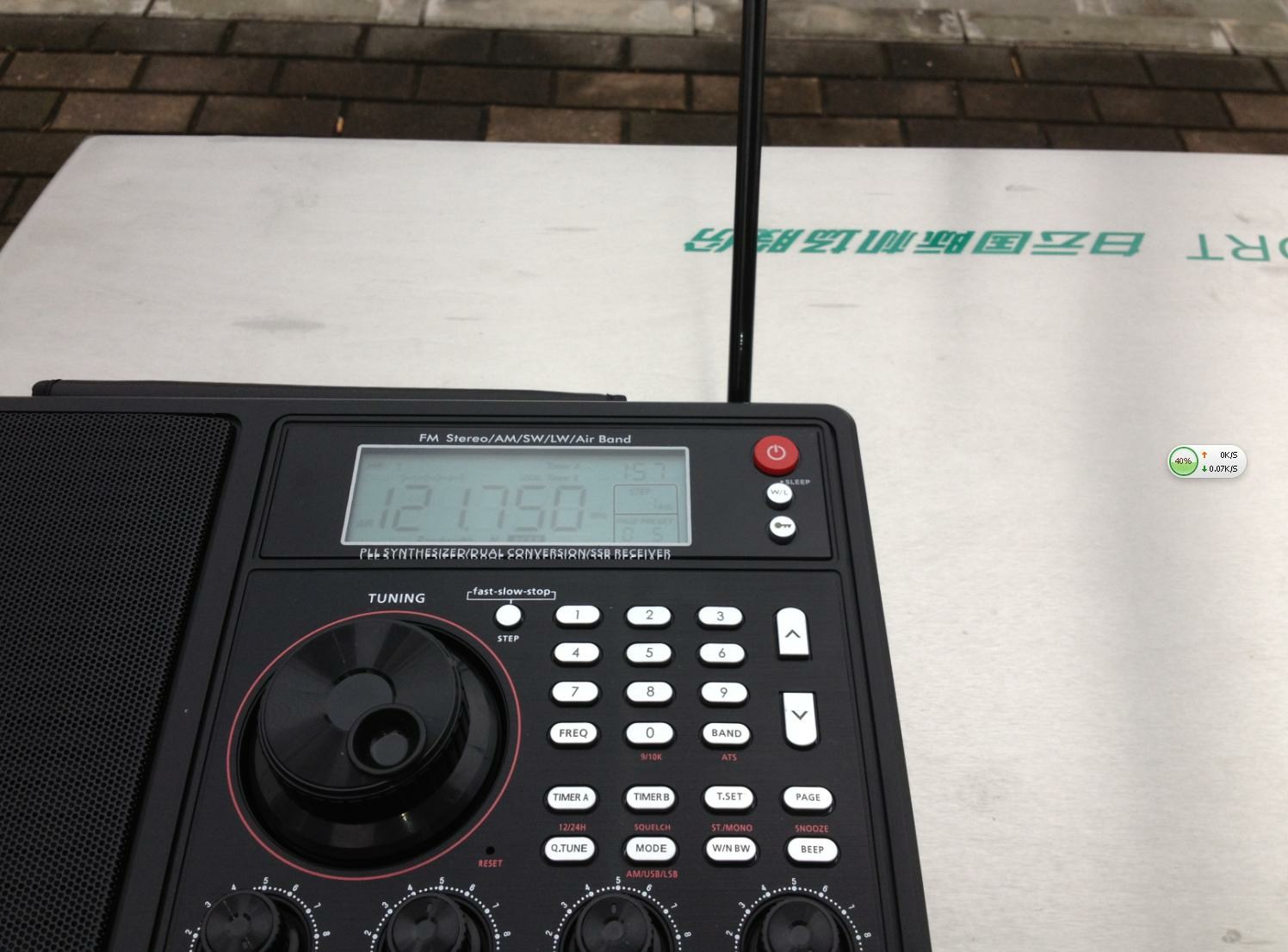
It looks like a new, large portable radio — along the lines of the Redsun RP2100 — is on the way. At least this one includes a direct-entry keypad and SSB, like the RP3100 is supposed to.
I hope they can do good QC, and keep the sample to sample variation low.
Thanks, Gary. It does look like a variation of the of the RP3100. Sounds like it’s not a Redsun product, but may have been ported from one of their engineers for JiDian. It certainly has the trademark look. If this is true, there’s a possibility that C.Crane could bring this to North America. Perhaps it’s the next radio in line to succeed the CCRadio SW? Though a great radio, the CCRadio-SW is getting a little long in the tooth.
The following is a no-spoiler review, as I assume many of you may be waiting for the film to hit the big screen, and I wouldn’t want to reveal any cinematic surprises.
We first mentioned The Numbers Station back in late 2011 –and admittedly, I was eager to see public attention drawn to this public-yet-covert shortwave communications medium that’s still in existence today. Indeed, it’s no wonder that a numbers station became the subject of a film; the subject is truly mysterious. Only a few days ago, while describing numbers stations to a visiting friend who had never heard of them, I played a recording of a numbers station that I made last year–her initial response upon hearing the recording was, in her words, that she experienced “chills” running up her spine.
But what is a numbers station?
Numbers stations, for those of you not familiar with them, are shortwave radio broadcasts that contain only strings of what seem to be random numbers. In truth, these numbers are encrypted messages for operatives in the field (otherwise known as secret agents). The operatives tune in the station with a simple shortwave radio, then decode the message with a one-time decryption key. Once the message has been deciphered, the message pads are immediately burnt or destroyed (or, at least, they’re meant to be…). Oddly, even though this is a very public communication which anyone with a shortwave radio can hear, only one or two individuals will likely ever decode the message. Such messages have been known to exist in a variety of languages at least since the time of the Cold War, but strangely did not conclude with the Cold War’s supposed end–they are ongoing even today. (Click here to check out our other numbers station posts.)
John Cusack as Emerson (Photo: Image Entertainment)
The Movie
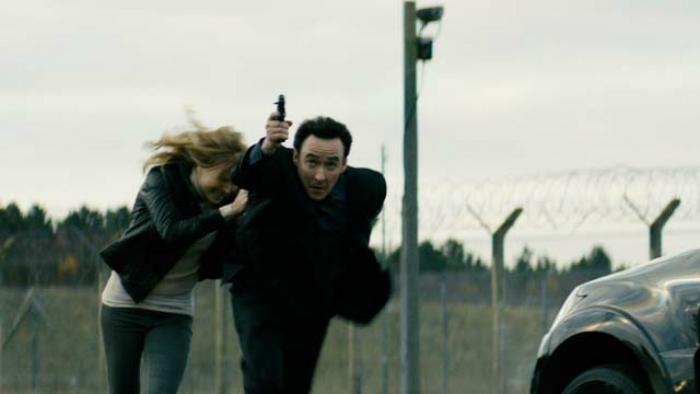
In the movie The Numbers Station, John Cusack’s character, Emerson, is a seasoned field operative–a “black-ops” agent–who faces a life-changing dilemma in the field which places his career in jeopardy. In an attempt to give Emerson some time to reconcile his emotions, his leader (Liam Cunningham) assigns him to what should be a simple, routine assignment: to protect Catherine (Malin Akerman), a cryptologist who broadcasts at a rural remote numbers station in the UK.
Things go terribly wrong when the station is compromised and Cusack finds himself again facing the same dilemma that sent him to this assignment in the first place: whether to “retire” his asset (namely, Catherine) in order to fulfill his duty, by cutting off loose ends? Or will his conscience–and tenuous friendship with Catherine–take him in another direction? It’s a difficult ethical dilemma, one Emerson has been attempting to avoid.
Malin Akerman as Catherine (Photo: Image Entertainment)
I’ve seen a number of John Cusack films over the years, and while he’s an extraordinary talent, The Numbers Stationunfortunately doesn’t quite allow us to see his full range as an actor simply because his character, Emerson, is stoic and quite introspective. But the chemistry between Emerson and Catherine is complex and tense, and one can’t help but believe he cares deeply for her.
On the action front, The Numbers Station is a much greater success: pacing is good, with a few moments to collect your breath; still, there’s always looming conflict. The bulk of the film is set in a dimly lit, underground bunker-come-numbers station, and there are actually very few shoot-’em-out scenes, yet the tension and suspense are constant.
I won’t comment on how the plot resolves, but I can say that if you like dark films with tension, moral decisions, action, and intrigue, this is well worth watching. I enjoyed it.
Moreover, if you love shortwave radio, and are intrigued by numbers stations, you will be pleased to discover that this film treats the concept with due respect and more accuracy than I would have anticipated.
(Photo: Image Entertainment)
How accurate is The Numbers Station?
While those who write about numbers stations have presumably never worked for one, there’s an existing body of knowledge out there built on thousands of hours of listening, cataloging stations and even court documents from cases involving spies. This gives us a fairly accurate idea of the true nature of numbers stations.
Likely inaccuracies
Though it is possible, I have never heard of a numbers station which has a live voice behind the microphone, reading numbers; these would most likely be advance-recorded or computer generated.
In the film, Malin Akerman’s character, Catherine, only seems to read a string of numbers for a matter of seconds, not minutes; in reality, this would take much more time.
I heard no preamble of numbers to ID the correct decipher key.
And yet…likely accuracies
In the film, under standard operating conditions, no one at the station knows the nature of the messages being broadcast–this reflects a probable fact about such stations.
The numbers station is located in a rural and remote part of the UK, a convincing setting for a numbers station (though some may broadcast from major broadcasting sites).
Once the station has been compromised, Cusack’s character explains in some detail how numbers stations work on the operative’s end; this description is very true to what is known or believed of actual numbers stations.
So, should you see it?
I anticipate that most any shortwave radio enthusiast will enjoy The Numbers Station. As a non-movie-reviewer–in other words, as a regular joe public movie-goer–I give it 8 stars out of 10. Go ahead!

 I recently discovered that the radio show L’etranger, on Radio Panik, 105.4 in Brussels, used shortwave radio recordings of pirate radio and numbers stations, from the SWLing Post and other sources, in one of their mixes of eclectic music and sound clips.