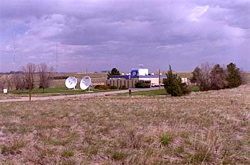
NIST Radio Station WWV Transmitter Building in Fort Collins, Colorado.
If shortwave radio has a pulse, it is the constant beat of the WWV and WWVH time stations.
Some of the first memories I have of hearing shortwave radio are of my father tuning in WWV each Sunday morning (on his RCA 6K3), to set his watch. Had this not been my father’s routine, I’m not so sure I would have known what shortwave radio was for many years.
Indeed, I’m so fond of WWV, that I have to make a modest confession: I often tune it in simply to listen to its predictably reassuring announcements of the time. Somehow it calms and comforts me that all is right on the airwaves.
Actually, WWV is and has always been much more than simply a time station. It is the most reliable way for us here in North America to check propagation characteristics both by listening to the signal strengths of the transmissions on 5, 10, 15 and 20 MHz, but also by the announcements made at specific times throughout the day.
Lately, WWV has even been announcing test tsunami warnings. It was the search for broadcasts of these warnings that lead me to Myke Dodge Weiskopf’s site, Myke.me. (Regular readers of the SWLing Post will be familiar with Myke’s work.) When I wrote to thank Myke for the audio, he drew my attention to something irresistible to a WWV disciple like me.
“At The Tone: A Little History of NIST Radio Stations WWV & WWVH”
Myke has meticulously and artfully created a CD audio archive of the WWV and WWVH time stations. A description of the project from its “about” section:
At The Tone is the first comprehensive audio survey of NIST Radio Stations WWV and WWVH: two legendary shortwave radio broadcasters whose primary purpose is the dissemination of scientifically precise time and frequency. Comprised of a 74-minute audio CD and a 32-page, full-color booklet, the set represents a huge cross-section of the stations’ “life and times,” including recordings of obsolete formats, original voices and identifications, special announcements, format changes, “leap seconds,” and other aural oddities from 1958 to 2005.
After listening to some of the sample audio from the project, I was hooked: I purchased the CD on Myke’s website and have enjoyed hearing the many tracks of audio history from WWV. The accompanying track notes alone provide a very complete history of the these NIST stations, and are the perfect companion to the audio tracks.
Indeed, I liken this audio journey to learning some untold life experience of a good friend or family member. WWV has been my radio companion all these years, but until I encountered Myke’s archive I had never heard the many voices of the station, leap seconds, experimental formats, etc. It puts the station in perspective, and opens an audio window to the time before “Coordinated Universal Time.”
It may seem foolish to wax enthusiastic about a time station. But before you judge me for my indulgence in this unlikely source of nostalgia, I encourage you to cruise to Myke’s site, purchase “At The Tone” and see (or rather, hear) for yourself!