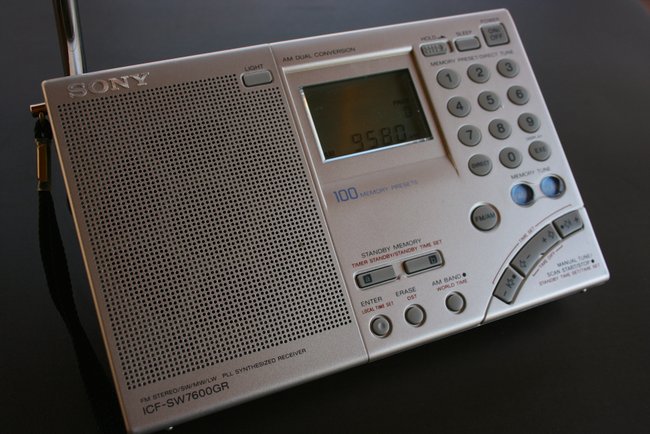
Tecsun PL-880 hidden feature/hack: 1 kHz bandwidth on shortwave

[Note: This procedure was updated and simplified by Guillermo on 22 December 2017]

Many thanks to SWLing Post contributor, Guillermo, who writes:

I own the PL-880 and just discovered a new feature : a 1.0 kHz bandwidth mode on shortwave (SW only not in MW).

The procedure to get it is as follows:

  1. Turn on the radio and tune any frecuency on SW . There is no need to connect or disconnect an external antenna and turn on or off the radio during this procedure.
  2. Be sure that on SW the 4 button feature(press 4 for about 2 seconds) is ON and 9 button feature(press 9 for about 2 seconds) indicates a value of 13 or more and not less than 10.
  3. Then turn OFF 4 button feature and then ON again . Press BW button and see the 1.0khz new BW on the screen. Now you can use it permanently on SW and ALSO on MW , UNTIL you press BW button again .

Well, I hope you understand this description–if not please let me know, and tell me if it works on your unit, or it is just works on mine.

Thank you, Guillermo! I see where this is somewhat of a fragile adjustment in that a number of actions could change the bandwidth back to a previous setting, but nonetheless is quite a fascinating hack/hidden feature! Thank you and I’ll add this to our list of PL-880 hidden features.

Post readers: please comment if you can successfully enable the 1.0 kHz bandwidth on your unit.  Please comment with your radio’s manufacture or purchase date if possible.

Norway: First country to end national broadcasts on FM

When listening to marginal FM signals, the AR1780 can be set to mono mode instead of default stereo mode.

(Source: The Guardian)

Digital switchover means that only the country’s local radio stations continue to use FM frequencies

Norway has completed its transition to digital radio, becoming the first country in the world to shut down national broadcasts of its FM network.

The country’s most northern regions and the Svalbard archipelago in the Arctic switched to digital audio broadcasting (DAB) as scheduled on Wednesday, said Digitalradio Norge (DRN), an umbrella group for Norway’s public and commercial radio.

The transition, which began on 11 January, allows for better sound quality and more channels and functions at an eighth of the cost of FM radio, according to authorities.

The move has, however, been met with some criticism linked to technical incidents and claims that there is not enough DAB coverage across the country.

Radio users have also complained about the cost of having to buy new receivers or adapters, usually priced at between €100 and €200 (£88 and £176).

Only 49% of motorists are able to listen to DAB in their cars, according to DRN figures.[…]

Continue reading the full article at The Guardian.

Don shares spectrum recordings from northern Peru

Many thanks to SWLing Post contributor, Don Moore, who writes:

I’ve been traveling through northern Peru and I’ve made some SDR recordings along the way – medium wave, long wave, and some shortwave meter bands. I hope to eventually get through them all!

I have also uploaded some recordings to a shared Google drive so that other DXers can hear what the bands sound like in northeastern Peru, on the edge of the Amazon jungle. Maybe some of the blog readers would be interested in this. You will need the below link to see the SDR files and an explanatory document. I plan to add a few more once I get another hotel with a good Internet connection again.

Click here to download.

Fantastic, Don!  Thank you for sharing your spectrum recordings!

Post readers: If you don’t already have HDSDR installed on your PC, you’ll need to grab it here. HDSDR is free and can playback these spectrum recordings. Once installed, simply press the “play” button on the HDSDR console and point HDSDR to the downloaded spectrum file. You’ll be tuning through Peruvian spectrum in no time!

Also, check out Don Moore’s excellent blog: http://www.donmooredxer.com 

a.bsolument: Converting radios from vintage valve into boutique Bluetooth

Many thanks to SWLing Post contributor, Kim Elliott, who shares this link to a French company called a.bsolument who specializes in converting vintage valve radios into hi-fidelity Bluetooth-connected audio devices.

According to a.solument’s introduction video, they take vintage radios in disrepair, gut the insides and replace the components with modern hardware which includes Bluetooth 4.0 and aux-in capabilities:

https://vimeo.com/87657532

While I LOVE vintage radios, I have conflicting feelings about this process.

I take pride in keeping my vintage gear in proper working order (through the help of a mentor). Something that simply cannot be replicated with digital hardware is the sound and warm fidelity of AM audio emanating from a valve classic. At home, I have the option of feeding all of my vintage gear Bluetooth and wireless connectivity via an AM transmitter. This allows me to play any digital content while preserving the original audio fidelity (and warming my radio room with those glowing tubes!).

With that said, I’m very much aware that it’s becoming increasingly difficult for the average consumer to find a technician who can repair tube gear affordably. Indeed, some feel it’s impossible thus toss their family radio in the trash.

If a.bsolument is giving vintage beauties–that would otherwise be in a landfill–a new lease on life, then I’m all for it!

What do you think?  Please comment!

Listening to Oumuamua via the Green Bank Telescope

Many thanks to SWLing Post contributor, Ferruccio Manfieri, who writes:

I bother you to mention this uncommon radio listening project i’ve just found via The Guardian:

Green Bank telescope in West Virginia will listen for radio signals from ‘Oumuamua, an object from another solar system

Astronomers are to use one of the world’s largest telescopes to check a mysterious object that is speeding through the solar system for signs of alien technology.

The Green Bank telescope in West Virginia will listen for radio signals being broadcast from a cigar-shaped body which was first spotted in the solar system in October. The body arrived from interstellar space and reached a peak speed of 196,000 mph as it swept past the sun.

Scientists on the Breakthrough Listen project, which searches for evidence of alien civilisations, said the Green Bank telescope would monitor the object, named ‘Oumuamua, from Wednesday. The first phase of observations is expected to last 10 hours and will tune in to four different radio transmission bands.

“Most likely it is of natural origin, but because it is so peculiar, we would like to check if it has any sign of artificial origin, such as radio emissions,” said Avi Loeb, professor of astronomy at Harvard University and an adviser to the Breakthrough Listen project. “If we do detect a signal that appears artificial in origin, we’ll know immediately.”

The linked article says that “(…)Scientists on the Breakthrough Listen project, which searches for evidence of alien civilisations, said the Green Bank telescope would monitor the object, named ‘Oumuamua, from Wednesday. The first phase of observations is expected to last 10 hours and will tune in to four different radio transmission bands.”

From the website of the project (http://breakthroughinitiatives.org/initiative/1):

Breakthrough Listen is the largest ever scientific research program aimed at finding evidence of civilizations beyond Earth. The scope and power of the search are on an unprecedented scale:

The program includes a survey of the 1,000,000 closest stars to Earth. It scans the center of our galaxy and the entire galactic plane. Beyond the Milky Way, it listens for messages from the 100 closest galaxies to ours.

The instruments used are among the world’s most powerful. They are 50 times more sensitive than existing telescopes dedicated to the search for intelligence.
The radio surveys cover 10 times more of the sky than previous programs. They also cover at least 5 times more of the radio spectrum – and do it 100 times faster. They are sensitive enough to hear a common aircraft radar transmitting to us from any of the 1000 nearest stars.

In particular:

“Listen’s observation campaign will begin on Wednesday, December 13 at 3:00 pm ET. Using the Robert C. Byrd Green Bank Telescope, it will continue to observe ‘Oumuamua across four radio bands, from 1 to 12 GHz. Its first phase of observations will last a total of 10 hours, divided into four “epochs” based on the object’s period of rotation.”

I know it’s out of our common shortwave range and scope of interest, but as a radio listening enthusiast I’m fascinated by this visionary scientific enterprise.

Thank you, Ferruccio, for sharing this.  Being a fan of radio astronomy, SETI, and weak signal DXing, of course I find this fascinating!  Thanks for sharing!

Radio Mi Amigo QSL Card with special stamp

Many thanks to SWLing Post contributor, Lennart Weirell, who writes:

Hi Thomas,

I have received a QSL-card from Radio Mi Amigo with a special individual stamp. Radio Mi Amigo announced this in the Newsletter in December:

“Unique Radio Mi Amigo stamps:

We are proud to announce our own official Radio Mi Amigo stamps. They are legal for use to send out our QSL Cards (printed by the ‘Deutsche Post’). You can get one of these (there are only 200 available and will never printed again from us) together with the QSL Card.”

I enclose a copy of the QSL-card:

Click to enlarge.

Excellent, Lennart! Many thanks for sharing your Radio Mi Amigo QSL card–a keeper for sure!